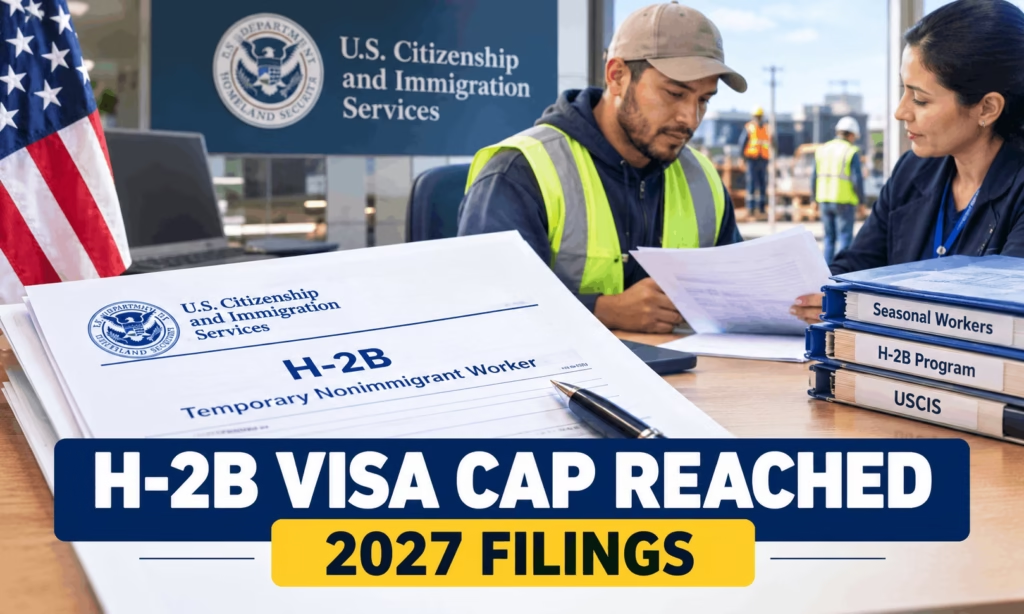
H-2B Visa Cap Reached: Seasonal employers who waited to file their H-2B petitions just lost their shot for the winter and early spring season. On September 11, 2026, USCIS confirmed that the H-2B visa cap reached its statutory limit for the first half of Fiscal Year 2027, the six month period running from October 1, 2026 through March 31, 2027. The final receipt date, the day USCIS determined it had received enough petitions to fill all 33,000 available slots, was September 4, 2026. Any cap subject petition postmarked or filed after that date requesting a start date before April 1, 2027 will be rejected outright, unless it qualifies for one of the narrow statutory exemptions. We’ll be updating this article monthly as USCIS and the Department of Labor release new numbers on the second half cap and any supplemental visa allocation for FY 2027.
This year’s cap closed noticeably faster than the pace many employers expected. As recently as mid August 2026, industry trackers showed roughly 59 percent of the 33,000 slot cap filled, a slower burn than the prior cycle. Demand accelerated sharply in the final weeks before the deadline, pushing the cap over the line by early September. The underlying process traces back to July, when the Department of Labor’s Office of Foreign Labor Certification randomly sorted more than 2,600 applications covering over 51,000 requested worker positions into processing groups, with Group A employers getting priority access to the 33,000 visa numbers and Group B employers left waiting for any slots that open up through withdrawals or denials.
What the H-2B Visa Cap Actually Limits?
The H-2B visa lets U.S. employers hire foreign workers for temporary, non agricultural jobs when there are not enough available domestic workers, covering industries like landscaping, hospitality, seafood processing, forestry, and amusement parks. Congress caps the program at 66,000 visas per fiscal year, split evenly into two halves. The first half covers workers who begin employment between October 1 and March 31, and the second half covers workers who begin employment between April 1 and September 30, each with its own separate 33,000 visa allotment. A cap reached announcement for one half does not affect the other half, which resets and opens for filing on its own separate schedule.
H-2B Visa Cap Key Dates and Numbers for FY 2027
| Milestone | Date | Detail |
|---|---|---|
| DOL filing window for winter season | July 3 to July 5, 2026 | Three day window for petitions requesting an October 1, 2026 start date |
| DOL randomization completed | July 6, 2026 | Applications sorted into Assignment Group A and Group B |
| Final receipt date for USCIS petitions | September 4, 2026 | Last day cap subject Form I-129 petitions were accepted before the cap filled |
| Cap reached announcement | September 11, 2026 | USCIS confirms the first half FY 2027 cap of 33,000 is full |
| First half FY 2027 cap period | October 1, 2026 to March 31, 2027 | Closed to new cap subject petitions |
| Second half FY 2027 cap period | April 1, 2027 to September 30, 2027 | Not yet open, filing window expected around early January 2027 |
How the DOL Assignment Group Lottery Decides Who Gets In
Since 2020, the Department of Labor has used a randomized assignment group process whenever more applications arrive in the opening filing window than the cap can support. Every employer who submits a labor certification application in the designated three day window is assigned a random number, then sorted in that order. Applications are grouped until the running total of requested worker positions reaches the 33,000 visa cap, and everyone inside that cutoff lands in Group A. Everyone after the cutoff lands in Group B or a later group. Landing in Group B is not a denial, it simply means the application waits behind Group A, and DOL continues pulling additional applications into processing whenever Group A cases are withdrawn, denied, or certified for fewer workers than originally requested.
For the winter FY 2027 filing window, DOL received roughly 2,625 applications requesting more than 51,000 total worker positions against the 33,000 visa cap, meaning a significant share of applications landed in Group B from the very start. That imbalance between demand and available visa numbers is the underlying reason the cap filled as quickly as it did once USCIS petitions started arriving.
Are There Exemptions From the H-2B Cap
Not every H-2B worker counts against the 66,000 statutory cap. Common exemptions include current H-2B workers already in the United States who are extending their stay, changing employers, or changing the terms of their employment without a new cap number, workers performing labor or services in the Commonwealth of the Northern Mariana Islands or Guam through the relevant transition provisions, and certain fish roe processing, fish roe technician, and supervisor positions. Employers who believe their case may qualify for an exemption should confirm eligibility with an immigration attorney before assuming a petition can bypass the cap, since USCIS reviews exemption claims closely and will reject petitions that do not clearly meet the statutory criteria.
Medicaid Work Requirements 2026: New Rule Rollout, State Start Dates and Who Is Exempt
ABLE Account Eligibility 2026: Who Qualifies Now, New Age Limit and Calculator
$354 Canada Disability Benefit September 2026: Full dates, Eligibility & Calculator
Supplemental H-2B Visas: What Happened Last Year and What to Expect Now
In recent fiscal years, Congress has periodically authorized the Department of Homeland Security and the Department of Labor to release supplemental H-2B visas above the standard 66,000 statutory cap when labor market conditions justify it. For FY 2026, DHS and DOL jointly authorized up to 64,716 additional supplemental visas through a temporary final rule, effectively nearly doubling the total number of H-2B visas available that year and giving many Group B employers from the FY 2026 cycle a second path to hire. As of this week, no supplemental visa rule has been announced for FY 2027, though employers who remember how the FY 2026 supplemental allocation played out are watching closely for a similar announcement, since historically these rules have arrived several months into the fiscal year rather than immediately after the statutory cap closes.
How to Apply for an H-2B Visa After the Cap Closes
Employers whose petitions missed the first half FY 2027 cutoff still have a few realistic paths forward. The most direct option is planning ahead for the second half of FY 2027, which covers start dates from April 1 through September 30, 2027, and opens on its own separate DOL filing window, typically in early January for an April 1 start date. The application process starts with a prevailing wage determination from DOL, followed by a test of the domestic labor market through required recruitment and advertising, then the labor certification application itself filed during the designated window, and finally Form I-129 filed with USCIS once DOL certification is approved. Employers should also monitor USCIS and DOL announcements for a potential FY 2027 supplemental visa rule, which could reopen limited filing opportunities for the first half period even after the statutory cap has closed.
Processing Time: How Long the H-2B Process Takes Once Filing Opens
The full H-2B timeline runs several months from start to finish even in a normal, non cap constrained cycle. A prevailing wage determination from DOL typically takes several weeks to process. The required recruitment period, including state workforce agency job order postings and print advertising, generally runs another two to four weeks before the labor certification application can be filed. Once filed during the designated window, DOL certification decisions for Group A applications are commonly issued within four to eight weeks, though Group B and later group applications can wait considerably longer, sometimes months, before DOL reaches them, if it reaches them at all before the cap period ends. After DOL certification, USCIS processing of Form I-129 typically takes several additional weeks, faster if premium processing is requested and available for the case type.
Payment Schedule and Wage Obligations for H-2B Employers
H-2B is not a benefit program with a payment schedule in the way a government assistance program works, but employers do take on binding wage obligations once a worker is approved. Employers must pay at least the prevailing wage determined by DOL for the specific occupation and geographic area, and that wage obligation begins according to the terms certified on the labor certification, generally tied to the approved start date rather than a recurring government disbursement date. Employers are also required to reimburse certain worker visa, transportation, and subsistence costs under specific circumstances, and failing to meet these wage and reimbursement obligations can result in penalties, debarment from the program, or back wage liability determined by the Department of Labor’s Wage and Hour Division.
How This Year’s Cap Timing Compares to Recent Years
Looking at how quickly the H-2B cap has closed over the past several cycles helps explain why this year caught some employers off guard. For the first half of FY 2026, the cap was effectively filled by early September 2025, following a similar pattern of slow early filing followed by a rapid final surge. Tracking data through mid August 2026 showed the FY 2027 first half cap at roughly 59 percent filled, a noticeably slower pace than the 91 percent mark the program had reached at the same point the prior cycle. Despite that slower start, the cap still closed within about three weeks of crossing the halfway mark, a reminder that H-2B demand tends to accelerate sharply as employers get closer to their actual staffing need rather than filing steadily throughout the window.
| Fiscal Year Period | Point Tracked | Cap Filled | Outcome |
|---|---|---|---|
| FY 2026 first half | Late August 2025 | 91% (30,071 of 33,000) | Cap reached in September 2025 |
| FY 2027 first half | Mid August 2026 | 59% (19,612 of 33,000) | Cap reached September 11, 2026 |
The gap between those two snapshots shows why relying on early season filing percentages to predict a comfortable buffer can backfire. A slower start does not mean a slower finish, and employers who assume they have more runway because the tracked percentage looks lower than the previous year risk missing the window entirely, exactly what appears to have happened to a meaningful share of Group B applicants this cycle.
SNAP Benefits October 2026 Increase: New Amounts, Eligibility and Calculator
PROMISE Act Social Security Deadline: What the September 17 Trigger Actually Means for Your Benefits
US Russia Sanctions Bill 2026: 100% Tariff Threat to India Explained
What the Cap Closing Means for Businesses and Workers
For employers, a closed cap period generally means either delaying the planned start date into the next available window, absorbing the cost of hiring domestic workers at a higher rate or with reduced availability, or scaling back seasonal operations to match available staffing. Industries that rely heavily on a predictable seasonal workforce, including landscaping companies preparing for spring contracts and hospitality businesses staffing up for peak tourist seasons, are typically hit hardest by an early cap closure, since their staffing needs are tied to fixed calendar dates that cannot simply be pushed back a few months.
For workers who were counting on returning to the same H-2B job they held in a previous season, a closed cap and a Group B assignment can mean a lost season of income, particularly for workers in countries where H-2B wages represent a significant portion of household earnings. Many returning workers and their employers view the twice yearly cap cycle and the unpredictable lottery-style group assignment as one of the more stressful parts of an otherwise well established seasonal employment relationship, which is part of why the supplemental visa allocations in recent years, when they have been authorized, have been so closely watched by both sides.
Common Mistakes Employers Make When Filing for H-2B
The most frequent and costly mistake is underestimating how long the pre-filing steps take. Employers sometimes wait until the DOL filing window is already open to begin the prevailing wage determination and required recruitment process, when in reality both steps need to be substantially complete well before the three day filing window arrives, since the labor certification application itself cannot be submitted until recruitment is finished and documented. A second common mistake is submitting a labor certification application with an unclear or poorly documented statement of temporary need, which is one of the leading reasons DOL denies otherwise timely filed applications, effectively wasting a Group A placement that could have gone to a complete, well supported filing. A third mistake is failing to track assignment group notifications closely, since employers who miss a request for additional information or documentation from DOL during the certification review can lose their place in the queue even after being placed in the favorable Group A.
FAQs
What does it mean that the H-2B visa cap was reached?
It means USCIS received enough H-2B petitions to fill the 33,000 visa allotment for a specific six month cap period, so new cap subject petitions requesting a start date within that period will be rejected unless they qualify for an exemption.
When was the H-2B cap reached for the first half of FY 2027?
USCIS announced on September 11, 2026 that the cap had been reached, with a final receipt date of September 4, 2026, for petitions requesting employment start dates before April 1, 2027.
Can I still file an H-2B petition right now?
Not for a start date before April 1, 2027, unless your case qualifies for a cap exemption. You can plan and file for the second half of FY 2027, covering start dates from April 1 through September 30, 2027.
Will there be supplemental H-2B visas for FY 2027?
No supplemental visa rule has been announced for FY 2027 as of this week. DHS and DOL authorized 64,716 supplemental visas for FY 2026, so employers are watching for a similar announcement, though nothing is confirmed yet.
What happens if my H-2B application lands in Group B?
Landing in Group B is not a denial. DOL continues processing Group B applications as capacity frees up from Group A withdrawals, denials, or partial certifications, though many Group B cases are never reached before the cap period ends.
How many H-2B visas are available each year?
Congress sets a statutory cap of 66,000 H-2B visas per fiscal year, split into 33,000 for the first half and 33,000 for the second half, plus any supplemental visas DHS and DOL choose to authorize separately.
Are returning H-2B workers exempt from the cap?
Current H-2B workers already in the United States who are extending their stay or changing employers without needing a new visa number generally do not count against the cap, but this depends on the specific case facts and should be confirmed with an immigration attorney.
What is the difference between H-2A and H-2B visas?
H-2A covers temporary agricultural work and has no annual numerical cap, while H-2B covers temporary non agricultural work and is limited to 66,000 visas per fiscal year under current law.
Planning Ahead for the Second Half of FY 2027
Employers who missed this cycle should start preparing now rather than waiting until the calendar turns to January. That means requesting a prevailing wage determination from DOL well in advance, since processing can take several weeks on its own, and building out the required recruitment campaign, including state workforce agency job orders and newspaper or equivalent advertising, early enough that it is fully documented before the anticipated filing window. Employers who plan to use a staffing agency, immigration attorney, or agricultural and hospitality labor consultant should also confirm availability early, since the busiest filing periods tend to book up support services quickly in the final weeks before a filing window opens.
Official H-2B Visa Resources and Links
| Resource | Purpose | Link |
|---|---|---|
| USCIS H-2B cap count page | Official, real-time cap status for both halves of the fiscal year | uscis.gov/working-in-the-united-states/temporary-workers/h-2b-non-agricultural-workers/cap-count-for-h-2b-nonimmigrants |
| DOL FLAG system | File and track H-2B labor certification applications | flag.dol.gov |
| USCIS online case status | Track a filed Form I-129 petition | egov.uscis.gov/casestatus |
| USCIS myUSCIS account login | Manage electronically filed petitions and documents | myaccount.uscis.gov |
| DOL Wage and Hour Division | Employer wage and reimbursement obligations under H-2B | dol.gov/agencies/whd |
Conclusion
The H-2B visa cap reached for the first half of FY 2027 closes the door on new petitions for October 2026 through March 2027 start dates, at least until or unless a supplemental visa rule changes the picture. For most seasonal employers left in Group B or shut out entirely, the realistic path forward is preparing early for the second half filing window covering April through September 2027 start dates, which typically opens in early January. Given how quickly this year’s winter cap filled compared to the slower pace tracked back in August, employers who wait until the last possible week to file risk missing the window again. Watch official USCIS and DOL announcements closely over the coming months for news on a potential FY 2027 supplemental allocation, since that remains the most likely way unfilled labor needs from this cap period could still be addressed before next spring. In the meantime, the most reliable protection against missing another window is treating the pre-filing paperwork as a year round task rather than a seasonal scramble.
2027 Social Security Benefits Changes: COLA Increase, Possible Cuts, and New Bills
Stimulus Check 2026: Fact-Checking Every Viral Payment Claim (Tracker)
Trump $5000 Dividend Check: Latest Update on Cost, Eligibility and Payment Date