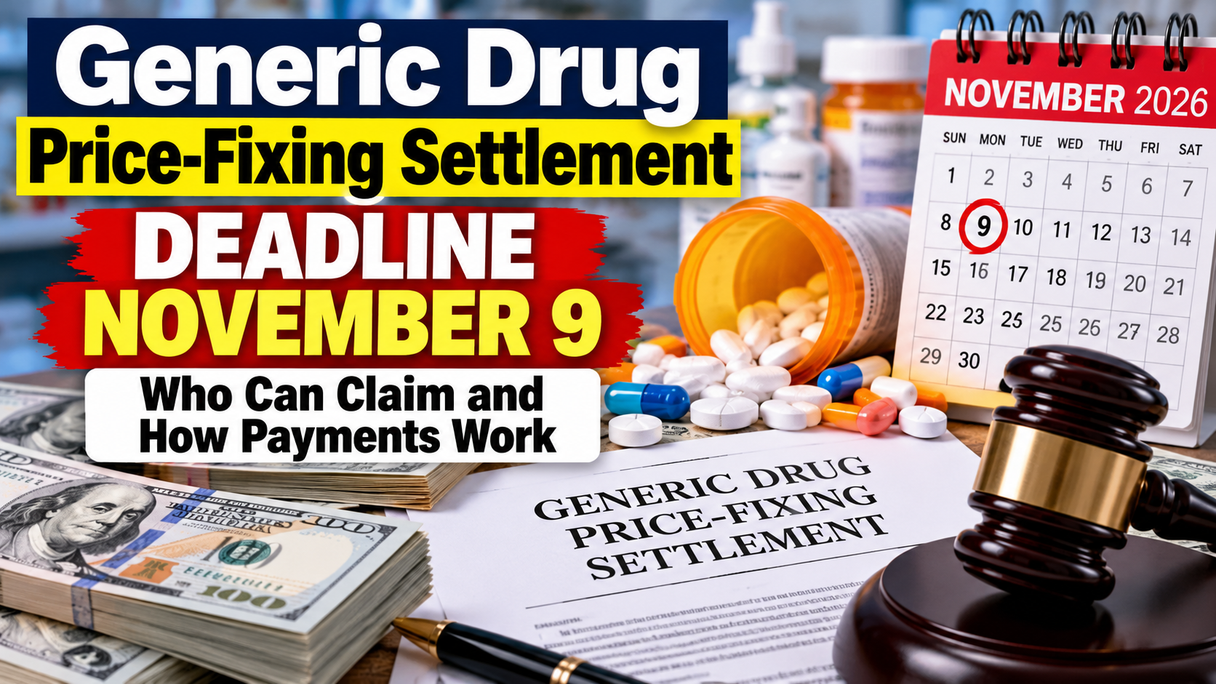
Generic Drug Price-Fixing Settlement Deadline 2026: If you or your health plan paid for certain generic prescriptions between May 2009 and the end of 2019, you have until Monday, November 9, 2026 to file a claim in the federal generic drug price-fixing settlements. That is nine days from today, and a claim is the only way to get paid.
Highlight about Generic Drug Price-Fixing Settlement Deadline
If you take nothing else from this article, take the date. Claims must be submitted online or postmarked by November 9, 2026. The court has already approved the money, so the only thing standing between you and a possible payment is a form.
| What | Details |
|---|---|
| Claim deadline | November 9, 2026 (online, or mailed with a postmark by that date) |
| Who it is for | Consumers and health plans that paid for covered generic drugs |
| Purchase window | May 1, 2009 through December 31, 2019 |
| Total in the end-payer settlements | About $533 million (Sandoz/Fougera $275M, Sun/Taro $200M, Apotex/Heritage $58M) |
| Where to file | GenericDrugsEndPayerSettlement.com, or by mail |
| Help line | 1-877-316-0171 |
| Proof required | Yes, for each drug you list |
| Payment date | Not announced as of early October 2026 |
| Separate state program | AGGenericDrugs.com, deadline March 8, 2027 |
One thing trips people up. There are two consumer claim programs tied to the same alleged scheme, and they have different deadlines, different websites and different money behind them. This article is mostly about the first one, the one that closes in nine days. The second gets its own section further down.
What the lawsuits say happened
Generic drugs are supposed to be the cheap option. Once a brand-name patent runs out, several companies can sell the same medicine, and competition is supposed to push the price down. The lawsuits claim that for about a decade, a lot of the companies making those pills did the opposite. According to the complaints, they talked to each other, split up customers, agreed on who would bid low and who would back off, and kept prices higher than a real market would have allowed.
The federal cases are bundled together as In re Generic Pharmaceuticals Pricing Antitrust Litigation, MDL No. 2724. They have been pending in the U.S. District Court for the Eastern District of Pennsylvania in Philadelphia since 2016, and Judge Cynthia M. Rufe is overseeing them. Filings from the drugmakers describe claims covering hundreds of generic drugs and a conspiracy said to have started around 2009.
This was not just civil litigation. Several executives pleaded guilty in the Justice Department’s criminal investigation, and Sandoz resolved federal criminal charges in 2020. The companies that settled with consumers and health plans did not admit wrongdoing as part of those deals, and the defendants generally deny the allegations. A number of big names, including Teva, Actavis, Amneal, Lupin, Mallinckrodt and Viatris, have not settled and are still in the fight, so more settlements could come later.
For regular people, the practical point is this. You almost certainly never bought these drugs directly from a manufacturer. You bought them at a pharmacy, or your insurer or employer plan paid for them. Lawyers call that being an “end payer,” and it is why the main class you can join is called the end-payer class.
Who can claim
The class definition is broad. You may qualify if, anywhere in the United States between May 1, 2009 and December 31, 2019, you paid all or part of the price of one of the covered generic drugs, and you did not buy it directly from the manufacturer. A copay counts. So does coinsurance, a deductible payment, or paying the full cash price at the counter.
There are two main kinds of claimants:
- Consumers. Individuals who paid something out of pocket for a covered drug, whether that was a $4 copay or a full cash purchase.
- Third-party payers. Health insurers, employer-sponsored plans, union benefit funds and similar organizations that reimbursed those drug purchases.
The settlements are not identical, and that matters for which box you check. According to the official settlement website, the Sandoz and Sun/Taro classes include both consumers and third-party payers. The Apotex and Heritage classes are for third-party payers. In practice, one combined claim process handles all three deals, so consumers file a single consumer claim and health plans file a single third-party payer claim.
The list of covered drugs is long. It runs to roughly 197 named drugs for the Sandoz and Sun/Taro classes by one recent count, and includes everyday medicines for blood pressure, cholesterol, diabetes, thyroid problems, asthma, infections, seizures and depression. Pravastatin, carbamazepine, albuterol and doxycycline are among the names that come up in the case materials. Do not guess from memory. Open the official covered-drug list and compare it to your pharmacy history.
Who is left out
A few groups cannot collect even if they bought a covered drug:
- Consumers whose purchases were covered by Medicaid.
- Anyone who bought directly from a manufacturer. Pharmacies, wholesalers and distributors have their own direct-purchaser class action, and it is not the one described here.
- People who formally opted out. That window has already closed.
- Certain government and defendant-related entities listed in the class definitions.
The official claim form lists the exclusions in full. If you are not sure whether you fall into one, read that section before you spend an hour pulling records.
How much money is in the settlements
The three end-payer settlements add up to about $533 million:
| Settlement | Amount | Final court approval |
|---|---|---|
| Sandoz / Fougera | $275 million | September 26, 2025 |
| Sun / Taro | $200 million | January 23, 2026 |
| Apotex / Heritage | $58 million | Late 2025 |
That sounds like a lot, and it is, but it gets divided among everyone who files a valid claim, after the judge-approved deductions for attorneys’ fees, litigation costs and administration. Those deductions come out of the fund, not out of your pocket.
The split is pro rata. Roughly speaking, the more you spent on covered drugs during the class period, relative to everyone else’s valid claims, the bigger your share. If your total is $300 across ten years, you will get a small payment. If you took a covered drug every month for years with a meaningful copay, or if you run a health plan that reimbursed thousands of fills, the number can be larger.
Nobody can tell you your exact check amount yet. The settlement documents do not give a per-person figure, and the final amount depends on how many valid claims come in by November 9. A fair expectation for an individual consumer is modest: this is a refund of a small overcharge, not a lottery ticket. It is still worth the effort if you can pull your records quickly, because the cost to file is nothing but your time.
How to file, step by step
Filing is free. You can do it online or on paper, and either way it has to be submitted or postmarked by November 9.
Online
- Go to GenericDrugsEndPayerSettlement.com, the court-approved site run by the claims administrator, A.B. Data.
- Pick the consumer claim form if you are an individual, or the third-party payer form if you are filing for a health plan or similar organization.
- Click to add your purchase information and list each covered drug you bought, with the total you paid out of pocket.
- Upload a proof-of-payment document for each drug on your list.
- Sign electronically. The form is signed under penalty of perjury, so the details need to be accurate.
- Hit submit and save the confirmation screen.
A warning about the online form: it does not let you save a half-finished claim and come back later. If you close the window, you start over. Gather your records first, then sit down and do it in one go.
By mail
Download the paper form from the settlement website, or call 1-877-316-0171 and ask for one to be mailed to you. Fill it out, attach copies of your proof, and mail it to the claims administrator. The mailing address listed by third-party trackers is In re: Generic Pharmaceuticals Pricing Antitrust Litigation, End-Payer Settlement, c/o A.B. Data Ltd., P.O. Box 173118, Milwaukee, WI 53217. Double-check that against the instructions printed on the official form before you send anything. Use a post office counter or certified mail so you have a dated receipt. With the deadline this close, mail is the riskier route. If you can file online, do that.
You do not need a Notice ID or Claim ID number, which is unusual for class settlements. If you got a postcard or email, it helps, but you can file without one.
One claim covers all three settlements. You do not file separately for Sandoz, Sun/Taro and Apotex/Heritage.
What proof you need
This is where people stall, so it is worth slowing down.
The official consumer form requires a document showing at least one purchase of each drug you list, during the class period. If you list albuterol and doxycycline, you need paperwork for at least one albuterol purchase and one doxycycline purchase. Acceptable records include:
- A receipt or invoice
- A pharmacy-printed purchase history
- An insurance explanation-of-benefits (EOB) statement
- A bank, card or other account statement that clearly shows the pharmacy purchase
You may have seen websites saying consumers can self-attest with no receipts. That is not what the official claim form says. It states that you must submit proof for each listed drug, and that the administrator can ask for more documents after you file. Claims can be audited and rejected for inadequate proof, suspected fraud, or amounts that look off compared with expected average purchases. When a third-party site and the official form disagree, go with the form.
Here is a practical way to dig out records fast:
- Call your pharmacy. Most chains can print or email a purchase history, and many go back several years. Ask specifically for the oldest records they have.
- Log in to your insurance portal. Past EOBs are often stored there, though how far back varies by insurer.
- Check old tax and HSA/FSA records. Pharmacy receipts used for medical deductions or flexible spending reimbursements can work.
- Ask your employer’s benefits office if the plan changed carriers during that window.
Be realistic about the early years. Records from 2009 or 2010 may simply be gone. That is fine. You are only required to show at least one purchase of each drug you claim, so list the drugs you can actually document and leave off the ones you cannot. Do not estimate or invent purchases. The penalty-of-perjury line is there for a reason.
How payments work and when to expect them
Payment is not automatic. Nothing arrives in your mailbox unless a valid claim reached the administrator first. Here is the sequence once the deadline passes:
- Claims close on November 9. Late claims are generally not accepted unless the court changes the date, which it can do, so check the official site rather than assuming either way.
- The administrator reviews every claim. That includes checking proof, flagging duplicates and suspicious filings, and sometimes asking claimants for more documents. This step is where audits and rejections happen.
- Valid claims are added up. The administrator calculates the total dollars claimed by consumers and third-party payers.
- The court approves a distribution. Money moves only after the judge signs off on the plan for paying claimants and after fees and costs are set.
- Payments go out pro rata. Each valid claimant gets a share based on how much they paid for covered drugs compared with the total.
So when does the money show up? Honestly, nobody knows yet. As of early October 2026, no payment date had been announced, and the claim form itself leaves the date unstated. In large antitrust settlements like this one, distributions commonly come many months after the claims deadline, and sometimes longer, because the review and court-approval steps take time. Treat that as a general pattern, not a promise about this case. Any payment date will be posted on the official settlement website, and that is where you should check, not on a random blog.
Some other things worth knowing:
- You will not be told your amount in advance. The number depends on total valid claims, which will not be known until after November 9.
- Keep your contact information current. If you move or change your email, tell the administrator, or a check can go to an old address.
- Save your confirmation. Screenshot it or print it. If a question ever comes up, that is your proof you filed on time.
- Taxes. Whether a settlement payment is taxable depends on your situation. I am not a tax professional, so if the amount is significant, ask one.
There is also an upside waiting in the background. Because litigation continues against drugmakers that have not settled, future settlements could add more money to the pool. Watch the official site for notices if new deals are announced.
The second program: state attorneys general
This is the part that confuses almost everyone, so here is the short version. A coalition of state attorneys general sued generic drugmakers separately from the private class actions. That litigation produced its own settlements, its own website and its own claim form, and it has a later deadline.
| End-payer class action | State attorneys general program | |
|---|---|---|
| Deadline | November 9, 2026 | March 8, 2027 |
| Website | GenericDrugsEndPayerSettlement.com | AGGenericDrugs.com (claims at AGGenericDrugsClaims.com) |
| Phone | 1-877-316-0171 | 1-866-290-0182 |
| Run by | Private class counsel in federal court in Pennsylvania | State attorneys general |
| Who it is for | Consumers and health plans | Individual consumers, with some state-specific business claims |
| Proof | Required for each drug listed | Simpler option available with no purchase details |
The states’ consumer claims period opened on September 22, 2026. The money so far comes from five companies, which the North Carolina attorney general’s office says total $96.5 million. A court-approved claim form offers two paths. Option 1 is a simplified claim for an equal cash payment and requires no purchase information. Option 2 is based on how much you spent, and those payments will not be lower than Option 1 payments. Residents of Alabama, Arkansas, Hawaii and Texas can also file for a fixed payment from the Apotex settlement fund. Third-party trackers put the deadline to opt out of the allocation plan at August 14, 2027, and the final hearing on that plan at September 8, 2027, so payments in that program will take a while. You can file in both programs if you qualify for both. Filing in one does not file you in the other, and the earlier deadline is November 9, so do that one first.
The $400 million Sandoz deal
The biggest recent news is on the state side. On August 3, 2026, a coalition of 43 states and territories announced a $400 million settlement in principle with Sandoz. On October 1, 2026, a bipartisan group of 48 attorneys general announced the finalized agreement. Michigan’s attorney general said the deal, together with earlier resolutions, brings Sandoz’s total payments to state enforcers to about $469 million. The settlement also resolves claims against Sandoz affiliates, including Novartis AG, which the states had accused of moving money around to avoid liability.
Per a press release from Pennsylvania’s attorney general, Pennsylvania’s share could be nearly $15 million. Oregon’s office said about $2.96 million would go to eligible Oregon consumers. Secondary reports say a federal judge in Connecticut gave the deal preliminary approval on October 16, 2026, and that roughly $172 million is earmarked for consumers, with the balance going to state entities. I could not confirm those two details in a primary court document, so treat them as reported, not settled.
The important practical points: the Sandoz state money is separate from the $275 million Sandoz class settlement that closes November 9, no payment date has been set for it, and consumers are being told to register at AGGenericDrugs.com for notice about claims and distributions. I could not confirm whether the current state claim form already covers the new Sandoz deal, so check that site directly.
Watch out for claim-recovery firms and scams
Whenever a settlement gets publicity, a cottage industry shows up. Class counsel told the court in November 2025 that outside “claims recovery” firms were sending misleading solicitations to people in these settlements. The official settlement pages now say plainly that class members do not need to sign up with a claims recovery firm or pay anyone to take part.
Some simple rules keep you safe:
- Filing is free. If anyone asks for money up front, or a percentage of your payout, to file a form you can fill out yourself, walk away.
- Use the official sites only. The class claim lives at GenericDrugsEndPayerSettlement.com. The state program lives at AGGenericDrugs.com. Type the address yourself instead of clicking a link in a text or email.
- Be wary of lookalike URLs and ads. Search results can put paid ads for third-party “claim helpers” above the real site.
- Never give out your Social Security number, bank login or card number to “verify” a claim. A legitimate claim form asks about your drug purchases, not your passwords.
- Check the phone number. The class help line is 1-877-316-0171 and the state line is 1-866-290-0182.
If a firm has already contacted you and you signed something, read it carefully. In some cases these firms collect a cut of whatever you receive. You can still file your own claim directly, but ask the firm in writing what you agreed to and whether you can cancel.
What happens if you miss the deadline
If you are a class member and do not file by November 9, you will most likely get no money from the three end-payer settlements. The opt-out window has already closed, so you cannot go back and sue those companies separately either. Coverage of the deals notes that once the claim deadlines pass, consumers can no longer sue the settling companies over the same issue.
There is one thing that does not disappear: you can still pursue the separate state program through March 8, 2027, if you qualify. That is a consolation, not a substitute. It is a different pot of money funded by different companies. Missing the November 9 date still means leaving the $533 million class money on the table.
Could the court extend the date? Courts can, and they sometimes do, but nobody should plan around it. Treat November 9 as firm.
A checklist for the next nine days
- Open the covered-drug list on the official site and circle every drug you or your family took between 2009 and 2019.
- Call your pharmacy today and ask for a printed or emailed purchase history going back as far as it can.
- Pull old insurance statements or account records as backup.
- Decide if you are filing as a consumer or for a health plan.
- Sit down with everything in front of you and file online in one session.
- Screenshot or print the confirmation.
- If you also qualify for the state program, register at AGGenericDrugs.com before March 8, 2027.
FAQ’s
I took these drugs for years, but I cannot find any paperwork. Can I still claim?
The official consumer form requires proof for each drug you list. If you truly have nothing for any drug, the class claim is probably not workable. Call 1-877-316-0171 and ask what other records they will accept. The state program may be an easier path because it has a simplified option.
I lived in one state then moved. Does that matter?
The class covers purchases in the United States. State residency matters more in the attorneys general program, where payments can depend on where you live when you claim.
I am a small business that provides health benefits. Can I file?
Possibly, as a third-party payer, if the plan reimbursed covered drug purchases. Use the third-party payer form, not the consumer one.
Will this affect my insurance or my prescriptions?
No. Filing a claim has no effect on your coverage or your ability to fill prescriptions.