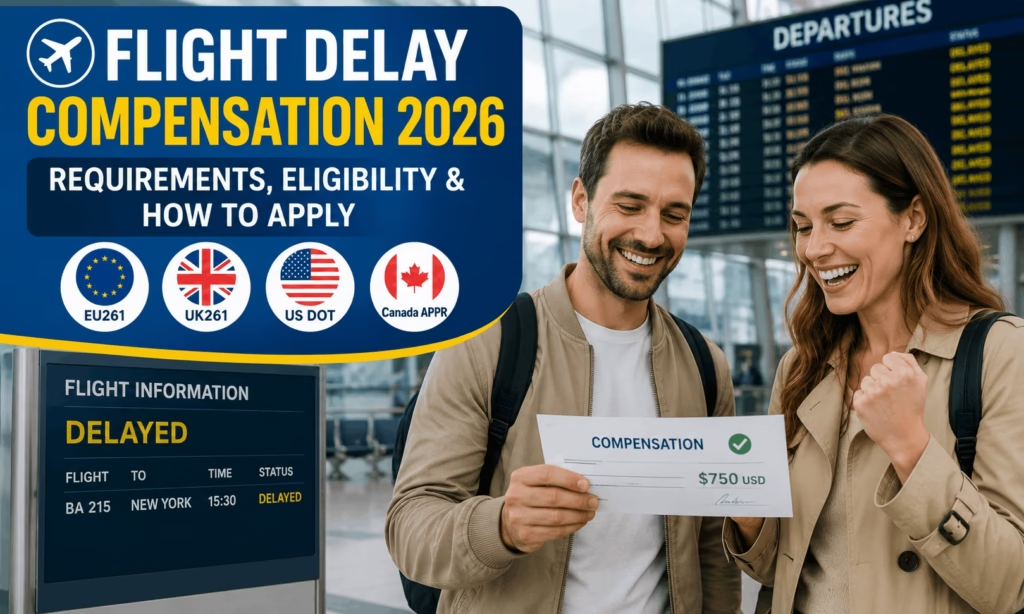
Flight Delay Compensation 2026: If your flight was delayed, cancelled, or you were denied boarding, understanding flight delay compensation rules can mean the difference between walking away empty-handed and recovering hundreds of dollars. The single biggest mistake travelers make is confusing a refund with compensation, a refund simply returns money you already paid because the flight didn’t deliver what you booked, while compensation is an additional statutory penalty the airline owes you on top of any refund. As of 2026, only a handful of jurisdictions legally require cash compensation for airline-caused disruptions: the European Union (EU261), the United Kingdom (UK261), Canada (APPR), and Israel. The United States remains a notable exception there is no federal law requiring airlines to pay cash for a delay itself, though the Department of Transportation’s strengthened October 2024 refund rule now guarantees automatic refunds for cancelled or significantly changed flights.
This guide breaks down exactly what flight delay compensation you’re entitled to depending on where your flight departs and which airline operates it not your nationality or where you booked plus the concrete eligibility thresholds, exact payout amounts, and the step-by-step application process for each major regime. All figures below reflect confirmed rules current through mid-2026, including the European Parliament’s June 2026 provisional agreement on EU261 reform, which keeps existing compensation levels unchanged for now. We’ll be updating this article monthly as new regulatory developments occur.
Flight Delay Compensation 2026 Key Highlights
| Jurisdiction | Governing Law | Delay Threshold | Maximum Compensation |
|---|---|---|---|
| European Union | EU261 (Regulation 261/2004) | 3+ hours (arrival delay) | Up to €600 |
| United Kingdom | UK261 (retained post-Brexit) | 3+ hours (arrival delay) | Up to £520 |
| Canada | Air Passenger Protection Regulations (APPR) | Varies by delay length | Up to CAD $1,000 |
| Israel | Aviation Services Law | 3+ hours (arrival delay) | Similar to EU261 structure |
| United States | 14 CFR §259.5 (DOT) | No fixed delay compensation | Automatic refund only; up to $2,150 for denied boarding |
Compensation vs. Refund vs. Care
Airlines benefit when passengers confuse these three separate rights, so it’s worth being precise:
- Refund: Your own money coming back to you because the flight didn’t deliver what you paid for — applies when a flight is cancelled and you choose not to travel.
- Compensation: An additional statutory cash penalty the airline owes you for the disruption itself, on top of any refund — only required in EU261/UK261/APPR-style jurisdictions.
- Care (Duty of Care): Meals, hotel accommodation, and ground transportation the airline must provide while you wait, regardless of the cause of the delay in most jurisdictions.
Claiming one does not waive the others — you can receive cash compensation, get a refund for an unused ticket, and have meals and a hotel covered, all from the same disruption.
EU261: The Global Benchmark for Flight Delay Compensation
Regulation (EC) No 261/2004, commonly known as EU261, remains the most generous and widely-used passenger compensation framework in the world. It applies to:
- Any flight departing from an EU airport, regardless of the airline’s nationality.
- Any flight arriving in the EU when operated by an EU-based carrier.
EU261 Compensation Amounts by Distance
| Flight Distance | Compensation Amount |
|---|---|
| Under 1,500 km | €250 |
| 1,500 km – 3,500 km (or any intra-EU flight over 1,500 km) | €400 |
| Over 3,500 km (non-EU flights) | €600 |
Eligibility Requirements
- Your flight must arrive at least 3 hours late compared to the original scheduled arrival time — importantly, this is based on arrival delay, not departure delay.
- The delay must not be caused by “extraordinary circumstances” — severe weather, air traffic control strikes, security threats, or similar events outside the airline’s control.
- Compensation amounts are fixed by distance only — they do not depend on your ticket price or cabin class. A €400 economy ticket and a €4,000 business class ticket on the same disrupted flight both receive the same compensation.
Major EU261 Update: What Changed in 2026
In June 2026, the European Parliament and Council reached a provisional agreement to modernize EU261. Importantly, this agreement preserves the current 3-hour delay threshold and existing €250–€600 compensation amounts — early proposals to raise the delay threshold before compensation kicks in were not adopted in this round. The confirmed changes focus on:
- Faster rerouting obligations for airlines
- A guaranteed free cabin bag included in the base fare
- Stronger protections for vulnerable passengers (those with disabilities, unaccompanied minors, pregnant travelers)
- A clearer, more specific list of what qualifies as “extraordinary circumstances”
If formally adopted, these enhanced rules are expected to take effect in the second half of 2027. Until then, the current EU261 framework remains fully in force exactly as described above. Separately, new EU-wide procedural rules that took effect in February 2026 standardized claim forms and required clearer disruption information at the time of the incident, aimed at speeding up how passengers claim what they’re already owed.
UK261: Post-Brexit Rules for UK Flights
Following Brexit, the UK retained its own version of the regulation, known as UK261, which mirrors EU261’s structure but pays out in British pounds:
| Flight Distance | UK261 Compensation |
|---|---|
| Under 1,500 km | £220 |
| 1,500 km – 3,500 km | £350 |
| Over 3,500 km | £520 |
UK261 applies to flights departing UK airports, and to UK-registered airlines operating flights arriving in the UK from abroad. The eligibility criteria — the 3-hour arrival delay threshold and the extraordinary circumstances exception — closely mirror EU261.
Canada’s Air Passenger Protection Regulations (APPR)
Canada’s Air Passenger Protection Regulations, in force since 2019, provide compensation up to CAD $1,000 depending on the length of the delay and whether it was within the airline’s control. As of 2026, the Canadian Transportation Agency (CTA) faces a significant complaint backlog — often 12 to 18 months to resolve a claim — though decisions favor passengers routinely once processed. Passengers have a generous one-year window from the date of the incident to file a complaint.
United States: No Fixed Compensation, But Stronger Refund Rights
The U.S. remains the clear outlier among major aviation markets — there is no federal law requiring airlines to pay cash compensation for a delay itself, comparable to EU261. Consumer advocates continue pushing for an automatic compensation model similar to Europe’s, but as of 2026, this has not been adopted at the federal level.
What U.S. passengers ARE entitled to, under the Department of Transportation’s strengthened October 28, 2024 final rule (14 CFR §259.5):
- Automatic cash refunds — no request required — when a flight is cancelled or “significantly changed” and the passenger doesn’t accept the alternative offered.
- “Significant change” is now specifically defined: a departure or arrival time change of 3+ hours for domestic flights or 6+ hours for international flights, an airport change, an added connection, or a downgrade in service class.
- Refund timing is legally mandated: within 7 business days for credit card purchases, or 20 calendar days for cash, check, or other payment methods.
- Denied boarding (overbooking) compensation: if you’re involuntarily bumped from an oversold flight, you may be entitled to up to $2,150 in cash, depending on the length of the resulting delay to your final destination.
Beyond these legal minimums, many U.S. airlines voluntarily offer meal vouchers, hotel accommodations, ground transportation, and travel credits during controllable delays — commitments tracked publicly on the DOT’s Airline Customer Service Dashboard, though these remain voluntary rather than legally required.
How to Apply for Flight Delay Compensation 2026?
- Note your actual arrival time. For EU261 and UK261 claims, compensation is based on arrival delay, not departure delay — the exact minute matters.
- Identify the operating carrier. The airline that physically operated the flight determines which regulatory regime applies, not the airline you booked through or the airline whose flight number appears on your ticket.
- Gather your documentation: boarding pass, booking confirmation, any communication from the airline about the delay/cancellation, and receipts for meals, hotels, or transport you paid for out of pocket.
- Check the reason for the delay. If the airline claims “extraordinary circumstances,” you can still request evidence — many claims initially denied on this basis are later paid after documented pushback.
- File directly with the airline first. Most regimes require you to formally request compensation from the airline before escalating to a regulator or small claims process.
- Escalate to the National Enforcement Body if refused. In the EU, this means your national aviation authority; in the UK, the CAA; in Canada, the CTA; in the U.S., the DOT’s Aviation Consumer Protection Division.
- Consider a claims service if you’d rather skip the paperwork. Third-party compensation companies pursue claims on a no-win, no-fee basis in exchange for a percentage of the payout — convenient, but it reduces your net compensation compared to filing yourself.
Common Reasons Airlines Deny Valid Claims
- Incorrectly citing “extraordinary circumstances” for delays that were actually within the airline’s control (crew scheduling, maintenance issues, IT failures)
- Confusing scheduled departure delay with the legally relevant arrival delay
- Offering only a travel voucher instead of the cash compensation or refund you’re legally owed — you are never required to accept a voucher in place of your statutory rights
- Claiming a flight doesn’t qualify because it was booked through a third-party site — jurisdiction is determined by the operating airline and route, not your booking channel
Official Resources
| EU261 Claims (National Enforcement Bodies) | europa.eu/youreurope/citizens/travel/passenger-rights/air |
| UK CAA Passenger Rights | caa.co.uk/passengers |
| Canada CTA Complaint Portal | otc-cta.gc.ca |
| US DOT Air Consumer Protection | transportation.gov/airconsumer |
| DOT Airline Customer Service Dashboard | transportation.gov/airconsumer/flight-delays |
| Home Page | govtschemes.org |
FAQs Flight Delay Compensation 2026
How much compensation can I get for a delayed flight?
Under EU261 and UK261, up to €600/£520 depending on flight distance, if your flight arrives 3+ hours late and the airline is at fault. In the U.S., there’s no fixed cash compensation for delays, but you’re entitled to an automatic refund if the flight is cancelled or significantly changed.
Does flight delay compensation depend on my ticket price or cabin class?
No, under EU261 and UK261 — compensation is fixed based on flight distance only, regardless of whether you flew economy or business class.
What counts as “extraordinary circumstances” that void my compensation claim?
Severe weather, air traffic control strikes, security threats, and similar events genuinely outside the airline’s control. Technical issues, crew shortages, and scheduling problems generally do NOT qualify and are usually still compensable.
Can I claim compensation if I still took the delayed flight?
Yes. Under EU261/UK261, you can receive compensation even if you eventually flew to your destination — you don’t have to refuse the flight to be eligible.
How long do I have to file a flight delay compensation claim?
This varies by jurisdiction — Canada allows one year; EU261 claim windows depend on the member state (often 2–6 years); always check your specific route’s applicable law promptly after the disruption.
Is the US getting EU261-style compensation rules soon?
Not currently confirmed. Consumer advocates continue to push for it, but as of 2026, no federal compensation mandate comparable to EU261 has been adopted in the United States.
What’s the difference between a refund and compensation?
A refund returns your own ticket cost when a flight is cancelled and you don’t fly. Compensation is an additional statutory payment for the disruption itself, on top of any refund — and you can be entitled to both simultaneously.