IRCC Study Permit Compliance Update 2026: International students in Canada are facing the most consequential study permit compliance requirements 2026 update in recent memory, and it has already produced real consequences for real students. On June 18, 2026, Immigration, Refugees and Citizenship Canada quietly revised the internal manual its officers use to assess study permit conditions, tightening enforcement around unauthorized transfers between designated learning institutions (DLIs), narrowing how officers assess program changes within the same school, and clarifying exactly when studies are considered officially completed. Every study permit carries two core legal conditions under section 220.1(1) of the Immigration and Refugee Protection Regulations: a student must enroll at the DLI specifically named on their permit and must actively pursue their program of study in good faith. Failing either condition can trigger a finding of non-compliance that puts future Post-Graduation Work Permit (PGWP) eligibility and permanent residence applications at risk. Just days after a related June 24 clarification on PGWP eligibility, more than 1,500 graduates from Portage College’s Calgary partnership programs received refusal letters, a crisis serious enough that a group of affected students launched a hunger strike outside IRCC offices on July 24, 2026. We’ll be updating this article monthly as IRCC issues further clarifications and as affected students pursue Federal Court review.
This article breaks down exactly what changed in the June 18, 2026 guidance update, how the new rules affect students transferring between institutions or changing programs, the updated financial requirement and Provincial Attestation Letter (PAL) rules for new applicants, the ongoing PGWP non-credit dispute affecting Calgary and Edmonton graduates, and the concrete steps current study permit holders should take to confirm their compliance status. Every detail below reflects IRCC’s own published program delivery instructions and verified reporting from ICEF Monitor and LiveWire Calgary.
IRCC Study Permit Compliance Update 2026 Key Highlights
| Detail | Current Figure or Rule (2026) |
|---|---|
| Guidance document updated | “Study permits: Assessing study permit conditions” |
| Date of update | June 18, 2026 |
| Related PGWP guidance clarified | June 24, 2026 |
| Core legal conditions | IRPR section 220.1(1): enroll at named DLI, actively pursue studies in good faith |
| DLI transfer rule | IRPR section R217.1: new study permit required before transferring institutions |
| Study permit validity after study completion | Becomes invalid 90 days after studies are officially completed |
| Prerequisite/pathway program permit validity | Program duration plus 90 days (previously up to a full extra year) |
| Minimum funds required (2026) | $22,895, in addition to first-year tuition and travel costs |
| Provincial Attestation Letter (PAL) | Required for most college-level applications; missing PAL means application returned as incomplete |
| Study permit holders in Canada | Estimates range from approximately 423,850 to 460,695 depending on source and date |
| Portage College/CIOT PGWP refusals | More than 1,500 graduates affected, mostly from India |
| Hunger strike began | July 24, 2026, Calgary |
| Non-credit PGWP rule origin | Public-private partnership (P3) ineligibility effective May 15, 2024, clarified on IRCC’s website June 24, 2026 |
The Two Core Legal Conditions Every Study Permit Carries
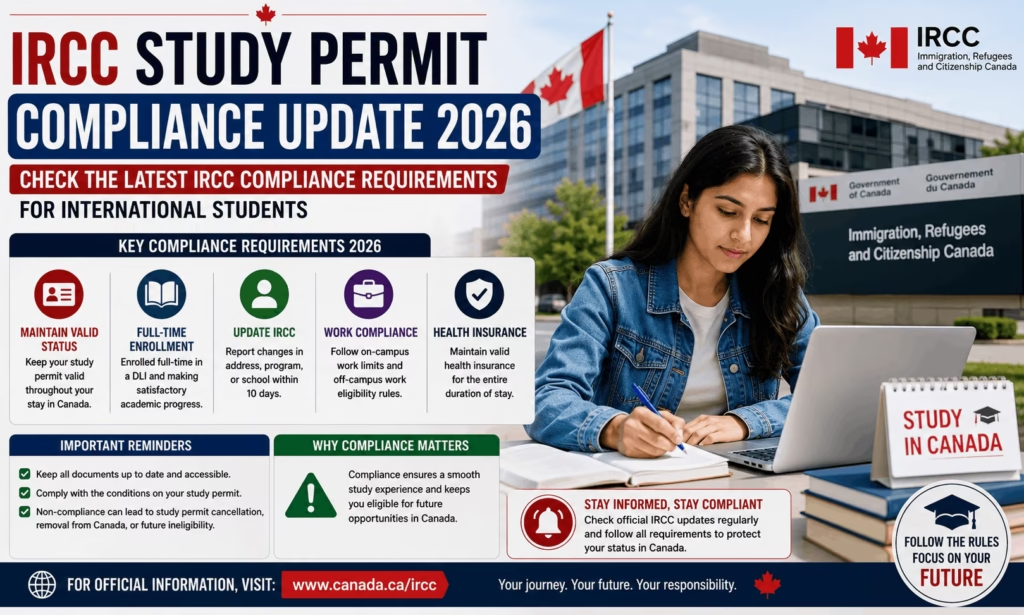
Every study permit issued in Canada carries two conditions written directly into section 220.1(1) of the Immigration and Refugee Protection Regulations. First, a student must be enrolled at the designated learning institution (DLI) specifically named on their permit. Second, a student must actively pursue their course or program of study in good faith, meaning genuine, ongoing academic engagement rather than nominal enrollment.
Failing either condition can result in a finding of non-compliance. The consequences extend well beyond the immediate situation, since a non-compliance finding can jeopardize future Post-Graduation Work Permit eligibility and complicate later permanent residence applications, given that officers reviewing those future applications can and do look back at a person’s history of adherence to prior permit conditions.
Canada Immigration Language Test Scrutiny 2026: IRCC’s New Fraud Verification Rules Explained
Free TSA PreCheck 2026: Who Actually Qualifies for No-Cost or Reimbursed Enrollment
What Changed in the June 18, 2026 Guidance Update
On June 18, 2026, IRCC revised its internal program delivery instructions covering how officers assess study permit conditions. This is not a change to the underlying law, since the regulations themselves were not amended, but it is a significant change to how officers interpret and enforce existing rules, and enforcement interpretation has direct, practical consequences for individual students. The revised guidance expanded detail around active pursuit of studies and academic progression, clarified precisely when a program of studies is considered officially completed, and narrowed how program changes within the same institution are assessed.
IRCC also removed three entire sections from its previous guidance and consolidated its rules around working during an approved leave from studies into a single, more restrictive section. Because these kinds of internal manual updates are typically made without public announcement, and are published only “as a courtesy to stakeholders” rather than through a formal news release, many students and even some educational institutions were unaware the guidance had changed until its effects became visible in individual case outcomes weeks later.
Free TSA PreCheck 2026: Who Actually Qualifies for No-Cost or Reimbursed Enrollment
NZ Pension 2026 New Rates, Eligibility, Payment Schedule & Fact Check!
New Rules on Transferring Between Institutions
One of the most consequential clarifications concerns unauthorized transfers between designated learning institutions. Under IRPR section R217.1, if your current study permit names a specific post-secondary institution, you must apply for and receive a new study permit before transferring to a different DLI. Failing to do so renders your existing permit invalid and places you in unauthorized study status at your new school, even if you are otherwise attending classes and paying tuition in good faith.
The updated guidance instructs officers to specifically verify whether a student’s original permit conditions prohibited a DLI change in the first place. If the original conditions did not explicitly prohibit the switch, a student generally cannot be found non-compliant solely for having changed institutions, which is an important nuance that had previously been applied inconsistently across different immigration offices before this clarification.
When Are Your Studies Officially Considered Complete?
The updated guidance also expands significantly on how IRCC determines the exact date a program of studies is considered finished, a date that carries major practical weight because a study permit becomes invalid 90 days after that completion date. Under the clarified rules, studies are considered officially completed on the date a DLI first notifies the student of program completion, through any of several notification methods the institution uses, such as a final transcript, a completion letter, or a formal notice of graduation.
The date stated on that notifying document is treated as the official completion date unless the student or the DLI can provide documented proof of a different date. This detail matters enormously for post-graduation planning, since the 90-day countdown to permit invalidity begins from this specific date, not from a student’s own understanding of when their coursework or exams concluded, making it essential for graduating students to confirm exactly which document and date their institution considers the official notification of completion.
Shorter Validity for Prerequisite and Pathway Programs
A separate but related clarification affects students enrolled in prerequisite or pathway programs, such as language training or foundational coursework completed before a main academic program begins. Previously, study permits for these preparatory programs could effectively extend validity by up to a full additional year beyond the pathway program’s actual length. Under the current guidance, permits tied to a prerequisite or pathway program are valid only for the duration of that specific program plus 90 days, a considerably shorter runway than students may have previously expected when planning their transition into a full academic program.
Students currently enrolled in, or planning to enroll in, a pathway or foundational program should recalculate their expected permit validity under this narrower rule immediately, rather than assuming the older, more generous timeline still applies.
Financial Requirements and the PAL for New Applicants
For students still preparing an initial study permit application, two requirements have become significantly stricter gatekeepers in 2026. Applicants must now demonstrate at least $22,895 in available funds for living expenses, a meaningfully higher threshold than in previous years, and this amount is required in addition to covering first-year tuition and travel costs, not inclusive of them.
Most college-level applicants must also include a valid Provincial Attestation Letter (PAL) confirming they hold a spot within their province’s capped intake for the year. Without a valid PAL included in the initial submission, IRCC will not process the application at all and will return it as incomplete rather than issuing a refusal on the merits, meaning applicants effectively lose processing time and must resubmit correctly. Immigration observers describe the overall posture of officers reviewing new applications in 2026 as shifting from looking for reasons to approve a file toward actively looking for compliance gaps, meaning even minor documentation inconsistencies or a vague study plan can result in an application being returned or refused.
The Portage College PGWP Crisis Explained
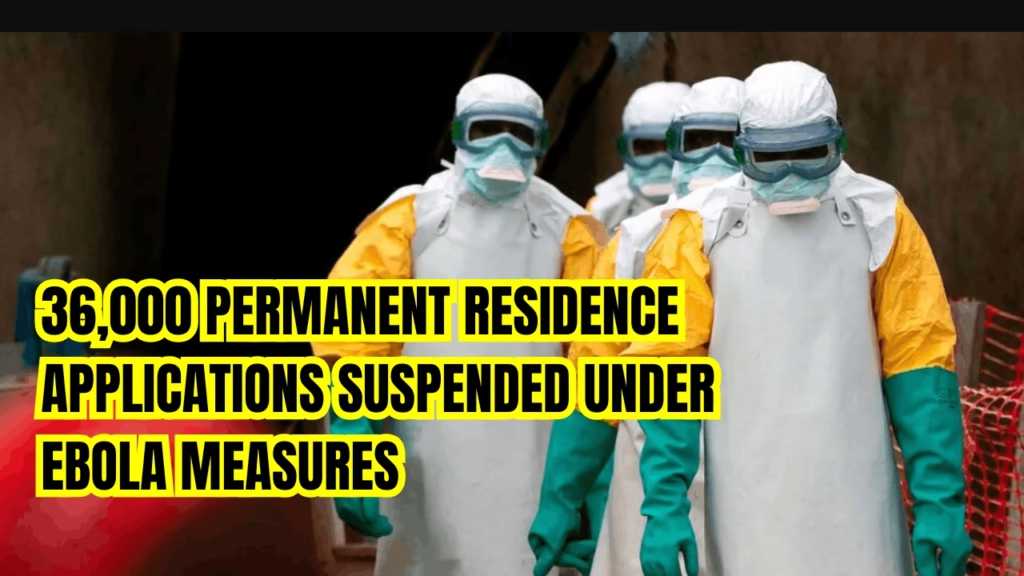
The clearest real-world illustration of how these guidance clarifications affect actual students is the ongoing dispute involving graduates of continuing-education programs delivered through the Canadian Institute of Osteopathic Therapy (CIOT) in Calgary, in partnership with Portage College. On June 24, 2026, IRCC updated its public PGWP eligibility webpage to specify that applicants who completed a “non-credit program of study,” other than an eligible flight school program, are not eligible for a PGWP. IRCC has stated this was a clarification of existing rules rather than a new eligibility change, pointing to a broader rule that took effect May 15, 2024 making students in public-private partnership (P3) delivery arrangements ineligible for PGWPs.
Regardless of how the change is characterized, its impact has been severe. More than 1,500 graduates, many from India, who completed diploma programs through this Portage College and CIOT partnership believing their credentials qualified them for a PGWP, began receiving refusal letters in late June and into July 2026, with roughly 480 graduates from one specific program cohort gathering publicly on July 17, 2026 to share their refusal letters and organize a collective response. Notably, some graduates from what appears to be the identical program have been approved while others were refused, deepening confusion and prompting affected students to describe near-identical refusal wording across hundreds of separate letters. On July 24, 2026, a group of affected students began a hunger strike in Calgary, and at least one graduate has filed for judicial review of her case in Federal Court.
What Current Students Should Do Now
Given how quickly an internal guidance clarification can translate into real refusals, current study permit holders should treat this update as an immediate action item rather than a future planning task. Confirm the exact institution named on your current permit and do not transfer to a different DLI without first securing a new study permit. If you are approaching graduation, confirm precisely which document and date your institution uses as its official notification of program completion, since this date starts your 90-day countdown. If you completed, or are currently enrolled in, a program delivered through a third-party partner institution rather than directly through your DLI’s main campus, confirm with a licensed immigration consultant or lawyer whether your specific program is considered credit-bearing and PGWP-eligible before relying on assumptions made at the time of enrollment.
Official Resources and Useful Links
| Resource | Purpose | Link |
|---|---|---|
| IRCC Secure Account (Login and Application Status) | Track a study permit or PGWP application | canada.ca (IRCC Secure Account sign-in) |
| IRCC, Study Permits: Assessing Study Permit Conditions | Official program delivery instructions for officers | canada.ca (IRCC program delivery instructions, study permits) |
| IRCC, Who’s Not Eligible for a PGWP | Official current PGWP eligibility exclusions | canada.ca/en/immigration-refugees-citizenship/services/work-canada/pgwp/eligibility |
| IRCC, List of Designated Learning Institutions | Confirm your institution’s current DLI status | canada.ca (List of designated learning institutions) |
| IRCC Processing Times Tool | Check current study permit and PGWP processing times | canada.ca (Check IRCC processing times) |
People Also Ask
What did IRCC change about study permits in June 2026? On June 18, 2026, IRCC revised its internal guidance on assessing study permit conditions, tightening rules on unauthorized institution transfers, clarifying when studies are officially completed, and shortening validity for prerequisite or pathway program permits.
Can I switch schools without losing my study permit status? Only if you first apply for and receive a new study permit under IRPR section R217.1. Transferring to a different designated learning institution without doing so makes your existing permit invalid and places you in unauthorized status.
Why are hundreds of international graduates losing their PGWP in 2026? A June 24, 2026 IRCC clarification confirmed that non-credit programs, excluding eligible flight school programs, do not qualify for a PGWP, which has led to mass refusals for graduates of certain public-private partnership programs, most visibly at Portage College’s Calgary delivery partner.
How much money do I need to show for a Canadian study permit in 2026? Applicants must demonstrate at least $22,895 in available funds for living expenses, in addition to covering first-year tuition and travel costs.
What is a Provincial Attestation Letter (PAL) and do I need one? A PAL confirms you hold a spot within your province’s capped study permit intake for the year. Most college-level applicants must include a valid PAL, or IRCC will return the application as incomplete without processing it.
FAQs
What are the two core conditions attached to every Canadian study permit?
Under IRPR section 220.1(1), every study permit holder must enroll at the designated learning institution named on their permit and must actively pursue their program of study in good faith. Breaching either condition can result in a finding of non-compliance.
When does my study permit become invalid after I graduate?
Your study permit becomes invalid 90 days after the date your institution officially notifies you that your studies are complete, using whichever notification method, such as a transcript or completion letter, the institution provides, unless a different date can be documented.
Are prerequisite or pathway program permits still valid for an extra year?
No. Under the current guidance, permits tied to a prerequisite or pathway program are valid only for the length of that program plus 90 days, a significant reduction from the previous effective extension of up to a full additional year.
Is the June 2026 PGWP non-credit rule actually new?
IRCC states it is a clarification of an existing rule that made public-private partnership program graduates ineligible for a PGWP starting May 15, 2024, rather than a brand-new eligibility change, though affected students dispute this characterization given the real-world impact on their applications.
What should I do if my PGWP was refused for a non-credit classification?
Consult a licensed immigration lawyer or Regulated Canadian Immigration Consultant promptly, since some affected graduates have pursued judicial review in Federal Court, and refusal generally means you must stop working immediately upon notification.
Can changing my program within the same school affect my compliance status?
Yes, though the current guidance narrows how officers assess in-school program changes compared with full institution transfers. Confirm with your DLI’s international student office whether your specific program change requires any additional IRCC notification.
Conclusion
The IRCC study permit compliance requirements 2026 update is a reminder that internal guidance clarifications, even ones made without public announcement, can have immediate and serious real-world consequences, as demonstrated by the more than 1,500 Calgary and Edmonton graduates now caught in PGWP refusals and a public hunger strike over a rule IRCC describes as merely clarified rather than changed. Current study permit holders should treat their institution’s DLI status, their program’s credit classification, and their exact study completion date as urgent items to confirm now, not later, particularly if their program was delivered through a third-party partner rather than directly through their DLI. This article will be updated monthly as IRCC issues further clarifications and as the Federal Court reviews filed by affected graduates progress.
New to Canada? Here’s How the FHSA Can Help You Buy Your First Home Faster
£5959 Attendance Allowance Could Boost Your Pension, Check If You Qualify
$1600 Property Tax Credit 2026 Fact Check, Eligibility, Dates & How to Apply
Trump’s $100000 H-1B Visa Fee 2026: Current Legal Status After the Court’s Latest Ruling