
Jensen Huang Returns as Nvidia CEO: Twelve days after Jensen Huang resigned as Nvidia’s chief executive, the company’s board voted unanimously on November 23 to bring him back. It is one of the fastest boardroom reversals in recent corporate history, and the White House had a visible hand in it.
Twelve days that shook a $4 trillion company
If you blinked in mid-November, you missed most of it. Nvidia, the company that makes the chips behind nearly every major AI system in America, lost its founder-CEO and got him back before Thanksgiving.
The first official word came on November 12, when Nvidia announced that Huang had resigned as president, CEO and director “with immediate effect.” The press release gave no reason. It named CFO Colette Kress interim CEO, made director Harvey C. Jones the board’s first-ever chair, and said a search for a permanent CEO had begun. Reporting from the Associated Press filled in the gap: Huang apparently left after revelations about extramarital relationships, one with a Chinese businesswoman suspected of being a Beijing intelligence asset.
What followed moved fast.
| Date (2026) | What happened |
|---|---|
| Nov. 12 | Huang resigns. Kress becomes interim CEO. Senate Banking asks Huang to testify. |
| Nov. 15 | Treasury Secretary Scott Bessent says on Fox News that the next CEO should come from outside Nvidia. |
| Nov. 16 | Trump says he “would not mind” Huang returning. A “Stand with Jensen” petition gains big-name signers. |
| Nov. 17 | Nvidia reports record results. Chair Harvey Jones says the board “does not intend to reinstate” Huang. The board forms a national security committee. |
| Nov. 23 | The board unanimously reinstates Huang as president, CEO and director. |
Read the last two rows together. On a Tuesday the chair said no. The following Monday the board said yes, unanimously. Something changed in between, and the board’s own release points at what: it says directors “received input from senior U.S. government officials.”
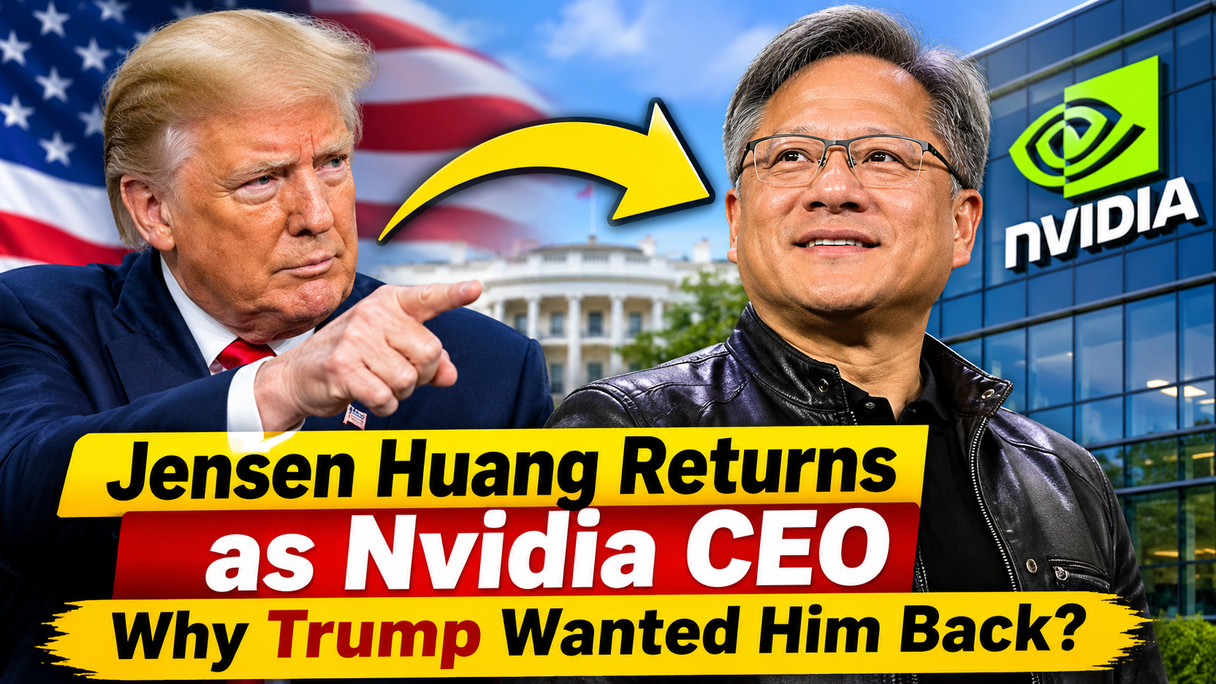
Why Trump wanted Jensen Huang Returns as Nvidia CEO ?
I couldn’t open The Hindu’s piece directly because the site blocks access, so what follows rests on the public record and on what Trump himself has said.
Start with the stated reasons, which were modest. On November 16, speaking to reporters before leaving for Asia, Trump said Huang had “learned a big lesson” and that he would “not mind” seeing him return. He added that a lot of people wanted that. A week later, CNBC and NBC News reported that Trump said he had spoken “directly and indirectly” with Nvidia’s board about reinstatement. Nvidia’s own release does not describe a White House request; it only says the board consulted senior U.S. officials and concluded Huang’s return poses no national security risk.
The unstated reasons are easier to see than to prove. Here is my read, and it is analysis, not reporting.
- Huang is the face of American AI. He has been a regular adviser to Trump on the subject and was a constant presence at the White House last year. A company worth roughly $4.3 trillion, run by a stand-in, is awkward for an administration that has hung much of its tech agenda on AI.
- Markets were bleeding. Nvidia shares closed down 4.27% on November 9 and had lost more than 22% over the prior month. When Nvidia sneezes, the S&P 500 catches a cold; it fell nearly 2% on November 16 alone. After the reinstatement, CNBC’s headline put the stock’s jump at 31%. Check the closing figure before you quote it.
- The alternative looked messy. Bessent wanted an outsider. Trump floated Apple’s Tim Cook. Neither option offered a quick, calm handoff.
- China is the real backdrop. Trump was heading to Asia to meet Xi Jinping, and Nvidia’s chip sales sit at the center of that relationship.
There is also a counterargument worth stating plainly. Critics could fairly argue that a president weighing in on a board’s choice of CEO, while that company is under federal scrutiny, blurs a line between government and business. Republican chairs of three House committees were already pressing Huang to testify on export controls. Trump has also said Commerce Secretary Howard Lutnick “might have delayed” blacklisting Megaspeed, the Singapore company at the heart of the probe, to avoid a clash with China. Trump told reporters “nobody’s proven” that the former Megaspeed executive at the center of the spy reports was an agent. China’s foreign ministry called the claim “completely groundless.” The Justice Department says it has not reached a conclusion.
New I-129 Form Is Now Mandatory: USCIS Rejects Old Edition for H-1B, L-1 and O-1 Petitions
Reason behind the Jensen Huang comeback
The November 23 release, filed with the SEC, is short on drama and long on conditions. The board says it met with Huang and was satisfied with his candor and his ability to lead. Jones said the board “believes Jensen is the right person to lead NVIDIA.” Huang said he returns with “the greatest humility and renewed commitment.” Kress goes back to being full-time CFO, and the board thanked her.
The release did not close the book on the scandal. An independent committee of directors, advised by outside counsel, is still investigating reports that a foreign intelligence effort targeted Huang. It has issued no findings, and the company says the work will go on to its conclusion. Huang says he supports it.
Then come the structural changes, which read like an answer to the question every Washington critic was asking: who watches the exports?
- A new National Security and Export Control Committee, made up of independent directors, will oversee trade compliance and national security risk. Reporting on the November 17 announcement says Suzanne Nora Johnson, a retired Goldman Sachs vice chairman, chairs it.
- That committee is hiring counsel with national security experience.
- Nvidia is searching for a Chief Compliance Officer who would report to the Nominating and Corporate Governance Committee.
- The company says it will keep cooperating with government investigations and inquiries.
Two things stand out. First, the board’s confidence rests partly on the government’s input, which is unusual language for a corporate filing. Second, Huang acknowledged “serious mistakes” in his personal life in a statement last week and said he would return if the board judged it best for shareholders. The board has now made that judgment. Whether the people who own the stock agree will show up in the share price, not in a press release.
The business case: a record quarter, and a hole where China used to be
Whatever you think of the boardroom drama, the company itself is not struggling. Nvidia’s third quarter of fiscal 2027, which ended October 25, produced $115.8 billion in revenue, up 103% from a year earlier and 20% from the prior quarter. Data center revenue was $107.6 billion. Net income came to $65.3 billion, and free cash flow was $43.8 billion for the quarter. The board returned $28.1 billion to shareholders through buybacks and dividends and added $150 billion to the buyback authorization in September.
Guidance for the fourth quarter is about $130 billion, plus or minus 3%, in a quarter that has an extra week. Kress called the Vera Rubin platform’s launch “explosive.”
Now the catch. The outlook assumes no data center compute revenue from China. That’s not a rounding error; it’s the whole fight. Last January the administration loosened restrictions on H200 chip exports to China with conditions, and Chinese buyers reportedly placed orders. Yet a top Commerce enforcement official later said Nvidia had sold zero H200s to China, according to Bloomberg Law. Nvidia is guiding as if that door stays shut.
That’s why the CEO question matters so much to people who never read a proxy statement. The company’s largest growth story depends on chips that Washington treats as strategic, and its largest open question depends on a relationship between Huang and two governments. A leadership vacuum during the Vera Rubin ramp was a risk the board, and apparently the White House, didn’t want to carry.
What happens next
Reinstatement doesn’t make the scrutiny go away. Several things are scheduled.
| Date (2026) | Event |
|---|---|
| Dec. 1 | Closed-door transcribed interview with Huang, requested by House Foreign Affairs, China and Intelligence committee chairs (Reps. Mast, Moolenaar, Crawford) |
| Dec. 2 | Same request for Nvidia General Counsel Tim Teter |
| Dec. 3 | Senate Banking Committee (Chair Tim Scott) asked Huang to appear at a public hearing; Commerce Under Secretary Jeffrey Kessler also invited by the House panels |
| Dec. 10 | Commerce Secretary Howard Lutnick asked to testify to Senate Banking; his spokesperson says he agreed |
The Senate letter, dated November 12, said the committee was prepared to use “all tools at our disposal, including subpoenas” if Huang declined. Rep. Brian Mast said Huang had agreed to brief lawmakers. Check whether those dates have shifted now that Huang is CEO again.
The Megaspeed case is the thread to watch. The Justice and Commerce departments are investigating whether the Singapore-based cloud company helped route advanced Nvidia chips to Chinese customers in violation of export controls. Commerce asked Nvidia for its Megaspeed sales records in May 2025, and Nvidia put the company on its no-sell list the next month. Megaspeed says it takes compliance seriously and has hired outside counsel for an internal review. The New York Times reported that a Malaysian sister company bought at least $4.8 billion in AI equipment containing Nvidia chips between June 2024 and February 2026.
It is worth being precise about what has not been shown. Nobody has publicly established that Nvidia or Huang knowingly broke export rules. Nvidia has said it has no reason to believe national security or company secrets were compromised, and the board has now concluded Huang’s return poses no national security risk. The allegations about the former Megaspeed executive remain allegations.
What it means if you own the stock, or just use the products
If Nvidia sits in your 401(k) or index fund, and for most Americans it does, this story was never abstract. At a market value above $4 trillion, one company’s leadership crisis showed up in broad market moves within days. The reinstatement removes one source of uncertainty and adds another: governance.
Here’s the plain-English version of what investors are weighing.
- Key-person risk is real. Huang co-founded the company 33 years ago and is closely tied to its strategy. Losing him for twelve days was enough to rattle the market.
- Oversight is thinner than it looks. A new committee and a compliance chief are good steps, but the committee was created days ago and the independent investigation hasn’t reported.
- Policy risk didn’t go away. Export rules toward China can change with a phone call or a summit. The company’s own guidance already assumes zero China data center sales.
- Politics is now part of the story. Whatever your view of the president, a company whose CEO’s job status tracked a White House comment is exposed to the next shift in that relationship.
For everyday users, the effect is less direct but not zero. Nvidia chips power the AI tools in search, office software and customer service. A stable roadmap helps keep those products on schedule. And the way the U.S. handles chip exports shapes how much computing power American companies can buy compared with overseas rivals.
NVIDIA, Board Reinstates Jensen Huang (SEC Form 8-K, Nov. 23)