New U.S. Passport Rules July 2026: The summer of 2026 is the most complex travel documentation season in modern American history and millions of travelers are heading to airports, borders, and international destinations without realizing how much the rules have changed. Between May 2025 and February 2026, the U.S. Department of Homeland Security (DHS), the Transportation Security Administration (TSA), and the U.S. Department of State rolled out a series of overlapping changes that affect every adult flying domestically, every American traveling abroad, and every foreign visitor entering the United States. As of July 2026, the critical facts are these: REAL ID enforcement is fully active at all U.S. airport security checkpoints, the TSA ConfirmID fee of $45 applies to non-compliant travelers since February 1, 2026, the U.S. passport online renewal system launched in September 2024 is now handling millions of eligible renewals faster than the paper process, and the State Department issued a record 27.3 million passports in Fiscal Year 2025 the highest in U.S. history.
If you are flying domestically or internationally this summer, three documents define your travel readiness right now: a REAL ID-compliant state driver’s license, a valid U.S. passport book or passport card, or another TSA-accepted form of identification. Standard state driver’s licenses without a gold or black star symbol in the upper corner are no longer accepted as sole identification at TSA security checkpoints for domestic flights. Current U.S. passport processing times stand at 4–6 weeks for routine applications and 2–3 weeks for expedited service with a $60 additional fee significantly improved from the 7–10 week crisis delays of 2022–2023. Anyone with international travel planned for the remainder of 2026 should check both passport validity and destination-specific entry requirements immediately.
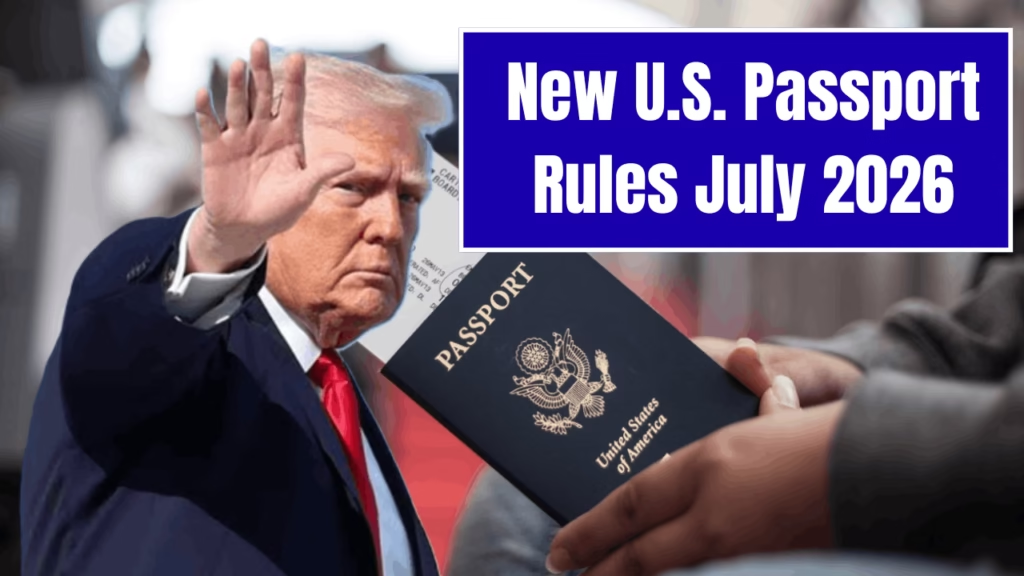
New U.S. Passport Rules July 2026 Highlights
| REAL ID Full Enforcement Began | May 7, 2025 |
| TSA ConfirmID Fee Effective Date | February 1, 2026 |
| TSA ConfirmID Fee Amount | $45 (non-refundable) |
| TSA ConfirmID Validity Period | 10 days only — not permanent |
| REAL ID Identifier on Your Card | Gold or black ★ star in upper corner |
| Cards Marked “Federal Limits Apply” | NOT accepted for domestic flights |
| Children Under 18 at TSA | No ID required for domestic travel |
| U.S. Passport as TSA Alternative | Fully accepted at all checkpoints |
| Passport Book — New Application Fee | $130 application + $35 execution = $165 total |
| Passport Book — Renewal Fee | $130 only (no execution fee) |
| Passport Card Fee (alone) | $30 |
| Child Passport (Under 16) Fee | $100 application + $35 execution = $135 total |
| Expedited Processing Fee | +$60 |
| Routine Processing Time (2026) | 4–6 weeks |
| Expedited Processing Time (2026) | 2–3 weeks |
| Same-Day Processing Available? | At passport agencies — travel within 14 days |
| AI-Edited Passport Photos | Rejected since January 1, 2026 |
| Online Passport Renewal Launched | September 2024 |
| Six-Month Passport Validity Rule | Most countries require 6+ months validity |
| Schengen Zone (Europe) Rule | 3 months minimum from entry date |
| Europe Entry/Exit System (EES) | Active — biometric checks replace stamps |
| ETIAS (Europe Digital Authorization) | Expected Q4 2026 — not yet required |
| Brazil Visa Requirement for Americans | Required since April 10, 2025 |
| Commemorative Trump Passport | Limited — Washington D.C. office only, ~July 4, 2026 |
| Digital IDs Accepted at TSA (Testing) | Apple Digital ID, Clear ID, Google ID pass |
| Passports Issued in FY2025 | Record 27.3 million |
Section 1: REAL ID Enforcement
The REAL ID Act of 2005, passed by Congress in the aftermath of the September 11 Commission’s recommendations for stronger identity verification, took more than two decades to reach full enforcement. That moment came on May 7, 2025, and the rules have only tightened since.
What REAL ID Means at the Airport Right Now
Every American traveler aged 18 or older must present one of the following at TSA security checkpoints to board a domestic flight:
- A REAL ID-compliant state driver’s license or ID card (look for the star)
- A valid U.S. passport book or passport card
- A DHS Trusted Traveler Card — Global Entry, NEXUS, SENTRI, or FAST
- A U.S. military ID (active duty, retired, or eligible dependent)
- A foreign government-issued passport
- Other federally approved forms of identification listed on the official TSA acceptable ID list
The gold or black star symbol in the upper portion of your state-issued card is the universal indicator of REAL ID compliance. Cards that read “Federal Limits Apply” are definitively not accepted for domestic air travel or entry into secure federal facilities including military bases and federal courthouses.
The TSA ConfirmID Process — $45 Fee
Starting February 1, 2026, TSA introduced the TSA ConfirmID process for travelers who arrive at a security checkpoint without an acceptable ID. The key details every traveler must know:
- The fee is $45 and is non-refundable, even if you fail the verification.
- Verification is valid for only 10 days, it is not a substitute for obtaining proper identification.
- The process involves biometric or biographic identity verification and can take 30 minutes or more arrive early.
- Pre-payment is recommended; visit the TSA ConfirmID page before heading to the airport.
- If you fail verification, you will not be allowed to board your flight.
- The fee falls on the traveler, not the taxpayer, by design, as stated in the official TSA announcement.
As of July 2026, 94% of U.S. domestic passengers already arrive with REAL ID or another compliant form of identification. If you are in the remaining 6%, get your REAL ID at your local DMV or carry your U.S. passport as backup.
Digital IDs at TSA — Pilot Program Update
TSA is in active testing of digital identification at dozens of U.S. airports. As part of this ongoing pilot program, TSA currently accepts:
- Apple Digital ID (on iPhone and Apple Watch, in select states)
- Clear ID
- Google ID pass
These are supplementary options only during the testing phase. Availability varies by airport and state. Do not rely on a digital ID as your only identification until nationwide acceptance is confirmed by TSA.
Section 2: New U.S. Passport Rules for Travel Season 2026
Passport Fees — What You Pay Right Now
The current U.S. passport fees as of 2026 are: adult passport book new application at $130 application fee plus $35 execution fee equaling $165 total; adult passport book renewal at $130 application fee only; adult passport card at $30 if applying alone, $15 if applying with passport book; and child passport book for under 16 at $100 application fee plus $35 execution fee equaling $135 total. Expedited processing adds $60 on top of all applicable fees.
Processing Times — Much Faster Than Recent Years
By May 2026, U.S. passport processing times improved to 4–6 weeks for routine applications and 2–3 weeks for expedited service with a $60 fee, down significantly from crisis-level delays of 7–10 weeks in 2022–2023. Add approximately two weeks of mailing time in each direction for paper applications, bringing the realistic total to 6–10 weeks routine and 4–7 weeks expedited from the day you send your application to the day the passport arrives.
For travelers with documented international travel within 14 days (or within 28 days if a visa is required), same-day to 3-business-day processing is available through U.S. passport agencies, in-person appointments are required with proof of travel including airline tickets.
Online Passport Renewal — Who Qualifies
The online passport renewal system, launched in September 2024, is now handling millions of eligible renewals through travel.state.gov. To qualify for online renewal, you must meet all of the following conditions:
- Your most recent passport was issued when you were 18 or older
- Your passport is currently valid or expired within the past 5 years
- No name change since your last passport was issued
- No other complications or flags on your file
If you do not meet all conditions, you must renew by mail using Form DS-82 or in person. Online renewal, launched in September 2024, now offers a faster alternative for eligible applicants. However, mailing time can add up to four weeks to the total process, so early application remains essential.
AI-Edited Passport Photos — Banned Since January 1, 2026
Starting January 1, 2026, photos digitally altered by AI tools face automatic rejection by the State Department. More than 300,000 applications were rejected in 2024 due to non-compliant photos, prompting these new enforcement measures beginning October 2025.
The 2026 passport photo rules are strict and non-negotiable:
- Photo must be exactly 2 x 2 inches (51 x 51 mm)
- Head height must measure between 1 inch and 1⅜ inches from chin to top of head
- White or off-white background only — no shadows
- No glasses of any kind
- No hats or head coverings unless worn for documented religious or medical reasons
- No open-mouth smiles — a natural, slight smile is acceptable
- Photo must have been taken within the last 6 months
- AI filters, face-smoothing, skin-tone alteration, or any digital editing = automatic rejection
The Commemorative Passport — Limited July 2026 Release
In late April 2026, the State Department announced a limited run of commemorative passports to mark America’s 250th birthday. Between 25,000 and 30,000 of the new passports will be available to applicants at the Washington D.C. passport office beginning shortly before July 4. This is a limited, location-specific rollout, not a nationwide policy change. Anyone who wants a standard passport can apply online or at any other passport acceptance facility and will receive the regular design.
Section 3: The Six-Month Passport Validity Rule — The Rule That Strands Travelers
This is the single most overlooked travel rule in the United States, and it is catching summer 2026 travelers completely off guard. The six-month rule requires your passport to remain valid for at least six months from the date of your entry to the country you’re visiting. Most countries, and many airlines, deny boarding if your passport expires within six months of your travel date. This is not a U.S. rule. Destination countries and airlines enforce it independently.
What This Means for Travelers in July 2026
- If your passport expires in December 2026 and your trip departs in July 2026, you may be denied boarding, even though your passport is technically valid on departure day.
- The Schengen Zone (most of Europe) uses a three-month rule, passport must be valid for at least three months from the date of entry. However, six months or more is always recommended.
- Airlines frequently apply the six-month rule universally to avoid liability, even when destination countries grant exemptions.
The recommendation is universal: if your passport expires before January 2027, renew it before traveling internationally this summer.
Section 4: International Travel Rule Changes Affecting Americans in 2026
Europe’s Entry/Exit System (EES) — Now Active
The European Commission’s Entry/Exit System is now active. Travelers should expect the transition to be uneven in some places, but they should not expect the old passport-stamp routine to define Schengen entry anymore. American travelers to Germany, France, Spain, Italy, Greece, Portugal, Iceland, and other Schengen member countries now face biometric checks, fingerprint scans and facial recognition, at border crossings instead of the traditional passport stamp. This system records entry and exit dates and verifies legal stay limits across the Schengen area.
ETIAS — Coming Q4 2026, Not Yet Required
The official ETIAS site says the system will start operations in the last quarter of 2026 and that no action is required from travelers yet. The European Travel Information and Authorisation System (ETIAS) will require U.S. citizens to obtain an online travel authorization before visiting Schengen countries. It is being framed as a travel authorization, not a visa, but from a practical standpoint, it adds a mandatory pre-departure digital step. Watch the EU’s official ETIAS portal for the confirmed launch date if you have Europe trips planned for fall or winter 2026.
Brazil — Visa Required Again Since April 2025
Since April 10, 2025, travelers using passports from the United States, Canada, and Australia once again need a visa for tourism and business travel to Brazil. Eligible travelers from those countries must apply for an electronic visitor visa. Americans who visited Brazil without a visa in recent years need to factor this is the Brazilian e-visa must be obtained before departure.
Child Support and Passport Revocations
One enforcement trend intensifying in 2026: Americans who owe more than $2,500 in back child support are at risk of passport denial or revocation under U.S. law. The State Department is actively cross-referencing child support databases with passport applications. If you have an outstanding child support balance, verify your standing before applying or renewing.
Section 5: What U.S. Passport Holders Should Do Before Any Summer Trip
Step 1 — Check your passport expiration date today. If it expires before January 2027, renew before traveling internationally this summer.
Step 2 — Check your driver’s license for the star. Look at the upper portion of your card. If there is no gold or black star, get your REAL ID at your state DMV before your next domestic flight — or carry your passport as your TSA ID.
Step 3 — Verify your destination’s entry requirements. Check the official U.S. State Department’s country-specific travel pages at travel.state.gov for visa requirements, digital authorizations, health documentation, and passport validity rules.
Step 4 — If traveling to Europe, prepare for biometric entry. The Entry/Exit System (EES) is active. Expect fingerprint and facial scans at Schengen border crossings. Your first visit under EES will take longer than previous trips — build extra time.
Step 5 — Apply for passport renewal early. Apply at least 8–10 weeks before your planned travel date to allow for processing and mailing. Use expedited service ($60 extra) or visit a passport agency in person for near-term travel.
Step 6 — Never use AI filters on your passport photo. Have your photo taken at a post office, pharmacy, or passport acceptance facility and confirm compliance before submitting.
FAQs
Can I use my passport instead of a REAL ID for domestic flights?
A valid passport is considered compliant identification for travelers flying domestically within the U.S. and to access secure federal locations without additional documentation.
What happens if I show up at TSA with a non-compliant ID?
Starting February 1, 2026, if you are unable to provide the required acceptable form of ID at a TSA checkpoint, you will have the option to pay a $45 fee to use TSA ConfirmID. TSA will then attempt to verify your identity so you can begin the airport security screening process.
How do I know if my license is REAL ID compliant?
Look at the upper portion of your card, typically the upper right corner, for a gold or black star symbol. The exact design varies slightly by state, but the star is the universal indicator of REAL ID compliance.
Do children need REAL ID for domestic flights?
TSA does not require children under 18 to provide identification when traveling within the United States.
Is ETIAS required for European travel right now?
No. The official ETIAS site says the system will start operations in the last quarter of 2026 and that no action is required from travelers yet.
<cite index=”24-1″></cite>
<cite index=”23-1″></cite>
</cite>