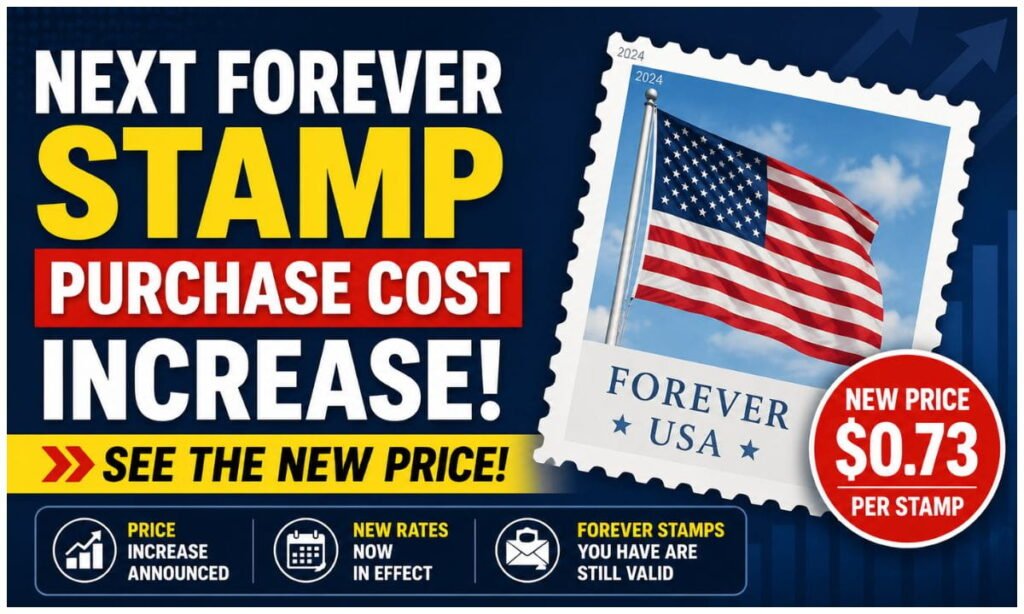
Next Forever Stamp Purchase Cost Increase: If you’ve been meaning to stock up on stamps, the moment to do it has already passed. As of Sunday, July 12, 2026, the price of a First-Class Mail Forever Stamp has jumped from 78 cents to 82 cents, marking the latest in a long string of increases the U.S. Postal Service has pushed through to keep itself financially afloat. The price of Forever stamps is rising once again, meaning anyone planning to send mail in the coming months will have to pay more for postage. The U.S. Postal Service (USPS) has announced a new price adjustment, raising the cost of a First-Class Mail Forever stamp from 78 cents to 83 cents.
This move reflects the agency’s rising operational costs, inflation, and ongoing efforts to invest in the nationwide mail delivery network. Since Forever stamps are designed to remain valid even if prices rise in the future, customers who purchase them before the new rate takes effect can continue using them to send standard one-ounce First-Class letters without paying extra postage later.
Forever Stamp Purchase Cost Increase – What Else Is Changing
This increase is part of a broader pricing strategy under the USPS’s long-term modernization plan, aimed at improving financial sustainability while maintaining reliable mail service across the United States. In addition to Forever stamps, rates for various other mailing services—including metered mail, postcards, international letters, and certain package services—may also be updated.
Consumers, businesses, and frequent mailers are advised to purchase Forever stamps at the current price before the increase takes effect if they wish to save money on future mailings. While the price hike per stamp may seem minor, the cumulative cost can be significant for households and organizations that regularly send letters, invoices, bills, greeting cards, or business correspondence.
The headline number is simple: a Forever Stamp now costs 82 cents, up 4 cents from the previous price. But the Forever stamp isn’t the only thing getting more expensive. Several other everyday mailing products are rising in step:
- 1-ounce metered letters: up from 74 cents to 78 cents
- Domestic postcards: up from 61 cents to 65 cents
- International postcards: up from $1.70 to $1.75
- 1-ounce international letters: up from $1.70 to $1.75
One thing holding steady, at least for now, is the additional-ounce rate for single-piece letters, which remains at 29 cents — a price that was itself bumped up a penny just last July.
The Postal Service filed notice of these changes with the Postal Regulatory Commission back in April, and the commission gave its approval in May. That gave USPS the green light to move forward with what it describes as a roughly 4.8 percent overall increase to mailing services pricing.
How We Got Here: A Fast Climb
For anyone who’s felt like Forever Stamp seem to get pricier every few months, that impression isn’t far off. The jump to 82 cents is only the most recent entry in a pattern of frequent hikes. Over the past five years, USPS has raised the price of a first-class stamp six separate times. Put another way: a Forever stamp cost just 58 cents in 2021. With this latest increase, the price has now climbed roughly 41 percent in five years — a pace that far outstrips general inflation over the same stretch.
To put some of the recent milestones in context:
- 2021: 58 cents
- Prior to this increase: 78 cents
- Now: 82 cents
That’s a steady, almost annual march upward, and postal officials have made clear they don’t consider the climb finished.
Why USPS Keeps Raising Prices?
The Postal Service has been blunt about the reasoning behind the increase, describing itself as facing what it calls a “severe financial crisis” driven by rising operational costs. The numbers back up that framing. According to a May 2026 analysis from the Postal Regulatory Commission, USPS’s operating expenses are climbing faster than its revenue: in fiscal year 2025 alone, costs rose by $1.8 billion, while revenue increased by only $1 billion. Meanwhile, the volume of mail Americans and businesses are sending keeps shrinking — it fell 3.7 percent in the last fiscal year. The same report noted that USPS prices overall rose about 15 percent between July 2024 and the end of fiscal year 2025, underscoring just how compressed the agency’s financial position has become.
Postmaster General David Steiner has been especially direct about the scale of the problem. Testifying before Congress in March, Steiner said the agency was at risk of running out of cash within 12 months without intervention. He argued that raising the price of a first-class stamp to somewhere between 90 and 95 cents would go a long way toward stabilizing the Postal Service’s finances — a number well above where the new 82-cent price lands.
“As you all know, there are only three things that any company can do to improve financial performance — sell more products, raise prices or cut costs,” Steiner told the House panel, adding that USPS needs to look for higher prices across both its package and mail products.
That testimony suggests the July 12 increase, while significant, may not be the last word on stamp pricing for the year, or even for 2026.
Structural Financial Pressures
USPS’s struggles aren’t simply a matter of choosing to raise prices; they stem from a mix of long-running structural issues. Lawmakers and postal watchers frequently point to the Postal Accountability and Enhancement Act of 2006, which, among other provisions, created a fund requiring the agency to prepay health benefits for future retirees — a mandate that has weighed on USPS’s balance sheet for years. Combine that with declining mail volumes as more communication and bill-paying moves online, rising transportation and labor costs, and mounting service complaints, and the agency has found itself squeezed from multiple directions at once.
It’s not just letter mail that’s getting pricier, either. Shipping products have also seen substantial increases this year. In January 2026, several postal services saw price adjustments. Then in March, USPS announced a temporary 8 percent increase to shipping prices meant to offset rising transportation costs, effective from late April 2026 through mid-January 2027. That pushed Priority Mail rates up an average of 6.6 percent, Priority Mail Express up 5.1 percent, and Ground Advantage — one of the more popular options for small packages — up 7.8 percent, with starting rates rising from $7.30 to roughly $7.90.
USPS has also introduced new fees this year tied to shipping compliance: a $3 Dimension Noncompliance Fee for packages missing or providing incorrect dimensions, a $7.50 HazMat fee for Priority Mail and Priority Mail Express packages containing hazardous materials, and a steep $50 fee for undeclared or improperly labeled hazardous shipments.
What This Means for the Stamps You Already Own
If you’re sitting on a stash of Forever stamps bought before Sunday, there’s good news: nothing changes for you. Forever stamps are designed to do exactly what their name promises — once purchased, they retain their value indefinitely, regardless of how many times the Postal Service raises prices afterward. A Forever stamp bought back in 2007, when the product debuted at 41 cents, is still valid for mailing a standard 1-ounce letter today, more than 20 cents cheaper than what a new stamp will cost you now.
That durability is precisely why financial planners and frugal shoppers often recommend buying Forever stamps in bulk ahead of an announced price increase — a strategy that no longer applies until the next hike is announced, since the window to lock in the 78-cent rate has now closed.
A Defense, and a Caveat
Despite the criticism the agency has faced — including bipartisan concerns in Congress over delayed deliveries — USPS maintains that its pricing remains reasonable by global standards. A USPS spokesperson told reporters that, notwithstanding the adjustment, the Postal Service’s mailing prices remain among the most affordable in the world.
Whether that framing offers much comfort to everyday consumers is another matter. For now, the practical takeaway is straightforward: as of July 12, 2026, a Forever stamp costs 82 cents, and given the agency’s own signals about further price hikes being likely, it may be worth keeping an eye on your mailbox for the next announcement.
Top Searched Question’s :-
What is the new price of the USPS Forever Stamp?
The new price of the Forever Stamp has been determined based on the latest USPS rate increase. Customers purchasing stamps after the effective date will need to pay the updated price.
When did the new price for Forever Stamps go into effect?
The new postage rates took effect on the official date announced by the USPS. Always check the USPS website for the latest pricing.
Can I still use Forever Stamps purchased at the old price?
Yes. Forever Stamps never expire and remain valid for mailing a 1-ounce First-Class Mail letter, even if the price increases in the future.
Why did the USPS raise the price of Forever Stamps?
The USPS periodically adjusts postage rates to cover rising operational costs, inflation, and investments aimed at improving mail services.
Where can I buy Forever Stamps at the new price?
You can purchase Forever Stamps at USPS Post Offices, the USPS online store, authorized retailers, grocery stores, pharmacies, and many office supply stores.