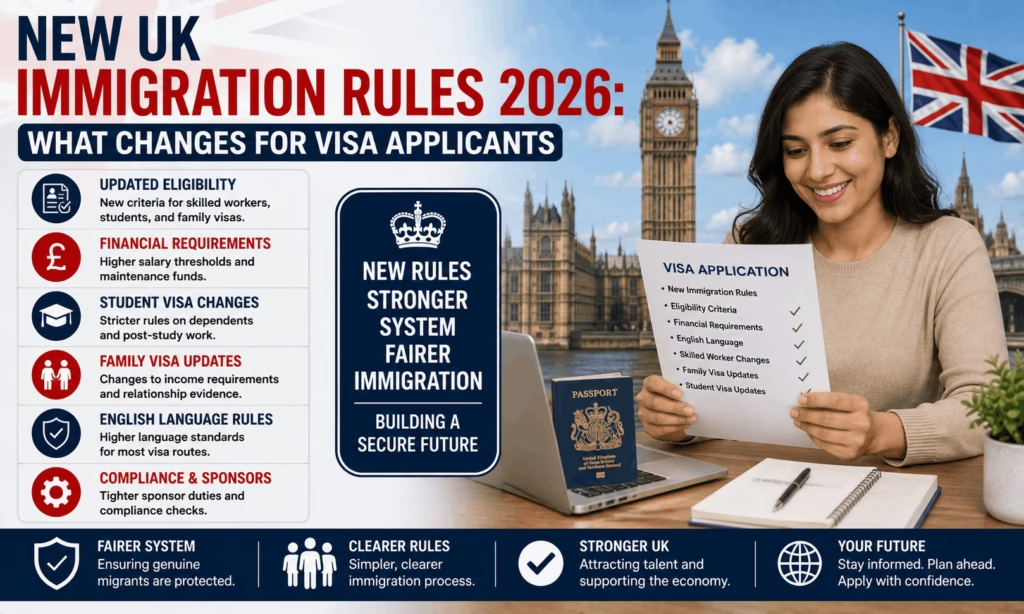
New UK Immigration Rules 2026: The UK Home Office published a sweeping Statement of Changes to the Immigration Rules on March 5, 2026, formally known as HC 1691, introducing one of the most significant immigration overhauls in recent years, with individual provisions phasing in between February 2026 and March 2027. The changes touch nearly every major visa category, including a new digital entry system, a so-called visa brake restricting entry for citizens of specific countries, tighter salary compliance checks for sponsored workers, and a higher English language bar for settlement.
For anyone currently holding a UK visa, applying for one, or planning to sponsor a worker, the practical effect is a rules landscape that looks meaningfully different depending on exactly when you apply. Someone who submitted a Skilled Worker application in January 2026 faces different requirements than someone applying in April 2026 or after March 2027, since several of these changes are staged rather than immediate. This article walks through every confirmed change, the exact date each one takes effect, and what applicants and sponsoring employers need to do differently starting now. We’ll be updating this article monthly as the Home Office confirms further implementation details through 2027.
Digital eVisas Replace the Paper Visa Vignette
Since February 25, 2026, most UK entry visas, including the Visitor and Work routes, have been issued as digital eVisas rather than the older paper vignette sticker placed in a passport. Anyone receiving a visa under this new process is required to create a UKVI account to view their immigration status, share it with employers or landlords through a share code, and update passport or personal details online. Crucially, this is not just an administrative formality. From the same date, carriers have been required to refuse boarding to passengers whose immigration status cannot be confirmed digitally through Home Office systems before departure, meaning permission checks now effectively happen before travel rather than on arrival in the UK. Anyone relying on an eVisa or EU Settlement Scheme digital status should confirm their current passport is correctly linked to their UKVI account well before booking travel to avoid being denied boarding.
The New Visa Brake: Who Is Affected
One of the most closely watched provisions in the March 2026 Statement is the introduction of a visa brake, a new mechanism allowing the Home Office to swiftly restrict entry routes for citizens of specific countries. Effective March 26, 2026, nationals of Afghanistan are no longer eligible for UK entry clearance through the Skilled Worker route, though applications submitted before that date remain unaffected. On the same date, nationals of Afghanistan, Cameroon, Myanmar, and Sudan lost eligibility to apply for entry clearance under the Student visa route. The Home Office has framed this specifically as part of a broader effort to reduce the number of individuals entering the asylum system through work and study routes.
Trump Birthright Citizenship Executive Orders: What Changed After Supreme Court Ruling
State-by-State SNAP Food Ban 2026: What’s Banned, Status Update
Visa National List Changes: Nicaragua and St Lucia
From March 5, 2026, nationals of Nicaragua and St Lucia were added to the UK’s visa national list and simultaneously removed from the Electronic Travel Authorisation eligible list, meaning citizens of both countries now require a full visa to visit the UK rather than the lighter-touch ETA. A six-week transitional arrangement allowed travelers with confirmed bookings made before March 5, 2026, and a valid ETA obtained before 3pm GMT on April 16, 2026, to still travel visa-free during that window, but that transitional period has now closed.
Asylum System and Refugee Protection Changes
From March 2, 2026, the Home Office introduced a new, more limited form of refugee status referred to as core protection. Under this regime, initial refugee and humanitarian protection permission is reduced from five years down to 30 months, a significant reduction that shortens the period before a refugee’s status must be reassessed or extended. This change forms part of the government’s stated aim to build a more responsive asylum system tied to conditions in an applicant’s country of origin, rather than granting a fixed longer-term status upfront.
Skilled Worker Salary Compliance: Pay Period Checks
Starting April 7, 2026 according to some legal trackers, and confirmed as April 8, 2026 by others tracking the same provision, sponsors of Skilled Worker visa holders must ensure the salary paid in every individual pay period meets at least the proportional minimum tied to the salary listed on the worker’s Certificate of Sponsorship, rather than simply averaging pay across a full year. For monthly paid employees specifically, UK Visas and Immigration will check that total salary across any three-month window meets at least one quarter of the annual Certificate of Sponsorship salary. This closes a compliance gap that previously allowed employers to average pay across bonus periods or irregular pay cycles, and non-compliance can now trigger prompt enforcement action against the sponsoring employer’s licence. Employers sponsoring Skilled Worker visa holders should review payroll processes now to confirm ongoing compliance with this pay-period-level requirement.
English Language Requirements Are Rising
New applicants for the Skilled Worker, Scale-up, and High Potential Individual visa routes have already needed to demonstrate English language ability at level B2 on the Common European Framework of Reference, rather than the previous B1 standard, since January 8, 2026. Separately, and on a longer timeline, anyone applying for settlement under routes including the Skilled Worker visa on or after March 26, 2027, will need to demonstrate B2 level English in speaking and listening, unless an exemption applies. This settlement-stage change specifically affects people who were originally granted their initial visa based on a B1 English test or a degree taught in English at B1 level, since they may need to sit an approved B2 test before their settlement application, even if they met the requirement at the time of their original visa grant.
Global Talent Visa Expansion
While much of the March 2026 Statement tightens requirements, the Global Talent route was expanded. From April 8, 2026, a new design endorsement pathway opened for professionals in fields including product design, architecture, and fashion, allowing applicants to qualify by demonstrating professional recognition, examples of published or exhibited work, and letters of recommendation from established organizations in their field. The Statement also clarified academic fast-track criteria agreed with the National Academies and introduced a faster route for eligible PhD-level research and innovation roles at approved organizations, reflecting a continued government push to attract specific high-value talent even while restricting other routes.
Global Business Mobility: Shorter Overseas Employment Requirement
For employers using the Global Business Mobility Secondment Worker route to bring overseas staff into the UK temporarily, the qualifying overseas employment requirement was reduced from 12 months to 6 months, effective April 8, 2026, making it easier for multinational employers to second staff to the UK sooner after they join an overseas entity of the same corporate group.
Max Social Security Benefit at Age 67 in 2026: How to Get It?
IRS confirms ACTC Refund 2026: $1,700 Child Tax Credit Payout Dates & Eligibility
Student Visa and University Compliance Changes
Separately from the March 2026 Statement, changes to student visa compliance rules for sponsoring universities took effect on June 1, 2026, tightening how education providers must monitor and report on the immigration compliance of their enrolled international students. This sits alongside the ongoing reduction to the Skilled Worker eligible occupations list, which took effect on July 22, 2025 and remains in place through the end of 2026, alongside the closure of overseas recruitment for social care workers on the same date, both part of a broader push to reduce reliance on overseas recruitment for medium-skilled roles while the Migration Advisory Committee reviews which occupations should remain eligible beyond 2026.
UK Immigration Rule Changes 2026-27
| Effective Date | Change | Who It Affects |
|---|---|---|
| July 22, 2025 | Reduced Skilled Worker eligible occupations list; care worker overseas recruitment ends | Employers sponsoring medium-skilled roles, care sector |
| January 8, 2026 | B2 English required (up from B1) for new applicants | Skilled Worker, Scale-up, High Potential Individual routes |
| February 25, 2026 | Digital eVisas replace paper vignettes; pre-travel status checks begin | Visitor and Work route applicants |
| March 2, 2026 | Core protection asylum status introduced, reduced to 30 months | Refugee and humanitarian protection applicants |
| March 5, 2026 | Statement of Changes HC 1691 published; Nicaragua and St Lucia added to visa national list | All routes; visitors from Nicaragua and St Lucia |
| March 26, 2026 | Visa brake: Afghanistan barred from Skilled Worker; Afghanistan, Cameroon, Myanmar, Sudan barred from Student visa | Nationals of the listed countries |
| April 7-8, 2026 | Skilled Worker pay-period salary compliance checks begin | Sponsoring employers and Skilled Worker visa holders |
| April 8, 2026 | Global Talent design pathway opens; GBM overseas employment requirement cut to 6 months | Design professionals, multinational secondees |
| June 1, 2026 | New student visa compliance rules for sponsoring universities | International students and universities |
| March 26, 2027 | B2 English required for settlement applications (up from B1) | Skilled Worker and related settlement applicants |
What Applicants and Employers Should Do Now
Anyone planning to travel to the UK on an eVisa should log in to their UKVI account well ahead of departure to confirm their current passport is correctly linked, since carriers can now refuse boarding over an unresolved digital status mismatch rather than the issue being resolved on arrival. Employers sponsoring Skilled Worker visa holders should audit their payroll cycles now against the pay-period compliance rule, rather than waiting for a UKVI check to reveal a shortfall retroactively. Anyone who obtained their original visa with a B1-level English test and expects to apply for settlement on or after March 26, 2027, should plan to sit an approved B2 test well in advance, since language testing appointments and preparation both take time. Nationals of the countries affected by the visa brake should seek advice from an immigration adviser about alternative routes, since the restriction applies specifically to the Skilled Worker and Student visa routes named in the Statement rather than every UK immigration category.
VA Burial Allowance 2026 Rates, Eligibility and How to Apply?
Form I-551 Confirmed Green Card Holders Enter US Without a Visa
Official Resources and Application Links
| Resource | Purpose | Link |
|---|---|---|
| UK Visas and Immigration official guidance | Full rules and route-specific requirements | gov.uk/browse/visas-immigration |
| UKVI account login and registration | View, update, and share your eVisa status | gov.uk/eVisa |
| Check your UK visa status | Verify current immigration status online | gov.uk/view-prove-immigration-status |
| Electronic Travel Authorisation (ETA) application | Apply for or check ETA eligibility | gov.uk/eta |
| Statement of Changes HC 1691 (official text) | Full legal text of the March 2026 changes | gov.uk (Statement of Changes in Immigration Rules) |
| Skilled Worker visa sponsor guidance | Employer compliance and sponsorship rules | gov.uk/skilled-worker-visa |
| UK Global Talent visa | Apply through the expanded endorsement pathways | gov.uk/global-talent |
FAQs
What is the UK visa brake introduced in 2026?
It is a new Home Office mechanism that allows the government to quickly restrict specific visa routes for nationals of particular countries. From March 26, 2026, it was applied to bar Afghan nationals from the Skilled Worker route and to bar nationals of Afghanistan, Cameroon, Myanmar, and Sudan from the Student visa route.
Do I need a new eVisa if I already have a UK visa?
If your existing visa or status has not been converted yet, you should check gov.uk directly, since the rollout applies primarily to new visas issued for applications paid for on or after February 25, 2026. Existing eVisa and EU Settlement Scheme holders should ensure their current passport is linked in their UKVI account regardless.
Has the English language requirement for UK visas changed?
Yes, in two stages. New applicants for the Skilled Worker, Scale-up, and High Potential Individual routes have needed B2 English instead of B1 since January 8, 2026. Separately, B2 English will also be required for settlement applications made on or after March 26, 2027.
What is the new Skilled Worker salary compliance rule?
From April 2026, sponsors must ensure a worker’s salary meets the required minimum in every individual pay period, rather than averaging pay across the full year, with monthly paid employees checked on a rolling three-month basis against their Certificate of Sponsorship salary.
Do Nicaragua and St Lucia nationals still qualify for the ETA?
No. Both countries were moved from the ETA eligible list to the visa national list from March 5, 2026, meaning their nationals now require a full UK visa to visit rather than the lighter-touch Electronic Travel Authorisation.
How long does refugee status last under the new core protection system?
Initial permission under the new core protection regime introduced March 2, 2026 lasts 30 months, down from the previous five-year grant of refugee status.
Is it harder to get a Global Talent visa in 2026?
Not necessarily. While several other routes tightened, the Global Talent route expanded in April 2026 with a new design endorsement pathway and a faster route for eligible PhD-level research and innovation roles.
Conclusion
The UK’s 2026 immigration overhaul is not a single rule change but a staged rollout of measures running from February 2026 through March 2027, tightening entry for specific nationalities, raising English language standards in two separate phases, and introducing pay-period-level salary compliance checks for sponsored workers, while simultaneously expanding the Global Talent route for select high-value applicants. Anyone with a pending or planned UK visa application should check the exact date their application falls under, since the requirements in place before and after each implementation date genuinely differ, and should rely on official gov.uk guidance rather than older summaries of the rules that may already be out of date.
EITC Refund 2026: IRS Confirms Up To $4,427 for Taxpayers With One Child