The OPM retirement backlog stood at 10,606 claims at the end of October 2026, up 20 percent from 8,814 in September. The average claim took 73 days to finish. Digital claims averaged 59 days and paper claims averaged 150 days, and the full process from your last day of work usually runs three to five months.
The OPM retirement backlog just broke a seven month winning streak. After falling every month from a record 65,237 claims in February, the pile of unfinished federal retirement cases jumped by 1,792 in October, the first increase since winter. The Office of Personnel Management received 10,329 new claims but finished only 7,004, which was 47 percent fewer than it processed in September and the lowest monthly total since January 2025. The average wait climbed from 66 days to 73. For a federal employee with a retirement date on the calendar, the headline number matters less than the question behind it: how long until a full pension check arrives? The honest answer is that digital filers are doing far better than anyone who sent paper.
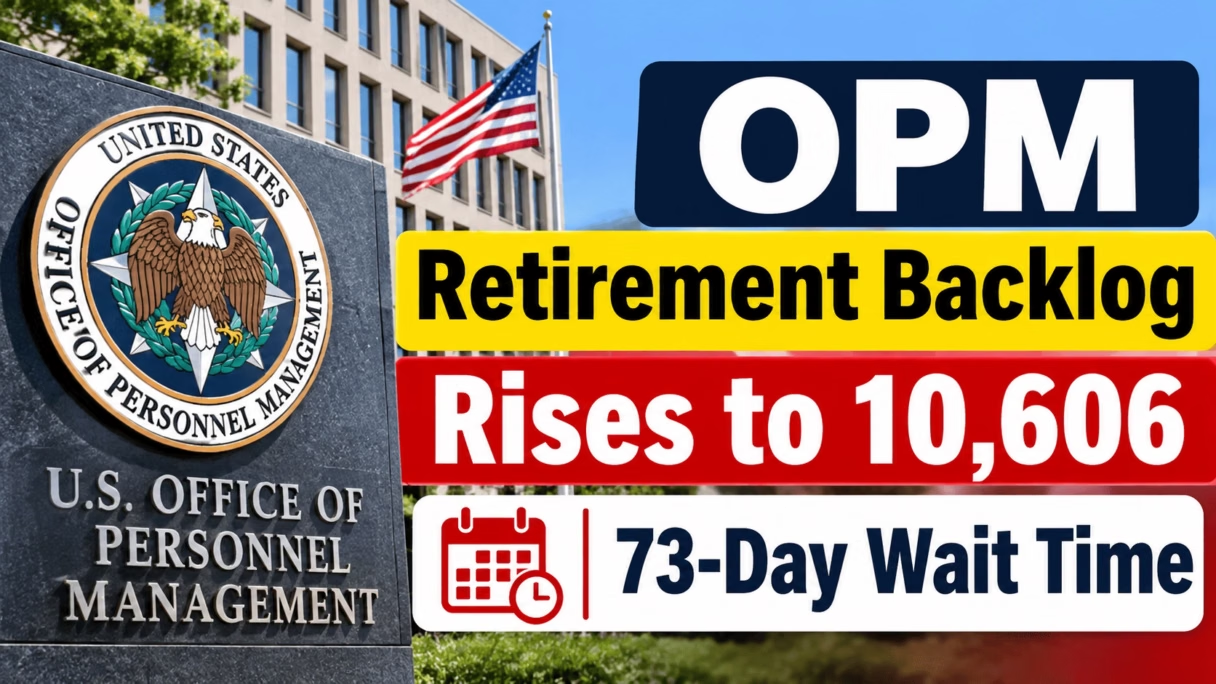
Context matters before anyone panics. The October backlog of 10,606 is still lower than any month in OPM’s data before September, and it is about 54,600 claims below the February peak. FedSmith, which tracks the monthly reports, attributes the rise largely to seasonality, noting that the backlog grew from September to October in 10 of the last 15 years. The bigger story is the gap between formats. About 85 percent of new claims now arrive through the Online Retirement Application, and OPM ended paper processing for most applicants on July 1. Below you will find the key numbers in one table, the history of the backlog, what interim pay really covers, a free calculator, steps to file, the most common causes of delay, how to check your status and the official links that are safe to use.
OPM Retirement Backlog Key Highlights
| Item | Latest figure |
|---|---|
| Backlog at end of October 2026 | 10,606 claims |
| Change from September | Up 1,792, or 20 percent |
| Backlog at end of September 2026 | 8,814 claims, the first month below 10,000 in OPM’s data |
| Record high | 65,237 claims in February 2026 |
| Claims received in October | 10,329 (8,746 digital, 1,583 paper) |
| Claims processed in October | 7,004 |
| Average processing time, October | 73 days |
| Digital claims average | 59 days |
| Paper claims average | 150 days |
| Record average wait this year | 109 days in July |
| Steady state benchmark | About 13,000 claims |
| Interim pay | 60 to 80 percent of estimated net annuity |
OPM Retirement Backlog in October 2026: What the Latest Numbers Show
Start with intake. OPM took in 10,329 claims in October, about 85 percent of them digital. That was the second highest October intake in the data, according to FedSmith, trailing only October 2025. It was also a big jump from September, when 8,080 claims came in.
Then look at output. OPM finished 7,004 claims, down from 13,227 in September, which had been the best September on record. Put simply, September was an unusually strong month for closing cases, and October gave some of that back. When the pile is small, a swing like that looks dramatic in percentage terms. The backlog started October at its lowest point in at least 14 years, so a gain of 1,792 claims reads as a 20 percent jump even though the total is still modest by historical standards.
The mix is worth noting too. All of the growth in October came from digital claims. The paper backlog actually edged down to an estimated 2,703 claims. That tells you the leftover paper pile is shrinking slowly, while fresh digital cases are now the main flow that OPM has to keep moving.
Why Did the OPM Retirement Backlog Rise in October?
OPM has not published an explanation, so the following is reporting and analysis, not an official statement. Two things stand out.
First, seasonality. FedSmith’s author points out that the backlog rose between September and October in 10 of the last 15 years. In our reading, employees lining up year end retirements may push intake up in the fall, with agencies sending those packages to OPM in waves.
Second, a hangover from a very good September. OPM finished more than 13,000 claims that month, which in our reading likely drained the easiest cases from the inventory. What remains tends to be the messier files, such as those with missing service records, court orders or questions about military or part time service.
OPM Retirement Processing Time: Digital vs Paper
The difference between formats is the clearest finding in the data. In October, the average digital claim took 59 days from the time OPM received a complete package. The average paper claim took 150 days, about two and a half times longer. In September the numbers were 56 days and 149 days.
| Month | Average days, all claims | Digital | Paper |
|---|---|---|---|
| July 2026 | 109 | Not available | Not available |
| August 2026 | 79 | Not available | Not available |
| September 2026 | 66 | 56 | 149 |
| October 2026 | 73 | 59 | 150 |
The trailing 12 month average sits near 79 days, and fiscal year 2026 as a whole averaged 79 days compared with 56 days in fiscal year 2025. In other words, the year was worse than the one before, even though the recent months look much better than the spring and summer.
One clarification helps set expectations. The OPM processing clock measures the time OPM spends on a claim after it receives a package from your agency. It does not include the weeks your agency and payroll provider spend preparing the file. That is why a claim with a 59 day average can still take three months or more from your last day of work.
How the OPM Retirement Backlog Grew to 65,237 and Fell Back
The backlog did not creep up. It exploded in the first part of 2026 and then collapsed. The Congressional Research Service ties the surge to the end of the deferred resignation program in September 2025 and to broader workforce reductions, which pushed an unusual number of federal employees toward retirement at once. A 43 day funding lapse from October 1 to November 12, 2025 may also have slowed the flow of applications from agencies to OPM.
The peak came in February 2026 at 65,237 claims. By March, about 55,700 claims were pending, according to a letter from House Oversight Democrats. Then the pile started falling, month after month, through September. The cumulative drop from February to September was 56,423 claims, or 86 percent.
| September snapshot | New claims | Processed | Ending backlog |
|---|---|---|---|
| 2022 | 8,086 | 10,681 | 26,642 |
| 2023 | 6,768 | 8,879 | 15,852 |
| 2024 | 5,618 | 6,302 | 14,494 |
| 2025 | 6,095 | 7,902 | 23,552 |
| 2026 | 8,080 | 13,227 | 8,814 |
The September 2026 backlog was 63 percent below the same month a year earlier. That is a striking turnaround, and it is why this month’s uptick should be read as a bump in a long recovery rather than a new crisis, at least for now.
A Caution About the Official OPM Retirement Numbers
Not everyone agrees the monthly figures tell a clean story. FedTools, an independent analyst, argues that OPM’s published monthly numbers do not reconcile. If you take the prior month’s backlog, add new claims and subtract claims processed, the result does not match the published ending backlog.
October shows the same pattern. Start with September’s 8,814. Add 10,329 new claims and subtract 7,004 processed claims, and you get 12,139. OPM reported 10,606, which is about 1,500 lower. FedTools counted a gap of 16,145 claims across fiscal year 2026. There may be a simple definitional reason, such as claims returned to agencies or cases that never entered the inventory, but OPM has not explained it publicly. Treat the monthly totals as a good guide to direction and not as an exact count.
How Long Does OPM Retirement Take?
The Congressional Research Service describes a full process of three to five months. Here is how the pieces fit together for a typical digital filer.
| Stage | Typical time |
|---|---|
| Agency HR and payroll prepare your file | 30 to 45 days |
| OPM intake and claim number assigned | 10 to 15 days |
| OPM review and benefit calculation | 10 to 90 days |
| Interim pay set up after OPM receives a complete package | About 6 days, per OPM |
| Annual leave lump sum from your agency | About two to three weeks after retirement |
| Thrift Savings Plan registration | 30 to 60 days |
Paper filers should plan for longer. FedSmith cites 77 to 90 days or more for paper claims at the OPM stage, and FedTools estimates roughly eight and a half months end to end for paper against five and a half months for digital, based on stage averages. Those are not forecasts for any single person, but they show how big the gap can be.
OPM Interim Retirement Pay Explained
While OPM finishes your claim, it pays an interim annuity. Interim pay generally runs 60 to 80 percent of your estimated net annuity, and it is reduced by federal income tax withholding. A retiree whose net pension will be $3,000 a month should expect somewhere between $1,800 and $2,400 in interim payments.
Once OPM finalizes the case, it sends a catch up payment covering the difference. The Congressional Research Service notes that OPM pays no interest on interim periods or on delayed final payments. That detail matters, because a longer wait costs you the use of the money even though you are eventually made whole.
Interim payments often begin one to three months after retirement, according to FedSmith. During that period, OPM does not withhold regular items such as health insurance premiums at standard rates, so the interim check does not look like your final pension. Plan for the mismatch, and check your interim status in Retirement Services Online, where an Interim Pay Case Status page is available.
OPM Retirement Wait Time Calculator
Use the calculator below to turn the averages into dates and dollars. Enter your last day of work, choose digital or paper, and add your estimated net monthly annuity. The tool shows a best case, a current average and a slow case for when OPM could finish, plus your likely interim pay and the catch up you may receive.
OPM Retirement Wait Time Calculator
Estimate when OPM could finish your claim and how much interim pay to expect while you wait.
Method: agency and payroll stage of 30 days (best case) or 45 days, plus OPM review time. OPM review uses 40 days digital or 77 days paper (best case), the October 2026 averages of 59 days digital and 150 days paper, and the July 2026 record average of 109 days for the slow case. Interim pay is 60 to 80 percent of the net annuity and no interest is paid on delays. These are averages, not a promise. Check Retirement Services Online for your real status.
A quick example shows how it works. Say you retire on December 31, 2026, file digitally and expect a net annuity of $3,000 a month. In the best case, with 30 days at your agency and 40 days at OPM, your claim could be done around March 11, 2027. At the current averages of 45 days plus 59 days, the date moves to about April 14. In a slow case that matches July’s record of 109 days, it could stretch to about June 3. Interim pay would run $1,800 to $2,400 a month, and the catch up at the current average would be roughly $2,050 to $4,100.
How to Apply for Federal Retirement Through the Online Retirement Application
Since the end of paper processing on July 1, 2026, OPM says more than 95 percent of retirement applications are handled digitally through the Online Retirement Application, known as ORA. Here is how the process works.
- If you are still working, start with your agency HR office. HR begins your application in ORA and verifies service, benefits coverage and records.
- Your payroll provider issues your final pay and any annual leave payout, and prepares the retirement record that OPM needs.
- If you left federal service more than 30 days ago, or you are a deferred or postponed retiree, apply directly through ORA at retire.opm.gov.
- OPM sends a welcome notice with your CSA claim number, confirms eligibility, calculates your annuity and authorizes payments through Treasury.
- Create your Retirement Services Online account with your claim number so you can track your case, update tax withholding and set direct deposit.
OPM also offers a pre-retirement application so that employees and HR staff can complete much of the work before the separation date. The agency has said it aims to pay a first pension payment within seven days of retirement for applicants who submit a complete package by their last day. Treat that as a goal and not a guarantee, since the October average still shows a wait of more than two months for the final decision.
Deferred retirees should apply at least 60 days before payments should start. Postponed retirees must also apply at least 60 days ahead, and the start date must be the first of a month before the 62nd birthday.
OPM Retirement Payment Schedule
OPM pays annuities on the first business day of the month for the previous month. By that rule, the next regular payment dates are Tuesday, December 1, 2026 and Monday, January 4, 2027, since New Year’s Day falls on a Friday. Retirees on interim pay are paid on the same monthly schedule.
| Date | What to watch |
|---|---|
| Tuesday, December 1, 2026 | Regular annuity payment for November |
| Early December 2026 | OPM’s November backlog numbers likely to be posted |
| Monday, January 4, 2027 | Regular annuity payment for December |
| Early January 2027 | December numbers and the first read on year end retirements |
The monthly report has appeared in the first days of the following month, and trackers wrote up October’s figures on November 10. If the pattern holds, November’s numbers should show whether October’s rise was a one month blip.
Why OPM Retirement Claims Get Delayed
Most long waits trace back to the same handful of causes. Missing service documentation is a leading one. If your file lacks records of military service, part time work or time at a previous agency, OPM must request them, and federal record centers can be slow. Court orders, such as those dividing a pension in a divorce, add a legal review. Questions about Social Security information, workers’ compensation claims or special provision service can also stop a case.
Agency errors matter as well. Earlier GAO work found that about 10 percent of applications arrived incomplete. OPM publishes agency accuracy data and requires training for ORA users. If your HR office has a record of sending clean packages, your risk of a delay is lower. If you worked for several agencies or have a complicated career, plan for the longer end of the range.
Staffing, a Funding Lapse and Congress: The Pressure on OPM
Several forces shaped the backlog. A GAO review found that Retirement Services staffing fell 16 percent, or 165 full time employees, from fiscal year 2024 to 2026. In an April 13 letter, House Oversight Democrats said OPM had lost roughly 1,000 employees, about a third of its workforce, over the past year, including around 100 in Retirement Services. The letter asked how OPM planned to clear the backlog under current staffing and pressed for details on moving disability, deferred and postponed cases into ORA.
OPM Director Scott Kupor told House appropriators in March that digital adjudication times were more than 50 percent lower than mail based times. The Congressional Research Service cautioned that OPM’s public data did not yet show improvement of that size. The October numbers, with digital claims at 59 days against 150 for paper, now offer some support for his claim.
How to Check Your OPM Retirement Status
Before you call, check online. Here is the order that tends to work best.
- If your package has not reached OPM, contact your agency HR office first. OPM cannot help until a CSA claim number exists.
- Once you have a claim number, sign in to Retirement Services Online at servicesonline.opm.gov and review your case status. Use the Interim Pay Case Status page to see how your interim payment is being handled.
- Submit an online help request if you need an answer. You will need a claim number that starts with CSA or CSF. OPM says responses usually take three to five business days.
- Call OPM Retirement Services at 1-888-767-6738, Monday through Friday from 7:40 a.m. to 5:00 p.m. Eastern. The busiest period is 10:30 a.m. to 1:30 p.m., so call outside it if you can. Hearing impaired callers can use 711.
What Federal Retirees Should Do While Waiting for OPM
Plan for a gap in income. Many financial planners suggest keeping three to six months of living expenses in cash before you retire, and nine months if your career is complicated. Your annual leave payout, which can be tens of thousands of dollars, is a useful tool for covering the early months.
Pay attention to taxes. Combining a large Thrift Savings Plan withdrawal, the leave payout and a retroactive pension lump sum in one tax year could push you into a higher bracket. Take only what you need from the TSP, and remember that you cannot withdraw until your account registration is complete, which can take 30 to 60 days.
Official Resources for OPM Retirement Wait Times
| Resource | What it is for | Link |
|---|---|---|
| Online Retirement Application (ORA) | File your retirement application | https://retire.opm.gov |
| Retirement Services Online (login) | Track your case, interim pay, tax withholding and deposits | https://www.servicesonline.opm.gov |
| Getting started with Retirement Services Online | Register and sign in | https://www.opm.gov/support/retirement/how-to/getting-started-with-opm-retirement-services-online/index.html |
| Check your interim retirement pay status | Steps to view interim pay | https://www.opm.gov/support/retirement/how-to/check-your-interim-retirement-pay-status/ |
| Contact OPM Retirement Services | Phone, mail and online help request | https://www.opm.gov/retirement-services/contact-retirement/ |
| OPM Retirement Center | Guides, forms and processing statistics | https://www.opm.gov/retirement-center/ |
| Last Day of Paper announcement | OPM news release on ending paper processing | https://www.opm.gov/news/news-releases/opm-marks-last-day-of-paper-ending-paper-retirement-processing-after-more-than-65-years/ |
| Thrift Savings Plan | TSP account and withdrawal information | https://www.tsp.gov |
| Congressional Research Service report IN12738 | Background on federal retirement processing | https://www.everycrsreport.com/reports/IN12738.html |
OPM Retirement Backlog FAQs
What is the OPM retirement backlog right now?
It was 10,606 claims at the end of October 2026, up 20 percent from 8,814 in September.
How long does OPM retirement processing take?
The average claim took 73 days in October. Digital claims averaged 59 days and paper claims 150 days. The whole process from your last day usually takes three to five months.
Why did the OPM backlog go up in October?
OPM has not given a reason. FedSmith points to seasonality, since the backlog rose from September to October in 10 of the last 15 years, along with a sharp drop in claims processed.
How much is interim retirement pay?
Interim pay is generally 60 to 80 percent of your estimated net annuity, reduced by federal income tax withholding.
Does OPM pay interest on delayed retirement payments?
No. The Congressional Research Service says OPM pays no interest on interim periods or on delayed final payments.
Can I still file a paper retirement application?
OPM ended paper processing for most applications on July 1, 2026, and says more than 95 percent are now handled through ORA. Use ORA unless OPM tells you otherwise.
What was the highest OPM retirement backlog?
The record was 65,237 claims in February 2026.
When will the next OPM backlog numbers come out?
Recent monthly reports have appeared in the first days of the following month, so November’s numbers are likely in early December.
How long does it take to get your first OPM pension check?
OPM says it sets up interim pay about six days after it receives a complete package from your agency, and interim payments often begin one to three months after retirement.
Is the OPM retirement backlog getting better or worse?
Better over the year, worse over the last month. It fell 86 percent from February to September, then rose 20 percent in October.
How do I check my OPM retirement claim status?
Sign in to Retirement Services Online with your claim number, or call 1-888-767-6738 on weekdays.
What is a CSA claim number?
It is the number OPM assigns when it receives your package. It starts with CSA or CSF and is needed for online help requests.
Why is paper retirement processing slower?
Paper files must be handled by hand and mailed between offices. The October average for paper was 150 days, compared with 59 for digital.
What happens if my retirement package is incomplete?
OPM contacts you or your agency for the missing items, and your case can stall until they arrive. Earlier GAO work found about 10 percent of applications were incomplete.
Do I need to apply for deferred retirement through ORA?
Yes. OPM requires deferred and postponed retirees to use ORA, and to apply at least 60 days before payments should start.
Is OPM short staffed?
A GAO review found Retirement Services staffing fell 16 percent between fiscal years 2024 and 2026, and House Democrats say OPM lost about a third of its overall workforce in a year.
Conclusion
The OPM retirement backlog rose in October, but the bigger picture still favors patience over alarm. At 10,606 claims, the pile is far below the February peak, and digital filers are waiting about two months at OPM instead of five. The weak spots are paper files, incomplete packages and the chance that a busy winter pushes the numbers higher again.
If you are retiring soon, file through ORA, start early, confirm your records and keep a cash cushion for the gap before your full pension begins. Use the calculator above to build your own timeline and check Retirement Services Online as soon as you have a claim number. We’ll be updating this article monthly.