
ACA Subsidy End in 2026: The question that matters now is what happens for 2027, because open enrollment is under way. HealthCare.gov enrollment for 2027 coverage runs from 1 November 2026 through 15 January 2027. No law has restored the enhanced credits.
As of latest updates, proposals to extend them have been introduced and debated, but none has become law. The rules you plan around now are the standard rules, with the IRS’s updated 2027 percentages.
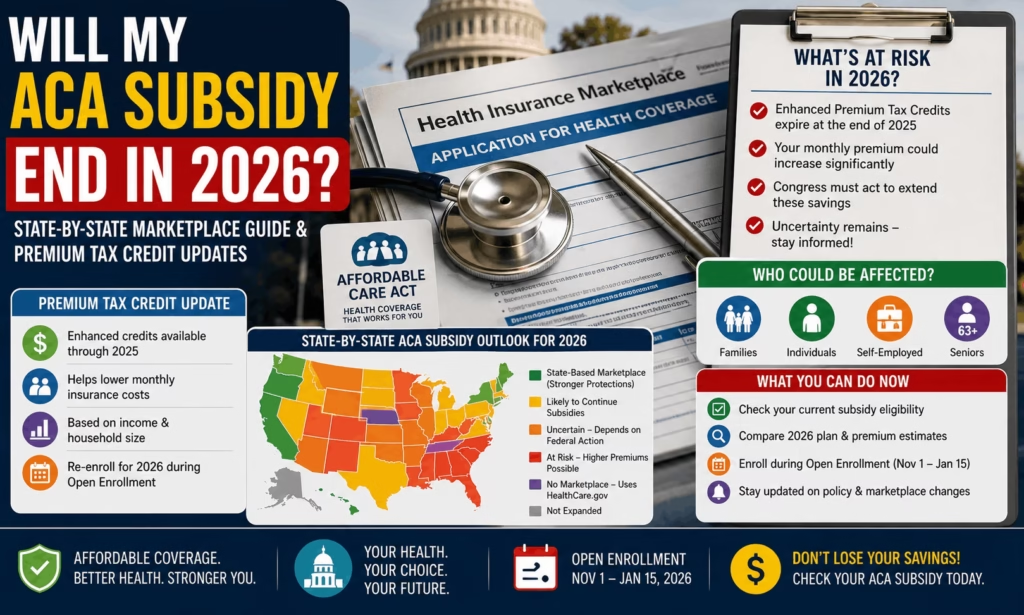
ACA Subsidy End in 2026
If you are asking whether your ACA Subsidy will end in 2026, the question is already half out of date. The change that worried people happened on 1 January 2026. The enhanced premium tax credits, the extra help created in 2021, expired on 31 December 2025. The original ACA credit never went away, and the income cliff at 400% of the federal poverty level returned in 2026. For most households that means higher monthly bills than in 2025. It does not mean the ACA Subsidy is gone for everyone.
How much you are affected depends heavily on your income and your state. A household just under 400% of poverty still gets a credit, and one just above gets none. About a dozen states add their own money on top of the federal credit. This guide on ACA Subsidy explains what ended, what continues, what the 2027 numbers are, how the states differ, and what to do before the deadlines. Official links appear on their own lines at the end of each section.
The short answer
- Enhanced credits: expired 31 December 2025 and have not been restored.
- Standard credit: still available for most people between 100% and 400% of the poverty line.
- 2027 deadline: enroll by 15 December 2026 for 1 January coverage. HealthCare.gov open enrollment runs to 15 January 2027.
- New for 2027: a higher IRS percentage table, no cap on repaying excess credits, and narrower credit eligibility for some immigrants.
What expired and what continues?
From 2021 through 2025, temporary enhancements raised the size of the credits and removed the upper income limit. Those enhancements ended on 31 December 2025. The permanent ACA subsidy did not expire, but the temporary extra help on top of it did.
Under current law, you can get a credit if your household income is between 100% and 400% of the federal poverty level and you meet the other eligibility rules. Anyone eligible for affordable employer coverage or for Medicaid generally cannot claim it.
Where Congress stands?
On 8 January 2026 the House voted to extend the enhanced credits for three years. That bill is H.R. 1834, the Breaking the Gridlock Act, which passed 230 to 196. The enrolled text changes the end date from “before January 1, 2026” to “before January 1, 2029.” The Senate has not voted on it, and no extension has become law as of the latest reports.
The Congressional Budget Office estimated the bill would raise the number of insured people by 0.1 million in 2026, 3.0 million in 2027 and 4.0 million in 2028. A bipartisan Senate group has discussed a shorter extension with income caps and minimum premiums. Nothing has been enacted. An election result does not change tax credits by itself, because only a new law signed by the President would. Plan on current law unless that changes.
Social Security Payments are coming early in November: Check who is getting paid and when
December Fed Rate Hike 2026: Impact on Mortgages, Credit Cards and Savings
Social Security Changes November 2026: SSA’s 3.6% COLA, Payment Dates & What Retirees Should Know
SSI Payment Dates December 2026 and January 2027: Who Gets Paid When?
The 2027 premium tax credit numbers
Rev. Proc. 2026-26 sets the 2027 applicable percentage table. This is the share of income you are expected to pay toward the benchmark Silver plan. The IRS bulletin lists these percentages:
| Household income (% of poverty line) | Starting % of income | Ending % of income |
| Under 133% | 2.15% | 2.15% |
| 133% to under 150% | 3.23% | 4.30% |
| 150% to under 200% | 4.30% | 6.78% |
| 200% to under 250% | 6.78% | 8.66% |
| 250% to under 300% | 8.66% | 10.22% |
| 300% to 400% | 10.22% | 10.22% |
| Over 400% | No credit | No credit |
SSDI Pay Chart 2026-27 Average Payments, 2027 COLA Raise and Payment Dates
401(k) Contribution Limit 2027 Rises to $25,500 as the IRA Limit Stays at $7,500
Social Security Payment for Birthdays: November 18 and 25, December 9, 16 and 23
Texas $1500 Stimulus Checks: Will Every Household Get a Payment? What the New Bill Means
The 2027 required contribution percentage for the employer-coverage affordability test is 10.22%. The credit equals the benchmark premium minus your expected contribution.
Here are two examples of my own arithmetic, for a single adult. 2027 coverage uses the 2026 poverty guidelines, under which 100% is $15,960. At 200% ($31,920), the expected contribution is about 6.78% of income, roughly $2,164 a year or $180 a month. At 300% ($47,880), it is 10.22%, roughly $4,893 a year or $408 a month. Under the enhanced rules, no one paid more than 8.5% of income.
The cliff and the repayment rule
The income cliff is the sharpest change. Earning even $1 above 400% of the poverty line means no federal credit. That threshold is $63,840 for one person and $86,560 for a couple in the 48 contiguous states and DC. Alaska and Hawaii use higher figures.
Repayment is the second risk. The credit is paid in advance based on your income estimate, then reconciled on your tax return. For tax years after 2025, there is no repayment cap, and the full difference is subtracted from your refund or added to your balance due. You will file for 2026 in early 2027, so this applies to the coverage you have now. If your income might land near a threshold, update your estimate with the Marketplace during the year.
Premiums, plan choice and enrollment
Costs rose sharply in 2026, and 2027 brings another increase. KFF’s analysis finds that the average finalized benchmark Silver premium rises 13% for 2027, after a 26% rise from 2025 to 2026. The same analysis says effectuated enrollment was down 12%, or 2.6 million people, to 19.2 million by February 2026. CBO projects Marketplace enrollment falling to 13.1 million in 2027. Eleven carriers had announced exits from at least one state as of 29 October, and Cigna is leaving all 11 states where it participates. If your insurer is leaving, you must pick a new plan.
CMS gives a more favorable picture for HealthCare.gov states. It says over 75% of HealthCare.gov purchasers will have access to premiums at or below $50 in 2027, with an average of about 100 plans and five to six insurers. Both can be true, because the cheapest plans are usually Bronze plans with higher deductibles. Compare total costs, including deductibles and networks, not just the monthly premium.
Other 2027 changes to check
- Immigrants: the 2025 budget law narrows who can get credits. Eligibility is limited to lawful permanent residents, Cuban and Haitian entrants, and residents under the Compact of Free Association. Refugees, asylees and others can still buy coverage but lose credit eligibility. Virginia says its own program still serves current “lawfully present” statuses.
- Medicaid work requirements: starting in 2027, people in required states who lose Medicaid solely for failing work requirements are also ineligible for subsidized Marketplace plans.
- Dates: a rule that would have shortened open enrollment was vacated by a court, so 15 January stands. A January 1 start needs enrollment by 15 December. Sign-ups from 16 December to 15 January start 1 February.
- Help is thinner: HHS has paused registration of new agents and brokers in the federal marketplace until February 2027. Expect longer waits for assisters.
State-by-state marketplace guide
Most states use HealthCare.gov and follow the federal rules above. About 20 states and DC run their own exchanges with different deadlines. Eleven states, all running their own marketplaces, offer extra state-funded premium help in 2027: California, Colorado, Connecticut, Maryland, Massachusetts, New Mexico, New Jersey, Rhode Island, Vermont, Virginia and Washington. State aid stacks on top of the federal credit. Here is what the sources show for each:
| State | 2027 state help | Notes |
| New Mexico | The only state fully replacing the lost enhanced federal subsidies | Continues its 2026 approach |
| California | Help for incomes up to 200% of poverty ($31,920 single, $66,000 for a family of four) | Funding rises to $300 million from $190 million; open enrollment ends 31 January |
| Virginia | New “Virginia Premium Savings,” layered on federal advance credits | 138% to 250% of poverty, $150 million fund; open enrollment ends 29 January |
| Rhode Island | New state-specific subsidy | Check the state exchange for income limits |
| Colorado | State premium help extended through 2027 | Open enrollment ends 15 January |
| Maryland | Program continues but may be scaled back | Fully replaced the enhanced credits below 200% of poverty in 2026 |
| Connecticut | Covered Connecticut continues | New help for early childhood educators; general state subsidy availability is uncertain |
| Massachusetts, Vermont | State-funded help continues | Confirm amounts with the state exchange |
| New Jersey | Existing state subsidy continues | Reported to reach well above 400% of poverty; confirm with the state |
| Washington | Capped monthly aid for some federal-credit recipients | Reported up to $35 a month; amounts vary |
| All other states | Federal credit only | Federal rules and the 15 January deadline apply (HealthCare.gov states) |
Amounts and limits change, so confirm them on your state exchange before relying on them.
What to do now?
- Renew actively. Log in, review your 2027 plan and confirm your income estimate. Auto-renewal may keep a plan whose price or network changed.
- Estimate income carefully. With no repayment cap, errors near 400% of poverty can cost a full year’s credit.
- Compare plans. Check premium, deductible, out-of-pocket maximum, doctors and drugs.
- Check Medicaid and state aid. Incomes under about 138% of poverty may qualify for Medicaid in expansion states.
- Mind the dates. 15 December and 15 January on HealthCare.gov. Your state may differ.
Official sources
| Source | What it covers | Link |
| IRS Internal Revenue Bulletin 2026-31 | 2027 applicable percentage table, 10.22% employer threshold | https://www.irs.gov/irb/2026-31_irb |
| IRS Q&A on the Premium Tax Credit | Repayment rules after 2025, how reconciliation works | https://irs.gov/affordable-care-act/individuals-and-families/questions-and-answers-on-the-premium-tax-credit |
| CMS Plan Year 2027 Fact Sheet | Open enrollment dates, plan and premium availability | https://www.cms.gov/newsroom/fact-sheets/plan-year-2027-marketplace-plans-prices-fact-sheet-0 |
| HealthCare.gov Marketplace | Deadlines, applications | https://healthcare.gov/health-insurance-marketplace/ |
| H.R. 1834, enrolled House text | The three-year extension bill | https://www.govinfo.gov/content/pkg/BILLS-119hr1834eh/html/BILLS-119hr1834eh.htm |
| CBO cost estimate, H.R. 1834 | Coverage effects of an extension | https://www.cbo.gov/system/files/2026-01/hr1834_0.pdf |
| Covered California 2027 rates release | State subsidy design and eligibility | https://www.coveredca.com/pdfs/07-21-26-COVEREDCA-PY27-Rates-Final.pdf |
| Virginia Marketplace FAQ | Virginia Premium Savings rules | https://www.marketplace.virginia.gov/Virginia-premium-savings-faq |
Frequently asked questions :-
Did ACA subsidies end in 2026?
The enhanced credits ended on 31 December 2025. The standard premium tax credit continues for eligible people.
Are the enhanced subsidies coming back for 2027?
Not under current law. The House passed an extension in January, but it has not passed the Senate or become law.
What is the income limit for 2027 coverage?
400% of the poverty line: $63,840 for one person and $86,560 for two in the 48 contiguous states and DC.
What happens if I earn slightly over 400%?
You get no federal credit and pay the full premium. Some states offer extra help.
Do I have to repay excess credits?
Yes. For tax years after 2025, repayment is uncapped, so the whole excess is owed.
When is open enrollment?
On HealthCare.gov, 1 November 2026 to 15 January 2027. Enroll by 15 December for 1 January coverage. State exchanges may differ.
Does my state offer extra help?
Eleven states do: California, Colorado, Connecticut, Maryland, Massachusetts, New Mexico, New Jersey, Rhode Island, Vermont, Virginia and Washington.
Can I get a subsidy if I am an immigrant?
Only certain groups qualify for credits from 2027, mainly green card holders, Cuban and Haitian entrants, and Compact of Free Association residents. Others may still buy unsubsidized coverage, and some states offer their own aid.
Is this tax or legal advice?
No. Check your own situation with the IRS, your state exchange or a licensed navigator.
Also Read :
Iowa SNAP Junk Food Ban 2026: What Was Banned, Court Update, EBT Rules and Latest Status