PNP work permit without AOR: For months, provincial nominees across Canada have been caught in the same trap. They submit their permanent residence application, they wait for the Acknowledgement of Receipt that unlocks their next work permit, and the wait drags on so long that their current work authorization runs out before the paperwork ever arrives. Some nominees who applied in late 2024 didn’t see an AOR until nearly a year later. Now Immigration, Refugees and Citizenship Canada has stepped in with a fix, and it’s already in effect.
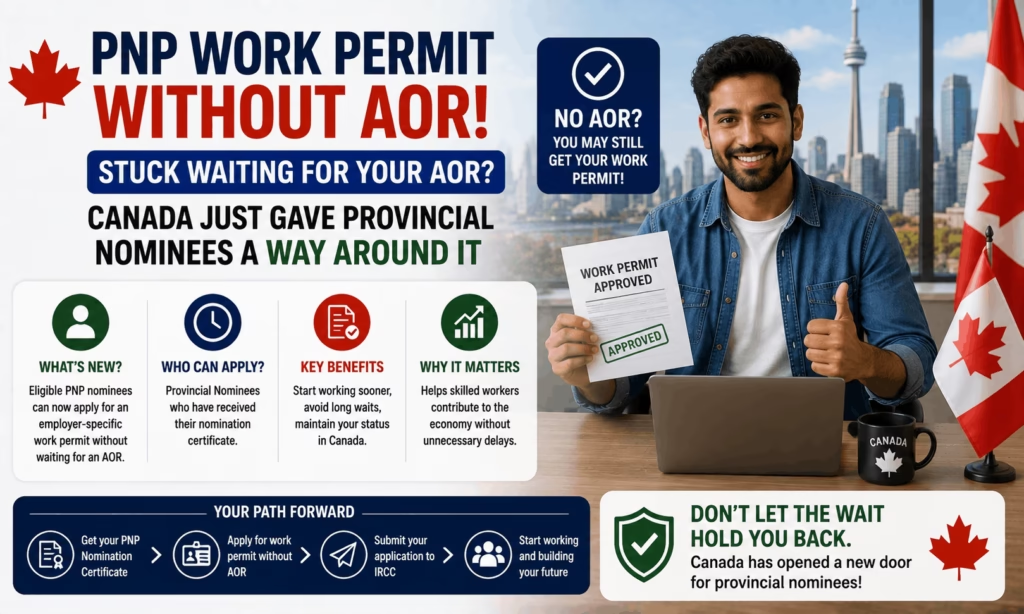
As of June 9, 2026, eligible Provincial Nominee Program applicants who are already in Canada can apply for a bridging open work permit, a PNP employer-specific permit, or a spousal open work permit without waiting for their AOR at all. Instead, they can hand over a submission confirmation email and proof they paid their fees, and an officer can confirm the rest through IRCC’s own systems. It’s a temporary measure, running through December 31, 2026, but for anyone whose work permit is expiring in the meantime, it could be the difference between staying employed and falling out of status. We’ll be updating this article monthly as IRCC releases more guidance or decides whether to extend the measure.
What Changed, and Why Now
IRCC laid out the new rules in Operational Bulletin 699, published June 9. The bulletin points directly at the problem it’s trying to solve: R10 completeness checks, the step where IRCC confirms a permanent residence application is complete enough to move into processing, have been taking far longer than anyone expected. According to data cited in the bulletin itself, a sample of 141 base PNP applicants who submitted their PR applications in late November 2024 didn’t receive their AOR until October 2025 at the earliest. That’s close to an 11-month gap between filing and getting the one document that used to be mandatory for the next step.
During that gap, nominees whose work permits were expiring had nowhere to turn. Without an AOR, they couldn’t file for a bridging open work permit, couldn’t get a PNP employer-specific extension, and their spouses couldn’t apply for an open work permit tied to their file either. People who had already been nominated by a province, already paid their fees, and already submitted a complete application were still at risk of losing their legal right to work in Canada simply because of a backlog they had no control over.
How the New Process Actually Works
Instead of requiring the AOR upfront, IRCC now accepts alternative proof that a PR application was submitted. In practice, that means two documents: a copy of the confirmation email IRCC sends when someone submits their PR application through the online portal, and proof that the PR application fees were paid. On top of that, immigration officers reviewing the file can independently verify through IRCC’s internal systems that the application was received and is still active.
This applies to three specific categories: bridging open work permits for PNP applicants, PNP employer-specific work permit applications, and open work permits for eligible spouses or common-law partners of a qualifying principal applicant. It covers both base PNP applicants and those in Express Entry-aligned PNP streams, as long as they’re physically present in Canada. Notably, it also applies even if the person’s provincial nomination has already technically expired, since the whole point is to keep someone working while the federal side of the process catches up.
One important detail for anyone who tried this route before June 9: if you already applied for a bridging open work permit and it was refused specifically because you didn’t have an AOR, the bulletin doesn’t automatically reopen that file. You’ll generally need to submit a new application under the current rules.
No SSI Payment in August 2026: SSI August 2026 “no payment” confusion Fact-Checked
State-by-State SNAP Food Ban 2026: What’s Banned, Status Update
Arkansas SNAP Junk Food Ban 2026: What’s Banned, Court Update, EBT Rules & Latest Status
Who Actually Qualifies
The measure is aimed squarely at people already living in Canada who’ve been nominated through a Provincial Nominee Program stream and have a permanent residence application sitting in IRCC’s queue without an AOR yet. If that describes your situation, and your current work permit is at risk of expiring, this is worth looking into right away rather than waiting to see if the AOR shows up in time.
It’s not a blanket policy that applies to every temporary resident or every PR pathway. Federal skilled worker applicants outside a PNP stream, for instance, aren’t the target of this bulletin. And it doesn’t retroactively fix an application that was already refused for missing the AOR before June 9. The focus is specifically on keeping current PNP nominees working while their PR file moves through the completeness check stage.
Why This Matters Beyond the Paperwork
This isn’t just a small administrative tweak. The Provincial Nominee Program has become one of Canada’s most heavily used pathways to permanent residence, and it’s about to get busier. Under the 2026 to 2028 Immigration Levels Plan, the federal government raised its PNP admission target to 91,500 for 2026, a 66 percent jump from the year before. At the same time, Canada’s overall permanent residence application inventory had already climbed past one million by early 2026, according to IRCC’s own published data.
That combination, more people coming in through PNP streams and a backlog that was already large before this surge, is exactly why the AOR delay became such a widespread problem in the first place. IRCC has reported some progress on the processing side, with the backlog for the enhanced PNP stream dropping to about 38 percent as of March 2026, but the completeness check delays that triggered this bulletin point to a separate bottleneck earlier in the pipeline that hadn’t been resolved yet. This temporary measure is essentially a pressure valve while that deeper fix continues.
A Related Change for Quebec
Quebec runs its own immigration selection process separate from the rest of Canada’s PNP system, and IRCC issued a related but distinct temporary public policy for Quebec-selected candidates just a few days before this one, on June 5, 2026. It’s aimed at prospective permanent residents in Quebec and their spouses or common-law partners who are facing similar processing-related gaps. If you’re going through Quebec’s selection process rather than a provincial nomination in another province, it’s worth checking that separate policy rather than assuming Operational Bulletin 699 covers your situation, since the two are not identical.
How to Apply Under the New Rules
If you think you qualify, the practical steps are straightforward. Gather your confirmation email from IRCC showing your PR application was submitted through the online portal, along with your proof of payment for the PR application fees. Submit your bridging open work permit, PNP employer-specific work permit, or spousal open work permit application through the normal IRCC channels, attaching these documents in place of the AOR. Be ready for an officer to verify your file status directly through IRCC’s internal records as part of processing your application.
Timing matters here more than almost anything else. If your current work permit is close to expiring, applying before it lapses is what allows you to keep working under maintained status while IRCC processes the new application. Waiting until after your permit has already expired puts you in a much more difficult position, regardless of this new flexibility.
This Is Temporary, Not Permanent
It’s worth being clear-eyed about what this measure is and isn’t. IRCC has described Operational Bulletin 699 as a temporary operational response to a specific processing delay, not a permanent change to how bridging work permits are assessed. The measure is scheduled to run from June 9, 2026, through December 31, 2026. As of now, IRCC has not announced whether it will extend the policy past that date, which means anyone whose PR application is likely to still be in the completeness check stage in early 2027 should keep an eye on future announcements rather than assume this flexibility will still be available.
FAQs
Do I need an AOR to apply for a bridging open work permit right now?
No, not if you’re an eligible in-Canada PNP applicant. Under Operational Bulletin 699, you can apply using a PR application submission confirmation email and proof of fee payment instead.
Does this apply if my provincial nomination has already expired?
Yes. The measure specifically covers applicants whose nomination has expired while they wait for their PR application to move through processing.
Can my spouse get an open work permit under this rule too?
Yes, if you qualify as the principal applicant under the alternative-proof route, your spouse or common-law partner may also apply for an open work permit without waiting for your AOR.
What if my bridging work permit was already refused for not having an AOR?
You’ll generally need to submit a new application under the current rules. The bulletin doesn’t automatically reopen previously refused files.
How long will this temporary measure last?
It’s scheduled to run from June 9, 2026, through December 31, 2026. IRCC has not announced whether it will be extended beyond that date.
Does this apply to Quebec-selected candidates?
Quebec has its own separate temporary public policy, issued June 5, 2026, for prospective PR candidates and their spouses. It’s related but not the same as Operational Bulletin 699.
Conclusion
For provincial nominees who’ve been stuck watching their work permit clock run down while an AOR sat somewhere in IRCC’s queue, this update closes a real gap. It doesn’t fix the underlying delay in completeness checks, and it isn’t meant to last forever, but for anyone eligible right now, it’s a practical way to keep working legally in Canada while the rest of the process catches up. If your PR application is pending and your work permit is approaching its expiry date, it’s worth gathering your submission confirmation and payment proof now rather than waiting to see what happens. We’ll continue updating this article as IRCC provides more guidance or makes a decision on extending the measure past December 2026.
Missouri SNAP Food Ban Delayed: What’s Banned & Latest Status
Hawaii SNAP Soda Ban Delayed to 2027: What Will Be Banned & Status
Florida SNAP Junk Food Ban 2026: What’s Banned, Court Update, EBT Rules & Latest Status
Nevada SNAP Food Ban: What’s Banned & Start Date Explained