Social Security New Identity Rules 2026: The Social Security Administration (SSA) has rolled out its Social Security New Identity Rules 2026, introducing stricter identity-proofing procedures designed to fight rising fraud across the agency’s phone, online, and in-person services. Under these updated rules, phone-only identity verification has been eliminated for most transactions, and beneficiaries who cannot verify themselves through a my Social Security account must now visit a local field office in person with valid documents. The SSA says the changes are meant to protect the records and benefits of the more than 70 million Americans who rely on Social Security, following reports of over $100 million a year lost to direct deposit fraud alone.
This guide explains exactly which documents you’ll need, who is affected by the new SSA identity verification rules, how the process works for direct deposit changes and new claims, and where to find official SSA resources for scheduling, login, and status checks. All details here reflect the latest confirmed SSA policy as of 2026. We’ll be updating this article monthly to include any further changes the agency announces.
Social Security New Identity Rules 2026 Quick Summary
The Social Security New Identity Rules 2026 primarily affect people who cannot use or do not have a my Social Security online account. If you already manage your benefits through your verified online account, you are largely unaffected and do not need to visit an SSA office. However, if you rely on phone calls to file claims, change your direct deposit information, or update your mailing address, you will now need to either complete identity verification online or visit a Social Security field office in person with acceptable documents.
| Key Highlight | Detail |
|---|---|
| Policy effective date | April 14, 2025 (extended from original March 31, 2025 date) |
| Multi-Factor Authentication (MFA) | Enforced on all my Social Security account logins |
| Phone-only verification | Eliminated for most transactions |
| In-person verification required for | New claims, direct deposit changes, address changes for paper-check recipients |
| Exempt from in-person rule | Medicare, Disability (SSDI), and SSI applications |
| Direct deposit change processing time | 1 business day (both online and in-person) |
| Estimated fraud losses addressed | $100+ million/year in direct deposit fraud |
| Beneficiaries potentially affected | 70+ million Americans |
| Appointment scheduling number | 1-800-772-1213 |
Who Qualifies: Who Is Affected by the New Identity Rules
Not every Social Security beneficiary needs to take action under the Social Security New Identity Rules 2026. Here’s exactly who falls under the new requirements:
People Without a Verified My Social Security Account
If you have never created a my Social Security account, or cannot verify your identity through it, you will be required to complete in-person identity proofing at an SSA field office for most transactions.
People Changing Direct Deposit Information
Since direct deposit fraud has been a major concern, anyone requesting a change to their bank account or direct deposit details — whether online or in person — must go through the enhanced identity verification process.
New Retirement, Survivor, or Spouse/Child Benefit Applicants
Individuals filing a new retirement claim, survivor benefit claim, or spousal/child benefit claim by phone or online without a verified account will need to complete their identity verification in person before the claim can proceed.
Paper Check Recipients Changing Their Address
Beneficiaries who still receive paper checks and want to update their mailing address must now prove their identity before the change is processed, to prevent fraudulent redirection of payments.
Third-Party Filers
The SSA has clarified that individuals filing on behalf of someone else — such as a representative payee — will also need to provide in-person identification for certain claims made via phone, internet, or paper application.
Who Is NOT Affected
Importantly, the SSA has exempted several groups from the strictest in-person requirement:
- Medicare applicants
- Disability (SSDI) applicants
- Supplemental Security Income (SSI) applicants
These categories are exempt because, according to the agency, “multiple opportunities exist during the decision process to verify a person’s identity” without requiring an office visit specifically for that purpose.
- Existing my Social Security account holders who can already verify themselves online are also not required to visit an office for standard benefit management.
Payment Schedule: Verification and Processing Timeline
While this isn’t a traditional payment schedule, understanding the timeline for identity verification and processing is essential for anyone affected by the new rules:
| Step | Timeline |
|---|---|
| Attempt online verification via my Social Security account | Immediate, if account is verified |
| Schedule in-person appointment (if required) | Call 1-800-772-1213 to book |
| In-person identity verification at field office | Same-day, once appointment is completed |
| Direct deposit change processing (online or in-person) | 1 business day |
| Claims started by phone but requiring in-person finish | Must be completed in person before claim proceeds |
The SSA has specifically accelerated direct deposit change processing from the previous 30-day hold for online changes down to just one business day, provided identity verification is successfully completed.
Eligibility: Required Documents for Identity Verification
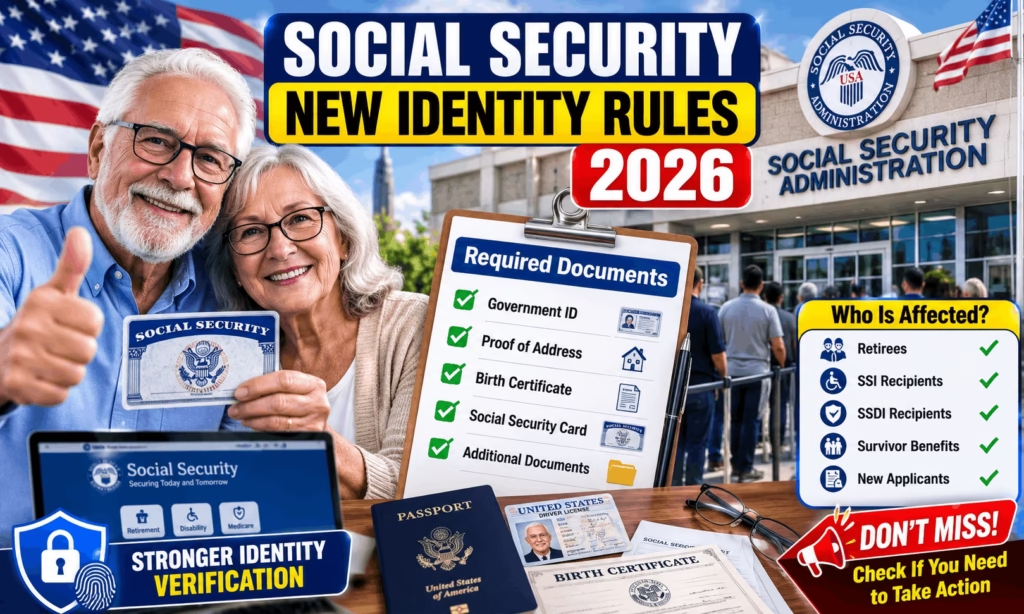
If you need to visit an SSA field office, it’s critical to bring the correct proof of identity documents. According to official SSA guidance, an acceptable document must be current (not expired) and show your name, date of birth or age, and preferably a recent photograph. The SSA’s preferred primary documents include:
Primary Identity Documents (Preferred)
- U.S. driver’s license
- U.S. state-issued non-driver identification card
- U.S. passport
Alternative Documents (If You Don’t Have the Above)
If you don’t have one of the primary documents above, or cannot obtain a replacement within 10 working days, the SSA may accept:
- U.S. military identification card
- Certificate of Naturalization or Certificate of Citizenship
- Employee identification card
- Certified copy of medical record (from a clinic, doctor, or hospital)
- Health insurance card (not a Medicare card)
- Medicaid card
- School identification card or record (commonly used for minors)
For Proof of U.S. Citizenship (If Applicable)
- U.S. birth certificate
- U.S. passport
- Consular Report of Birth Abroad
Important Document Rules
- All documents must be original or agency-certified copies — the SSA does not accept photocopies or notarized copies.
- Documents must reflect your current legal name; if your name has changed, bring the full chain of name-change records (marriage certificate, divorce decree, or court order).
- For those filing on behalf of another person, additional documentation proving custody or responsibility for that individual may be required.
Latest Updates on the SSA Identity Verification Policy
The Social Security New Identity Rules were first announced on March 18, 2025, with an original effective date of March 31, 2025. Following backlash from advocates and lawmakers concerned about the impact on elderly, rural, and disabled beneficiaries, the SSA extended the effective date by two weeks to April 14, 2025, giving employees additional training time and exempting Medicare, Disability, and SSI applications from the strictest in-person requirement.
Acting SSA Commissioner Leland Dudek stated that the agency was “losing over $100 million a year in direct deposit fraud,” and that the new measures were designed to “better protect Americans while expediting service.” As of 2026, the SSA has continued refining this framework, layering in mandatory multi-factor authentication (MFA) for all my Social Security account logins to prevent account takeovers, in addition to the in-person verification requirements introduced in 2025.
For situations where a physical office visit isn’t feasible — such as for beneficiaries with severe mobility limitations or those living far from a field office — the SSA has also been developing a video service delivery option as an alternative method of identity verification, reducing the need for an in-person visit in select cases.
Advocacy groups, including retiree organizations, have continued to raise concerns that the policy could disproportionately affect older Americans in rural areas, people with limited internet access, and those with disabilities, especially as the agency has simultaneously reduced its number of physical field offices and staff in recent years. The SSA maintains that verified my Social Security account holders remain unaffected by these changes and can continue managing their benefits entirely online.
Why the SSA Introduced These Identity Rules
The core driver behind the Social Security New Identity Rules 2026 is the sharp rise in fraudulent activity targeting Social Security payments, particularly through direct deposit rerouting scams, where fraudsters use stolen personal information to redirect a victim’s monthly benefit to a different bank account. Because phone-based verification historically relied on knowledge-based authentication (such as answering security questions using publicly available or previously breached personal data), it became an easy target for scammers. By shifting most verification to secure online accounts or in-person appointments, the SSA aims to close this vulnerability while still processing legitimate requests faster than before.
How to Prepare for the New Identity Verification Process
If you haven’t already, the SSA recommends taking these steps proactively rather than waiting until you need to make a change:
- Create a my Social Security account at ssa.gov/myaccount well before you need to file a claim or change your information.
- Verify your account using Login.gov or ID.me, and enable multi-factor authentication.
- Gather your identity documents now — particularly your driver’s license, state ID, or passport — and confirm they are not expired.
- Call ahead to 1-800-772-1213 if you anticipate needing an in-person appointment, since field offices may experience longer wait times due to increased demand.
- Keep name-change documentation on hand if your legal name differs from what’s shown on your primary ID.
Official SSA Resources
For accurate registration, login, and appointment scheduling, use these official SSA resources:
| Create/Login to my Social Security Account | https://www.ssa.gov/myaccount/ |
| SSA Identity Proofing Announcement | https://www.ssa.gov/news/en/press/releases/2025-03-26.html |
| Documents Needed for a Social Security Card | https://www.ssa.gov/ssnumber/ss5doc.htm |
| Find Your Local SSA Field Office | https://secure.ssa.gov/ICON/main.jsp |
| SSA National Appointment Line | 1-800-772-1213 |
| Home Page | https://govtschemes.org/ |
Conclusion
The Social Security New Identity Rules 2026 mark one of the most significant shifts in how the SSA verifies beneficiaries in decades, moving away from phone-based verification toward secure online accounts and, when necessary, in-person appointments. While the changes are designed to combat rampant direct deposit fraud, they also mean beneficiaries — especially those without a my Social Security account — should prepare their documents and plan ahead before they need to file a claim or update their information. Creating a verified online account remains the simplest way to avoid an in-person visit altogether. We will continue updating this article every month as the SSA refines its identity verification policies further.
FAQs
What are the Social Security New Identity Rules 2026?
They are updated SSA identity-proofing procedures that eliminate most phone-only identity verification, require in-person visits for people who cannot verify through a my Social Security account, and add mandatory multi-factor authentication for all online account logins.
Who needs to verify their identity in person for Social Security?
Anyone without a verified my Social Security account who wants to file a new claim, change direct deposit information, or update a mailing address (for paper check recipients) generally needs in-person verification, unless applying for Medicare, Disability, or SSI.
What documents do I need for Social Security identity verification?
The SSA prefers a U.S. driver’s license, state-issued non-driver ID, or U.S. passport. If unavailable, alternatives include a military ID, Certificate of Naturalization, employee ID card, certified medical record, health insurance card, Medicaid card, or school ID for minors.
Can I still verify my identity over the phone?
No. As of the current policy, phone-only identity verification has been eliminated for most transactions. You must either verify online through your my Social Security account or complete verification in person at a field office.
Is Medicare or SSI affected by the new in-person verification rule?
No. Medicare, Disability (SSDI), and SSI applications are exempt from the strict in-person identity-proofing requirement because multiple verification opportunities already exist during their decision process.
How long does a direct deposit change take under the new rules?
Once identity is verified, direct deposit changes are now processed within one business day, whether submitted online or in person — a significant speed-up from the previous 30-day hold for online changes.
How do I schedule an in-person Social Security appointment?
Call the SSA’s national appointment line at 1-800-772-1213 to schedule a visit at your local field office, and be sure to bring current, unexpired identity documents.