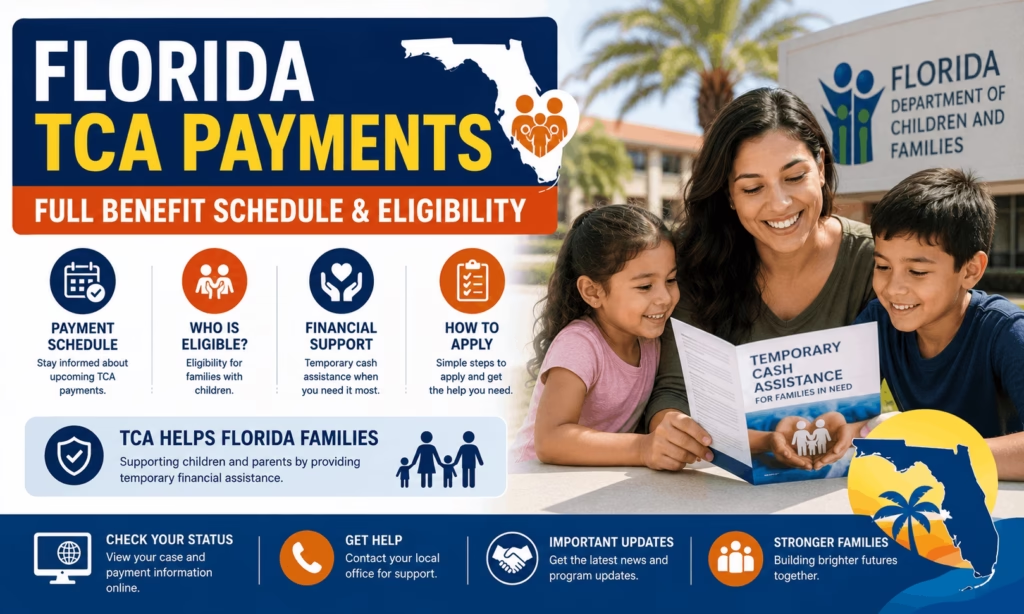
TANF Cash Help Assistance September 2026: Families waiting on their TANF payment schedule by state this month will not all see money land on the same day, and that is by design, not by accident. Temporary Assistance for Needy Families, widely known as TANF, is a federal block grant that each state, the District of Columbia, and dozens of tribal governments run through their own local rules. There is no single national deposit date the way there is for Social Security. Instead, most states either post cash aid in the first few days of the month, or stagger deposits across a window based on the last digit of a case number, the last digit of a Social Security number, or the first letter of a recipient’s last name.
The bigger story behind this month’s payments is the calendar sitting over the entire program. Congress has only funded TANF through December 31, 2026 under the Consolidated Appropriations Act, 2026 (P.L. 119-75), which means lawmakers will need to act again before the end of the year just to keep the block grant running into 2027. At the same time, states are already telling recipients to prepare for structural changes on the horizon, including the District of Columbia’s plan to end benefits for households on the program for more than 60 months and to nearly quadruple its failure-to-work sanction, both starting October 1, 2027. We’ll be updating this article monthly as new payment dates, funding decisions, and state policy changes are confirmed.
Because TANF is state-administered, the program goes by different names depending on where a family lives. California calls it CalWORKs. Other states simply call it cash assistance or public assistance. Whatever the label, the underlying federal purpose is the same: monthly cash support for low-income families with children, paired with work and training requirements meant to move parents toward self-sufficiency. This guide breaks down how the deposit schedule works this month, what current benefit amounts look like across states, how to apply, how long processing typically takes, and what to watch for as the federal funding clock ticks down.
TANF Cash Help Assistance September 2026 Key Highlights
| Detail | Current Status |
|---|---|
| Program name | Temporary Assistance for Needy Families (TANF) |
| Administered by | HHS Administration for Children and Families (ACF), Office of Family Assistance, through state and tribal agencies |
| Federal funding authority | Extended through December 31, 2026 under P.L. 119-75 |
| Annual federal block grant | $16.4 billion to states, DC, and tribes combined |
| Typical deposit window | 1st through 15th of the month, varies by state |
| Common scheduling method | Last digit of case number, last digit of SSN, or first letter of last name |
| Upcoming holiday affecting timing | Labor Day, September 7, falls before most deposit windows open this month |
| Notable 2027 change announced | DC will end TANF for households over 60 months and raise its work sanction from 6% to 25%, effective October 1, 2027 |
| Federal lifetime limit | 60 months, with state hardship extensions allowed for up to 20% of caseload |
What Is TANF?
TANF was created under the Personal Responsibility and Work Opportunity Reconciliation Act of 1996, replacing the older Aid to Families with Dependent Children program. It is not solely a cash program. States can use TANF and their required state match, known as maintenance of effort funding, for direct cash assistance, child care subsidies, job training, short-term emergency aid, and services for families at risk of child removal. The TANF payment schedule by state only governs the direct cash assistance portion, which is what most applicants think of when they picture the program.
Unlike Social Security or SSI, TANF funding has stayed essentially flat at the federal level since 1996. States have absorbed rising costs on their own, which is part of why some states, including DC, are now proposing structural changes rather than simply extending the program as-is.
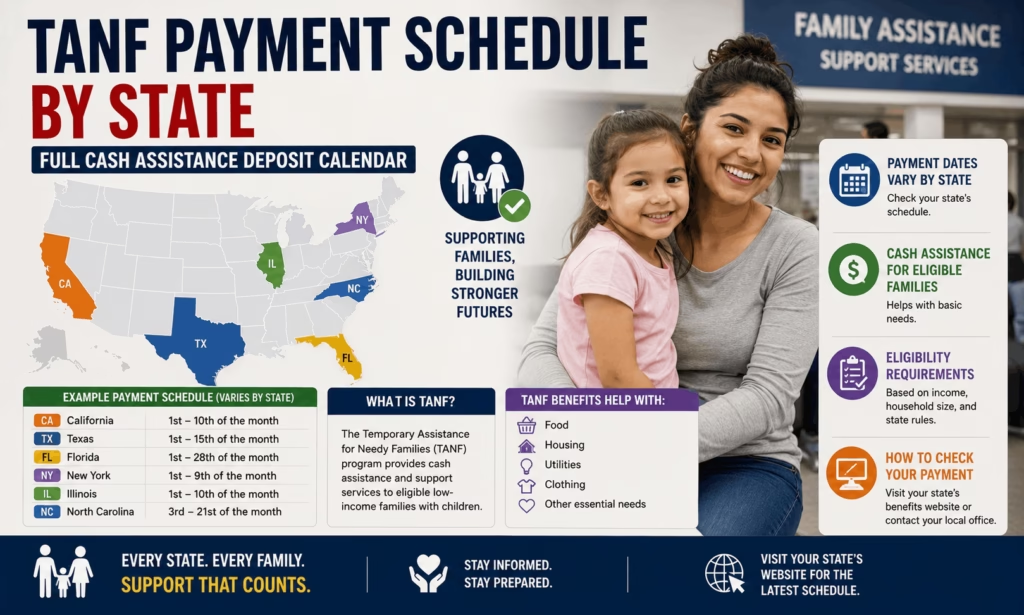
TANF Payment Schedule By State This Month
Below is how the major state systems are currently structured. Always confirm your exact date with your state or county agency, since local rules and caseworker notices override any general schedule.
| State | Program Name | How Deposit Date Is Determined | Typical Window |
|---|---|---|---|
| California | CalWORKs | Uniform early-month deposit for all cases, not tied to case number | 1st through 3rd |
| Texas | TANF, tracked by Eligibility Determination Group (EDG) | EDG number assigned at approval | Spread across the month, check Your Texas Benefits account |
| New York | Cash Assistance | Next-to-last digit of case number, sometimes called the “toe digit” | 1st through 9th |
| Florida | Temporary Cash Assistance | Last digit of case number | First three days of the month |
| Ohio | Ohio Works First | Case number based stagger | 1st through 15th |
| Pennsylvania | Cash Assistance | Case number based stagger | 2nd through 27th |
| North Carolina | Work First Family Assistance | Last digit(s) of Social Security number | 3rd through 27th, odd-numbered days |
| Illinois | TANF | Case number based stagger | First half of the month |
| Arizona | Cash Assistance | First letter of last name | Staggered across early month |
| Washington, DC | TANF | Fixed monthly cycle through EBT | Early month, subject to policy changes starting October 2027 |
If your state is not listed here, the same three systems generally apply somewhere in your state’s rules: a fixed date for everyone, a case-number stagger, or a name or SSN-based stagger. Your approval notice, sometimes called a Notice of Action, will state your specific deposit day.
10 New Canada Immigration Changes And Updates In September 2026
How States Choose A Deposit Method
There are three main scheduling models used across the country, and understanding which one your state uses makes it much easier to predict your own date without waiting on hold with a call center.
The first model is a fixed date for everyone. A handful of states simply pick one or two days near the start of the month, such as the 1st through the 3rd, and every eligible household is paid within that same window regardless of case number. California’s CalWORKs program is a well-known example of this approach, largely because rent and housing costs are typically due at the start of the month and the state wants cash assistance available before those bills come due.
The second model is a case-number stagger. Under this system, the state assigns each household a deposit day tied to the last digit, or sometimes the last two digits, of the case number issued when the application was approved. This spreads processing and ATM or point-of-sale traffic across several days instead of concentrating it all on one date, which reduces system strain and long lines at the start of the month. Texas, Ohio, Pennsylvania, and New York all use variations of this model, though the exact digit used and the length of the deposit window differ from state to state.
The third model relies on a personal identifier other than the case number, most often the last digit of a Social Security number or the first letter of a household’s last name. North Carolina is a commonly cited example of an SSN-based system, while Arizona and a small number of other states use the first-letter-of-last-name approach instead.
None of these systems is inherently faster or slower than another. They exist mainly to smooth out processing volume for the state agency, not to reward or penalize any particular household. If you have moved between states, do not assume your new state uses the same method as your old one, since even neighboring states frequently use different scheduling rules.
Why Your Deposit Date Might Shift This Month
Labor Day falls on September 7, 2026. Because that date lands early in the month, it generally will not push back deposits scheduled for the 1st through the 6th, but any state that would normally issue on the holiday itself typically moves the deposit to the prior business day. States that stagger deposits later in the month are not affected by this particular holiday. If your scheduled day ever falls on a weekend, most states either pay on the prior business day or, for automated EBT systems, still load the deposit exactly on schedule at midnight regardless of the day of the week. Confirm your state’s specific holiday policy since it is not standardized nationally.
The Federal Funding Deadline Families Should Watch
The most important background fact behind this month’s payments has nothing to do with any single state’s calendar. It is the federal law that keeps the entire TANF block grant running in the first place. TANF has not received a full, long-term reauthorization from Congress since the Deficit Reduction Act of 2005 extended it through the end of FY2010. Every extension since then has been short-term, and the current one, the Consolidated Appropriations Act, 2026 (P.L. 119-75), only carries the program through December 31, 2026.
That means lawmakers will need to pass another extension, or a full reauthorization, before the calendar turns to 2027 in order to avoid a lapse in the $16.4 billion state family assistance grant that funds cash aid nationwide. Bills such as the Protect TANF Resources for Families Act have been introduced in the current Congress proposing a longer, multi-year reauthorization window, but as of now no long-term deal has been finalized. Families should not expect an interruption in this month’s payment because of this deadline, since states typically continue operating on existing funds even during short gaps in federal reauthorization votes, but it is worth tracking heading into the fourth quarter of the year, particularly if government funding negotiations become contentious closer to the deadline.
Looking Ahead: State-Level Policy Changes Already Announced
While the federal funding deadline sits at the end of this year, some states are already telegraphing structural changes to how their TANF programs will operate afterward. The District of Columbia has been the most specific so far, confirming that beginning October 1, 2027, it will align its program more closely with the federal 60-month structure by ending benefits for households that have received TANF for 60 months or longer, unless a hardship extension applies. At the same time, DC plans to raise its failure-to-work sanction from 6% to 25% of the family’s grant for work-eligible households that do not meet participation requirements.
DC officials have pointed to a 48% increase in program costs since 2020, with a projected additional $11 million in growth for the current fiscal year, as the primary driver behind the change. A TANF Hardship Policy Working Group has been meeting with recipients and community partners to shape a hardship policy expected to be released this fall, and DC’s Department of Human Services is encouraging work-eligible households to connect with their TANF Employment and Education Program provider now to build a Detailed Individual Responsibility Plan before the change takes effect. Other states have not announced comparably specific timelines yet, but the pattern of flat federal funding against rising program costs is not unique to DC, so similar announcements in additional states would not be surprising as 2027 approaches.
Current TANF Benefit Amounts By State
Benefit amounts are set entirely by each state, and there is no federal minimum or maximum. That produces enormous variation nationwide for the same size household. The figures below reflect a single-parent family with two children.
| State | Approximate Monthly Benefit (Family of Three) |
|---|---|
| California | Among the highest in the country, generally $900 to $1,200 |
| New Hampshire | Among the highest in the country, generally $900 to $1,200 |
| Alaska | Among the highest in the country, generally $900 to $1,200 |
| Alabama | Around $215 |
| Georgia | Around $280 to $300 |
| Oklahoma | Around $300 |
| Arkansas | Around $300 |
| Florida | Roughly $300 to $400 |
States near the bottom of this range have not raised benefit levels significantly in years, while a handful of states apply automatic cost-of-living adjustments. Because the gap is so wide, a family relocating between states can see its monthly cash assistance change dramatically even with identical household circumstances.
TANF Versus Other Cash Benefit Programs
Recipients sometimes confuse TANF with SNAP, Social Security, or state-specific programs that share an EBT card, so it helps to be clear about what TANF is not. TANF is not a food benefit, that role belongs to SNAP, which many states now issue through an agency renamed the Food and Nutrition Administration at the federal level. TANF is also not a retirement or disability program, which are handled separately through Social Security and SSI. A single household can qualify for TANF, SNAP, Medicaid, and housing assistance at the same time, and in many states those benefits load onto the same physical EBT card even though each program keeps its own eligibility rules, its own benefit calculation, and, importantly, its own deposit schedule. Do not assume that because your SNAP benefit arrived on a certain day, your TANF cash assistance will follow the same timing that same month.
Eligibility And Work Requirements
Eligibility depends on income, household size, and citizenship or immigration status, layered on top of each state’s own additional rules. Work-eligible adults are generally required to participate in approved activities such as job search, vocational training, or subsidized employment. In many states, single parents with a child under age six face a reduced work requirement, often around 20 hours per week, while other work-eligible adults may face requirements closer to 30 hours per week. States that fail to meet federally required work participation rates can face funding penalties, which is part of why some states are tightening their own sanction policies rather than risk losing federal money.
The federal lifetime limit for TANF cash assistance is 60 months, though states may extend benefits beyond that limit for up to 20% of their caseload through hardship exceptions. The District of Columbia’s newly announced hardship policy, expected to be finalized this fall, is a direct response to this rule as the city prepares to enforce the 60-month cutoff starting October 1, 2027.
1% Remittance Transfer Tax: What It Actually Covers, and Why Enforcement Is Still Catching Up
$4427 EITC Payment: How to Know If You Qualify and When Will You Get It?
How To Apply For TANF
- Contact your state or county human services agency, or apply through your state’s online benefits portal.
- Gather proof of identity, income, household size, residency, and citizenship or immigration status for every household member.
- Complete an interview, either in person, by phone, or virtually depending on your state’s current process.
- Sign any required work participation or responsibility agreement, since most states require this before benefits are approved.
- Wait for a written eligibility decision, known in most states as a Notice of Action.
Application portals and required documents vary by state, so check your own state agency’s page before starting, since some now require online pre-screening tools before you can submit a full application.
Processing Time
Federal rules require states to make an eligibility decision within 45 days of a completed application in most cases, though many states process TANF applications faster, often within two to four weeks, when documentation is submitted promptly. Delays are most common when income verification, immigration status documents, or a required work-related interview are missing or incomplete. If your application is approved, your first payment does not always follow the standard monthly schedule. Many states issue an initial payment shortly after approval, then move the case onto the regular monthly cycle the following month.
What To Do If Your Payment Is Late
First, confirm that your scheduled date has actually passed based on your state’s system, whether that is a case-number stagger, an SSN-based stagger, or a fixed date. Then check your EBT balance through your state’s card issuer phone line or online portal for any recent transaction or deposit activity. Review your case for any pending notices, since a missed work activity, an incomplete redetermination, or an unreported income change can delay or reduce a scheduled payment. If the deposit still has not appeared after your state’s posted grace period, contact your caseworker or county office directly rather than waiting for the next cycle.
Official TANF Resources
| Resource | What It’s For | Link |
|---|---|---|
| ACF Office of Family Assistance | Federal TANF program overview and state data | acf.gov/ofa |
| State TANF Data and Reports | Caseload, spending, and work participation data by state | acf.gov/ofa/programs/tanf/data-reports |
| Benefits.gov | General benefits screening and program directory | benefits.gov |
| Your Texas Benefits | Texas application, login, and status check | yourtexasbenefits.com |
| BenefitsCal | California CalWORKs application, login, and status check | benefitscal.com |
| DC Cash Assistance Program | District of Columbia TANF applications and updates | dhs.dc.gov/page/cash-assistance |
| Congress.gov TANF Primer | Federal funding law and policy background | congress.gov/crs-product/R48413 |
FAQs
Is TANF paid on the same date in every state?
No. Each state sets its own TANF payment schedule by state, and there is no single federal deposit date the way there is for Social Security.
What is the difference between TANF and SNAP payment dates?
They are separate programs with separate schedules, even when both benefits load onto the same EBT card. A TANF deposit and a SNAP deposit for the same household can arrive on entirely different days.
How long does it take to get approved for TANF?
Most states are required to issue a decision within 45 days, though many approve or deny applications faster when documentation is complete and no interview delays occur.
Will TANF still exist after December 31, 2026?
The program’s current funding authority runs through that date under P.L. 119-75. Congress has extended TANF repeatedly since 2010 through short-term measures, and another extension or reauthorization would be needed to continue the program into 2027 without interruption.
Does TANF count as income for other benefits?
TANF cash assistance is generally counted as unearned income when determining eligibility for other means-tested programs, though exact treatment depends on the specific program and state.
Can I still get TANF if I have been on it for more than 60 months?
In most states, no, unless you qualify for a state hardship extension. The federal limit is 60 months, and states may extend benefits for up to 20% of their caseload under hardship rules.
People Also Ask
What day does cash assistance get deposited?
It depends entirely on your state’s system. Some states use a fixed early-month date for everyone, while others stagger deposits based on a case number, Social Security number, or last name.
How much is TANF a month for a family of 3?
Amounts vary widely by state, ranging from roughly $215 in the lowest-paying states to over $1,000 in the highest-paying states for a single-parent family with two children.
Why did my TANF payment come late this month?
Late payments are usually tied to a pending redetermination, an unreported income change, a missed work activity requirement, or a holiday shifting the standard deposit date.
Can TANF benefits be cut off without notice?
States are generally required to send a written notice before reducing or ending benefits, though the required notice period varies by state and by the reason for the change.
Conclusion
The TANF payment schedule by state will keep varying widely this month and every month, because the program was built from the start to give states control over both benefit amounts and deposit timing. What has changed recently is the backdrop those schedules sit inside: a federal funding authorization that only runs through the end of this year, and early signals from states like DC that structural changes to time limits and work sanctions are coming as soon as October 2027. Families relying on TANF should confirm their own state’s exact deposit date directly with their caseworker or state portal, keep documentation current to avoid processing delays, and watch for federal funding news as the December 31 deadline approaches. This article will be updated monthly as new payment dates and policy developments are confirmed.
H-1B Spouse Work Permit at Risk: How Trump’s Latest Move Could Cut Family Incomes in Half
80% to 100% VA Disability: Why the Final Jump Is the Hardest One Veterans Face
FY2027 Government Shutdown Risk: Congress Races the September 30 Funding Cliff