Texas $1500 Checks: Texas has never really been in the business of mailing checks to its residents. There’s no state income tax, no ready-made list of who lives where, and a constitution that’s wary of handing public money straight to individuals. So when Gina Hinojosa promised on the campaign trail to send every Texas household $1,500, plenty of people treated it as a campaign line. Then, on November 9, it became a bill.
State Sen. Roland Gutierrez, a San Antonio Democrat, filed Senate Bill 297 on the first day of pre-filing for the 2027 session. It was one of more than 1,000 bills filed that Monday, but it may tell us more than any of them about how the next two years in Austin will go. The money exists. The path to passage is another story. Here’s where things stand as of mid-November 2026.
Texas $1500 Checks – How we got here
Hinojosa floated the idea in July, when she was still the Democratic nominee chasing Gov. Greg Abbott. Her pitch was simple: Texas is sitting on a mountain of cash in its rainy day fund, families are getting squeezed by rent, groceries, insurance and electric bills, so give some of it back. She accused Abbott of “hoarding” the money and branded the plan a “Corruption Tax Refund.” Her campaign argued the state needs only about $10 billion in reserve, which would free up $17 billion to return to households.
It worked, or at least it didn’t hurt. On November 3, Hinojosa beat Abbott, becoming the first Democrat elected governor of Texas in more than 30 years and the state’s first Latina governor. Democrats also flipped the Texas House, and James Talarico beat Ken Paxton in the U.S. Senate race. Democrats won every statewide seat on the ballot, ending a Republican run of about 24 years.
In a post-election interview with The New York Times, Hinojosa called the check idea “a very popular position.” Now she has to find out whether it’s popular with the people who actually have to vote on it.
What SB 297 actually says
Pulling from reporting based on the bill text on the Texas Legislature’s website, a few details stand out.
The money. The bill appropriates $17 billion from the Economic Stabilization Fund, the formal name for the rainy day fund, and lets up to 1% go toward administrative costs.
The payment. One-time, $1,500, per household rather than per person. Someone living alone gets one payment. Roommates sharing an apartment get one between them, related or not.
Who qualifies. A household must have its usual residence in Texas on January 1, 2027, and the person representing it must be at least 18 or an emancipated minor. Eligibility can’t depend on income, employment, homeownership, property taxes or whether anyone files a tax return. The bill also says nothing about citizenship or immigration status, which has already become the most contested detail in the whole proposal.
How checks would go out. The comptroller’s office would have to build a distribution system from scratch. With no income tax, Texas has no database of every household and its bank account. The agency could use information “lawfully available” to it or other state agencies, and residents could apply directly with something like a lease or utility bill. Reporters noted it isn’t clear whether households the state identifies as eligible would be paid automatically. The comptroller would also have to find a way to reach Texans without a permanent address.
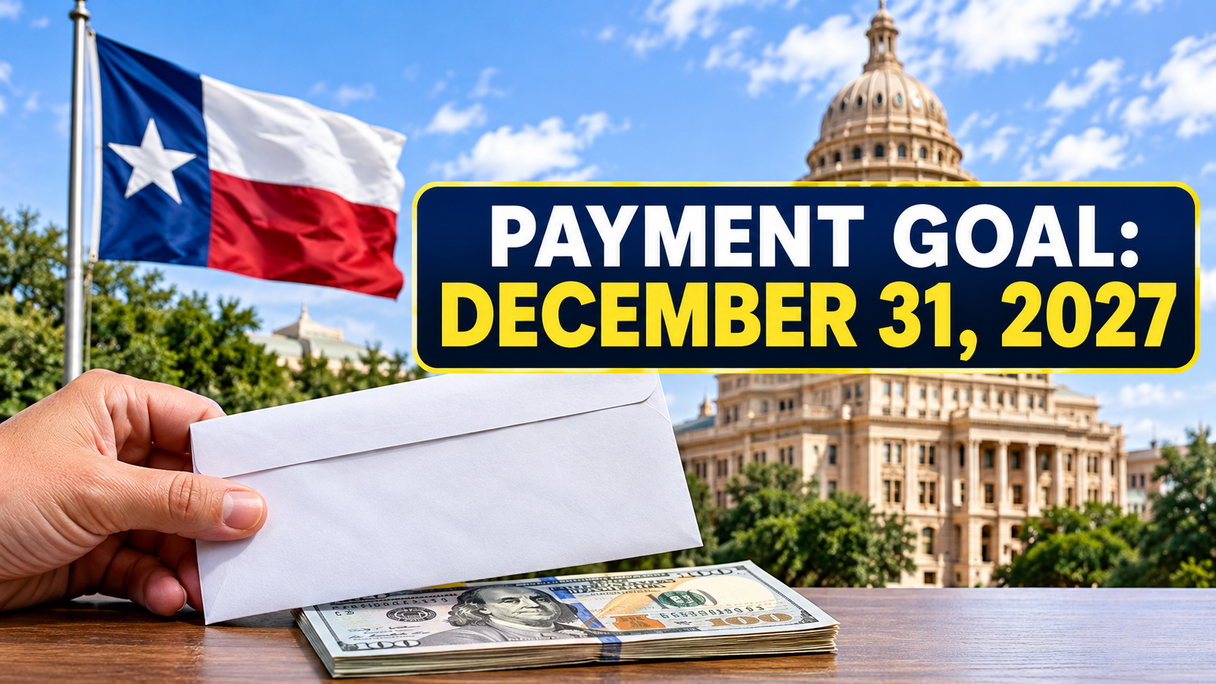
The timeline. The aim is to issue payments by the end of 2027, with applications open through the end of 2028. That’s a target, not a promise.
The legal hook. Texas law generally bars the Legislature from granting public money to individuals, with an exception for a “public calamity.” The bill declares a statewide “household affordability emergency,” driven by higher housing, food, electricity, transportation and insurance costs, to be exactly that. Whether a court would buy it is, as the Texas Tribune put it, unclear.
How much is in the rainy day fund?
The fund was created in 1988 after an oil bust and recession forced the state to raise taxes. It’s fed largely by oil and natural gas severance taxes, and it’s bigger than it has ever been. The comptroller’s Biennial Revenue Estimate projected the fund would hit its constitutional cap for the first time at the start of fiscal 2026, with no new transfers in the 2026-27 budget period and a projected fiscal 2027 ending balance near $28.5 billion. The comptroller’s fiscal 2026 cash report put the balance at $27.5 billion, up $2.7 billion. Earlier this year the Tribune cited a record $24.8 billion as of November 2025. Those are snapshots from different dates, not contradictions.
Either way, $17 billion is a big bite, roughly 60 percent of the projected balance. Critics say that leaves Texas exposed if a hurricane, freeze or recession hits. Supporters answer that the fund is already at its cap and can’t take in more under current law, and that about $10 billion would still remain. There’s also a math problem inside the bill. Texas has roughly 11.6 million households. At $1,500 each, plus up to 1% for administration, $17 billion falls at least $400 million short, according to the Tribune’s analysis.
The bill doesn’t authorize spending beyond the $17 billion, so if the money runs out, the comptroller would have to report the shortfall to state leaders. Somebody either doesn’t get paid or the Legislature goes back for a second withdrawal.
The vote count is the real story
Withdrawing from the rainy day fund for this purpose takes a two-thirds vote of the members present in each chamber. That’s a high bar anywhere. In a divided Legislature it’s a steep one.
Democrats won the House with somewhere in the high 70s out of 150 seats, depending on the tally. A two-thirds vote of a full chamber is 100, so by my rough arithmetic they’d need more than twenty Republicans to cross over. The Senate is tougher. Republicans hold it 19-12, and with all 31 senators present, two-thirds is 21. Democrats would need to peel off nine Republicans, the number the Tribune cites. Lt. Gov.-elect Vikki Goodwin, a Democrat, will preside over the chamber, but how much power she has depends on the rules the Republican senators adopt in January.
The Tribune’s assessment was blunt: getting Republicans on board will be “difficult if not impossible.” GOP lawmakers have favored property tax cuts and have criticized direct payments before. The politics are awkward on both sides. In September, President Trump pledged $5,000 for every adult if Republicans held Congress, and Democrats called it a bribe. Now Democrats are the ones proposing checks.
I couldn’t find an on-the-record response to SB 297 from Lt. Gov. Dan Patrick or Abbott. The loudest pushback so far has come from conservative outlets, which have focused on the missing citizenship requirement and the drain on reserves.
The inflation argument
Not every objection is partisan. John Diamond, a senior director at Rice University’s Baker Institute for Public Policy, told the Tribune that $1,500 checks could fuel demand and push prices up. He pointed to research suggesting the $1,400 federal checks in 2021 contributed to inflation, partly because they arrived while supply chains were still jammed. He kept it in perspective: $17 billion isn’t a massive amount against a roughly $2.9 trillion Texas economy, but it could still create some pricing pressure. “You really don’t want to add any fuel to the fire,” he said.
Hinojosa pushed back in an August interview, saying economists who vetted the idea told her a one-time state payment of this scale wouldn’t behave like the big federal stimulus checks. Both can be true. This is not trillions in pandemic spending, but it isn’t nothing either, especially in tight housing markets.
What $1,500 means, and who gets it
For many Texas families it’s real money. The Tribune noted that $1,500 covers all or a big chunk of the typical monthly rent in many Texas metros, going by Zillow data. It could pay for a car repair or a few months of electric bills.
It’s also a one-shot. Nothing in the bill repeats it or fixes why costs are high, which is the standard critique from economists and Republicans alike: structural relief like property tax cuts, housing supply or utility reform lasts longer than a check. Democrats answer that people are hurting now and the money is sitting right there. And because there’s no income cap, a wealthy Austin household gets the same payment as a family in the Rio Grande Valley. That keeps the program simple and hard to paint as a handout to one group, but a lot of the money would go to people who don’t need it.
The citizenship fight
If one detail defines the debate, it’s this one. The bill doesn’t expressly require citizenship or lawful immigration status. The Tribune flagged it as a likely flashpoint, and outlets like Breitbart and Texas Scorecard have run headlines saying it could send checks to people in the country illegally. Neither Gutierrez’s office nor Hinojosa’s team had answered the Scorecard’s question about whether the omission was intentional.
Supporters could argue it’s a household relief program that relies on residency documents, like many state and local programs. Opponents will say that in a state where border politics dominate, a program with no citizenship check is a nonstarter, and that the omission alone could cost votes from moderate Republicans. It’s the kind of thing that could get amended in committee, if the bill ever gets there. As of November 11, the Legislature’s tracking site showed SB 297 as filed and received by the Senate secretary on November 9, with no committee referral and no vote.
What happens next
The 90th Texas Legislature convenes January 12, 2027. Bill filing runs through March 12, and the session ends at the end of May. Lawmakers meet for only 140 days every two years, so a bill that isn’t moving by spring is probably dead. Watch for four things. First, whether the Republican-run Senate even gives SB 297 a hearing. Second, whether a companion bill starts in the Democratic House and gets a cleaner vote.
Third, whether amendments such as a citizenship requirement, an income cap or a smaller appropriation change the Republican math, at the risk of upsetting parts of the Democratic coalition. Fourth, the state budget, which originates in the House this session and could turn the check into a bargaining chip. And if it did pass, the “public calamity” theory could still land in court.
It’s also quite possible this is partly about the vote and not the check. The Tribune observed that if the proposal dies for lack of GOP support, Democrats get a message: Republicans had a chance to put money in people’s pockets and didn’t. With a divided Legislature, much of the next two years may look like that, each side offering what the other can’t accept, then arguing over whose fault it is.
No household payments have been authorized. Nobody in Texas should expect a $1,500 check or apply for anything. SB 297 is a filed bill, not a law, and it faces a steep climb that includes a two-thirds vote in a Senate where Democrats are badly outnumbered. But it’s a serious proposal with real numbers behind it, from a governor-elect who made it a centerpiece of a winning campaign. The state has the money on paper. The open questions are whether lawmakers will use it this way, whether it’s legal, whether it would cause more inflation than it relieves, and whether voters will hold Republicans accountable if they say no.
We’ll know more in January 2027.
FAQ’s about Texas $1,500 Household Relief Proposal
Is the $1,500 payment approved?
No. As of mid-November 2026, Senate Bill 297 has only been filed. It had no committee referral and no vote as of November 11, and no payments have been authorized. Nobody should apply for anything yet.
Who proposed it?
Gov.-elect Gina Hinojosa, a Democrat, made it a campaign pledge. State Sen. Roland Gutierrez, D-San Antonio, filed SB 297 on November 9 to carry it out.
How much would each household get, and how often?
A one-time payment of $1,500 per household, not per person. Roommates sharing a home would receive one payment between them.
Where would the money come from?
$17 billion from the Economic Stabilization Fund, known as the rainy day fund. The comptroller’s cash report put the fund at $27.5 billion for fiscal 2026, and the state projects about $28.5 billion by the end of fiscal 2027.
Who would qualify?
A household must have its usual residence in Texas on January 1, 2027, and be represented by an adult or an emancipated minor. The bill bars conditions based on income, employment, homeownership, property taxes or tax filing. It doesn’t mention citizenship or immigration status.
When would payments go out?
The target is the end of 2027, with applications open through the end of 2028. That is a goal, not a guarantee.
What has to happen for it to pass?
Both chambers of the Legislature must approve it, and tapping the rainy day fund takes a two-thirds vote of members present in each chamber. Democrats control the House but Republicans hold the Senate 19-12, so Democrats would need about nine Republican senators. The session begins January 12, 2027.
Is it legal?
Unclear. Texas generally bars giving public money directly to individuals, with an exception for a “public calamity.” The bill declares the affordability crisis one, but no court has tested that.
Would it cause inflation?
Economists disagree. John Diamond of Rice University’s Baker Institute says it could add some price pressure, though $17 billion is small against the state’s economy. Hinojosa says a one-time state payment wouldn’t act like the federal stimulus checks.
Is $17 billion enough?
Probably not quite. Texas has about 11.6 million households, so the bill falls at least $400 million short, according to the Texas Tribune.
Could this change before it becomes law?
Yes. Possible changes include a citizenship requirement, an income cap or a smaller appropriation.