By GovtSchemes.org Editorial Team | Last updated: October 21, 2026
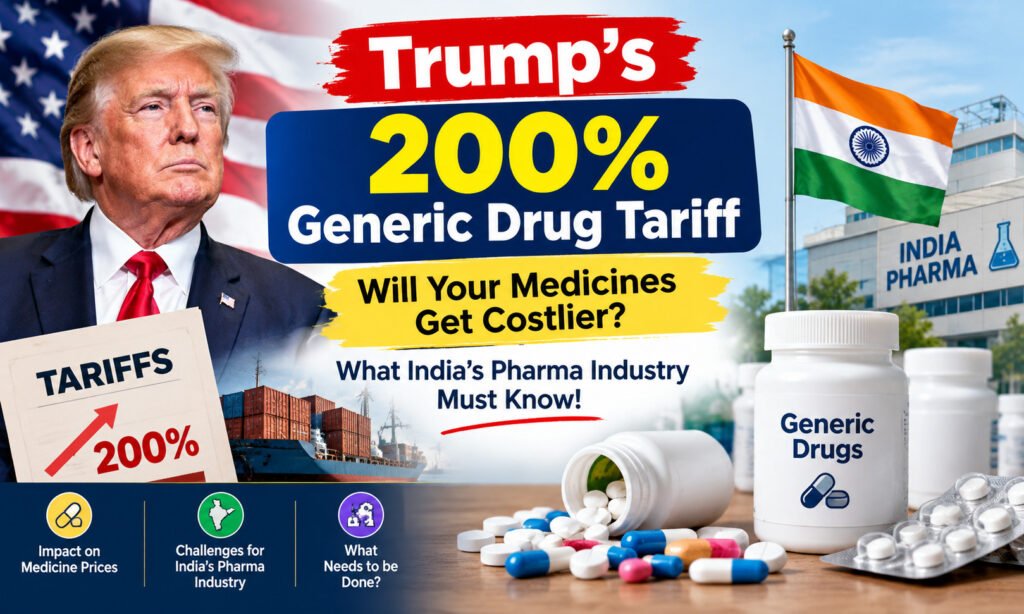
Headlines about a “200% tariff on generic drugs” sound like an immediate shock. They are not. The plan announced in July 2026 is a three-stage schedule that starts at zero and does not reach 100% until August 2028. This guide separates what is actually in force today from what is only a plan, shows who is exposed, and covers the newest developments, including a separate Indian decision on cancer drug prices that matters to patients right now.
The Short Answer
- Today: Generic medicines enter the United States with no new tariff. They are excluded from the Section 232 pharmaceutical tariffs for now.
- The plan: Generics stay at 0% for two years from August 1, 2026, then 100% for one year, then 200%.
- Is it law? As of this update we could not find a published proclamation or rule that turns the plan into law. It started as a social media post, so details can still change.
- Indian patients: There is no direct price effect in India from a US import tariff.
- Indian exporters: The risk is real but sits two years away, and negotiations are still open.
What Was Announced
On July 21, 2026 in the US (July 22 in India), President Trump posted on Truth Social that generic drugs entering the United States would keep a zero tariff for two years from August 1, 2026. After that, the rate would rise to 100% for one year and to 200% after that. He said the goal is to bring generic drug production back to the US, with a penalty for companies that do not build plants and equipment within the time given. He added that the policy on patented, branded and innovative drugs would stay as it is.
| Period | Tariff on imported generics | Status |
|---|---|---|
| August 1, 2026 to July 31, 2028 | 0% | Current position |
| August 1, 2028 to July 31, 2029 | 100% | Announced, not in force |
| From August 1, 2029 | 200% | Announced, not in force |
What Is Actually in Force Right Now
It is easy to mix up two separate US actions, so here they are side by side.
1. The patented-drug tariff (in force). A proclamation signed on April 2, 2026 under Section 232 sets a 100% tariff on most patented pharmaceuticals and related ingredients. It applied from July 31, 2026 to the large companies named in an annex, and from September 29, 2026 to all other importers. Companies with a Commerce-approved plan to manufacture in the US can qualify for a 20% rate, which rises to 100% on April 2, 2030.
2. The generic-drug plan (not in force). The same proclamation excludes generics, biosimilars and their ingredients “at this time” and tells the Commerce Department to report within a year on whether tariffs on generics are needed. That points to a review around April 2027. The July announcement layers a timetable on top of that review, but we have not seen it written into a legal order.
One correction worth making: you may see claims that the branded-drug tariff has applied since October 2025. That was an announcement made in September 2025. The legal tariff came with the April 2026 proclamation.
Why India Is in the Spotlight
- India sent about $9.7 billion of pharmaceuticals to the US in 2025, roughly 38% of its $25.8 billion in global pharma exports, according to a Global Trade Research Initiative report.
- India is the largest foreign source of generic medicines for the US. Estimates of its share range from about 40% to as high as 47%, depending on whether volume, prescriptions or value is counted, so treat any single figure with care.
- Generics make up about 90% of US prescriptions, which is why a tariff on them reaches far beyond any one industry.
- Generic drugs are a thin-margin business. Pharmexcil, the Indian pharma export council, said its members cannot absorb 100% duty, let alone 200%.
How markets reacted
On July 22, pharma shares fell on the BSE. Aurobindo Pharma dropped about 4.1%, Glenmark 3.3%, Biocon 3.2%, Cipla 2.5%, Sun Pharma 1.9% and Dr Reddy’s 1.9%. The Nifty Pharma index slid roughly 2%. Analysts noted there is no earnings hit before 2028, so the fall reflected uncertainty rather than lost sales.
Trending Now: What Has Changed in the Last Few Weeks
1. India caps trade margins on 137 cancer drugs
This is the most relevant story for ordinary Indian families, and it is unrelated to the US tariff. India’s drug price regulator, the National Pharmaceutical Pricing Authority (NPPA), capped the trade margin at 30% on 137 non-scheduled anti-cancer formulations. According to a Ministry of Chemicals and Fertilisers statement reported on October 17, the cap takes effect on November 9, 2026, and retail prices could fall by up to 70% depending on the current price structure.
What the order requires:
- Manufacturers must publish revised price lists on their websites and share them with retailers and hospitals.
- Pharmacies and hospitals must charge the lower rates from November 9 and display them.
- Companies must keep production and supply at current levels so patients do not face shortages.
- Patients can check the new prices on the NPPA website and mobile app.
So for the question “will my medicines get costlier,” the honest picture is mixed: the US tariff plan does not raise Indian prices directly, and one major category of medicines is set to get cheaper.
2. India-US trade talks are still open
On the sidelines of the G20 trade ministers’ meeting in Milwaukee, Commerce Minister Piyush Goyal met US Trade Representative Jamieson Greer. Around the same time Prime Minister Modi and President Trump spoke by phone. India is trying to finalise an interim trade deal in line with a February 7, 2026 joint statement, but changes in the US tariff landscape have meant more rounds of talks. Generic drugs are part of what India wants protected, so any deal text is worth watching.
3. Indian drugmakers are widening their map
Analysts at GlobalData said in mid-October that Indian companies are looking harder at Europe, emerging markets and specialty medicines. The firm also estimates that Indian manufacturers account for roughly half of all generic drug applications (ANDAs) filed with the US Food and Drug Administration up to June 2026, which shows how deeply they are tied into the US system. The message was less about leaving the US and more about reducing dependence on a single market.
4. Patented-drug tariffs are now live for everyone
Since September 29, 2026 the 100% tariff on patented drugs applies to all importers, not just the largest companies. Indian industry leaders have said India’s exports are mostly generics and ingredients, which remain outside that tariff.
Will Medicines Get Costlier?
| Who | Effect | Why |
|---|---|---|
| Patients in India | No direct change from the US plan | The tariff is charged on imports into the US |
| Indian cancer patients | Prices set to fall from November 9 | Separate NPPA margin cap |
| US patients and pharmacies | Likely higher costs if tariffs start | Importers would pass on at least part of the duty |
| Indian drug exporters | Pressure from 2028 | Thin margins and a short window to build US plants |
| US drug supply | Shortage risk raised by analysts | Low-priced generics may become unprofitable to supply |
Can the Plan Really Work?
Several questions hang over it:
- Legal basis. A post is not a regulation. Watch for a proclamation, executive order or Federal Register notice.
- Time. Industry voices say two years is too short to move a generic supply chain to the US, since plants must be built, inspected and approved.
- Ingredients. Many US-made generics still depend on imported active ingredients, often from China. Reports differ on whether the plan would cover them.
- Bargaining. Trade experts see the schedule as leverage while talks continue, so the final shape may change.
What to Watch Next
- A formal legal document implementing the generic tariff plan.
- The Commerce Department’s generics review due around April 2027.
- Text of any India-US interim trade deal, especially on generics and ingredients.
- Announcements by Indian companies on US plants, partnerships or acquisitions.
- The November 9 start of the NPPA cancer drug price cuts and how quickly pharmacies show new prices.
Frequently Asked Questions
Is there a tariff on Indian generic medicines in the US right now?
No. Generic medicines, biosimilars and their ingredients are excluded from the Section 232 pharmaceutical tariffs for now, and they enter at 0%.
What exactly did Trump announce about generics?
A zero tariff for two years from August 1, 2026, then 100% for one year starting August 2028, and 200% from August 2029.
Has the 200% tariff become law?
Not as far as we could find. It was announced publicly, but we did not see a published proclamation or rule implementing it. Check the Federal Register for updates.
Will medicine prices rise in India because of this?
Not directly. The tariff applies to imports into the US. Separately, India’s NPPA has capped trade margins on 137 cancer drugs from November 9, which could lower their prices by up to 70%.
Which Indian companies are most exposed?
Companies with large US sales, such as Sun Pharma, Dr Reddy’s, Cipla, Lupin, Zydus Lifesciences and Aurobindo Pharma. Check each company’s latest filings for its exact US revenue share.
Does the plan affect branded and patented drugs?
No. Patented drugs fall under the separate 100% Section 232 tariff from the April 2, 2026 proclamation, and Trump said that policy stays unchanged.
What can Indian drugmakers do?
Build or buy US manufacturing, move toward complex generics and biosimilars, and expand sales in other regions.
Official Sources and Links
| Source | What you can find | Link |
|---|---|---|
| White House, Presidential Actions | Proclamations and executive orders, including the April 2, 2026 pharmaceutical proclamation | https://www.whitehouse.gov/presidential-actions/ |
| Federal Register | Official legal notices; check for any generic-drug tariff rule | https://www.federalregister.gov |
| Office of the US Trade Representative | Trade policy and India-US negotiation updates | https://ustr.gov |
| US Department of Commerce | Section 232 investigations and the generics review | https://www.commerce.gov |
| US Customs and Border Protection | Import duty guidance for importers | https://www.cbp.gov |
| US FDA, Generic Drugs | Facts on generic drug approvals and supply | https://www.fda.gov/drugs/generic-drugs |
| Truth Social (President Trump) | The original July 2026 post | https://truthsocial.com/@realDonaldTrump |
| Ministry of Commerce, India | India-US trade talks and export data | https://commerce.gov.in |
| Department of Pharmaceuticals, India | Indian pharma policy | https://pharmaceuticals.gov.in |
| National Pharmaceutical Pricing Authority | Revised cancer drug prices and price lists | https://nppaindia.nic.in |
| Press Information Bureau | Government of India statements | https://pib.gov.in |
| Pharmexcil | Indian pharma export council | https://pharmexcil.com |
| Indian Pharmaceutical Alliance | Industry body of Indian drugmakers | https://ipa-india.org |
Method and Sources
This article was written from public reporting on the Truth Social announcement, law-firm summaries of the April 2, 2026 proclamation, statements reported from the Indian government on the NPPA order and trade talks, and market data from the day of the announcement. Figures and quotes are paraphrased. Company-level US revenue shares are not listed because published numbers differ; please check company filings. Link addresses should be confirmed on each site before you rely on them.
This article is for information only and is not investment, legal or medical advice.