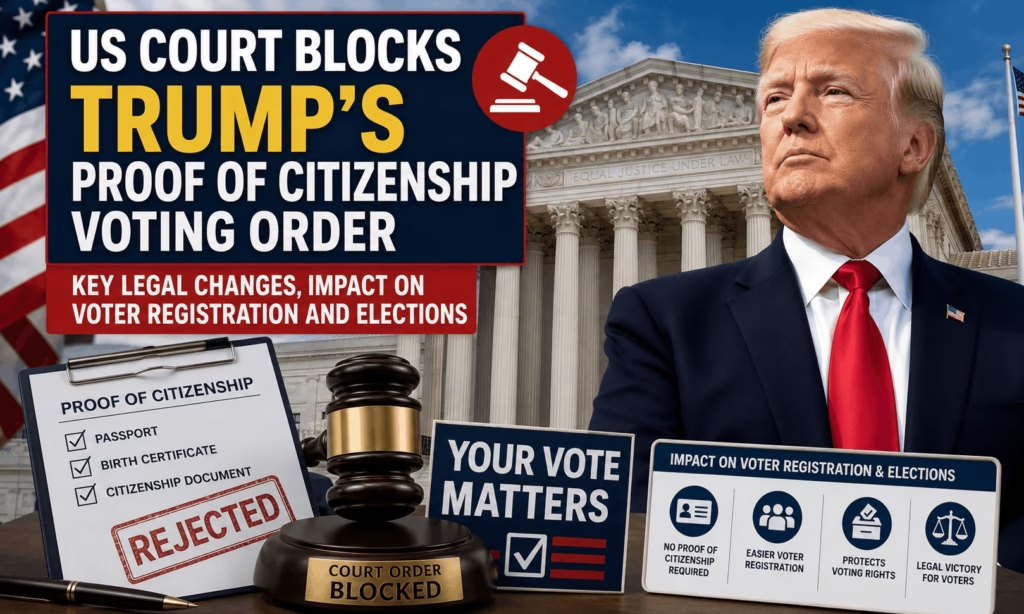
US Court Blocks Trump’s Proof of Citizenship Voting Order: A federal judge permanently blocked one of the Trump administration’s most contentious voting-related executive orders on June 25, 2026, when U.S. District Court Judge Denise Casper ruled that the president lacks constitutional authority to impose a documentary proof of citizenship requirement on federal voter registration. Just four days later, a second, separate voting rights case resolved the other major open question hanging over the 2026 midterms: on June 29, 2026, the U.S. Supreme Court ruled 5-4 in Watson v. Republican National Committee that states can continue counting mail-in ballots that arrive after Election Day, as long as they were postmarked on time — directly rejecting a Trump-aligned challenge to absentee ballot grace periods used in more than half the states.
Together, these two rulings resolve nearly every major legal question about federal election rules heading into the 2026 midterms. This guide brings both developments together with the newest Supreme Court decision that most earlier coverage of the voting order case could not yet include, since it was still pending at publication. Every fact is drawn from the court opinions themselves and official statements from the parties involved. We’ll be updating this article monthly as new legal developments occur.
Proof of Citizenship Voting Order 2026 Key Highlights
| Case | 19 State Attorneys General v. Trump Administration |
| Ruling date | June 25, 2026 |
| Judge | U.S. District Court Judge Denise Casper (Boston) |
| Ruling type | Permanent injunction (converted from prior preliminary injunction) |
| Executive order signed | Early 2025 |
| Constitutional basis | Elections Clause — states/Congress hold election authority, not the President |
| States that sued | 19, including CA, NY, MA, AZ, CO, IL, MI, NJ, WA-region coalition |
| Related Supreme Court mail ballot case | Watson v. RNC — decided June 29, 2026, 5-4 |
| Mail ballot ruling outcome | States CAN count ballots postmarked by Election Day, received later |
| Legislative alternative | SAVE America Act — passed House, stalled in Senate |
What Trump’s Executive Order Actually Proposed
The order attempted to overhaul federal election administration through three major provisions:
- Documentary proof of citizenship (passport or birth certificate) required to register to vote using the federal voter registration form.
- Mail-in ballots required to arrive by Election Day, eliminating grace periods currently allowed in 14+ states for ballots postmarked on time.
- Withholding federal funding from states that didn’t comply with either requirement.
The Court’s Three Core Findings
1. Presidential power doesn’t extend to elections. Judge Casper cited the Elections Clause, which assigns primary authority over federal election administration to states, subject to congressional — not presidential — oversight. She wrote that while the Constitution grants the president “executive Power,” it grants no specific authority over elections.
2. The administration couldn’t prove the fraud it claimed. The Department of Justice failed to substantiate claims of “widespread illegal voting” that supposedly justified the order — the court found no evidentiary support for the administration’s central premise.
3. Existing law already covers the concern. The federal voter registration form already requires a citizenship attestation under penalty of felony, undercutting the argument that documentary proof filled a genuine legal gap.
Who Brought the Case
Nineteen state attorneys general filed the lawsuit, including California, Nevada, Massachusetts, Arizona, Colorado, Connecticut, Delaware, Hawaii, Illinois, Maine, Maryland, Michigan, Minnesota, New Jersey, New Mexico, New York, Rhode Island, Vermont, and Wisconsin. California AG Rob Bonta and New York AG Letitia James both publicly framed the ruling as reaffirming that election authority belongs to states and Congress, not the presidency.
Major Update: Supreme Court Resolves the Mail Ballot Question
This is the biggest development since the voting order ruling, and it closes a gap that earlier coverage left open. On June 29, 2026, in Watson v. Republican National Committee, the Supreme Court ruled 5-4 to uphold a Mississippi law allowing mail-in ballots to be counted as long as they’re postmarked by, and received within five days of, Election Day — rejecting the argument that federal law requires ballots to be physically received by Election Day itself.
Key details of the ruling:
- Justice Amy Coney Barrett wrote the majority opinion, holding that federal “election day” statutes govern when voting must be completed, not when ballots must be received.
- The ruling crossed ideological lines: Barrett and Chief Justice Roberts joined liberal Justices Jackson, Kagan, and Sotomayor in the majority, while the Court’s other four conservative justices dissented.
- The decision reversed a 5th Circuit Court of Appeals ruling that had sided with Republican challengers.
- More than half the states plus Washington, D.C. permit mailed ballots to arrive and be counted some number of days after the election, provided they’re postmarked on time — and in roughly half of those states, the more forgiving deadlines apply only to military and overseas voters.
What this means practically: Because Judge Casper’s June 25 ruling already blocked the executive order’s attempt to eliminate these grace periods, and the Supreme Court’s June 29 ruling separately confirmed grace periods are lawful under federal statute, both legal paths that could have eliminated mail ballot grace periods for the 2026 midterms have now failed. States with existing grace periods can keep them in place for this year’s elections.
The Broader Legal Pattern: Three Consecutive Court Defeats
This ruling is the third judicial defeat for the voting order specifically:
- A federal judge in Washington, D.C. blocked the proof-of-citizenship requirement from being added to the federal voter registration form.
- The same judge later barred the Secretary of Defense from requiring documentary proof of citizenship for military voter registration.
- Judge Casper’s June 25, 2026 ruling delivered the permanent, nationwide injunction covering all 19 plaintiff states.
Trump’s Response: Pushing the SAVE America Act
Following the court defeats, Trump shifted focus to the SAVE America Act, the legislative version of the proof-of-citizenship requirement. It has passed the House but remains stalled in the Senate, where it needs 60 votes to overcome the filibuster and Republicans hold fewer than that threshold. Trump has publicly pushed for eliminating the filibuster to pass it — an escalation that a number of Republican senators have historically resisted. In a notable political move, Trump canceled the signing of an unrelated bipartisan housing bill, saying he wouldn’t sign it until Congress passed the proof-of-citizenship requirement.
What This Means for Voters in the 2026 Midterms
| Question | Current Status |
|---|---|
| Do I need to show a passport/birth certificate to register to vote? | No — blocked nationwide by permanent injunction |
| Will my mail ballot still count if it arrives a few days late (postmarked on time)? | Yes, in states with existing grace periods — confirmed by both rulings |
| Could Congress still pass a proof-of-citizenship law? | Possible in theory via the SAVE America Act, but currently stalled in the Senate |
| Should I confirm my state’s specific rules? | Yes — always verify directly through your state’s official election website |
Important Links
| Case Filings & Rulings: | courtlistener.com |
| Track SAVE America Act: | congress.gov |
| Federal Voter Registration Form: | eac.gov |
| State-by-State Election Rules: | vote.org |
| Supreme Court Opinions: | supremecourt.gov |
FAQs
Is proof of citizenship now required to register to vote?
No. Judge Casper’s June 25, 2026 ruling permanently blocked this requirement nationwide. The standard federal form, which requires a citizenship attestation under penalty of felony, remains unchanged.
Did the Supreme Court rule on mail-in ballots?
Yes — on June 29, 2026, in Watson v. RNC, the Court ruled 5-4 that states can count mail ballots postmarked by Election Day even if they arrive a few days later.
Does this affect the 2026 midterm elections?
Yes, directly. Both rulings preserve the status quo for the 2026 midterms — no new documentary proof requirement and no elimination of mail ballot grace periods.
Can Trump still get a proof-of-citizenship requirement passed?
Only through Congress now, via the SAVE America Act, which has passed the House but remains stalled in the Senate due to the filibuster.
Which states have mail ballot grace periods?
More than half of U.S. states plus Washington, D.C. allow some grace period for ballots postmarked by Election Day; voters should confirm their specific state’s rules through their official election website.
Who sued to block the proof-of-citizenship order?
Nineteen state attorneys general, led by a coalition including California, New York, and Massachusetts, among others.