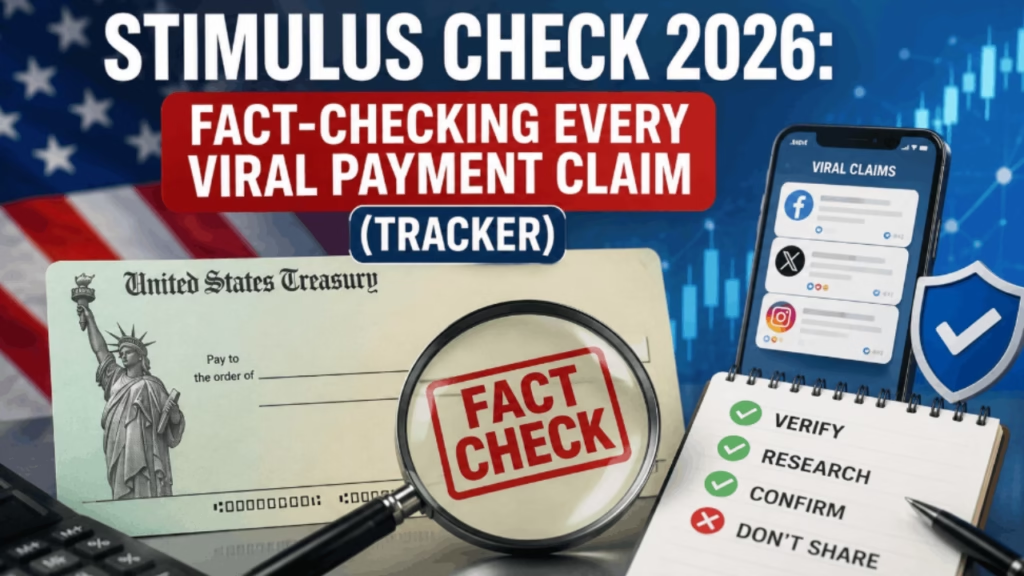
Stimulus Check 2026: If you’ve seen headlines about a stimulus check 2026 payment of $1,000, $2,000, $3,000, or more, you’re not alone search interest in federal stimulus 2026 claims has spiked repeatedly this year across social media, text messages, and clickbait news sites. This tracker exists to answer one question clearly: is any of it real? As of mid-2026, no new federal stimulus check has been approved by Congress or announced by the IRS. Every viral dollar figure circulating whether framed as a “tariff dividend,” a “direct deposit update,” or a “confirmed payment” traces back to informal proposals, state-level programs, or outright misinformation, not enacted law. This guide fact-checks every major stimulus check 2026 rumor in one place, sourced from official government statements and independent policy analysis.
Understanding the difference between a confirmed government payment and a viral stimulus rumor matters, because scams frequently exploit this exact confusion. Fraudulent texts and emails claiming to offer a “stimulus payment 2026” often ask for personal information or advance fees something the IRS and Treasury Department never do. Below, we break down the most-searched claims one by one: the $2,000 tariff dividend proposal, various $1,000–$3,000 payment rumors, Social Security dollar-figure claims often confused with stimulus payments, and direct deposit rumors all checked against what’s actually been passed into law.
Is There a Confirmed Stimulus Check 2026?
No. Multiple independent fact-checks confirm that no new federal stimulus payment has been authorized for 2026. The three rounds of pandemic-era stimulus payments issued between 2020 and 2021 — up to $1,200, $600, and $1,400 respectively remain the last federally authorized direct payments, and the deadline to claim any missed pandemic-era payment closed at the start of 2026. Congress has not passed legislation creating a fourth round.
The $2,000 “Tariff Dividend” Proposal — What’s Actually True
Much of the current stimulus speculation traces back to informal discussion of a $2,000 tariff dividend, an idea floated in connection with using tariff revenue to fund household rebates. This remains a proposal, not law no bill has passed Congress or been signed. Independent economic analysis has also raised serious doubts about its feasibility: one late-2025 estimate put the cost of a nationwide $2,000 payment between roughly $280 billion and $607 billion, depending on eligibility rules, while projected tariff revenue for 2025–2026 fell well short of that range. Several state governors have separately pursued their own state-level rebate efforts in response to tariff-driven price increases these are individual state actions, not a federal stimulus program.
The Supreme Court Ruling That Changed Everything
To understand why the $2,000 stimulus check 2026 claims keep resurfacing without ever materializing, it helps to know what actually happened at the legal level. On February 20, 2026, the Supreme Court struck down the tariffs imposed under the International Emergency Powers Act (IEEPA), ruling them unlawful. This decision didn’t create a consumer stimulus program it triggered the opposite: a refund process for the businesses and importers who had paid those tariffs.
In response, U.S. Customs and Border Protection launched a portal called CAPE (Consolidated Administration and Processing of Entries) to process refund claims from more than 330,000 importers. By mid-2026, roughly $166 billion in tariff revenue was in the refund pipeline, with tens of billions already transmitted to Treasury for disbursement. Crucially, these refunds go to the businesses that paid the tariffs importers like large retailers and manufacturers not to individual consumers. This is the single most misunderstood part of the entire stimulus rumor cycle: real money is moving, but not toward a $2,000 check in your mailbox.
Following the ruling, the administration invoked a different legal authority (Section 122 of the Trade Act of 1974) to reimpose a 10% tariff, with officials stating this was intended to keep tariff revenue roughly level for 2026. That tariff authority is time-limited and set to expire unless Congress acts to extend it another reason the underlying funding source for any consumer dividend remains legally uncertain.
Is There Actual Legislation for a Consumer Rebate?
As of 2026, one real legislative proposal exists that’s worth distinguishing from the informal “$2,000 dividend” talk: a bill called the Tariff Refunds for Working Families Act, introduced by a U.S. Senator, which would create a tax rebate for households affected by higher tariff-driven prices. As drafted, it would provide a payment of $1,200 to joint filers earning under $180,000 annually, plus $600 per dependent child, starting with the 2026 tax year. This is a genuine bill but it is still just introduced, not passed, funded, or signed into law. Financial analysts who track this closely have described the odds of any broad tariff-dividend program advancing as very low, citing a lack of sufficient political support and the risk that unfunded direct payments could add to inflation pressure.
Why the Math Doesn’t Support a $2,000 Check for Everyone
Independent economic analysis has repeatedly flagged a funding gap between what a $2,000-per-person program would cost and what tariff revenue actually generates. Estimates for the cost of a nationwide $2,000 dividend range from roughly $280 billion to $607 billion depending on eligibility rules, while projected tariff revenue for 2025 and 2026 combined falls well short of the amount needed to fund it while also being counted on to reduce the federal deficit. This funding shortfall is a core reason policy analysts consider the consumer-facing $2,000 dividend unlikely to become real, separate from the fact that no bill authorizing it has even been introduced, let alone passed.
Fact-Checking the $1,000–$3,000 Payment Claims
Search terms like “$3,000 stimulus payment July 2026,” “$1,000 stimulus payment 2026,” and similar variations have circulated widely, but none correspond to an actual authorized program:
- $3,000 stimulus claims: No legislation supports a $3,000 federal payment for 2026. This figure does not match any proposal currently before Congress.
- $2,000 stimulus claims: These generally trace back to the unresolved tariff dividend proposal described above an idea, not an approved payment.
- $1,000 stimulus claims: No confirmed federal program matches this amount either; some posts appear to reference state-specific rebates (such as Alaska’s program, discussed below) mischaracterized as national stimulus checks.
- $1,130 / $1,745 / $1,800 / $2,580 stimulus claims: These specific figures have no confirmed government source. Treat any post citing an oddly specific, unsourced dollar amount as a red flag rather than a verified fact.
Alaska’s Payment Is Real — But It Isn’t a Federal Stimulus
Some viral posts describe an “Alaska stimulus check,” which causes confusion because Alaska does issue a real annual payment: the Permanent Fund Dividend (PFD), funded through state oil revenue and available only to eligible Alaska residents. It has operated since 1976 and is entirely separate from any federal stimulus program. If you don’t live in Alaska, this payment does not apply to you, regardless of how a headline frames it.
Social Security Dollar Figures Often Mistaken for Stimulus Checks
Several viral claims such as “$4,018 Social Security payment,” “$5,108 Social Security check,” “$5,251 Social Security payment,” “$4,200 Social Security back payment,” and “$2,000 Social Security boost” are frequently shared using stimulus-style language (“confirmed,” “boost,” “back payment”), but these are not stimulus checks at all. They stem from real but misapplied Social Security figures:
- $4,018/month was the 2025 maximum benefit at full retirement age (it rose to $4,152 for 2026).
- $5,108–$5,251/month figures are close to the maximum possible benefit for someone who delayed claiming until age 70 — not a typical or universal payment.
- $2,000 “boost” does not match any confirmed Social Security policy; the actual 2026 increase was a 2.8% COLA, adding roughly $56/month to the average retired worker’s check.
- “$4,200 back payment” has no confirmed source in official SSA communications.
There is no evidence of a flat, universal Social Security payment matching any of these figures. The only confirmed 2026 change is the standard 2.8% cost-of-living adjustment applied automatically to existing benefits.
Direct Deposit Rumors: “$4,873,” “$4,983,” and Similar Claims
Posts referencing a specific “$4,873 direct deposit” or “$4,983 SSA direct deposit” for 2026 also lack confirmed government sourcing. Direct deposit itself is simply the standard, legitimate delivery method the SSA uses for the vast majority of beneficiaries it is not a new or additional payment. If your regular Social Security or SSI deposit changed amount, the explanation is almost always the routine COLA adjustment or your individual benefit calculation, not a newly announced flat payment.
How to Verify Any Stimulus or Payment Claim Yourself
- Check IRS.gov and SSA.gov directly — legitimate federal payments are always announced through official channels first, not social media.
- Be skeptical of any claim using words like “confirmed,” “approved,” or “boost” without linking to actual legislation or an official agency statement.
- Remember that the IRS and Treasury Department never request personal information or advance fees to release a payment — any message doing so is a scam, not a stimulus notification.
- Distinguish between proposals (ideas discussed by lawmakers) and enacted law (bills that have passed Congress and been signed) — most viral stimulus claims describe the former as if it were the latter.
FAQs
Is there a confirmed stimulus check for 2026?
No. As of mid-2026, no new federal stimulus payment has been passed by Congress or announced by the IRS.
What happened to the $2,000 stimulus check plan?
It remains an informal tariff dividend proposal that has not been enacted into law, and independent analysis has raised significant doubts about its funding feasibility.
Are the $4,018, $5,108, or $5,251 Social Security figures real?
They reflect real maximum benefit thresholds for specific claiming scenarios (like delaying to age 70), not universal payments everyone receives. The only confirmed 2026 increase for all beneficiaries is the 2.8% COLA.
Is the $1,000 Alaska stimulus check real?
Alaska’s payment is real, but it’s the state’s long-running Permanent Fund Dividend (PFD), not a federal stimulus check, and it’s only available to eligible Alaska residents.
How can I tell if a stimulus check message is a scam?
Legitimate government payments are never announced through unsolicited texts or emails, and no legitimate agency asks for personal information or a fee to release funds. Verify any claim directly on IRS.gov or SSA.gov before trusting it.
Will there be a stimulus check later in 2026?
No legislation is currently pending that would authorize one. Any future program would need to pass Congress and receive official confirmation from the IRS or Treasury Department before it could be considered real.
Is the $166 billion tariff refund going to consumers?
No. That refund follows the Supreme Court’s February 2026 ruling against certain tariffs, and it goes to the importers and businesses that originally paid those tariffs — not to individual households.