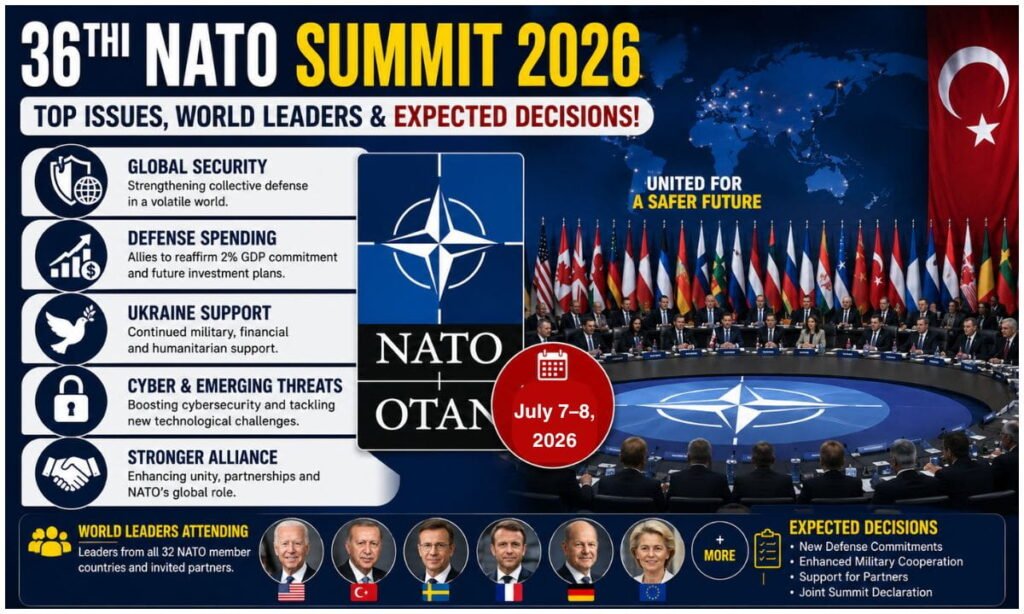
36th NATO Summit 2026: Leaders from all 32 NATO member states have gathered in Ankara, Turkey, on July 7–8, 2026, for the NATO Summit — a meeting unfolding against a backdrop of growing uncertainty about Washington’s long-term commitment to European security. It is the second time Turkey has hosted a NATO summit, following Istanbul in 2004, and the gathering carries a different weight this year: it comes as President Donald Trump continues to publicly question the value of the alliance while his administration quietly reshapes the American military footprint on the continent.
NATO Summit – Where and when?
The NATO Summit is being held at the Beştepe Presidential Complex in Ankara and is chaired by NATO Secretary General Mark Rutte. The formal proceedings began Tuesday and are set to wrap up Wednesday, when Trump is expected to hold a news conference before returning to Washington. His trip is notably brief — he was expected to leave the White House Monday night and be back in the U.S. by Wednesday evening, a shorter stay than past presidents have typically made at NATO gatherings.
Turkish authorities carried out extensive preparations ahead of the NATO Summit 2026, including road upgrades near the venue and heightened security. The Ankara governorship also imposed a ban on rallies, demonstrations and leaflet distribution across the province from June 28 through July 10. In the run-up to the summit, anti-NATO protests broke out in Istanbul, Ankara and Izmir, led largely by labor unions and civil society groups opposed to rising military budgets. Human Rights Watch and local rights advocates reported that security crackdowns tied to the summit resulted in the detention of more than 200 people, including activists, lawyers and journalists.
Who is attending NATO Summit 2026?
Beyond the 32 alliance members, Ukrainian President Volodymyr Zelenskyy and South Korean President Lee Jae-myung are attending as guests, alongside European Council President Antonio Costa and European Commission President Ursula von der Leyen. Australia, Japan and New Zealand are sending defense or foreign ministers, as are several Gulf states — Bahrain, Kuwait, Qatar and the UAE — whose attendance reflects fallout from the U.S.-Israeli military campaign against Iran earlier this year. Syrian President Ahmed al-Sharaa is not formally part of the summit but is expected to hold a separate bilateral meeting with Trump while in Ankara.
The America question
The NATO Summit central undercurrent is Washington’s shifting posture. Since Russia’s 2022 invasion of Ukraine, the U.S. had generally kept at least four brigade-sized formations in Europe. That began to change last October, when the Pentagon ended rotational deployments to Romania, and continued this spring with the cancellation of a long-range fires battalion built specifically to counter Russian missile threats in the region. The administration has also floated withdrawing brigades from Germany and Poland, though a Congressional Research Service report for lawmakers notes that a 2026 defense law bars reducing U.S. troop levels in Europe below 76,000 without first consulting Congress — and roughly 38,000 troops remain in Germany alone.
Accounts of the drawdown’s actual scale vary. Some analysts argue a widely reported plan to pull 5,000 troops from Germany never materially affected theater command structures, and that a proposed withdrawal from Poland was reversed after Warsaw’s own defense spending increases made the move politically costly. NATO’s Supreme Allied Commander, General Alexus Grynkevich, has said any reductions would be phased and coordinated with allies to avoid gaps in coverage. Even so, U.S. lawmakers on the House and Senate Armed Services Committees have voiced concern, and Trump himself has periodically suggested he might withdraw from NATO altogether — an option that legal experts note he cannot pursue unilaterally, since U.S. law requires Senate approval to leave the alliance.
The unease has been compounded by unrelated frictions: Trump’s stated interest in acquiring Greenland, a territory of NATO founding member Denmark, and his anger over European allies declining to materially support the U.S.-Israeli operation against Iran earlier this year. “We helped them with Ukraine,” Trump said in May, arguing that Europe was not equally supportive when Washington needed assistance. As recently as last week, he wrote online that continued U.S. support was “not reciprocal,” reiterating a long-standing complaint that America shoulders a disproportionate share of NATO’s costs — even though, technically, allies spend on their own national defense budgets rather than paying into NATO directly.
Money and capability
Defense spending remains the summit’s dominant formal agenda item. At last year’s summit in The Hague, allies agreed to a new target of 5% of GDP on defense-related spending by 2035 — 3.5% on core military spending and 1.5% on broader security investment such as infrastructure, cyber resilience and industrial capacity, a sharp jump from the previous 2% guideline. Rutte has pushed allies to arrive in Ankara with “clear, concrete and credible” implementation plans rather than fresh pledges, and NATO officials say some countries — including Poland and the Nordic and Baltic states — are already on track to hit the 5% goal well ahead of schedule, while Germany is expected to reach it by 2029. Others are lagging.
The alliance says European members and Canada increased core defense investment by roughly $139 billion in nominal terms in 2025 alone. A parallel NATO Summit Defence Industry Forum is being held alongside the leaders’ meeting, with Rutte promising announcements of “tens of billions” of dollars in new defense contracts and describing the moment as the start of a transatlantic “defense industrial revolution.” The emphasis this year, officials say, is shifting from pledging money to translating it into actual weapons production, munitions capacity and joint procurement — areas where Europe’s defense industry still faces bottlenecks.
Turkey’s Balancing Act
Turkey’s role as host underscores its unusual position within the alliance: it fields NATO’s second-largest army and sits at the crossroads of the Black Sea, the eastern Mediterranean and the Caucasus, giving it leverage that few other members can match. That leverage has occasionally strained relations — Ankara has used itsveto power in recent years to slow initiatives on Nordic enlargement and NATO planning for Poland and the Baltics before eventually relenting. President Recep Tayyip Erdogan is using the summit to press Washington on the possible sale of F-35 fighter jets to Turkey, a request Trump has said he is considering. Trump has also suggested that Erdogan’s hosting of the summit was itself a factor in his decision to attend.
Ukraine and Russia
Long-term support for Ukraine remains one of NATO’s three stated priorities for the summit, alongside defense investment and expanded defense production. Leaders are expected to reaffirm language from prior summits describing Russia as the alliance’s most direct and significant threat, though the precise wording — and how forcefully it reasserts the “ironclad” commitment to Article 5 collective defense — will be watched closely as a signal of alliance unity. Rutte struck a defiant tone in remarks last week, addressing Russian President Vladimir Putin directly: “We will defend ourselves.”
NATO Summit – The bottom line
Officials and analysts largely agree the NATO Summitis not at a breaking point, but is entering what one German Marshall Fund expert called “a period of profound adjustment.” The core tension running through Ankara is whether Washington’s demand for greater European burden-sharing can be reconciled with a military drawdown that many allies fear could leave gaps in Europe’s defenses — even as European governments accelerate their own spending and industrial buildup in response.
Top Asked Questions :-
When and where 36th NATO Summit 2026 taking place?
The summit is taking place on July 7–8, 2026, in Ankara, Turkey.
Where it is being held?
The NATO Summit is being held at the Beştepe Presidential Complex in Ankara and is chaired by NATO Secretary General Mark Rutte.
What are the main objectives of the summit?
Strengthening collective defense, enhancing cooperation, and addressing global security challenges.
What issues are expected to be discussed?
Defense spending, the war in Ukraine, cybersecurity, counter-terrorism, and military modernization.
What happens after the summit concludes?
NATO leaders typically issue a joint declaration outlining key decisions, commitments, and future priorities.