NATO Summit: NATO’s 36th summit opened in Ankara on Tuesday, bringing leaders of all 32 alliance members to Türkiye’s capital for two days of talks dominated by defense spending, industrial capacity, and continued support for Ukraine. It is only the second time Türkiye has hosted a NATO Summit, following Istanbul in 2004, and it arrives at a moment when the alliance’s internal cohesion is being tested by Washington’s shifting posture toward Europe.
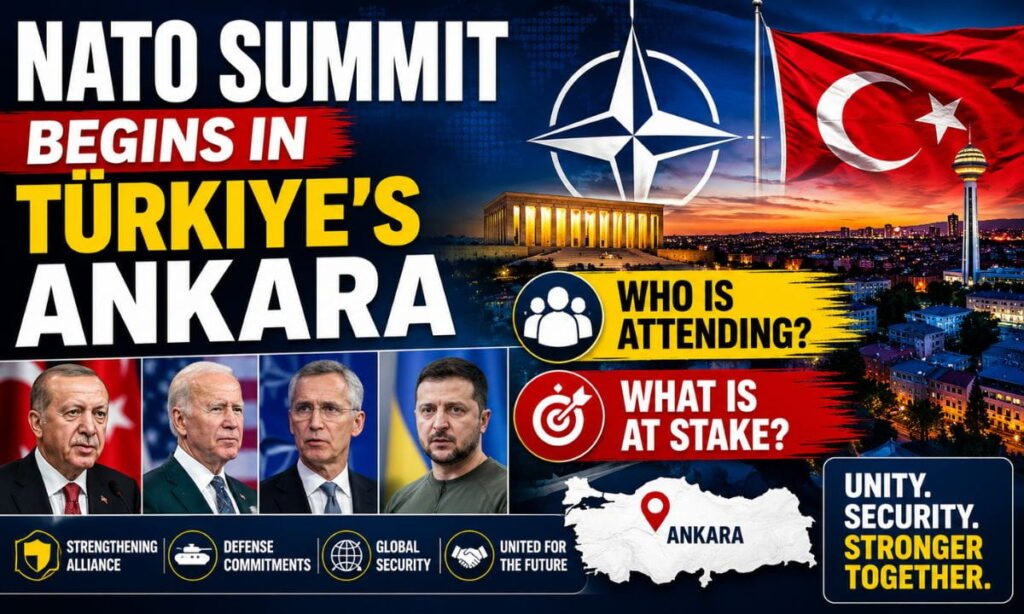
Who is in Ankara?
Heads of state and government from all 32 NATO members are present in the Turkish capital this week. Beyond the alliance’s own membership, two non-member heads of state are also attending: Ukraine’s Volodymyr Zelenskyy and South Korea’s Lee Jae-myung. Australia, Japan and New Zealand are represented by defense or foreign ministers, as are Gulf states affected by the recent US-Israel war on Iran — Bahrain, Kuwait and Qatar.
Syria’s president, Ahmed al-Sharaa, is not formally part of the NATO Summit but is holding a bilateral meeting with President Donald Trump while in Ankara. Trump is also expected to hold separate one-on-one talks with Zelenskyy during his time in the Turkish capital.
The gathering follows a format alliance officials adopted last year in The Hague: a dinner of leaders, a separate dinner bringing in Ukraine, and a dinner of defense ministers with the Indo-Pacific Four partner nations, followed by one formal meeting of allies. Officials say the shift toward shorter, leaders-only formats reflects a preference from the American side, and Trump’s own preference for brevity in these gatherings.
Defense spending takes center stage
The dominant theme of the NATO Summit is money — specifically, whether European allies and Canada are living up to last year’s pledge. At last year’s Hague summit, allies agreed to invest 5% of GDP annually on defense by 2035, split between 3.5% on core defense requirements and 1.5% on broader security-related spending.
Secretary General Mark Rutte used his pre-summit remarks to argue the trend line is already encouraging. He said European allies and Canada are already investing roughly 4% of GDP in defense and security just one year into the ten-year push, and told reporters he expects nations gathered in Ankara to lay out credible national plans for reaching the full 5% target. NATO estimates published in March 2026 showed every member had already met the older 2%-of-GDP benchmark in 2025, up from just three allies in 2014.
Rutte has also framed the spending increases as an industrial opportunity. He said Ankara would see tens of billions of dollars in new defense contracts announced, work he argues will support jobs and innovation on both sides of the Atlantic. That theme carries into the NATO Summit dedicated Defence Industry Forum, held alongside the leaders’ meetings, which NATO describes as its premier high-level event on transatlantic defence production, investment and innovation, bringing together officials and defense-industry executives.
Analysts note the political subtext. Defence spending and support for Ukraine’s military needs are expected to top the NATO Summit agenda, but the numbers are also meant as a message to a US president who has long questioned the value of the alliance. Trump has argued for years that the United States has carried an unfair share of NATO’s costs, and Rutte’s Ankara remarks were widely read as an effort to show allies are responding.
Not everyone is satisfied. Ozgur Unluhisarcikli of the German Marshall Fund, the alliance’s regional director for Türkiye, argued the real test this year is less about pledges and more about delivery. He said the emphasis in Ankara would shift toward turning increased spending into actual military capabilities rather than simply larger budget lines.
Ukraine’s place at the table
Support for Kyiv remains a central item, made more urgent by a Russian missile and drone attack on Kyiv on the eve of the summit. Rutte confirmed the alliance “must continue to ensure Ukraine gets what it needs” after the July 6 strikes, which killed at least 21 people according to Radio Free Europe/Radio Liberty reporting.
According to a draft declaration reviewed by Reuters, NATO allies are expected to commit roughly €70 billion ($80 billion) in military equipment, training and other assistance for Ukraine in 2026, while pledging to sustain at least comparable support in 2027. Part of that funding is expected to draw on existing bilateral commitments as well as the European Union’s €90 billion loan facility for Ukraine covering 2026 and 2027, though the United States is not expected to contribute funding of its own to the package.
Zelenskyy, for his part, used social media ahead of the NATO Summit to press allies for more air-defense support, specifically calling for additional Patriot interceptor missiles. Rutte acknowledged the alliance’s near-term options are constrained. He said there is a limit on how many interceptors currently sit on NATO territory, which is why the alliance needs to ramp up production rather than simply redistribute existing stock. Officials in Ankara are also said to be exploring a possible licensing arrangement that would let Ukraine produce some of this equipment domestically.
Trump, Erdogan and Türkiye’s balancing act
Host nation Türkiye is using the summit to press its own agenda. President Recep Tayyip Erdoğan said he hopes Washington will agree to sell F-35 fighter jets to Türkiye, a request Trump said he was considering alongside a possible lifting of sanctions on Ankara.
Analysts describe Türkiye’s position within NATO as inherently double-edged. One assessment from the Modern War Institute described the country as militarily valuable, geographically essential and regionally influential, particularly given crises along the alliance’s southern and eastern flanks, even as its domestic politics and ties with Moscow remain persistent sources of friction among allies. The same analysis noted that Turkey holds the alliance’s second-largest army and sits at the crossroads of the Black Sea, the eastern Mediterranean, the Middle East andthe Caucasus — a geography few members can afford to treat as peripheral.
Security, protests and a locked-down capital
Hosting the summit has meant an extraordinary security footprint in Ankara. Authorities banned all rallies, demonstrations and leaflet distribution across Ankara province from June 28 through July 10, closed several major roads, and granted administrative leave to some public employees for the duration of the event. In the run-up to the summit, anti-NATO demonstrations took place in Istanbul, Ankara and Izmir, led by labor unions and civil-society groups objecting to rising military budgets and NATO’s expansion policies. Human Rights Watch and local rights groups reported that more than 200 people, including activists, lawyers and journalists, were detained amid anti-terror operations and crackdowns on protesters.
What comes next?
Leaders are expected to close the summit on Wednesday with a formal declaration reaffirming Article 5 collective-defense commitments, the Ukraine assistance package, and national timelines for reaching the 5%-of-GDP target. As one regional analyst put it, the meeting’s significance may lie less in any single new decision than in the show of continuity itself — a demonstration, even amid visible disagreements over funding and US troop posture in Europe, that the allies are still talking, still meeting, and still trying to project unity even as underlying doubts persist.
FAQ’s on NATO Summit in 2026
What is the NATO summit?
A meeting of NATO leaders to discuss global security and defense.
Where is the NATO Summit taking place?
In Ankara, Turkey.
Who is attending?
Leaders of NATO member countries, the NATO Secretary General, and invited partners.
What are the key topics?
Defense, regional security, cyber security, and military cooperation.
Will significant decisions be made?
Yes, leaders may announce new security commitments and joint statements.
Why is this NATO Summit important?
NATO Summit helps shape NATO’s future strategy and international security policy.