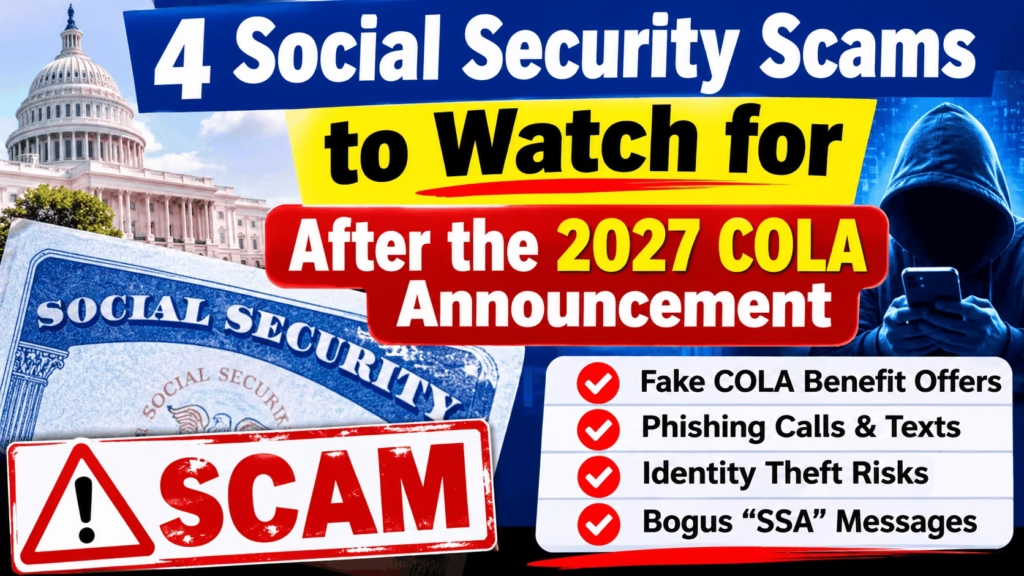
Social Security scams after the 2027 COLA announcement are already surfacing, and the timing is no accident. On Wednesday, October 14, 2026, the Social Security Administration confirmed a 3.6 percent cost-of-living adjustment for 2027, which lifts the average retired worker’s check by about $75 a month and reaches roughly 76 million Americans. Every year, within days of that headline, criminals reuse a familiar script: you must apply, verify your identity, pay a fee or update your bank details to receive the raise. None of it is true. The Social Security COLA is automatic, and nobody needs to do anything to get it. This guide explains four COLA-linked schemes that the agency and its inspector general have warned about, the dates and official links you can trust, and what to do if you already responded to a suspicious message. We’ll be updating this article monthly.
The stakes are real. The Federal Trade Commission reported that Americans lost $3.5 billion to imposter scams in 2025, with about $920 million of that tied to government impersonators. In a June 2026 update, the SSA noted that the FTC received more than 375,000 government imposter reports in 2025, and that losses among people 60 and older roughly quadrupled between 2020 and 2024. Older adults, people with limited English, and veterans are frequent targets. A higher monthly benefit gives scammers a believable reason to call, text or email, because many people are genuinely expecting news about their payment. Knowing how the Social Security scams work is the quickest way to protect your benefit.
What the 2027 COLA Announcement Changed
Before you can spot a fake, you need the real numbers. The Social Security Administration published its 2027 fact sheet on the same day as the announcement. The adjustment is based on the rise in the Consumer Price Index for Urban Wage Earners and Clerical Workers from the third quarter of 2025 through the third quarter of 2026. It follows a 2.8 percent increase for 2026 and is the largest since 2023.
| Item | Detail |
|---|---|
| COLA announced | Wednesday, October 14, 2026 |
| 2027 COLA percentage | 3.6 percent |
| 2026 COLA for comparison | 2.8 percent |
| People affected | About 76 million Americans |
| Social Security beneficiaries | Nearly 72 million |
| SSI recipients | About 7.3 million |
| Average retired worker, before and after | $2,095 to $2,170 per month |
| Average increase for retirees | About $75 per month |
| Aged couple, both receiving benefits | $3,238 to $3,355 per month |
| Aged widow or widower alone | $1,936 to $2,005 per month |
| Widowed mother and two children | $3,932 to $4,074 per month |
| Taxable maximum earnings | $184,500 in 2026, $192,300 in 2027 |
| Quarter of coverage | $1,890 in 2026, $1,970 in 2027 |
Those figures matter for a simple reason. Scammers love to invent numbers. In the past, fake emails have promised a $200 monthly increase, a $2,400 yearly bonus or a $600 payment in June. The real 2027 increase is 3.6 percent, and any message quoting a very different amount is a warning sign.
Scam 1: The Fake “Apply or Verify to Get Your COLA” Message
The oldest COLA scam is also the most common. Someone calls, texts or emails claiming to be from the Social Security Administration. They say your 2027 increase is ready but you must confirm your name, date of birth, Social Security number or bank account to receive it. Some versions say you must “apply” for the raise or complete a quick form before a deadline.
How it works: once a criminal has your personal details, they contact the real SSA, pose as you, and try to redirect your direct deposit, address or phone number. A past SSA warning described exactly this pattern, where callers asked people to verify information for a supposed COLA and then used the data to change benefit records.
Variations keep appearing. In 2026, readers of a Medicare column reported emails promising a $200 monthly increase, or $2,400 for the year. The inspector general has specifically warned about messages promising those amounts. They are false.
What to do: hang up, delete the email, or ignore the text. If you want to confirm your new amount, do not use any link or number in the message. Go to ssa.gov/cola or sign in to your own my Social Security account.
When Will Medicare Costs Increase? Part B Premium Forecast, Key Dates and What Retirees Will Pay
Scam 2: The Pay-to-Boost Scheme That Promises a Bigger Benefit
A newer twist targets people hoping for more than the standard raise. In September 2026, the inspector general issued an alert titled “Don’t Pay for Promises of Increased SSA Benefits,” after reports of schemes offering to “maximize,” “boost” or “unlock” Social Security payments. Money.com highlighted the warning in late September as a growing scam.
These offers often arrive through social media ads, cold calls or text messages. The pitch sounds like a service: pay a processing fee, a membership or a “filing charge,” and an insider will unlock a larger monthly check. Sometimes the scammer says the fee is refundable or will be deducted from your first higher payment.
The truth is simple. Social Security benefits are set by law, based on your earnings record, the age you claim and the annual COLA. No private company can increase your benefit by charging you a fee. The agency does not charge to receive your benefit or the COLA, and it does not sell upgrades.
This scam fits the FTC’s broader finding that social media is now the costliest contact method for fraud. Reported losses linked to social media reached $2.1 billion in 2025, and nearly one in three people who lost money to imposters first met the scammer there. If an ad promises to boost your retirement income, treat it as a red flag.
Legitimate help exists, and it is usually free. The SSA website explains how claiming age affects your payment. Waiting past full retirement age can raise your monthly benefit, with a maximum of about 124 percent of your full amount at age 70 for people born after 1960. A nonprofit counselor or a fee-only financial planner can explain your options without promising anything that sounds too good to be true.
Scam 3: The Direct Deposit Change and Prize-Linked Offers
The third scam attacks the way you get paid. In early September 2026, the inspector general warned about direct deposit offers tied to prizes. The details vary, but the structure matches older fraud patterns: a message says you have won something, or qualify for a bonus, and asks for bank information so the money can be deposited.
Another version arrives after the COLA announcement. A caller says your increase cannot be processed because your direct deposit information is “out of date,” and offers to fix it over the phone. If you read out your routing and account numbers, you hand over access to your own money. A related trick persuades victims to set up a new account and share online banking credentials.
Direct deposit fraud can be hard to notice at first. Your benefit simply fails to arrive, or arrives in someone else’s account. The SSA recommends checking your benefit information regularly through your personal account, and you can set up email or text alerts in the message center preferences so you see changes quickly.
Protect yourself by treating any request for bank details as suspicious unless you started the conversation. If you need to update direct deposit, use your my Social Security account or call the national number, 1-800-772-1213, which operates on weekdays from 7 a.m. to 7 p.m. You can also visit a local field office. Never read your account number to an unexpected caller.
Scam 4: Threats, Fake Overpayments and Phishing Links
The fourth scam relies on fear instead of excitement. Fraudsters impersonating the SSA or law enforcement claim that your Social Security number has been suspended, that your account is tied to a crime, or that you were overpaid and must repay immediately. Some email versions urge you to download a “security update tool” to fix an error, which can install malware.
The threats are always built around urgency and secrecy. You may be told not to hang up, not to talk to family, and to pay with gift cards, a payment app, a wire transfer or cryptocurrency. Federal agencies describe this in a national “Never Ever” campaign. Never ever will someone from the government say your money is not safe, threaten to suspend benefits unless you pay immediately, or demand payment by app, crypto, wire or gift card.
Phishing links are the digital cousin. Some messages mimic official notices and send you to a lookalike site designed to steal your login. A past warning from the inspector general’s office noted that scam emails can look legitimate, even using the exact agency logo. After a COLA announcement, you may see fake “new COLA notice” emails that include a link or attachment. The real notice appears in your secure message center in late November or arrives by mail in December.
The agency recommends a mental checklist known as the four Ps of scams: pretend, problem, pressure and pay. Scammers pretend to be someone official, describe a problem, pressure you to act fast, and ask you to pay in a hard-to-trace way. If you spot two of the four, stop.
The SSA itself primarily contacts people by mail. It may call about an existing claim or business matter, but it will not threaten you with arrest, will not suspend your Social Security number and will not demand payment by gift card or crypto.
How to Apply for the 2027 COLA
The short answer is that you do not apply. There is no application, no form and no registration for the cost-of-living adjustment. If you receive Social Security retirement, disability, survivor or SSI benefits, the increase is added to your payment automatically.
You may, however, want to create or check your my Social Security account so you can see your notice early and spot problems quickly. Here is the safe path.
- Open your browser and type ssa.gov/myaccount yourself rather than clicking a link in a message.
- Select the option to sign in or create an account. The system uses a verified credential such as Login.gov or ID.me.
- Set up two-step protection, then choose email or text alerts in the message center preferences.
- Look for your 2027 benefit amount in the message center starting in late November.
- Confirm that your address, phone number and direct deposit details are correct.
If someone asks you to apply, register or pay for the COLA, it is a scam.
Social Security Cuts After COLA Announcement? What the 3.6% Raise Means for Your 2027 Checks
VA Disability Pay Rise 2027: 100% Rating Goes From $3,939 to $4,080 a Month
Processing Time for the 2027 COLA
Because the increase is automatic, there is nothing to process on your side. The agency applies the 3.6 percent adjustment to benefit records in batches before the first payments. What matters to you is when you will know your exact amount.
For people with a my Social Security account, the 2027 benefit amount will appear in the message center beginning in late November. People without an online account will receive a mailed COLA notice in December. The notice shows your new gross benefit, any Medicare premium deducted, and the net amount you will receive. Medicare information for 2027, including premiums, will be posted on the Medicare website, so your net increase may be smaller than the headline percentage.
If December arrives and you have no notice, do not respond to a message offering to “speed things up.” Contact the SSA at its official number or visit a local office.
Payment Schedule: When the Higher Checks Arrive
Supplemental Security Income recipients get their increase first. About 7.3 million people on SSI will see higher payments beginning December 31, 2026, because January 1 is a holiday. Social Security beneficiaries will see the increase in payments for January 2027.
| Group | When the 2027 increase starts |
|---|---|
| SSI recipients | December 31, 2026 |
| Social Security, birthdays on the 1st to 10th | Wednesday, January 13, 2027 |
| Social Security, birthdays on the 11th to 20th | Wednesday, January 20, 2027 |
| Social Security, birthdays on the 21st to 31st | Wednesday, January 27, 2027 |
| Beneficiaries paid on the 3rd of the month | The 3rd falls on a Sunday in January 2027, so check your account for the exact deposit day |
| Online COLA notice | Late November 2026 in my Social Security |
| Mailed COLA notice | December 2026 |
The Wednesday schedule applies to most people who started benefits after May 1997. People who receive both SSI and Social Security, or who started before May 1997, are usually paid on the 3rd. Because the 3rd lands on a weekend this year, confirm your exact date in your account rather than relying on a text message that claims to know it.
Any message that gives you a different payment date and asks you to click a link to “claim” or “confirm” it is not from the agency.
2027 COLA Calculator
Many of the scam messages work because people are unsure what their raise should be. You can estimate your own number in seconds. Multiply your current monthly benefit by 0.036 to find the monthly increase, then add it to your current benefit. For example, a retiree receiving $2,095 would gain about $75, bringing the check to about $2,170, which matches the SSA fact sheet.
2027 Social Security COLA Calculator
Official 2027 COLA: 3.6 percent. Effective with January 2027 benefits (SSI: December 31, 2026).
| Current monthly benefit | |
| Monthly increase | |
| New monthly benefit (before Medicare) | |
| Yearly increase |
This is a gross estimate based on the announced 3.6 percent COLA. Your exact 2027 amount, including any Medicare premium change, appears in your my Social Security message center from late November, or in a mailed notice in December. The COLA is automatic. You never need to apply, pay a fee or share personal details to receive it. Official site: ssa.gov/cola
What to Do If You Responded to a Scam
Acting quickly can limit the damage. Take these steps in order.
- If you shared your Social Security number or personal details, go to IdentityTheft.gov for a personalized recovery plan.
- Contact your bank right away if you shared account numbers or sent money. Ask them to stop or reverse transactions and to watch for unauthorized activity.
- Report Social Security-related scams to the Office of the Inspector General at oig.ssa.gov/report or call 1-800-269-0271.
- Report other government impersonation scams to the FTC at ReportFraud.ftc.gov.
- If you lost money online, you can also file a complaint with the FBI’s Internet Crime Complaint Center.
- Check your my Social Security account for changes to your address or direct deposit, and consider a credit freeze.
- Tell a family member or friend. Shame keeps many victims silent, and scammers count on it.
Reporting helps investigators spot new trends. An OIG adviser has said reports help the agency publicize emerging fraud threats.
Official Resources and Links
Use only these verified government addresses, and type them yourself instead of clicking links in messages.
| Purpose | Official site or number |
|---|---|
| 2027 COLA information | https://www.ssa.gov/cola |
| 2027 COLA fact sheet | https://www.ssa.gov/news/en/cola/factsheets/2027.html |
| Login and registration for my Social Security | https://www.ssa.gov/myaccount |
| Check benefit and payment status | Sign in at https://www.ssa.gov/myaccount and open your message center and payment details |
| Social Security scam information | https://www.ssa.gov/scam |
| Report a Social Security scam | https://oig.ssa.gov/report |
| Current scam alerts | https://oig.ssa.gov/scam-alerts |
| Report any government imposter scam | https://reportfraud.ftc.gov |
| Identity theft recovery | https://www.identitytheft.gov |
| Medicare 2027 changes | https://www.medicare.gov |
| SSA national number | 1-800-772-1213 (TTY 1-800-325-0778) |
| SSA OIG fraud hotline | 1-800-269-0271 |
Costco Dot Cakes: Where to Find the New Mini Six-Pack and How Much It Costs?
FAQs About Social Security Scams and the 2027 COLA
Do I have to apply for the 2027 COLA?
No. The cost-of-living adjustment is automatic for everyone who receives Social Security or SSI. Any request to apply, register or verify your identity for the increase is a scam.
How much is the Social Security COLA for 2027?
The 2027 COLA is 3.6 percent. The agency says the average retired worker will see about $75 more per month, rising from about $2,095 to about $2,170.
When will I find out my exact 2027 benefit amount?
Online account holders can see their new amount in the my Social Security message center starting in late November. Everyone else will receive a notice by mail in December.
Will the SSA call me about my COLA?
The agency primarily uses mail, and it does not need to call you to give you the increase. If a caller asks for your Social Security number or bank details to release the COLA, hang up and contact the SSA at its official number.
Can someone pay to increase my Social Security benefit?
No. Benefits follow federal law and your work record. Offers to maximize, boost or unlock your payment for a fee are scams, and the inspector general has warned about them.
How do I report a Social Security scam?
Go to oig.ssa.gov/report or call 1-800-269-0271. You can also report to the FTC at ReportFraud.ftc.gov.
What are the most common Social Security scams right now?
The most reported types include fake COLA verification calls, threats that your number will be suspended, supposed overpayment demands, phishing emails with security update downloads, and offers to boost benefits for a fee. Direct deposit and prize-linked offers have also drawn recent warnings.
Why are there so many scams after the COLA announcement?
Millions of people are waiting for news about their payment, so a message that mentions the increase seems believable. Scammers also reuse tactics that worked in earlier years.
What should I do if I clicked a link in a fake Social Security text?
Do not enter any information. If you did, change your passwords, check your my Social Security account, contact your bank and visit IdentityTheft.gov. Then report the message to the inspector general.
When is the next COLA announcement?
The agency announces the COLA each October, based on inflation data for the third quarter. The Senior Citizens League says it will publish its first estimate for the 2028 COLA in November 2026.
Conclusion
The 3.6 percent COLA is good news for roughly 76 million Americans, and criminals know it. The four schemes to watch after the announcement are the fake apply-or-verify request, the pay-to-boost offer, the direct deposit and prize-linked ask, and the threat, overpayment and phishing combination. Each depends on one thing: getting you to act before you check.
Remember the facts that cannot be faked. The increase is automatic. It costs nothing. Your exact amount will appear in your my Social Security account in late November or in a letter in December. SSI recipients see their raise on December 31, 2026, and Social Security recipients see it with January 2027 payments.
If a message says otherwise, stop, hang up and verify through an official channel. Share this guide with parents, grandparents and neighbors who may be targeted, and report anything suspicious at oig.ssa.gov/report. Staying alert is the simplest way to keep every dollar of your new benefit.