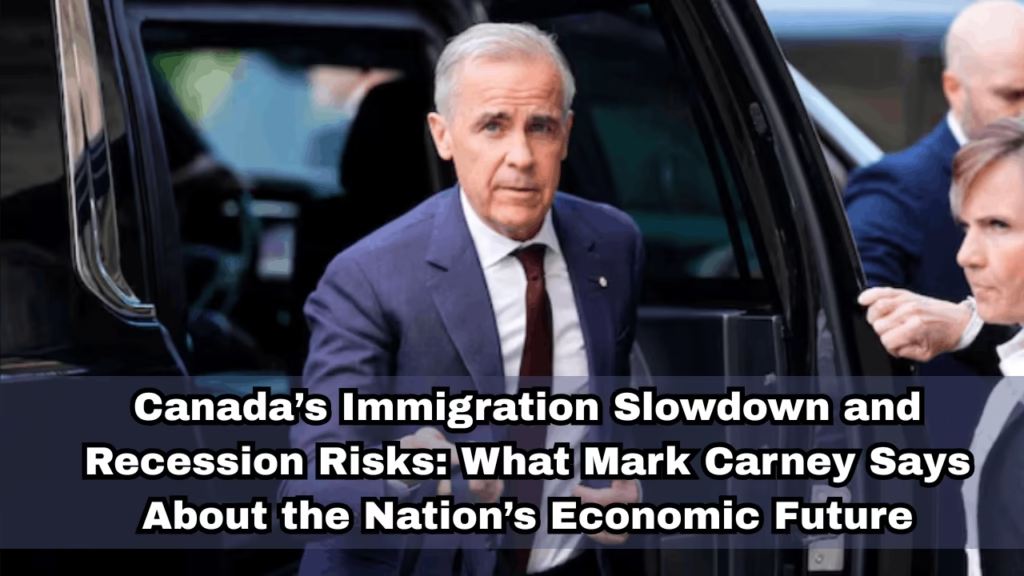
Canada’s Immigration Slowdown and Recession Risks: In a statement that immediately ignited a national debate, Prime Minister Mark Carney made his most direct public acknowledgment yet on June 3, 2026, linking Canada’s economic contraction and lower immigration targets to two consecutive quarters of GDP decline. Speaking to reporters outside a cabinet meeting on Parliament Hill in Ottawa, Carney admitted that reduced immigration under his government is helping to explain why Canada’s economy has weakened heading into the second half of 2026 — while carefully avoiding the word “recession” itself.
The statement arrived just days after Statistics Canada released its first-quarter 2026 GDP report — a report that showed real economic output was essentially flat, following a contraction in the fourth quarter of 2025. For millions of Canadians already contending with high living costs, US trade tariff uncertainty, and a still-tight job market, the Prime Minister’s admission has raised urgent questions about the direction of the Canadian economy, the government’s immigration strategy, and what both mean for working Canadians, newcomers, and future prosperity.
What Mark Carney Says About the Nation’s Economic Future?
The Mark Carney immigration recession statement June 2026 was notable both for what it said and what it deliberately did not say. Speaking before the cabinet meeting, Carney acknowledged that Ottawa’s decision to take back control of immigration levels — reducing the intake of temporary and permanent residents — is contributing to “some of the weakness we are seeing in economic data.” He also suggested that this was an expected and intentional consequence of a broader economic restructuring strategy, rather than an unplanned policy failure.
Carney framed the current weakness as part of deliberate economic governance: reducing runaway population growth that had placed enormous pressure on Canada’s housing supply, social services, and labour market; shifting the economy toward investment-led growth; and moving toward more controlled, sustainable population management. He added that one short-term benefit of lower immigration may be a reduction in youth unemployment — which stood at 14.3% in April 2026 — as opportunities in the labour market gradually open up.
Canada Grocery Benefits 2026: PM Carney’s Grocery Relief Measures Are Now Paying Out
Canada’s EV Rebate Program 2026: $5,000 For Fully Electric Vehicles And $2,500 For Plug-In Hybrids
What Carney did not say was equally telling. He refused to use the word “recession” when asked directly by reporters — a semantic caution that drew immediate fire from Conservative Leader Pierre Poilievre, who accused the Prime Minister of “hiding” from the devastating economic figures for five days before making an appearance. Poilievre said the refusal to answer a basic yes-or-no question about recession showed the government was unwilling to confront the reality facing Canadians. The political battle over framing Canada’s economic condition has now become one of the defining debates of the current Parliament.
GDP Data: Is Canada Actually in a Recession?
The Canada GDP contraction Q4 2025 Q1 2026 figures are what triggered the controversy. According to Statistics Canada’s official release published on May 29, 2026:
- Q4 2025: Real GDP declined 0.2% on a quarterly basis, representing a 1.0% annualized contraction
- Q1 2026: Real GDP was unchanged on a quarterly basis, representing a 0.1% annualized contraction
- Household spending: Rose 0.4% in Q1 2026 — a positive signal
- Business capital investment: Declined for a fifth consecutive quarter — a significant concern
- Final domestic demand: Edged 0.1% lower in Q1 2026
- Imports: Rose 2.9%, driven largely by gold imports
Two consecutive quarters of annualized GDP contraction meet the textbook definition of a technical recession Canada 2026. However, economists have been quick to point out that the picture is far more nuanced. On a per capita basis — adjusting for population — real GDP actually increased 0.2% in Q1 2026, because Canada’s population itself declined for the second straight quarter while total output remained flat. In other words, the average Canadian produced slightly more economic output, even as the overall economy flatlined.
Three National Bank economists noted in a research note following the GDP release that immigration policy is a “key variable” weighing on growth, pointing out that Canada’s population was smaller in Q1 2026 than it was in Q4 2025 — a fact that directly suppresses headline GDP even when individual productivity is stable or improving. An advance estimate from Statistics Canada also pointed to a GDP rebound in April 2026, which — if confirmed — would add further evidence that the current weakness is transitional rather than structural.
Canada’s Immigration Connection
The foundation of the Mark Carney immigration policy economic impact 2026 story is rooted in a remarkable demographic shift. Statistics Canada confirmed that Canada’s population actually declined in 2025 — a drop of more than 100,000 people — marking the first annual population decline in records dating back to the 1940s. This reversal followed years of historically high immigration intake that had driven Canada’s population growth to among the fastest rates in the developed world.
The quarterly progression tells a dramatic story:
- Q4 2023: Population grew by +256,804 people (+0.6%)
- Q4 2024: Growth slowed sharply to +80,385 (+0.2%)
- Q1 2025: Near-zero growth at just +20,107 people (+0.0%)
- Q3 2025: Population declined by 76,068 people — the first quarterly drop
- Q4 2025: Population declined by a further 103,504 people
This sharp reversal traces directly to the Canada immigration target reduction Trudeau Carney 2024 2025. Facing a deepening housing affordability crisis and mounting public discontent, then-Prime Minister Justin Trudeau announced in late 2024 a plan to significantly reduce both temporary and permanent resident arrivals. The targets were set at: 395,000 permanent residents in 2025, 380,000 in 2026, and 365,000 in 2027 — down sharply from 485,000 in 2024. Non-permanent residents such as international students and temporary foreign workers were cut even more aggressively, with the goal of reducing non-permanent residents from approximately 6.5% of Canada’s population to below 5% by end-2027.
The Parliamentary Budget Officer has estimated that the new immigration path demographic outlook Canada 2027 implies a significantly lower population trajectory by the end of next year — with implications that go far beyond GDP headline numbers and ripple through housing markets, universities, retailers, transit systems, and entry-level employers across the country.
Full List of Canada Benefit Payments August 2026: CPP, OAS, CCB, GST Credit and More!
Canada Pension Payment 2026 Full Schedule: CPP, OAS & GIS Payment Dates Released!
Canada Housing Benefit 2026: Check Payment Dates, Eligibility, Application Process & Fact Check!
Pandemic-Era Immigration: Did It Mask Canada’s True Economic Condition?
One of the sharpest critiques that has emerged in the wake of Carney’s comments is that the surge of immigration during and after the COVID-19 pandemic may have artificially inflated Canada’s headline GDP figures, concealing underlying structural weaknesses that were always present.
Conservative immigration critic Michelle Rempel Garner stated publicly that “mass rapid intake of low-skilled temporary foreign labour both masked and juiced structural economic issues.” The argument is that the arrival of hundreds of thousands of newcomers each year created the appearance of robust economic activity — consumer spending, housing demand, rental income, retail sales — while doing little to address the chronic issues of low productivity, weak business investment, and the failure to build adequate housing supply.
This is the core of the Canada immigration economic growth debate 2026: high immigration produced headline GDP growth, but at the cost of falling per capita output, worsening housing affordability, and a labour market where wages for lower-income workers were suppressed by a large inflow of workers willing to accept below-market compensation. Now that the immigration tap has been turned down, the headline numbers look weaker — but the per capita story is more complex.
What the Recession Debate Really Means for Canadians
Whether Canada meets every economist’s definition of a recession matters less than what Canadians are experiencing on the ground. The Canada recession impact on everyday Canadians 2026 is real in several ways:
Housing Market: One of the most significant potential benefits of lower immigration is a gradual softening of Canada’s historically overheated housing market. With fewer newcomers arriving to compete for limited rental units and homes for sale, the extreme demand pressure that pushed average home prices above $700,000 nationally may begin to ease. First-time buyers who were locked out of the market for years are watching this development closely.
Labour Market: Business investment has declined for five consecutive quarters, which is creating job market uncertainty. Youth unemployment at 14.3% in April 2026 is unacceptably high. Carney’s suggestion that reduced immigration may free up labour market opportunities for young Canadians and domestic workers has merit in some sectors — but it is also true that labour shortages remain acute in healthcare, construction, and skilled trades, where immigration has historically filled critical gaps that the domestic workforce cannot.
Consumer Spending: Despite the GDP headlines, Canadian household spending rose 0.4% in Q1 2026, suggesting that individual Canadians are continuing to spend. This is a significant buffer against a deeper downturn and reflects the underlying resilience of Canadian consumers even in a slowing economy.
Trade and Tariff Uncertainty: The US tariffs Canada economic impact 2026 remain a major headwind that is entirely separate from the immigration question. Higher gold imports, declining business investment, and suppressed export expectations all reflect the ongoing uncertainty created by US trade policy — a factor that complicates any attempt to isolate immigration as the sole driver of Canada’s economic weakness.
Carney’s Strategic Vision: Restructuring Over Short-Term Growth
It is critical to understand that the Mark Carney Canada economic restructuring strategy 2026 is not accidental. Carney has been explicit that Canada must shift away from the model of population-led GDP growth that characterized the Trudeau years — a model that inflated housing costs, suppressed per capita productivity, and deferred the hard work of building a productive, competitive, investment-driven economy.
His government’s stated economic pillars include: controlling population growth at a sustainable pace, reducing government spending growth, attracting private business investment — particularly in clean energy, critical minerals, and advanced manufacturing — and rebuilding Canada’s economic relationship with the United States and other trading partners on more balanced terms. The short-term cost of this restructuring is weaker headline GDP numbers. The intended long-term benefit is an economy where output per person — not just output in total — is growing sustainably.
Carney also warned that Canada’s economic data will likely remain “uneven” through the coming quarters as these policy changes work through the system. That is a carefully chosen word: not “declining,” not “recovering,” but uneven — a signal that the government expects continued volatility in the data as the transition plays out.
Canada Pension Plan Payment August 27th, 2026: Who Will Receive CPP Benefits and How Much?
Canada Child Benefit Increase 2026: Updated Payment Amounts, Eligibility and Deposit Dates!
Canada GST Top-Up Payment 2026 Fact Check, Eligibility, Payment Date & Amount!
What Comes Next for Canada’s Immigration Policy?
Despite the economic turbulence, there are no signals from the Carney government that Canada is about to dramatically reverse its immigration course. According to analysis from Immigration News Canada, permanent resident targets may hold steady at approximately 380,000 through the near term, with a possible modest increase in international student numbers in November 2026 as the government reassesses its international education strategy.
The Canada immigration policy forecast second half 2026 will be shaped by several key variables: the April GDP rebound estimate, the trajectory of youth unemployment, housing market conditions through summer 2026, and the ongoing negotiations with the United States over trade and tariff arrangements.
Canada Groceries and Essentials Benefit 2026: Eligibility, Payment Amounts & August Status Explained
New to Canada? Here’s How the FHSA Can Help You Buy Your First Home Faster
$680 Canada Payment 2026 – Eligibility Criteria & Fact Check!
What is clear is that the debate Carney has opened — about the relationship between immigration, economic growth, population sustainability, and individual living standards — is one of the most consequential policy discussions Canada has had in decades. And unlike many government admissions, this one came with a specific acknowledgment: the choices made have economic consequences, and those consequences are now visible in the data.
Mark Carney publicly acknowledged on June 3, 2026 that lower immigration is contributing to Canada’s economic weakness — the first time a sitting PM has directly linked the two Canada recorded two consecutive quarters of annualized GDP contraction (Q4 2025 and Q1 2026), meeting the technical definition of a recession — though per capita GDP rose 0.2% in Q1 2026 Canada experienced its first annual population decline since the 1940s in 2025, driven by immigration cuts enacted under Trudeau and continued under Carney Business investment has fallen for five straight quarters, while household spending remains resilient at +0.4% Carney frames the weakness as a deliberate transition — not a crisis — toward a more sustainable, investment-led economic model Youth unemployment stands at 14.3%, which the PM says may improve as labour market opportunities open with lower immigration inflows Permanent resident targets remain at 380,000 for 2026, with no reversal of immigration cuts announced.
Also Check: Adult Child Sponsorship in Canada 2026: Immigration Pathways, Requirements and Alternatives
Canada GST Top-Up Payment 2026 Fact Check, Eligibility, Payment Date & Amount!