Trump $100000 Post Study Work Fee: For decades, the United States has stood as the single most desirable destination for Indian students chasing higher education and, more importantly, the career opportunities that follow it. A degree from an American university has long been seen as a passport not just to knowledge, but to a well-paying job, a green card, and eventually a settled life abroad. That dream is now facing one of its most serious threats yet. According to a report first published by the Wall Street Journal and since corroborated by multiple outlets, the Trump administration is weighing a plan to charge international students Trump $100000 Post Study Work Fee to stay in the country and work after graduating. If implemented, this proposal would fundamentally alter the calculus for hundreds of thousands of students, a very large share of them Indian, who plan their entire academic and financial futures around the ability to work in America after they graduate.
This potential policy does not exist in isolation. It arrives on the heels of an already turbulent year for skilled-worker and student immigration in the United States, one marked by a controversial Trump $100000 Post Study Work Fee slapped on H-1B visas, a court battle over that fee, and now a fresh proposal that could hit students even before they reach the H-1B stage. For Indian families who often take on significant debt to send their children to study in the US, and for Indian students who have built their career plans around the Optional Practical Training program, the news lands as a gut punch. This article unpacks what is actually being proposed, how we got here, who stands to be affected, what the numbers tell us, and what Trump $100000 Post Study Work Fee could mean for the future of Indian students’ American dream.
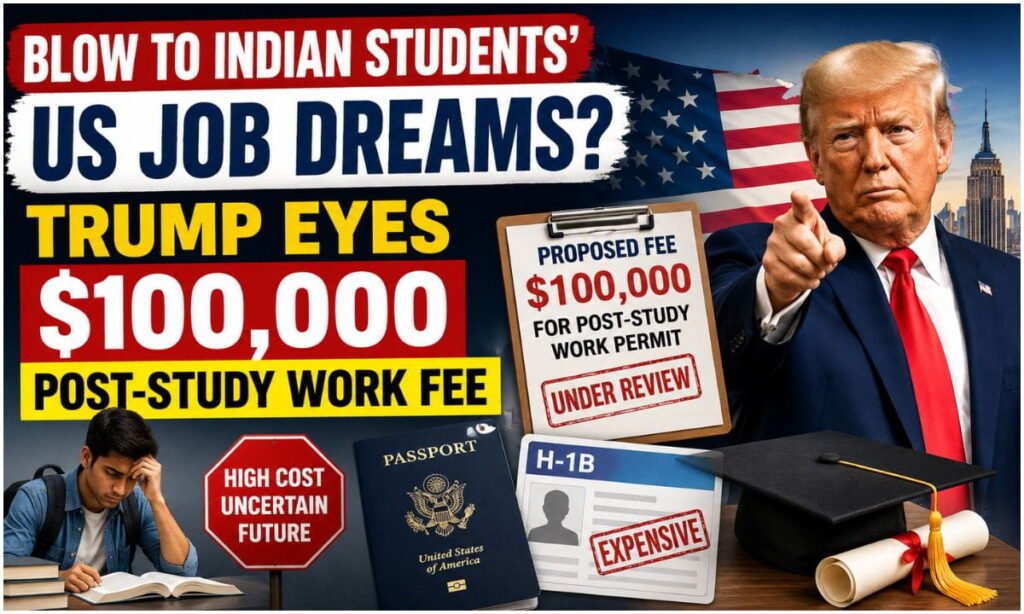
Trump $100000 Post Study Work Fee – What Exactly Is Being Proposed?
The latest reports indicate that the administration is considering attaching a Trump $100000 Post Study Work Fee to the Optional Practical Training program, which permits eligible international graduates to work in the United States for up to three years, depending on their field of study. OPT is not a niche program. Government data shows that approximately 419,000 international graduates were employed under the program in 2024, making it one of the largest and most important bridges between international education and the American workforce.
For those unfamiliar with how this system works, OPT allows international students on an F-1 visa to work in a job related to their field of study for up to twelve months after completing their degree. Students who graduate in STEM fields—science, technology, engineering, and mathematics—are eligible for a 24-month extension, bringing their total eligible work period to three years. This extension has been an enormous draw for Indian students in particular, most of whom pursue master’s degrees in computer science, data science, engineering, and related technical fields precisely because those disciplines qualify for the extended OPT window. It is often during this OPT period that international graduates are sponsored by employers for the H-1B visa, the primary route to longer-term skilled work authorization in the US.
If a $100,000 Post Study Work Fee were attached to OPT, it would represent an entirely new financial barrier at a stage where none has previously existed. Currently, students pay relatively modest processing fees to apply for OPT authorization. A six-figure fee would be a categorical shift, effectively pricing out all but the wealthiest students or those whose employers are willing to foot an enormous bill on their behalf—something that is exceedingly rare for entry-level hires straight out of a master’s program.
It’s worth noting the current status of the plan. A White House official said there was no imminent policy change, but didn’t deny the proposal was under consideration. In other words, this is not yet a signed executive order or a formal rule published in the Federal Register. It is, as of now, an idea being actively deliberated inside the administration, reportedly discussed among officials weighing its economic and political consequences. That said, given the pace at which this administration has moved on other immigration matters this year, students and universities are not treating this as an idle rumor.
The Backstory: How the $100,000 Post Study Work Fee Figure Became the Administration’s Favorite Number
To understand why this new OPT proposal is landing with such force, it helps to rewind to September 2025, when the administration first introduced the $100,000 Post Study Work Fee figure into the immigration conversation—this time attached to H-1B visas. President Trump ordered an annual $100,000 fee be added to H-1B skilled worker visas, creating potentially major repercussions for the tech industry where such permits are prolific. Announcing the move from the Oval Office, Trump told reporters, “The main thing is, we’re going to have great people coming in, and they’re going to be paying.”
The H-1B program has always been closely tied to Indian talent. The United States awards 85,000 H-1B visas per year on a lottery system, with India accounting for around three-quarters of the recipients. There are as many as 730,000 H-1B holders in the US and an additional 550,000 dependants, including spouses and children, representing nearly 1.3 million US residents. Given how central Indian professionals are to this visa category, any change to H-1B rules inevitably becomes an Indian immigration story as much as an American policy story.
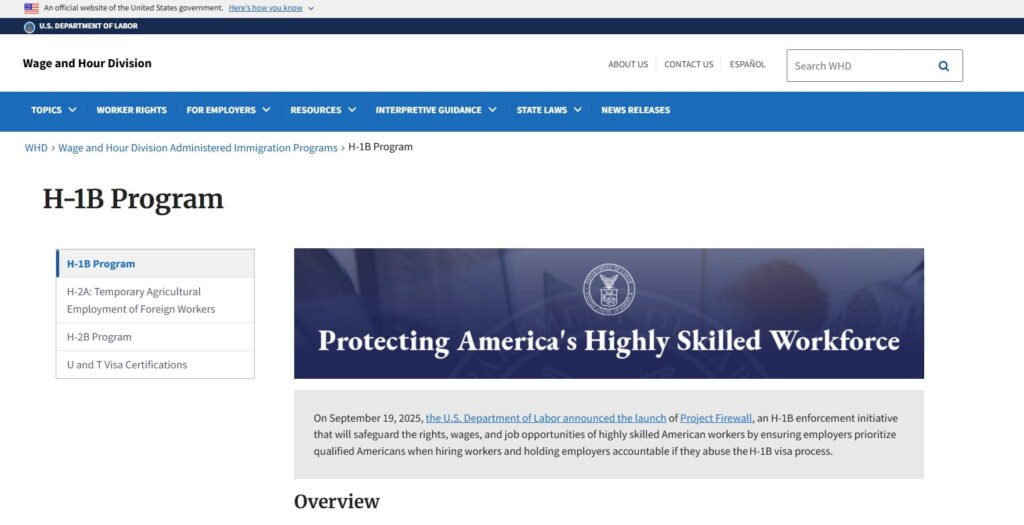
The initial announcement caused chaos. The changes to the H-1B visas rattled the tech industry and left US companies scrambling to figure out the implications, while hasty clarifications from the White House that the new charge would be a one-off payment rather than the annual fee originally announced only added to the uncertainty. The confusion was not just bureaucratic noise—it had real, immediate, human consequences. There was reportedly panic on an India-bound Emirates flight after the announcement, with many Indian passengers worried they might not be able to return to the US, prompting some to disembark just before takeoff and delaying the flight by around three hours.
Officials later tried to narrow the scope of the fee to manage the backlash. Notably, the order would not apply to future extensions, transfers, or renewals for H-1B visa workers already in the United States, and was set to expire in one year unless extended. Even so, the psychological and financial shock had already rippled across the community of Indian students and professionals who saw the H-1B pathway, imperfect as it always was, suddenly become dramatically more expensive and uncertain.
The fee did not survive unchallenged. The administration’s attempt to introduce the $100,000 charge tied to H-1B visas drew strong criticism from the technology industry and was ultimately halted after a federal appeals court in Boston blocked the government from enforcing it. This is a critical detail: the H-1B version of this fee is not currently in force. It was blocked in court. And yet, rather than abandoning the six-figure fee concept altogether, the administration appears to be redirecting it toward a different target—OPT—while also narrowing the original H-1B fee’s application.
SNAP Junk Food Ban 2026: Full State-by-State Waiver List, Court Update Aur Restricted Food List
Following intense pushback from technology entities, which contended that escalating regulatory expenses would jeopardise access to foreign skilled labour, officials reportedly scaled back the coverage of the H-1B fee framework to apply exclusively to specific foreign specialists entering the US directly under the H-1B classification. Meanwhile, the prospective OPT regulation would directly impact international scholars already matriculated at US universities—a notably different and, in some ways, more vulnerable population than incoming H-1B applicants, since these are students who have already enrolled, already paid tuition, and already built their post-graduation plans around the existing rules.
Why Indian Students Are Uniquely Exposed ?
No other country sends as many students to the United States who go on to use these work-authorization pathways at the scale India does. Data released by the US Department of Homeland Security showed there were 422,335 Indian students in the United States in 2024, an increase of 11.8 percent on the year before. That is a staggering number, and it reflects a decades-long trend of Indian families viewing US graduate education, particularly in STEM fields, as one of the most reliable pathways to global career mobility.
The reason Indian students are disproportionately affected by any OPT or H-1B fee comes down to a few structural realities. First, Indian graduate students are heavily concentrated in computer science, engineering, and data-focused master’s programs—exactly the disciplines that qualify for the 24-month STEM OPT extension and that feed most directly into H-1B sponsorship. Second, unlike students from wealthier backgrounds in some other countries, a large proportion of Indian students finance their US education through significant loans taken out by their families, loans that are implicitly predicated on the assumption that a few years of US work experience and salary will make repayment feasible.
Third, the H-1B lottery system itself has long been skewed toward Indian applicants simply because of the sheer volume of Indian nationals in the pipeline, meaning any additional cost or restriction imposed on the H-1B or OPT stage compounds against an already difficult odds game.
Put simply: when the US government raises the price of staying and working after graduation, it is not spreading that burden evenly across all international students. It is landing hardest on the population that is both the largest in absolute numbers and the most reliant on that post-study work period to make the enormous financial investment of a US degree pay off.
The Human Cost: Dreams Deferred, Loans Unpaid
It is easy to discuss visa fees in the abstract language of policy and economics, but the human stories underneath these headlines are what make this issue resonate so deeply in India. Consider the experience described by one aspiring engineering student from Bengaluru, who had meticulously planned his path to a top-tier American university, hoping to eventually convert his student status into an H-1B visa.
He explained that back when the fee was lower, it was still something students could pin their hopes on, and that converting a student visa to H-1B status would have been comparatively easier. Following the fee announcement, he described his central ambition as derailed, in his words a deep disappointment to plans he had built his future around.
This is not an isolated sentiment. Across student forums, WhatsApp groups of prospective applicants, and admissions counseling offices in cities like Delhi, Mumbai, Hyderabad, and Chennai, the mood has shifted from cautious optimism to genuine anxiety. Families who had budgeted for tuition, living expenses, and standardized test preparation now find themselves recalculating whether the entire endeavor still makes financial sense if a six-figure fee stands between a degree and the ability to legally work.
There is also a broader emotional dimension. For many Indian students, the ambition to study and work in the US is not purely transactional. It is tied to notions of merit, opportunity, and escaping the intense competition of India’s own domestic job market for high-skill roles. When that door appears to be closing, or at minimum becoming prohibitively expensive, it forces a painful reassessment of identity and plans that, for some students, have been in the making since high school.
Mixed Reactions: Not Everyone Sees It as Purely Negative
Interestingly, reactions within India to the earlier H-1B fee hike were not universally negative, and this nuance is worth capturing because it will likely reappear if the OPT fee moves forward. Some voices in India’s higher education and technology establishment have framed the fee hikes as a “blessing in disguise.” The director of the Indian Institute of Technology Madras, V. Kamakoti, remarked that he saw the situation as a blessing in disguise and suggested there was reason to thank President Trump for it.
The logic behind this optimistic framing generally runs as follows: if it becomes significantly harder or more expensive for Indian graduates to remain in the United States, that talent does not simply vanish—it may instead redirect toward India’s own booming technology and startup ecosystem, or toward other countries actively courting skilled migrants, such as Canada, the United Kingdom, Germany, and Australia. Proponents of this view argue that India has spent years lamenting its “brain drain” to the US, and that a policy shock of this magnitude could, paradoxically, accelerate a “brain gain” as talented engineers, researchers, and entrepreneurs choose to build careers closer to home instead.
There is also a strand of public commentary suggesting the fee could benefit domestic Indian companies and startups by making it easier to retain graduates who might otherwise have left immediately after their studies. The argument holds that American companies that have long relied on OPT and H-1B labor as a cost-effective source of skilled talent would be the real long-term losers if the pipeline dries up, since replacing that talent domestically in the US is neither quick nor simple given existing shortages in fields like software engineering and data science.
That said, this optimistic reframing tends to come more from commentators, educators, and industry observers than from the students and families who are directly and immediately affected. For a student midway through an expensive graduate program in the US, or a family that has already committed to a loan based on a particular set of assumptions, the “blessing in disguise” argument offers little practical comfort in the short term, even if it may hold some truth over a longer horizon.
The Legal and Political Uncertainty Surrounding the Fee
One of the most important things to understand about this story is how unsettled the legal and political ground still is. The original H-1B fee, once announced with considerable fanfare, ran almost immediately into legal trouble. A federal appeals court in Boston blocked the government from enforcing the $100,000 H-1B fee just last week relative to current reporting, marking a significant setback for the administration’s broader immigration fee strategy.
This legal defeat is central to understanding why the OPT proposal has now emerged as a live possibility. Having been rebuffed on the H-1B front by the courts, and having already narrowed that fee’s scope in response to technology industry pressure, the administration appears to be exploring whether a similarly steep fee could be imposed at an earlier stage of the pipeline—OPT—potentially through different legal or regulatory authority than the one that was successfully challenged in court.
It’s also worth noting the political dynamics at play. Technology entities pushed back hard against the H-1B fee, arguing that escalating regulatory expenses would jeopardize access to foreign skilled labor, and it is highly likely that universities, which depend enormously on international student tuition revenue, along with the broader higher education lobby, would mount a similarly vigorous opposition to an OPT fee. Universities have significant financial incentives tied to international enrollment, and a fee that makes the US a dramatically less attractive destination for graduate study could hit university budgets, particularly at institutions with large STEM graduate programs, quite hard.
Critics outside the government have been blunt in their assessment. Some commentators and immigration experts have reportedly characterized the OPT fee proposal as an ill-conceived idea, warning that it risks damaging America’s ability to retain global talent and could inflict serious financial harm on universities that depend on international student revenue streams. Whether this criticism will be enough to stop the proposal before it becomes formal policy remains to be seen, especially given that a formal announcement, if it comes, would likely trigger its own wave of legal challenges, much like the H-1B fee did.
What This Means for the Broader US-India Education and Talent Relationship ?
Beyond the immediate impact on individual students, this unfolding situation carries larger implications for the US-India relationship in education and technology. For years, the flow of Indian students to American universities, and their subsequent employment in US companies, has functioned as one of the most consequential threads binding the two countries together economically and culturally. Indian-origin professionals occupy leadership positions across America’s largest technology companies, and the pipeline of talent from Indian universities into American graduate schools and then into the American workforce has been mutually reinforcing: American companies get access to a deep pool of technically skilled workers, Indian professionals gain access to higher salaries and career growth, and Indian families see tangible returns on investment in education.
A sustained policy of erecting six-figure financial barriers at multiple stages of this pipeline—first at the H-1B stage, and now potentially at the OPT stage—threatens to disrupt this long-standing arrangement in ways that could take years to fully play out. If fewer Indian students choose to pursue US graduate education because the post-study work pathway becomes prohibitively expensive or uncertain, the effects will not be limited to the students themselves. US universities could see enrollment declines in graduate STEM programs that have long relied heavily on international, and particularly Indian, students to fill seats and contribute tuition revenue. American technology companies could face a tighter domestic labor market for specialized technical roles. And India itself could see either a redirection of talent toward domestic opportunities or toward competing destination countries actively working to position themselves as more welcoming alternatives.
Countries like Canada, the United Kingdom, Germany, and Australia have, in recent years, adjusted their own immigration policies specifically to attract skilled graduates and workers who might otherwise have chosen the United States. Should the US impose a $100,000 OPT Post Study Work Fee, it would likely accelerate interest in these alternative destinations among prospective Indian students who are currently weighing where to apply for graduate school. Education consultants in India have already reported increased inquiries about programs in Canada, the UK, and continental Europe in the wake of the H-1B fee announcement last year, and a formal OPT fee would likely intensify that trend considerably.
What Should Indian Students and Families Do Right Now?
Given the uncertainty, it is worth being clear-eyed about what is actually known versus what remains speculative. As of now, the OPT fee is a proposal under consideration, not a finalized rule. A White House official has stated there is no imminent policy change, even while not ruling out that the idea is being discussed internally. This means that current and prospective students should not assume the fee will definitely take effect, nor should they assume it definitely will not.
For students who are already in the United States on OPT, or who are currently enrolled and planning to apply for OPT in the near future, the most prudent course of action is to stay closely engaged with their university’s international student office, which will typically be among the first to receive and disseminate any formal guidance if and when the administration moves from consideration to action. Immigration attorneys who specialize in student and employment-based visas will also be a critical resource for understanding how any new rule, if implemented, might apply to students already in the pipeline versus those applying afresh.
For prospective students still in the process of deciding where to apply for graduate study, this development adds one more variable to an already complex decision matrix that includes program quality, cost of tuition and living expenses, scholarship availability, and career outcomes. It may be worth diversifying application strategies to include a mix of US programs alongside strong options in Canada, the UK, Australia, and Europe, so that the eventual decision is not overly dependent on a single country’s immigration policy trajectory, which as this past year has shown, can shift with startling speed.
Financially, families who have taken or are considering education loans specifically premised on US post-study earnings should build some contingency into their planning. This does not necessarily mean abandoning US study plans altogether, but it may mean having a realistic backup scenario in mind, whether that involves returning to India after the degree, pursuing an alternative country for work authorization, or exploring other visa categories that might remain unaffected by this specific fee proposal.
The Bigger Picture: A Pattern, Not an Isolated Incident
Stepping back from the specifics of the OPT proposal, it is worth situating this story within the broader pattern of immigration policy under the current administration. The H-1B fee announcement, the subsequent narrowing of its scope after industry pushback, its partial blockage in federal court, and now the emergence of the OPT fee idea all point to an administration that is persistently exploring mechanisms to reduce the flow of foreign skilled labor into the United States, or at minimum to extract significant new revenue from those who wish to work there, even as it faces consistent legal and industry resistance to each individual attempt.
This pattern suggests that Indian students and the broader community of international students in the US should expect continued volatility on this front rather than a single, settled outcome. Even if the OPT fee proposal does not proceed in its currently reported form, it would not be surprising to see other mechanisms explored in the future, whether through fee structures, visa caps, processing changes, or other regulatory tools available to the executive branch.
For India specifically, this represents a moment of genuine strategic significance. The country’s technology sector, its startup ecosystem, and its higher education institutions all have a stake in how this plays out. Whether the ultimate effect is a genuine “brain drain reversal,” as some optimists suggest, or simply a painful and costly disruption to hundreds of thousands of individual students’ carefully laid plans, likely depends on factors that are still unfolding, including how vigorously universities and the technology industry push back, how courts continue to rule on these fee structures, and how the political winds shift in Washington over the coming months.
Conclusion
The prospect of a $100,000 fee attached to the Optional Practical Training program represents one of the most consequential potential shifts yet in the landscape facing Indian students hoping to build careers in the United States. Coming just months after the chaotic rollout, partial retreat, and court-imposed block on a similarly structured H-1B fee, the OPT proposal signals that the administration remains committed to using steep financial barriers as a tool of immigration policy, even as it continues to face substantial legal and industry resistance.
For the roughly 422,000 Indian students currently studying in the United States, and for the many more contemplating whether to apply, the message emerging from Washington is one of profound uncertainty. Plans that were once built on relatively stable assumptions about post-graduation work authorization now require constant reassessment. Families weighing significant financial investments in US education must now factor in the very real possibility that the return on that investment could be complicated, delayed, or in the worst case, foreclosed entirely by a fee few can realistically afford.
Whether this proposal ultimately becomes formal policy, gets blocked by courts as its H-1B predecessor was, or fades away amid industry and university pushback, remains to be seen. What is clear is that the era of the United States being viewed as a straightforward, predictable destination for Indian academic and professional ambition has, at least for now, given way to something far more uncertain. Students, families, universities, and employers on both sides of this relationship will be watching closely in the weeks ahead to see whether this latest six-figure fee moves from deliberation to reality, and what it might mean for the future of one of the world’s most important educational and professional pipelines.
Official Sources
| H-1B program | CLICK HERE |
FAQ’s on Post Study Work Fee
Has the proposed $100,000 post-study work fee been officially approved?
No. As of now, there is no officially implemented federal policy requiring international students to pay a $100,000 work fee after their studies. Reports and proposals should be verified through official U.S. government sources before being considered final.
If such a proposal becomes law, which students would be affected?
If this proposal is introduced and approved, it would primarily affect international students wishing to remain in the United States after graduation through post-study employment programs like Optional Practical Training (OPT) or work visa programs. Its exact scope would depend on the final legislation.
Would Indian students be specifically targeted?
No. Any federal immigration or work-related fee implemented by the U.S. government would generally apply based on visa category or immigration status, not nationality. However, Indian students could be significantly impacted, as they constitute one of the largest groups of international students in the U.S.
What should current and prospective Indian students do?
Students should continue to adhere to existing visa and post-study work regulations while monitoring updates from official sources such as the U.S. Department of State, U.S. Citizenship and Immigration Services (USCIS), and their university’s international student office.
Would this proposal immediately affect current F-1 visa holders?
No. Until a new law or regulation is officially implemented, current F-1 visa holders will remain subject to existing immigration rules regarding their studies, Optional Practical Training (OPT), and work authorization.