US Immigration Crackdown 2026: The numbers out of the State Department this year are hard to ignore. More than 100,000 non-immigrant visas have been revoked since President Trump returned to office, including roughly 8,000 student visas and 2,500 employment-based visas, a jump of about 150 percent compared with the prior year. What makes 2026 different from earlier immigration crackdowns is not just the scale, it is where the trigger is coming from. Visa holders are no longer only being screened once at the consulate. They are now being continuously monitored after entry, and a single flagged social media post, an unreported address change, or a few hours of unpaid side work can be enough to end months or years of lawful status.
This is the reality behind the phrase ‘America First’ immigration enforcement in 2026, and it is catching thousands of students, workers and families off guard because the mistakes triggering revocation are often small, technical, and not something most visa holders would even think to worry about. This article breaks down exactly which mistakes are costing people their visas right now, what the current travel ban and public charge rules mean for you, and what steps actually protect your status. We will be updating this article monthly as the State Department, USCIS, and federal courts issue new enforcement data and rulings.
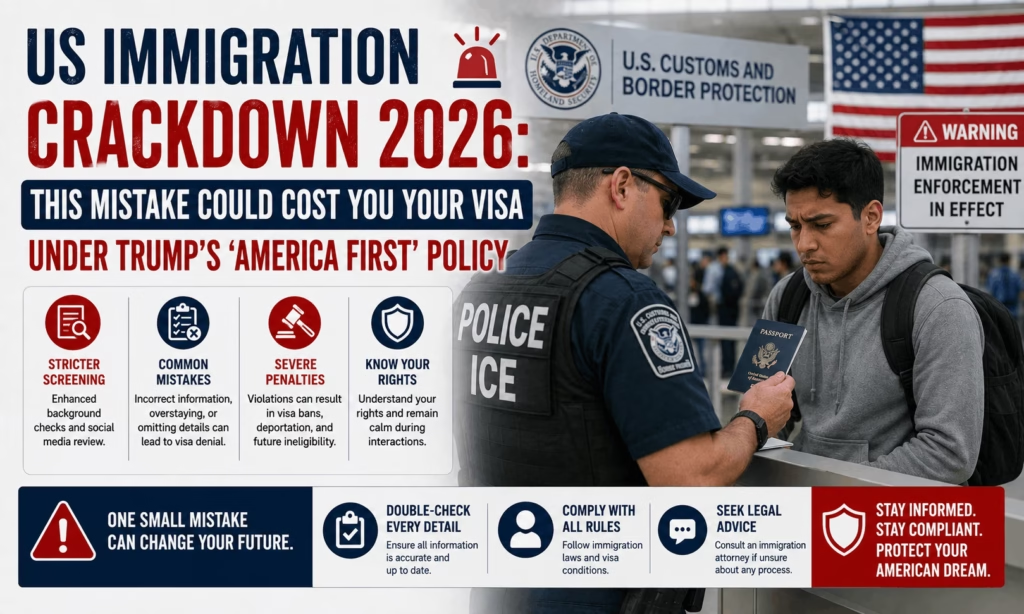
US Immigration Crackdown Key Numbers
| Total non-immigrant visas revoked since Trump’s return to office | Over 100,000 |
| Student (F and J) visas revoked | Approximately 8,000 |
| Employment-based visas revoked | Approximately 2,500 |
| Year-over-year increase in revocations | About 150 percent |
| Countries under full or partial travel ban (Proclamation 10998) | 39 countries plus Palestinian Authority document holders |
| Countries under separate immigrant visa freeze (public charge basis) | 75 countries |
| OPT-related visa revocations, Q1 2026 alone | Over 500 |
| ICE arrests with no criminal record, early 2026 | Nearly 40 percent of all arrests |
| Days after status termination before unlawful presence begins accruing | Immediately, no grace period after unauthorized employment is detected |
The Mistake Most Visa Holders Don’t See Coming: Continuous Vetting
For decades, a US visa was treated as a one-time decision made at the consulate. That assumption no longer holds in 2026. Immigration attorneys tracking the current enforcement wave describe a shift toward what one legal source calls treating visa eligibility as something that can be reassessed after issuance, not just at the point of entry. Automated flags, inter-agency information sharing, and what officials call continuous vetting mean that behavior after your visa is approved, not just what you wrote on your original application, can trigger a revocation years later.
Some of these are described by attorneys as prudential or precautionary revocations, meaning there is often no formal allegation of fraud or violation at all. In these cases the existing visa stamp is simply invalidated and the holder must reapply and sit for a brand new in-person consular interview, at a time when interview backlogs in several countries, including India, have stretched appointment availability to months. If you are inside the United States when this happens, your day-to-day status may still be technically valid, but your ability to re-enter after any international travel is not, which is why immigration lawyers are now advising many visa holders to avoid non-essential travel abroad entirely until their situation is clarified.
SSDI Fast-Track Approval 2026: Compassionate Allowances, QDD
Quebec Experience Program 2026: PEQ Reopening Dates, Eligibility
$5000 CRA Data Breach Settlement 2026: Who Qualifies and How to Claim
Social Media Screening: The Mistake That’s Catching Students and Workers Off Guard
Since March 30, 2026, expanded social media screening has become one of the fastest-growing sources of visa trouble, and it affects far more than what most people would call political activity. Consular officers and post-issuance review teams are checking public and, in some cases, disclosed private social media activity for content that could be read as supportive of groups or activities the US government considers hostile to its interests. Reports confirm that some student visas have already been revoked over online activism or participation in protests flagged during this screening process.
It is worth being precise here, because the rules are not as blanket as many assume. Political content that is common in the social media environments of countries facing heightened scrutiny, such as criticism of authoritarian governments or documentation of human rights concerns, is generally not treated negatively by consular officers reviewing those specific applicants. The risk comes from content that could plausibly be misread as connected to groups or activity flagged under current US security priorities. Given how much judgment call is involved in that distinction, immigration advocates are advising visa holders in sensitive categories to think carefully before posting, sharing, or even liking content on topics tied to conflict, protest movements, or groups that could be characterized as extremist, even when the original intent was clearly educational or personal.
Unauthorized Employment: Still the Single Biggest Trigger for Status Loss
If social media is the newest risk, unauthorized employment remains the oldest and most common one, and 2026 enforcement data shows it is accelerating fast. USCIS activated a new fraud detection algorithm that cross-references SEVIS records with IRS payroll data and site visit findings, and the agency reports the system is now flagging roughly 25 percent more anomalies than it did before the update. Enhanced employer site visits, now a routine part of OPT oversight, produced more than 500 visa revocations in the first quarter of 2026 alone.
The legal consequence of unauthorized work is immediate and severe. Under federal regulation, unauthorized employment voids F-1 status instantly the moment it is detected, and critically, no grace period applies once that termination happens. Every day spent in the country after that point begins counting toward the unlawful presence bars under federal law, which can lock a person out of returning to the US for three or ten years depending on how long the unlawful presence lasted before departure. What surprises many students specifically is how broadly unauthorized employment gets defined. Accepting payment for a brand collaboration, receiving free products in exchange for promotional content, or working even briefly for an employer before a Designated School Official updates the SEVIS record can all qualify.
SEVIS Termination: The Paperwork Mistake With Outsized Consequences
For international students on F-1 and exchange visitors on J-1 status, keeping the SEVIS record accurate is not optional bureaucracy, it is the entire legal basis for remaining in status. SEVIS terminations most commonly stem from four causes: unauthorized employment, falling below the required full-time course load without prior DSO authorization, overstaying the post-completion grace period, or leaving a program without providing proper notice. The moment a Designated School Official enters a termination, the record shifts to “Terminated” status and unlawful presence begins accruing the very next day.
A terminated SEVIS record does more than end your current stay. It bars re-entry to the US on your existing visa, automatically cancels any authorized Optional Practical Training, and blocks eligibility for a change of status application filed from inside the country. Reinstatement is possible in theory, through a Form I-539 filed within five months of the violation, but it requires proving exceptional circumstances, and immigration attorneys note this relief is rarely granted in cases connected to fraud findings. One detail that trips up even conscientious students is how simple the underlying mistake usually is: a changed address that was never reported to the DSO, or a program change that was never formally logged, can be exactly the kind of small oversight that opens the door to a termination review months later.
Canada Set to Finalize LNG Agreement With Germany’s SEFE for Ksi Lisims LNG Project
New UK Immigration Rules 2026: What Changes for Visa Applicants?
Travel Ban and Public Charge Freeze: What Actually Changed
Two separate policies are currently reshaping who can even get a new visa in the first place, and confusing them is itself a common and costly mistake. The first is Presidential Proclamation 10998, signed December 16, 2025 and effective January 1, 2026, which expanded an earlier travel ban from 19 countries to 39 countries, plus anyone travelling on Palestinian Authority-issued documents. Of those 39, 19 face a full suspension covering every visa category, while the remaining 20 face partial restrictions depending on visa type. Crucially, this ban only applies to people who were outside the United States on the effective date and did not already hold a valid visa, so anyone with a visa issued before January 1, 2026 remains unaffected by this specific rule.
The second policy is entirely separate and easy to confuse with the first. Effective January 21, 2026, the State Department paused immigrant visa processing, the kind that leads directly to a green card, for nationals of 75 countries, citing what officials describe as public charge concerns tied to factors like health, age, English proficiency, and financial resources. This pause does not affect tourist, student, or most employment-based visas, only the immigrant visa track. It was announced administratively rather than through a formal presidential proclamation, and unlike the 39-country ban, it has not been published in the Federal Register, which is part of why immigration lawyers describe its legal footing as more contested. A federal court vacated the broader 39-country adjudication pause affecting Venezuela, Cuba, and Nicaragua on June 5, 2026, and rejected the government’s request to pause that ruling on July 15, 2026, so processing for those specific nationalities has resumed while the government’s appeal remains pending, a reminder that this entire area of law is still actively moving through the courts.
Birth Tourism and Visa Fraud: A Newer Enforcement Target
Alongside status violations, the State Department has expanded a specific crackdown on birth tourism networks, describing any visa obtained for the purpose of concealing birth-related travel as fraud that can result in denial, revocation, or permanent future inadmissibility. Recent enforcement action tied to this initiative has spanned investigations across Africa, Europe, and North Africa, resulting in hundreds of additional visa revocations and the disruption of organized fraud operations. This is a useful reminder that the current enforcement environment is not limited to status violations after entry, consular officers are also being instructed to scrutinize the stated purpose of travel far more closely at the application stage itself.
How to Protect Your Status: Practical Steps That Actually Matter
Report every address, program, and enrollment change to your DSO or employer’s HR and immigration team immediately rather than waiting for a renewal cycle, since an outdated SEVIS or petition record is one of the easiest things for an automated system to flag. Confirm any paid or unpaid work, including brand deals, content promotion, or informal freelance projects, is explicitly authorized under your specific visa category before you start, not after. Review your social media presence with a critical eye toward content that could be misread out of context by a screening algorithm, even if your intent was never political or provocative. Avoid non-essential international travel if your visa or status has any pending review, flag, or ambiguity, since re-entry is where many of these issues surface first. Keep copies of your I-94, visa stamp, approval notices, and any correspondence with USCIS or your DSO in one accessible place, since a fast, well-documented response is often the difference between a manageable review and a termination. If you receive any notice suggesting a review, revocation, or SEVIS flag, contact an immigration attorney immediately rather than waiting to see if it resolves on its own, given how narrow the reinstatement window and legal remedies currently are.
Official Resources: Status Checks, Case Tracking and Verification
| Resource | Purpose | Official Link |
|---|---|---|
| Check Visa Status | Track a pending or issued visa application | ceac.state.gov/CEACStatTracker |
| USCIS Case Status Online | Check the status of a pending petition | egov.uscis.gov/casestatus |
| SEVP Portal (Students) | Check SEVIS record status and requirements | studyinthestates.dhs.gov |
| State Department Travel Advisories | Current travel ban and country-specific restrictions | travel.state.gov |
| my Social Security Account (work authorization) | Verify employment authorization records | ssa.gov/myaccount |
| US Embassy and Consulates | Local visa services, interview scheduling, alerts | usembassy.gov |
| USCIS Contact Center | Report issues or ask about a pending case | uscis.gov/contactcenter |
FAQs
What is the biggest mistake causing visa revocations in 2026?
Unauthorized employment remains the single most common trigger, followed closely by flagged social media content and unreported SEVIS or status changes such as address updates or program changes.
Can my visa be revoked even if I never broke a law?
Yes. Attorneys describe many recent cases as prudential or precautionary revocations, where there is no formal allegation of fraud or a specific violation, but the visa is still invalidated pending additional review or a new interview.
Does the 39-country travel ban affect people who already have a valid US visa?
No. The travel ban under Proclamation 10998 only applies to people who were outside the US on the effective date and did not already hold a valid visa on that date. Existing valid visas are not affected by this specific rule.
What happens if my SEVIS record is terminated?
A terminated SEVIS record ends your legal student status immediately, cancels any authorized practical training, blocks in-country change of status applications, and starts the clock on unlawful presence the next day, unless you successfully file for reinstatement within five months.
Is the 75-country immigrant visa freeze the same as the travel ban?
No. The travel ban under Proclamation 10998 covers 39 countries and affects most visa categories. The separate 75-country freeze, effective January 21, 2026, only pauses immigrant visa (green card track) processing and cites public charge concerns rather than security grounds.
Can I still travel internationally if I’m on a valid visa in 2026?
You can, but immigration attorneys are broadly advising against non-essential international travel for anyone whose status could be flagged, since re-entry screening is where many recent revocations and denials have surfaced.
People Also Ask
What triggers a US visa to be revoked?
Common triggers include unauthorized employment, flagged social media content, unreported SEVIS or address changes, criminal charges even without conviction, and administrative or security-related reviews unrelated to any specific violation.
How do I know if my visa has been revoked?
Some people only discover a revocation when they attempt to travel or check their status online, since notification is not always sent proactively, which is why regularly checking your case status through official portals is recommended.
Can a revoked visa be reinstated?
A revoked visa itself generally cannot be reinstated, and the holder must reapply and typically attend a new consular interview, though status inside the US may remain valid separately from the visa stamp used for re-entry.
Does overstaying a visa always lead to deportation?
Overstaying creates immediate grounds for removability under federal law, and even a single day past the authorized period establishes a basis for deportation proceedings, though not every overstay results in enforcement action.
Conclusion
The scale of the current US immigration crackdown, over 100,000 visas revoked, a 39-country travel ban, a separate 75-country immigrant visa freeze, and hundreds of OPT-related terminations in a single quarter, makes clear that 2026 enforcement is both broader and more automated than anything visa holders have dealt with before. What stands out most is how ordinary the underlying mistakes often are: an unreported address change, a small side gig, a social media post shared without a second thought. None of these require intent to cause serious consequences under the current review system. The best protection right now is treating visa compliance as an ongoing responsibility rather than a one-time application step, documenting everything, and getting legal advice quickly the moment anything looks even slightly off. We will keep updating this article every month as new enforcement data, court rulings, and policy changes are released.
EITC Refund 2026: IRS Confirms Up To $4,427 for Taxpayers With One Child
OAS Payment Increase August 2026: Confirmed Amounts, Payment Date, and the Annual GIS Reset !