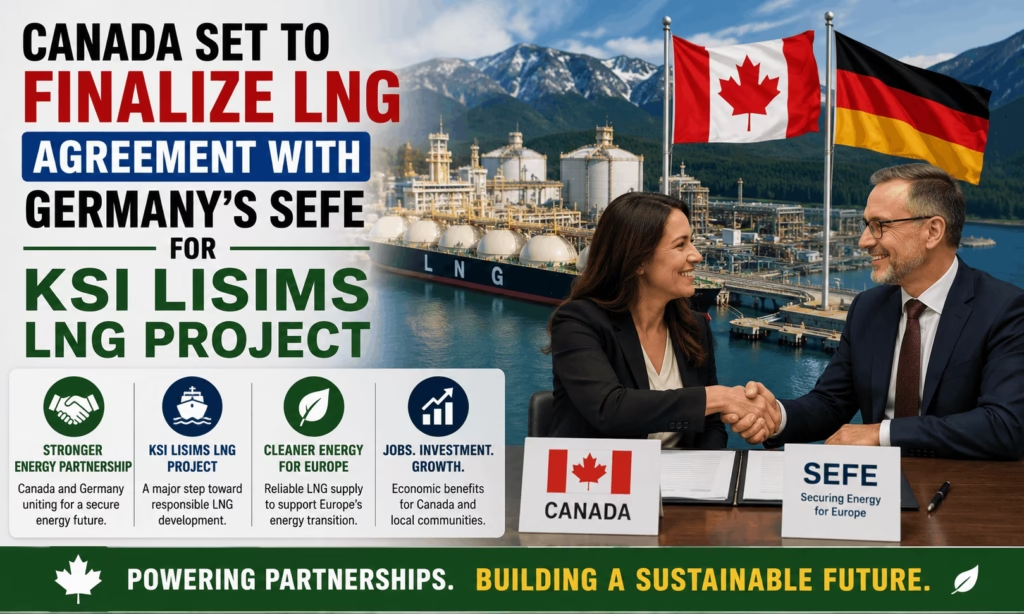
Canada Set to Finalize LNG Agreement With Germany’s SEFE for Ksi Lisims LNG Project: Canada’s Minister of Energy and Natural Resources, Tim Hodgson, stood in Vancouver on May 27, 2026, alongside British Columbia officials and Nisga’a Nation leadership to announce a Heads of Agreement between Ksi Lisims LNG and Germany’s state-controlled gas importer SEFE, marking Canada’s first agreement to supply liquefied natural gas directly to a European buyer. Under the deal, SEFE agreed to purchase one million tonnes per annum of LNG on a free-on-board basis for up to 20 years, with deliveries expected to begin in the early 2030s, though the agreement remains contingent on both sides finalizing a definitive Sales and Purchase Agreement.
Since that announcement, the story has moved considerably further. Ksi Lisims signed benefits agreements with three additional First Nations in the Prince Rupert region in June, prompting two of them to drop legal challenges against the project, and a second German buyer signed a separate offtake agreement shortly after SEFE, pushing total contracted volume toward 7 million tonnes annually. Then, in late July 2026, German utility Uniper went a step further than SEFE by signing Canada’s first fully binding long-term LNG export contract to Europe, agreeing to purchase 2 million tonnes per year starting in 2032. This article lays out the complete, updated timeline of Canada’s Ksi Lisims LNG agreements with German buyers, what remains before a final investment decision, and the hurdles still standing in the project’s way. We’ll be updating this article monthly as new offtake agreements, legal developments, and the final investment decision are confirmed.
What Is the Ksi Lisims LNG Project?
Ksi Lisims LNG is a proposed floating liquefied natural gas export facility planned for Pearse Island on the northern coast of British Columbia, within Nisga’a Nation treaty lands near the mouth of the Nass River. Once operational, it is designed to produce 12 million tonnes of LNG annually, which would make it Canada’s second-largest LNG export facility after LNG Canada. The project is a partnership between the Nisga’a Nation, the Rockies LNG consortium of Canadian natural gas producers, and Houston-based Western LNG, with natural gas delivered to the facility through the associated Prince Rupert Gas Transmission pipeline.
The project has been positioned by Ottawa as one of Canada’s flagship efforts to diversify energy exports beyond the United States, particularly toward Asian and now European markets, at a moment when the federal government has publicly emphasized reducing economic reliance on a single trading partner.
The SEFE Heads of Agreement: What Was Actually Signed
The May 27, 2026 agreement between Ksi Lisims and SEFE was signed as a Heads of Agreement at the Canadian embassy in Berlin, in the presence of Canada’s ambassador to Germany, Vera Alexander, and Bernhard Kluttig, head of the German Federal Ministry for Economic Affairs and Energy’s department for security, gas, and hydrogen. It is important to understand what this type of agreement does and does not represent. A Heads of Agreement outlines the core commercial terms both parties intend to finalize, but it is not itself a binding purchase contract. The SEFE deal explicitly remains contingent on the two parties negotiating and signing a definitive Sales and Purchase Agreement before it becomes enforceable.
Under the terms outlined, SEFE agreed to purchase one million tonnes per annum of LNG for up to 20 years, with first deliveries expected in the early 2030s. German Economy Minister Katherina Reiche described the agreement in explicitly geopolitical terms, saying that by working more closely together, both countries strengthen their supply chains and make their economies more resilient to global risks, a clear reference to Europe’s continued effort to move away from Russian energy dependence.
Who Is SEFE, and Why Does This Deal Matter to Germany?
SEFE, whose name stands for Securing Energy for Europe, was formerly a subsidiary of Russia’s Gazprom before the German government seized and nationalized the company in 2022 for approximately 6.3 billion euros, roughly C$10.1 billion, after Gazprom abandoned the business amid the fallout from Russia’s invasion of Ukraine. Since then, SEFE has been actively rebuilding its supplier portfolio away from Russian gas, and the Ksi Lisims agreement represents one of its efforts to diversify supply toward stable democratic partners in the Pacific and North American LNG market.
EITC Refund 2026: IRS Confirms Up To $4,427 for Taxpayers With One Child
A Second German Buyer and New Indigenous Support
Roughly two weeks after the SEFE announcement, Ksi Lisims signed a second offtake agreement with another German energy trader, bringing total contracted volume for the project to approximately 7 million tonnes annually, or about 58 percent of the facility’s full 12 million tonne nameplate capacity. In the same period, Ksi Lisims signed new benefits agreements with three neighboring First Nations in the Prince Rupert region, the Gitxaala, Lax Kw’alaams, and Metlakatla, and as a direct result, two of these nations agreed to drop existing court challenges against the project’s regulatory approval, a meaningful development given that legal opposition from some Indigenous communities has been one of the project’s more persistent hurdles.
Uniper’s Binding Deal: Canada’s First Direct LNG Export Contract to Europe
The most significant recent development came in late July 2026, when Ksi Lisims signed a 20-year offtake agreement with German energy company Uniper, itself nationalized by Germany in a large-scale bailout in 2022 after it nearly collapsed financially. Unlike the SEFE Heads of Agreement, the Uniper contract is fully binding, making it Canada’s first confirmed binding long-term LNG export contract to Europe. Under the deal, Uniper will purchase 2 million tonnes per annum starting in 2032, with delivery to customers across Germany, the United Kingdom, Sweden, and the Netherlands. Federal officials framed the deal as evidence the project is advancing toward bankability, with government estimates suggesting Ksi Lisims could ultimately contribute roughly $15 billion to Canada’s GDP once operational.
Trump Birthright Citizenship Executive Orders: What Changed After Supreme Court Ruling
State-by-State SNAP Food Ban 2026: What’s Banned, Status Update
What Still Needs to Happen Before a Final Investment Decision
Despite this run of offtake agreements, Ksi Lisims has not yet reached a final investment decision, the point at which its backers commit the estimated $20 billion needed to actually build the facility. Industry analysts estimate the project’s owners need commitments for roughly 10 million tonnes annually, out of the 12 million tonne total capacity, before they can secure the construction financing required to sanction the project. With current contracted volume sitting around 7 to 9 million tonnes across all announced deals, one to two more offtake agreements of a similar size could be enough to clear that threshold.
Beyond offtake volume, three other pieces need to fall into place. The Prince Rupert Gas Transmission pipeline, which would carry natural gas roughly 900 kilometres from northeastern BC to the coastal facility, still faces legal challenges from some Indigenous groups who say their concerns about the pipeline’s approval were not adequately addressed. The North Coast Transmission Line, the BC Hydro-built power line needed to supply up to 600 megawatts of clean electricity to run the facility’s liquefaction process, was fast-tracked by the BC government in October 2025, with construction expected to begin in the summer of 2026, but it is not yet complete. Finally, environmental groups including Environmental Defence have publicly criticized the pace of announcements, arguing the underlying project still faces unresolved legal opposition and warning about methane emissions across its supply chain, even as the government continues to promote the facility’s net-zero electricity design, which is required to be net-zero ready by 2030 using BC Hydro’s clean grid rather than gas-fired liquefaction.
Ksi Lisims LNG Timeline: Key Milestones
| Date | Milestone |
|---|---|
| September 2025 | BC Environmental Assessment Certificate issued |
| November 2025 | BC Energy Regulator facility permit issued; project designated a federal Major Project |
| January 2026 | BC Hydro signs MOU to deliver up to 600 MW of clean electricity to the project |
| May 27, 2026 | Heads of Agreement signed with Germany’s SEFE for 1 Mtpa over 20 years (non-binding) |
| Early June 2026 | Second German offtake agreement signed; total contracted volume reaches roughly 7 Mtpa |
| June 2026 | Benefits agreements signed with Gitxaala, Lax Kw’alaams, and Metlakatla First Nations; two drop legal challenges |
| Late July 2026 | Binding 20-year offtake agreement signed with Uniper for 2 Mtpa, Canada’s first binding direct LNG export contract to Europe |
| Expected by end of 2026 | Final investment decision targeted by project backers |
| Early 2030s | First LNG deliveries expected to begin under the SEFE and Uniper agreements |
Confirmed Offtake Agreements
| Buyer | Volume | Contract Length | Status | Delivery Start |
|---|---|---|---|---|
| Shell | Undisclosed | 20 years | Signed purchase agreement | Not specified |
| TotalEnergies | Undisclosed | 20 years | Signed purchase agreement | Not specified |
| SEFE (Germany) | 1 Mtpa | 20 years | Heads of Agreement, non-binding, pending definitive SPA | Early 2030s |
| Second German trader | Undisclosed | Not specified | Signed offtake agreement | Not specified |
| Uniper (Germany) | 2 Mtpa | 20 years | Binding offtake agreement | 2032 |
Why This Deal Matters Beyond LNG Exports
For Germany and its European partners, the agreements represent continued diversification away from Russian gas dependence, spreading new long-term supply commitments across a democratic, politically stable exporter. For Canada, the deals mark a genuine shift, since prior Canadian LNG exports have overwhelmingly targeted Asian markets rather than Europe, and federal officials have repeatedly framed this expansion as part of a broader strategy to reduce economic dependence on the United States by opening new export routes. For the Nisga’a Nation, the project represents a rare example of an Indigenous nation holding direct equity ownership in a major energy export facility on its own treaty lands, a structure Nisga’a leadership has pointed to as a model of Indigenous-led resource development rather than one where Indigenous communities are simply consulted after the fact.
VA Burial Allowance 2026 Rates, Eligibility and How to Apply?
Form I-551 Confirmed Green Card Holders Enter US Without a Visa
Official Resources and Where to Follow Updates
| Resource | Purpose | Link |
|---|---|---|
| Natural Resources Canada news releases | Official federal government announcements on the project | canada.ca/en/natural-resources-canada/news |
| Ksi Lisims LNG official project site | Project overview, ownership structure, and updates | ksilisimslng.com |
| SEFE newsroom | Official SEFE press releases on the agreement | sefe.eu/en/media/newsroom |
| BC government energy news | Provincial announcements and permitting updates | news.gov.bc.ca |
| Canada’s Major Projects Office | Federal fast-track project status | canada.ca (Major Projects Office) |
| BC Environmental Assessment Office | Environmental certificate and permitting records | eao.bc.ca |
FAQs
Has Canada officially finalized the LNG deal with SEFE?
Canada and Ksi Lisims signed a Heads of Agreement with SEFE on May 27, 2026, outlining the core terms of a 1 million tonne per year, 20-year supply deal. This is not yet a fully binding contract, since it remains contingent on both parties finalizing a definitive Sales and Purchase Agreement.
What is the difference between the SEFE deal and the Uniper deal?
The SEFE agreement is a non-binding Heads of Agreement pending a definitive contract, while the Uniper agreement, signed in late July 2026, is a fully binding 20-year offtake contract for 2 million tonnes per year, making it Canada’s first confirmed binding LNG export agreement with a European buyer.
When will Ksi Lisims LNG actually start exporting to Europe?
Both the SEFE and Uniper agreements target delivery starting in the early 2030s, with the Uniper contract specifically citing 2032 as the delivery start date, assuming the project reaches a final investment decision and completes construction on schedule.
Has Ksi Lisims LNG reached a final investment decision?
Not yet. The project’s backers are targeting a final investment decision by the end of 2026, but they still need additional offtake commitments, estimated at around 10 million tonnes annually in total, along with completed financing arrangements, before that decision can be made.
Why was SEFE nationalized by Germany?
SEFE was originally a subsidiary of Russia’s Gazprom. The German government seized and nationalized the company in 2022, for roughly 6.3 billion euros, after Gazprom abandoned the business during the fallout from Russia’s invasion of Ukraine, leaving Germany to secure its own gas supply chain.
What obstacles remain for the Ksi Lisims LNG project?
The project still needs additional offtake agreements to reach the roughly 10 million tonne threshold analysts say is needed for financing, completion of the North Coast Transmission Line for clean electricity, resolution of outstanding legal challenges from some Indigenous groups regarding the associated pipeline, and a formal final investment decision from its owners.
Is the Nisga’a Nation an owner of the Ksi Lisims LNG project?
Yes. The Nisga’a Nation is one of three project partners alongside the Rockies LNG consortium and Western LNG, and the facility is planned for construction on Nisga’a treaty lands, with Nisga’a leadership directly involved in project governance and public announcements.
Conclusion
What began as a Heads of Agreement between Canada’s Ksi Lisims LNG and Germany’s SEFE on May 27, 2026 has since evolved into a broader pattern of European buyers committing to Canadian LNG, culminating in Uniper’s binding 20-year contract signed in late July 2026, Canada’s first confirmed binding direct LNG export agreement with Europe. With contracted volume now approaching 7 to 9 million tonnes out of the project’s 12 million tonne capacity, Ksi Lisims is edging closer to the roughly 10 million tonne threshold its backers say is needed before a final investment decision, though completion of the North Coast Transmission Line, resolution of pipeline-related legal challenges, and additional offtake agreements all still need to be settled before construction can formally begin.