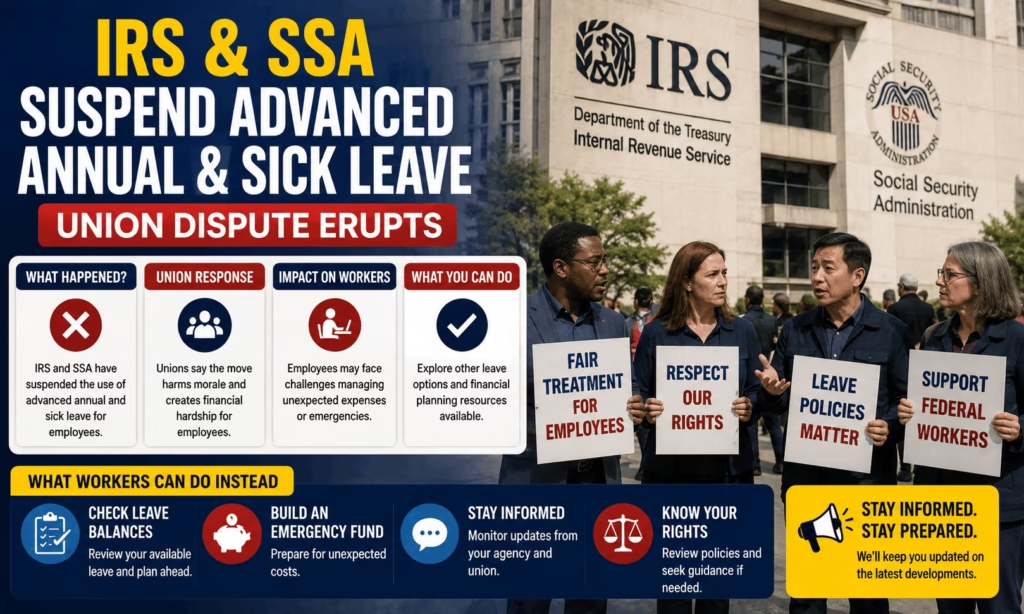
IRS SSA Advanced Leave Suspension: Two of the federal government’s largest agencies have quietly shut off a benefit that thousands of employees have relied on during medical emergencies and family crises. The IRS SSA advanced leave suspension took effect on July 24, when human resources officials at both the Internal Revenue Service and the Social Security Administration sent nearly identical emails telling staff that requests for advanced annual and advanced sick leave would no longer be accepted, effective immediately and until further notice. Any request still pending at the time of the announcement was automatically denied.
The move affects employees who have already used up their earned leave and previously relied on borrowing time off against hours they expected to accrue in the future. Both agencies framed the change as a fiscal and operational necessity, describing outstanding advanced leave balances as a kind of debt against future work that limits their ability to invest in staff and resources. Labor unions representing workers at both agencies see it very differently, and the dispute is now escalating into grievances, arbitration claims, and public pressure campaigns. We’ll be updating this article monthly as new developments unfold, so check back for the latest on this ongoing dispute.
IRS SSA Advanced Leave Suspension Key Highlights
| Detail | Information |
|---|---|
| Effective date | July 24, 2026, effective immediately |
| Agencies affected | Internal Revenue Service (IRS) and Social Security Administration (SSA) |
| Type of leave suspended | Advanced annual leave and advanced sick leave |
| Status of pending requests | Automatically denied |
| Status of previously granted advanced leave | Remains in place but must still be repaid |
| Stated reason | Reduce existing advanced leave balances agency-wide |
| Unions involved | National Treasury Employees Union (NTEU), American Federation of Government Employees (AFGE) |
| NTEU membership affected | Roughly 50,000 IRS employees |
| Union response | Grievances filed at both agencies; NTEU calls it a CBA violation |
| SSA union representative quoted | Jessica LaPointe, AFGE Council 220 President |
What Changed at IRS and SSA on Advanced Leave
Advanced leave is a long-standing federal personnel tool that allows agencies to let employees borrow paid time off before they have actually earned it. It has traditionally functioned as a stopgap for workers facing situations like a new cancer diagnosis, recovery from a serious accident, or the sudden need to care for a sick child or aging parent, especially for employees who do not have enough banked leave to cover an extended absence. Under normal circumstances, the borrowed hours are expected to be paid back as the employee continues accruing leave over time.
According to internal HR communications sent to staff, both the IRS and SSA now describe their existing advanced leave balances as unsustainable. The agencies wrote that in many cases, employees who have already borrowed large amounts of leave are unlikely to ever earn enough future leave to repay what they owe, creating what the emails called a debt against future work that has not yet occurred and that the public expects the agencies to deliver. That reasoning underpins the decision to pause new approvals while each agency works to bring existing balances down.
Importantly, the suspension is not retroactive in the sense of clawing back leave employees have already used. Advanced leave balances already granted before July 24 remain in place, and employees who used that time are not being asked to return it immediately. However, those balances still count as debt that must eventually be repaid through future accrued leave, even if the employee later separates from federal service, which can create financial exposure for workers who leave the agency before earning back what they borrowed.
Service Canada Benefit Payments August 2026 Dates, Amounts and Who Qualifies
Government Shutdown Stopgap Spending Bill: Senate Passes Funding Patch Through December 11
USPS Operational Restructuring: Latest Updates on Cash Crisis and Network Overhaul
Why SSA and IRS Say the Leave Suspension Is Necessary
Agency leadership has tied the change directly to workforce availability and public service delivery. In its message to staff, SSA stated that the American public depends on the agency to deliver on its mission every day, and that doing so requires a workforce that is present and actively performing the public-facing work Americans rely on the agency to handle, from processing retirement claims to answering benefit questions. SSA also noted that advanced leave, by definition, means an employee is compensated for time away from the job before the corresponding work has actually been completed.
The IRS used almost identical language in its own communication to employees, framing the outstanding advanced leave balances as a constraint on the agency’s ability to invest in staff, tools, and resources tied to its broader mission. Officials at both agencies say the suspension will remain in place while they work through efforts to reduce what they describe as significant, agency-wide advanced leave balances that have built up over time.
Unions Push Back Against the Advanced Leave Policy Change
The response from federal employee unions has been swift and pointed. The National Treasury Employees Union, which represents roughly 50,000 IRS workers, called the suspension an illegal violation of the collective bargaining agreement. NTEU National President Doreen Greenwald said the move was unnecessarily cruel and harmful to IRS employees who are either facing a medical crisis themselves or caring for an ill family member, and rejected any suggestion that employees have been abusing the benefit or that continued use of advanced leave has harmed public service delivery.
At SSA, the American Federation of Government Employees has also filed a grievance over the policy. Jessica LaPointe, president of AFGE Council 220, which represents SSA field office and teleservice center employees, described advanced leave as functioning like a form of short-term or long-term disability insurance for federal workers. LaPointe pointed to real cases among SSA staff, including employees undergoing cancer treatment, workers recovering from car accidents, and caregivers responsible for sick children or elderly parents, arguing that many employees have relied on advanced leave responsibly to supplement relatively low government wages rather than abusing the system. She said the suspension effectively forces federal workers who administer the public’s disability and retirement benefits to go unpaid themselves when a personal emergency strikes.
The Broader Labor Relations Fight Behind the Leave Dispute
This advanced leave suspension is unfolding against the backdrop of a much larger, ongoing standoff between federal employee unions and agency leadership. NTEU recently won a separate arbitration award against the IRS after the agency unilaterally cancelled offsite work arrangements in 2025 rather than reviewing eligibility on a case-by-case basis, as required under the union’s collective bargaining agreement. The IRS chose not to participate in that arbitration proceeding and can still appeal the ruling, which puts the decision on hold while NTEU publicly calls on the agency to comply voluntarily.
A similar pattern has played out at SSA, where a separate arbitrator previously found that the agency violated its labor agreement with AFGE by ending telework arrangements without proper justification. That telework suspension, originally described by former acting SSA leadership as a temporary 90-day pause, ultimately stretched on for well over a year and continued under current SSA Commissioner Frank Bisignano. Both disputes reflect a broader tension that intensified after 2025 executive actions sought to limit collective bargaining rights at a number of federal agencies, prompting a wave of grievances, arbitration cases, and legal challenges across the federal workforce.
Weekly Jobless Claims Report: 199,000 Filings Signal Labor Market Cooling
Federal Employee RIF Rules 2026: What the New OPM Regulations Actually Change
IRS Releases New Details on the Saver’s Match Program: Up to $1,000 for Your Retirement Account
What Federal Employees Can Do Instead of Advanced Leave
Employees at IRS and SSA who are dealing with a medical emergency or family crisis are not entirely without options, even with advanced leave off the table for now. The Voluntary Leave Transfer Program allows federal employees facing a qualifying medical emergency to receive donated annual leave from coworkers, although availability depends entirely on whether colleagues choose to donate and there is no guarantee enough leave will be available when it is needed. The Family and Medical Leave Act also remains available to eligible federal employees, offering job-protected, though generally unpaid, leave for qualifying medical and family situations.
It is worth noting that advanced leave has always been a discretionary benefit rather than a guaranteed entitlement. Individual agencies retain the authority under Office of Personnel Management regulations to approve, limit, or suspend advanced leave requests based on their own internal policies. The IRS and SSA suspensions do not change the government-wide rules that apply to advanced leave at other federal agencies, meaning employees elsewhere in government may still be able to request it depending on their agency’s current policy.
What Happens Next in the IRS and SSA Leave Dispute
Neither the IRS nor SSA has announced a specific end date for the suspension, and both agencies have said the pause will remain in effect while they work to reduce outstanding advanced leave balances agency-wide. With NTEU and AFGE both pursuing formal grievances, and with NTEU already citing a related arbitration win over the IRS’s handling of workplace policy changes, the advanced leave dispute is likely to move through similar internal grievance and arbitration channels in the coming months rather than being resolved immediately through negotiation.
Federal employees affected by the change, or those simply trying to plan ahead, are encouraged to confirm their individual advanced leave balance and repayment obligations directly with their agency’s human resources office, particularly if they are approaching retirement or considering separating from federal service, since outstanding advanced leave debt generally must still be repaid even after an employee leaves.
Official Resources for IRS and SSA Employees
| Resource | Purpose | Official Link |
|---|---|---|
| OPM Advanced Leave Guidance | Federal rules governing advanced annual and sick leave | https://www.opm.gov/policy-data-oversight/pay-leave/leave-administration |
| IRS Human Capital Office | Internal HR policy information for IRS employees | https://www.irs.gov |
| Social Security Administration | Official SSA site for employees and beneficiaries | https://www.ssa.gov |
| National Treasury Employees Union | Union updates, grievance information, and member resources | https://www.nteu.org |
| American Federation of Government Employees | Union updates and AFGE Council 220 resources for SSA workers | https://www.afge.org |
| Federal Employee Voluntary Leave Transfer Program | Information on donated leave for medical emergencies | https://www.opm.gov/policy-data-oversight/pay-leave/leave-administration/fact-sheets/voluntary-leave-transfer-program |
FAQs on the IRS SSA Advanced Leave Suspension
When did IRS and SSA suspend advanced leave?
Both agencies suspended approvals for advanced annual and advanced sick leave effective July 24, 2026, and the suspension remains in place until further notice.
Does the suspension affect advanced leave I already received?
No. Advanced leave already granted before the suspension remains in place. However, employees are still required to repay that leave through future accrued time, even if they later leave federal service.
Why did IRS and SSA suspend advanced leave for employees?
Both agencies say the suspension is meant to reduce large outstanding advanced leave balances that they describe as a form of debt against future work, and to help ensure staff are present and available to carry out their public service responsibilities.
Are federal employee unions challenging the advanced leave suspension?
Yes. The National Treasury Employees Union, which represents IRS workers, calls the suspension an illegal violation of its collective bargaining agreement and has demanded the agency reverse it. The American Federation of Government Employees has filed a grievance on behalf of SSA employees.
What can federal employees use instead of advanced leave during a medical emergency?
Employees may be eligible for donated leave through the Voluntary Leave Transfer Program if a coworker chooses to donate hours, or they may qualify for job-protected, generally unpaid leave under the Family and Medical Leave Act.
Does this suspension apply to all federal agencies or just IRS and SSA?
The suspension currently applies only to the IRS and SSA. Advanced leave remains a discretionary benefit that other federal agencies can continue to approve or restrict under their own policies and existing OPM regulations.
Is advanced leave a legal entitlement for federal employees?
No. Advanced leave has always been discretionary rather than guaranteed. Agencies have the authority to grant, limit, or suspend it based on operational needs, which is the authority the IRS and SSA are currently citing.
Conclusion
The advanced leave suspension at IRS and SSA has turned what agency leadership frames as a routine fiscal correction into the latest flashpoint in a broader standoff between federal employee unions and agency management. For workers who relied on advanced leave as a safety net during medical emergencies or family crises, the immediate effect is a narrower set of options at exactly the moments they may need flexibility the most. With grievances already filed at both agencies and a track record of related arbitration disputes still working their way through the system, the coming months are likely to determine whether the suspension holds, gets modified through negotiation, or is ultimately challenged successfully through the same labor channels that have already produced wins for federal unions on other workplace policy changes this year.
Social Security $200 Monthly Increase 2027: Which Seniors Qualify for the Biggest Raise?
H-1B 60-Day Grace Period Elimination: What US Visa Workers Should Know
450,000 Borrowers Student Debt Erased: How to Check If You Qualify?