IRS Saver’s Match Program: The Treasury Department and the IRS formally launched the rulemaking process for the Saver’s Match program this week, issuing Notice 2026-48 to announce their intent to propose regulations for a federal matching contribution that will deposit up to $1,000 directly into eligible workers’ retirement accounts starting with 2027 contributions. The notice lays out how the IRS Saver’s Match program is expected to work and opens a formal comment period for the public before final rules are written.
The announcement lands alongside a related but separate move by the Treasury Department to stand up TrumpIRA.gov, a new federal platform directed by presidential executive order that is expected to be operational by January 1, 2027, connecting workers who lack an employer-sponsored retirement plan with low-cost IRAs that qualify to receive this new government match. IRS Commissioner Frank Bisignano said the program gives millions of low- and moderate-income Americans a meaningful new opportunity to build retirement savings. This article breaks down exactly what Notice 2026-48 confirms, how the Saver’s Match differs from the older Saver’s Credit it replaces, and how it relates to the separate Trump Accounts program already contributing $1,000 to millions of children’s accounts. We’ll be updating this article monthly as Treasury and the IRS finalize the program’s regulations.
What Is the IRS Saver’s Match Program?
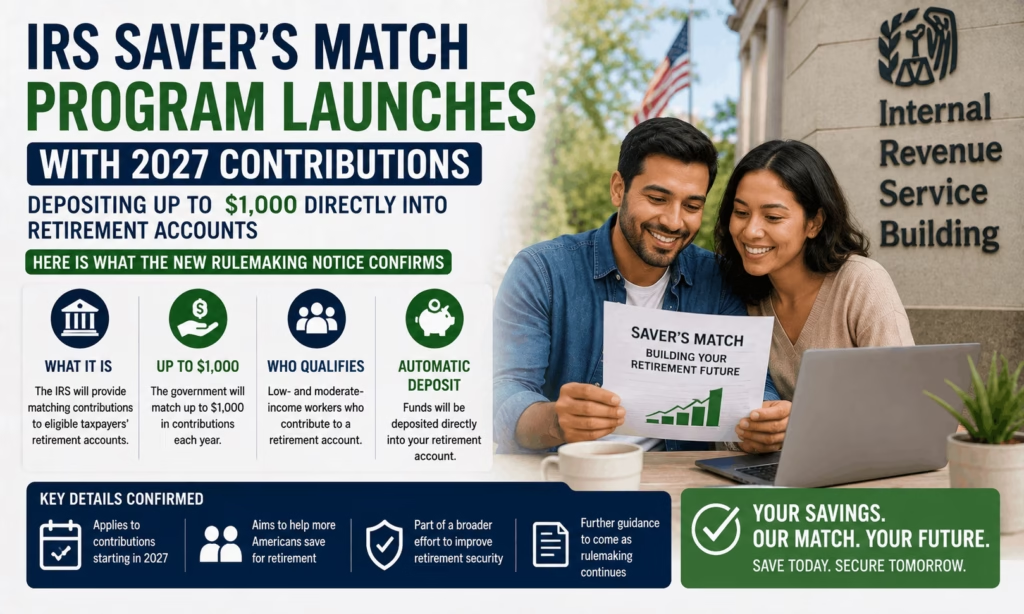
The Saver’s Match is a federal matching contribution that the government deposits directly into a qualifying worker’s retirement account, rather than issuing a tax credit that shows up when you file your return. Eligible workers who contribute to a qualifying IRA or workplace retirement plan can receive a government match of up to $1,000 per year, deposited straight into the account itself, where it continues growing alongside the worker’s own contributions.
This program was actually created years earlier, under the SECURE 2.0 Act signed into law in December 2022, with an effective start date tied to the 2027 tax year. What changed this week is that Treasury and the IRS have now formally begun the regulatory process needed to implement it, following President Trump’s direction to expand and refine the program during his 2026 State of the Union address, where he described extending federal-worker-style retirement benefits to private-sector employees who currently lack access to any employer match.
Notice 2026-48: What the IRS Just Announced
Notice 2026-48 announces the government’s intent to propose formal regulations for the Saver’s Match and describes the anticipated structure of the program in advance of that rulemaking. The notice specifically requests public comments on the anticipated Saver’s Match contribution rules, giving individuals, employers, and financial institutions a chance to weigh in before Treasury finalizes how the program will actually operate. This is a standard part of the federal rulemaking process, where an agency signals its planned approach and invites feedback before issuing a formal Notice of Proposed Rulemaking with binding draft regulations.
Commissioner Bisignano framed the announcement as a direct benefit to workers who have historically been left out of employer-sponsored retirement systems, saying the program gives millions of low- and moderate-income Americans the opportunity to strengthen their retirement savings in a way that was not previously available to them.
SSDI Fast-Track Approval 2026: Compassionate Allowances, QDD
Quebec Experience Program 2026: PEQ Reopening Dates, Eligibility
$5000 CRA Data Breach Settlement 2026: Who Qualifies and How to Claim
H-1B 60-Day Grace Period Elimination: What US Visa Workers Should Know
How Much You Could Receive, and When It Starts?
Under the program as described, eligible workers can receive a federal match of up to $1,000 per year, deposited directly into their retirement account based on their own contributions for that year. This matching contribution becomes available starting with 2027 retirement savings contributions, meaning workers will not see this specific match applied to money they contributed in 2026 or earlier years, but should begin factoring it into planning for contributions made during the 2027 tax year and beyond.
Because the match is deposited directly into the account rather than delivered as a line item on a tax return, it is designed to compound alongside the worker’s own savings from the moment it lands, rather than becoming spendable cash the way a traditional tax credit refund typically works.
TrumpIRA.gov: The New Platform Launching January 2027
Separately from the Saver’s Match notice itself, the Treasury Department is standing up TrumpIRA.gov under a presidential executive order, with the platform expected to be operational by January 1, 2027, the same year the Saver’s Match becomes available. According to the White House, TrumpIRA.gov is designed to help workers, particularly independent contractors, part-time workers, small business employees, and self-employed individuals who do not have access to an employer-sponsored retirement plan, compare high-quality, low-cost IRAs based on cost, quality, and investment options.
Treasury and the IRS have indicated that TrumpIRA.gov will list financial institutions offering IRAs that accept Saver’s Match contributions and meet other established program criteria, and that additional information for IRA providers seeking to be listed on the platform will be released later this year. The executive order also directs Treasury to prepare legislative recommendations aimed at codifying and building out the TrumpIRA.gov framework on a more permanent, expanded basis going forward.
Who Is Likely Eligible for the Saver’s Match
While the final regulations are still being written, the Saver’s Match is designed around the same core group SECURE 2.0 originally targeted: low- and moderate-income workers who are actively contributing to a qualifying retirement account, including a traditional or Roth IRA or certain workplace plans. According to White House estimates cited alongside the broader retirement initiative, the policy could make as many as 56 million previously uncovered or underserved workers newly eligible to participate in a low-fee retirement savings structure, with a particular emphasis on workers who currently lack any employer-sponsored plan or employer match at all.
Because Treasury has not yet finalized the specific income thresholds and contribution requirements through formal rulemaking, workers should watch for the forthcoming Notice of Proposed Rulemaking rather than relying on early estimates for exact eligibility cutoffs.
How the Saver’s Match Differs From the Older Saver’s Credit
Before the Saver’s Match, eligible workers could claim something called the Saver’s Credit, a nonrefundable tax credit worth a percentage of retirement contributions, applied when filing an annual tax return. The Saver’s Match replaces this structure with a direct deposit into the retirement account itself, which matters for two practical reasons. First, because it is deposited into the account rather than claimed on a return, it does not require the worker to owe federal tax in order to benefit, addressing a common criticism of the old nonrefundable credit, which provided no benefit to workers whose tax liability was already at or near zero. Second, because the money lands directly in the retirement account, it begins earning investment returns immediately alongside the worker’s own contributions, rather than arriving as a separate refund the following year.
A Related but Separate Program: Trump Accounts for Children
The Saver’s Match should not be confused with Trump Accounts, a separate federal program that has been rolling out over the past several months. Trump Accounts are a new type of traditional individual retirement account established under the 2025 tax law known as the One Big Beautiful Bill Act, designed specifically for children under 18. Under the Trump Accounts contribution pilot program, the Treasury Department makes a one-time $1,000 contribution into the account of every eligible child born in the United States between January 1, 2025, and December 31, 2028, once a parent or guardian makes an election on the child’s behalf.
According to IRS data released in late March 2026, more than four million children had already been signed up for Trump Accounts, with more than one million of those children covered by elections for the $1,000 pilot program contribution. Accounts became available to open starting July 4, 2026, and carry a separate annual contribution limit of $5,000 during the child’s growth period, distinct from the standard IRA contribution limits that apply to adult savers.
Employers Are Matching the Trump Account Contribution
A number of major US employers have announced they will match the government’s $1,000 Trump Account contribution for their own employees’ children, effectively doubling the starting balance for many families. Companies that have announced matching contributions include JPMorgan Chase, Bank of America, Fox Corporation, Bank of New York Mellon, BlackRock, Intel, Charles Schwab, Dell Technologies, Robinhood, SoFi, Charter Communications, and Chime Financial. JPMorgan CEO Jamie Dimon said the match is meant to make it easier for employees to start saving early and plan for their family’s financial future, while Fox Corporation Executive Chair Lachlan Murdoch described the move as reinforcing the company’s commitment to employees’ long-term financial well-being.
Canada Set to Finalize LNG Agreement With Germany’s SEFE for Ksi Lisims LNG Project
New UK Immigration Rules 2026: What Changes for Visa Applicants?
Saver’s Match vs. Trump Accounts: Key Differences
| Feature | Saver’s Match | Trump Accounts |
|---|---|---|
| Who it is for | Working adults contributing to a retirement account | Children under 18, born 2025-2028 |
| Type of benefit | Ongoing annual government match, up to $1,000 per year | One-time $1,000 pilot contribution |
| Starts with | 2027 retirement contributions | Accounts opened starting July 4, 2026 |
| Legal basis | SECURE 2.0 Act (2022), implementation directed in 2026 | One Big Beautiful Bill Act (2025) |
| Delivery method | Direct deposit into the worker’s own retirement account | Direct deposit by Treasury into the child’s account |
| Related platform | TrumpIRA.gov, operational by January 1, 2027 | Managed through IRS-authorized Trump Account trustees |
Key Dates and Milestones at a Glance
| Date | Milestone |
|---|---|
| December 2022 | SECURE 2.0 Act creates the original Saver’s Match framework |
| July 4, 2025 | One Big Beautiful Bill Act signed, establishing Trump Accounts |
| December 2, 2025 | IRS issues Notice 2025-68 on Trump Account regulations |
| March 6, 2026 | Treasury and IRS issue proposed regulations for the Trump Accounts contribution pilot |
| March 31, 2026 | IRS reports over 4 million children signed up for Trump Accounts |
| July 4, 2026 | Trump Accounts become available to open and receive contributions |
| Early August 2026 | Notice 2026-48 launches Saver’s Match rulemaking process |
| 2027 | Saver’s Match applies to retirement contributions for the first time |
| January 1, 2027 | TrumpIRA.gov expected to become operational |
What Workers Should Do to Prepare
Since the Saver’s Match applies starting with 2027 contributions, workers do not need to take immediate action for money already contributed in 2026, but it is a good time to review whether you currently have access to an IRA or workplace retirement account at all, since the match requires an active qualifying contribution to apply to. Workers without an employer-sponsored plan should watch for TrumpIRA.gov to launch in early 2027, since it is specifically designed to help identify low-cost IRA providers that are set up to receive the match. Anyone interested in weighing in on how the program is structured can also review Notice 2026-48 directly and consider submitting a comment during the public comment period Treasury has opened as part of this rulemaking process.
Official Resources and Where to Track This Program
| Resource | Purpose | Link |
|---|---|---|
| IRS newsroom | Official IRS announcements and notices | irs.gov/newsroom |
| Notice 2026-48 | Full text of the Saver’s Match rulemaking notice | irs.gov (Notice 2026-48) |
| Trump Accounts official IRS page | Rules and guidance for the children’s retirement program | irs.gov (Trump Accounts) |
| TrumpIRA.gov | New federal platform for comparing qualifying IRAs (operational by January 2027) | trumpira.gov |
| Regulations.gov | Submit public comments on proposed retirement rules | regulations.gov |
| Treasury Department retirement policy page | Official policy background and updates | home.treasury.gov |
FAQs
What is the IRS Saver’s Match program?
It is a federal matching contribution that deposits up to $1,000 per year directly into an eligible worker’s retirement account, based on their own contributions, starting with the 2027 tax year.
When does the Saver’s Match program start?
It applies starting with retirement contributions made for the 2027 tax year. The IRS issued Notice 2026-48 in early August 2026 to begin the formal rulemaking process ahead of that start date.
Is the Saver’s Match the same as the Trump Accounts $1,000 contribution?
No. The Saver’s Match is an ongoing annual matching contribution for working adults tied to their own retirement contributions, while Trump Accounts provide a separate, one-time $1,000 government contribution to a retirement account opened for an eligible child born between 2025 and 2028.
What is TrumpIRA.gov?
It is a new federal platform, directed by presidential executive order, expected to be operational by January 1, 2027, designed to help workers without an employer-sponsored retirement plan compare and choose low-cost IRAs that qualify to receive Saver’s Match contributions.
How is the Saver’s Match different from the old Saver’s Credit?
The Saver’s Credit was a nonrefundable tax credit claimed on your annual tax return, which provided no benefit if you owed little or no federal tax. The Saver’s Match instead deposits money directly into your retirement account, so it can benefit you regardless of your tax liability and begins growing immediately.
Who is eligible for the Saver’s Match?
Final eligibility rules have not yet been issued through formal regulations, but the program is designed for low- and moderate-income workers contributing to a qualifying retirement account, with White House estimates suggesting it could make around 56 million previously underserved workers newly eligible.
Can I comment on the proposed Saver’s Match rules?
Yes. Notice 2026-48 opened a formal public comment period, allowing individuals, employers, and financial institutions to submit feedback on the anticipated program structure before Treasury finalizes the regulations.
Do I need to do anything right now to get the Saver’s Match?
Not yet. Since the match applies starting with 2027 contributions, there is no action required immediately, though it is a good time to confirm you have access to a qualifying retirement account and to watch for the launch of TrumpIRA.gov in early 2027.
Conclusion
The IRS Saver’s Match program moved from a years-old statutory promise to an active rulemaking process this week, with Notice 2026-48 laying out how the government intends to deposit up to $1,000 directly into eligible workers’ retirement accounts starting with 2027 contributions. Paired with the upcoming TrumpIRA.gov platform and the already-active Trump Accounts program for children, these initiatives represent a broader federal push to expand retirement savings access for workers who have historically lacked an employer match. With final regulations still pending, the most useful step for workers right now is confirming they have a qualifying retirement account in place and watching official IRS and Treasury channels for the finalized eligibility rules before 2027 arrives.
EITC Refund 2026: IRS Confirms Up To $4,427 for Taxpayers With One Child