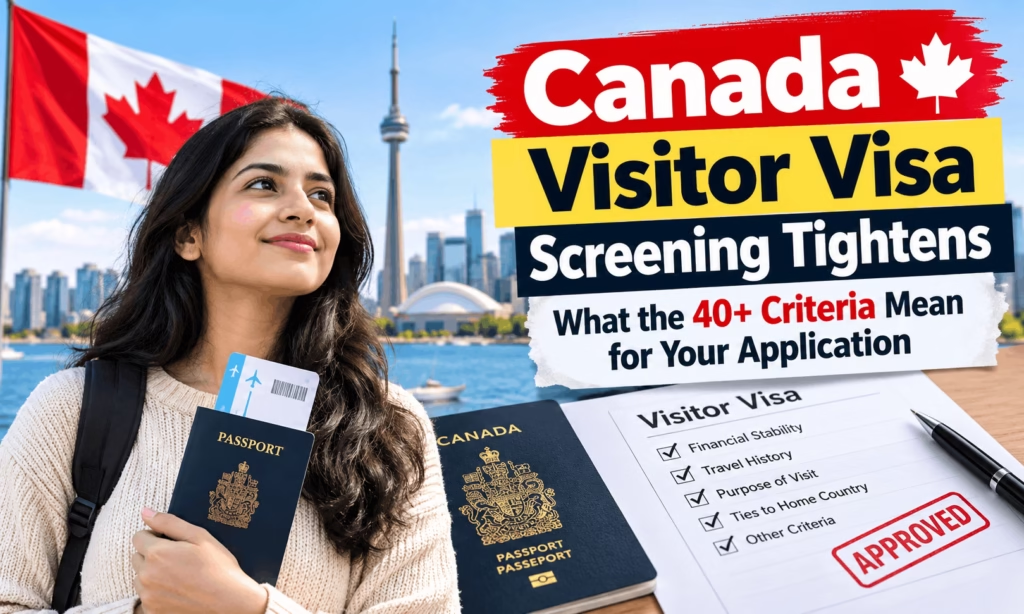
Canada visitor visa screening now runs every applicant through more than 40 separate criteria before a decision is made, and Immigration, Refugees and Citizenship Canada has confirmed the framework is fully in play for 2026 applications. The department’s own transition binder lists safety and security concerns, passport integrity, identity management, bilateral benefits and migration trends, including asylum claims and visa violations, as the pillars behind the 40-plus factors. This is not a new law or a single announcement; it is the standing Visa Policy Framework that decides which nationalities need a Temporary Resident Visa versus a lighter electronic travel authorization, and it now sits alongside individual, case-by-case scrutiny that has visibly tightened through 2025 and 2026. We’ll be updating this article monthly.
The practical effect shows up in refusal patterns and wait times, not in a new form to fill out. IRCC has told officers to look harder at proof of funds, travel purpose, ties to the home country and past compliance with Canadian immigration rules, and processing for some countries has stretched from a few weeks to several months. A Federal Court ruling on September 17, 2026, even set aside a visa refusal after finding an officer failed to properly weigh the evidence in front of them, a sign of how closely these decisions are now being contested and reviewed. Below is what the 40-plus criteria actually cover, current fees and processing times, a self-check tool to gauge your application’s strength, and the official links you need to apply or check status.
Canada Visitor Visa Screening Readiness Checker
Canada Visitor Visa Screening Readiness Checker
Answer the questions below to see how your application profile lines up with the factors IRCC officers weigh most heavily. This is a general guide based on published IRCC criteria, not a prediction of any individual decision.
This checker reflects publicly known IRCC risk and benefit factors. It cannot access IRCC systems and does not predict any specific decision. Officers assess each file individually under the Immigration and Refugee Protection Act.
What Are the 40+ Criteria in Canada’s Visa Screening Framework?
IRCC’s Visa Policy Framework, the same policy that decides whether a country’s citizens need a full visa or just an eTA, uses more than 40 criteria grouped into a few broad categories. The department’s own deputy minister transition binder lays them out directly, and the same criteria inform how individual applications are weighed once someone from a visa-required country applies for a Temporary Resident Visa.
| Category | What it covers |
|---|---|
| Safety and security concerns | Criminal history, security database matches, information shared with allied governments |
| Passport integrity and identity management | Document authenticity, biometric matches, consistency of identity across records |
| Bilateral benefits | Trade, tourism and diplomatic relationships between Canada and the applicant’s country |
| Migration trends | Asylum claim rates, visa refusal rates, overstays and unauthorized work or study by nationality |
On top of these nationality-level factors, individual officers assess personal circumstances for each applicant: financial capacity, genuine travel purpose, ties to the home country, and the likelihood the person will leave Canada at the end of an authorized stay. IRCC describes this as pushing “the border out,” meaning screening starts long before a traveller reaches a Canadian airport or land crossing.
H-2B Visa Cap Reached: What It Means for 2027 Filings
Social Security COLA 2027 Projection: How Much Benefits Rise?
Why Canada Visitor Visa Screening Feels Tougher in 2026
Applicants and immigration consultants report noticeably closer review this year, and IRCC’s own guidance confirms the shift. Officers have been told to place greater weight on proof of funds and the source of that money, to scrutinize travel purpose and stay plans more closely, to weigh international travel history more heavily, and to run enhanced biometric and security checks. A visa can also now be issued as single-entry rather than multiple-entry in some cases, and IRCC has signaled it may refuse or cancel entry at the border even after a visa was issued, if new concerns arise.
This tightening sits inside a broader policy push. Canada’s 2025-2027 Immigration Levels Plan lowered permanent resident targets to 395,000 in 2025, 380,000 in 2026 and 365,000 in 2027, and the government has set a goal of keeping temporary residents under 5% of Canada’s population by the end of 2027. Stricter visitor screening, tighter study permit financial rules introduced in July 2026, and closer border questioning introduced in August 2025 are all part of the same effort to manage the temporary resident population.
Key Dates and Highlights in Canada’s Visitor Visa Tightening
| Date | What changed |
|---|---|
| August 12, 2025 | IRCC begins stricter entry screening for tourists and temporary residents at airports and land borders |
| 2025-2027 Immigration Levels Plan | Permanent resident targets cut to 395,000 (2025), 380,000 (2026), 365,000 (2027) |
| July 24, 2026 | Study permit applicants required to show 6 months of bank statements and verified fund sources |
| September 17, 2026 | Federal Court overturns a visa refusal after finding an officer failed to address key evidence |
| September 18, 2026 | Service Canada publishes updated employer guidance for the Temporary Foreign Worker Program |
| End of 2026 target | IRCC aims to bring non-permanent residents under 5% of Canada’s population |
Temporary Resident Visa vs. eTA: Which Screening Path Applies to You?
Not every visitor goes through the same process. Canada sorts travellers into two tracks based mainly on nationality, and the 40-plus criteria are what decide which track a country falls into.
| Feature | Temporary Resident Visa (TRV) | Electronic Travel Authorization (eTA) |
|---|---|---|
| Who needs it | Citizens of visa-required countries; China and India are the top source countries | Visa-exempt nationals flying to or through Canada |
| Application | Detailed form with supporting documents | Fully digital, self-declared basic information |
| Biometrics | Required (fingerprints and photo) for most applicants aged 14 to 79 | Not required |
| Review | Manual officer review; passport physically stamped | Mostly automated; approved in minutes for most |
| Fee | $100 plus $85 biometrics, per person | $7 |
| Validity | Up to 10 years, multiple entry in most cases | Up to 5 years or until passport expires |
HUD-VASH Housing Voucher New 2026 Eligibility Rules Explained
VA Disability Cancer Claims: New Conditions & Expedited Processing
FEHB Plans Leaving Open Season: What It Means for Your Premium
Canada Visitor Visa Fees and Payment Schedule 2026
Government fees are set by IRCC and paid online when you submit your application. They are non-refundable even if the application is refused.
| Fee | Amount | Note |
|---|---|---|
| Visitor visa, single or multiple entry, per person | $100 CAD | Paid when you submit your online application |
| Family maximum (5 or more applying together) | $500 CAD | Capped rate regardless of family size beyond 5 |
| Biometrics, per person | $85 CAD | Paid with the application; valid for 10 years once given |
| Biometrics, family maximum | $170 CAD | Applies when 5 or more family members apply together |
| eTA (if you qualify instead of a TRV) | $7 CAD | For visa-exempt nationals flying to Canada |
How Long Does Canada Visitor Visa Processing Take in 2026?
Processing time is one of the clearest signs of tighter screening. IRCC’s published estimates vary enormously by country, and the gap between low-volume and high-volume markets has widened through 2026.
| Country or region | Typical processing time |
|---|---|
| Applications submitted inside Canada | Around 11 to 18 days |
| United States | Around 17 to 22 days |
| Germany, France, UK, Australia | Around 2 to 3 weeks |
| Philippines | Around 6 to 10 weeks |
| Mexico | Around 4 to 6 weeks |
| India | Around 8 to 12 weeks, up sharply from about 24 days in mid-2025 |
| Pakistan | Around 10 to 14 weeks |
| Nigeria | Around 10 to 16 weeks |
These figures shift constantly with application volume, so check IRCC’s live processing-time tool before you apply. Processing time is generally counted from when IRCC receives your biometrics, not from the day you submit your online form, and you have 30 days after receiving your biometric instruction letter to attend a Visa Application Centre.
How to Apply for a Canada Visitor Visa?
- Confirm whether you need a full visitor visa (TRV) or the lighter eTA, based on your citizenship and how you are travelling to Canada.
- Create an IRCC secure online account and complete the visitor visa application, answering every question about travel history, funds and purpose accurately.
- Gather supporting documents: a valid passport, proof of funds such as recent bank statements, a clear travel itinerary, a letter of invitation if visiting family or friends, and evidence of ties to your home country such as employment or property records.
- Pay the $100 visa fee and $85 biometrics fee online.
- Complete biometrics at a Visa Application Centre within 30 days of receiving your instruction letter.
- Track your application status through your IRCC online account and respond quickly to any request for additional documents.
How Canada’s Screening Compares With Other Major Destinations?
Canada is not alone in tightening visitor screening, but its approach stands out for combining a nationality-level framework with individual, case-by-case review at every application. The United States relies heavily on consular interviews and, more recently, expanded online presence checks for several visa categories. The United Kingdom uses a points-based assessment focused primarily on financial documentation and a genuine visitor test. Canada’s 40-plus criteria sit closer to a hybrid model: broad, published risk and benefit factors decide which nationalities need a full visa, while officers then apply a separate, more granular review of funds, purpose and ties to each individual file.
What makes Canada’s system notable in 2026 is the transparency around the criteria themselves. IRCC’s transition binders, released to Parliament and posted publicly on canada.ca, spell out the four pillars in plain language, giving applicants and immigration consultants a clearer sense of what officers are trained to weigh than a typical opaque consular process offers elsewhere.
What Increases Your Refusal Risk Under the 40+ Criteria?
Several patterns show up repeatedly in refused applications, and they map directly onto the criteria IRCC has confirmed it weighs.
- Weak or inconsistent proof of funds, including bank statements that do not match the applicant’s stated income or that show a sudden, unexplained large deposit
- Vague or unsupported travel purpose, especially when the itinerary does not match the length of stay requested
- Limited ties to the home country, such as no stable job, property or family responsibilities that would motivate a return
- Prior immigration violations anywhere, including overstays, unauthorized work or study, or a previous Canadian refusal not properly explained in the new application
- Inconsistent documents across the application, the invitation letter and supporting evidence, which officers may read as a misrepresentation risk
None of these guarantee a refusal on their own, and the September 2026 Federal Court decision is a reminder that officers must still meaningfully engage with the evidence an applicant provides. A refusal can also be challenged or a new, stronger application submitted, since a Canada visitor visa refusal does not automatically bar future approval.
Flat-Rate COLA: What the 2027 Social Security Proposal Really Means for Retirees
Hungary Poland Immigrant Visa Resumption: What Changed and Who Is Affected?
DHS LPR Rule for Foreign Government Employees’ Children: Eligibility, Fees and How to Apply
Canada Visitor Visa Processing Time: What Actually Slows a File Down
Beyond nationality-based averages, several specific triggers commonly add weeks or months to an individual processing time. A previous visa refusal anywhere, not just in Canada, prompts officers to review the applicant’s full immigration history more closely. Extensive travel across many countries, especially to destinations associated with higher security screening, can trigger additional verification by the Canada Border Services Agency or the Canadian Security Intelligence Service. Incomplete applications, missing signatures, or documents that are not properly translated into English or French also bounce files back for correction, effectively restarting parts of the review.
Applicants can reduce delays by double-checking every field before submission, ensuring bank statements and support letters use consistent names, dates and figures, and submitting certified translations upfront rather than waiting for IRCC to request them. None of this guarantees a faster decision, since processing also depends on how many applications a given visa office is handling at the time, but a complete, consistent file removes one of the most common causes of an artificially long wait.
Official Canada Visitor Visa Resources
Use these official IRCC pages for applications, status checks, fees and current processing times.
| Resource | Use it for | Link |
|---|---|---|
| IRCC secure account | Login, registration, application submission and status tracking | canada.ca IRCC account |
| Apply for a visitor visa | Full application instructions and eligibility | canada.ca apply for a visitor visa |
| Check application status | Tracking a submitted visitor visa application | canada.ca check status |
| Processing times tool | Current estimated wait times by country and program | canada.ca processing times |
| Fee list | Official visitor visa and biometrics fees | canada.ca fees |
| eTA application | Applying for an Electronic Travel Authorization instead | canada.ca eTA |
| Visa Application Centres | Finding your nearest biometrics collection point | vfsglobal.com |
| Entry requirements | Current border rules for travellers to Canada | travel.gc.ca entry requirements |
For general enquiries, use IRCC’s official web form linked from canada.ca; the department does not offer a general public phone line for visitor visa status updates. Be cautious of third-party sites charging a fee to check your status; IRCC’s own tools are free.
FAQs About Canada Visitor Visa Screening
What are the 40+ criteria in Canada’s visa screening?
They fall into four groups: safety and security concerns, passport integrity and identity management, bilateral benefits between Canada and the applicant’s country, and migration trends such as asylum claims, visa refusals and overstays. IRCC uses these criteria to set visa policy by nationality and, together with personal factors like funds and travel purpose, to assess individual applications.
Why is Canada visitor visa screening tighter in 2026?
IRCC has told officers to weigh proof of funds, travel purpose, home-country ties and travel history more heavily, as part of a broader push to reduce temporary resident numbers under the 2025-2027 Immigration Levels Plan. Processing has also slowed for several high-volume countries as a result.
How much does a Canada visitor visa cost in 2026?
The visitor visa fee is $100 CAD per person, plus an $85 CAD biometrics fee, for about $185 CAD total per adult. A family of five or more applying together pays a maximum of $500 CAD for the visa and $170 CAD for biometrics.
How long does a Canada visitor visa take to process?
It varies widely by country, from around 11 to 18 days for applications submitted inside Canada up to 10 to 16 weeks for some high-volume countries such as Pakistan and Nigeria. Check IRCC’s live processing-time tool for your specific country before applying.
What increases the risk of a Canada visitor visa refusal?
Weak or inconsistent proof of funds, a vague travel purpose, limited ties to the home country, prior immigration violations, and inconsistent documents across the application are the factors most often linked to refusals under IRCC’s screening criteria.
Does a visa refusal stop me from applying to Canada again?
No. A Canada visitor visa refusal does not automatically prevent a future approval. Applicants can strengthen their documentation, address the reasons cited in the refusal letter, and submit a new application.
What documents do I need for a Canada visitor visa?
A valid passport, proof of funds such as bank statements, a travel itinerary, a letter of invitation if visiting family or friends, and evidence of ties to your home country such as employment or property records.
Is an eTA the same as a visitor visa?
No. An eTA is a lighter, fully digital authorization for visa-exempt travellers flying to Canada, costing $7 and often approved within minutes. A Temporary Resident Visa is a physical visa for citizens of visa-required countries, involving biometrics and manual officer review.
Which countries have the longest Canada visa processing times?
As of 2026, Nigeria and Pakistan have among the longest visitor visa processing times, often 10 to 16 weeks, followed by India at around 8 to 12 weeks, up sharply from roughly 24 days in mid-2025.
Can Canada refuse entry even after issuing a visitor visa?
Yes. A visa allows you to seek entry, but a border services officer makes the final admission decision at the port of entry and can refuse entry if new concerns arise, even with a valid visa.
What counts as proof of ties to my home country?
Stable employment or a running business, property ownership, family responsibilities such as dependents, and a consistent financial and travel history are the main forms of evidence officers look for.
Conclusion: Prepare for a Closer Review, Not a New Form
Canada visitor visa screening has not added a new application step; it has sharpened how officers apply the same 40-plus criteria IRCC has used for years. Financial proof, travel purpose, home-country ties and a clean immigration history now carry more weight than they did even a year ago, and processing times have stretched for several major source countries as a result. Use the checker above to see where your own application may be strong or thin, gather consistent documentation before you apply, and check IRCC’s live processing-time tool for your country. We will refresh this guide’s data, fees and timelines every month as IRCC updates its published figures.
FEHB 2026 Open Season: Which Plans Left and What It Means for Your Premium?
IRS 2027 Tax Brackets: How Much Can You Earn Before Hitting the 37% Rate
32-Hour Workweek Bill: What the Thirty-Two Hour Workweek Act Means for Your Paycheck