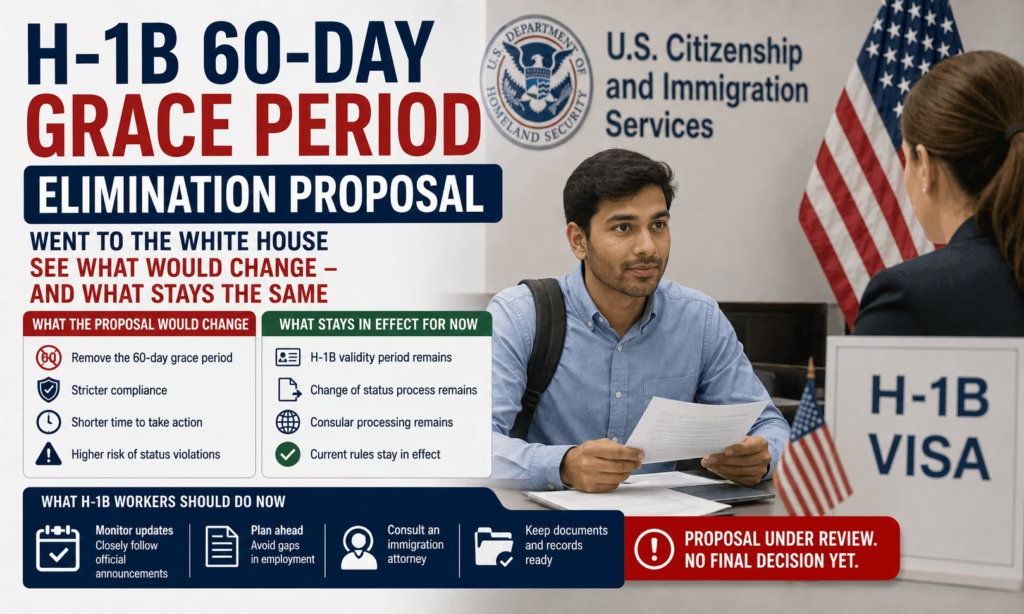
H-1B 60-Day Grace Period Elimination: The Department of Homeland Security sent a proposed rule titled Eliminating the Discretionary 60-day Grace Period, formally listed as RIN 1615-AD22, to the White House Office of Information and Regulatory Affairs for review on August 6, 2026. If finalized, the rule would remove the 60-day window that currently lets H-1B workers and several other nonimmigrant visa holders remain lawfully in the United States after losing a job, while they search for a new sponsoring employer or arrange to change status or depart.
The proposal has not been made public in full text, has not been published in the Federal Register, and has not taken effect, meaning the existing 60-day grace period remains fully in place for now. But its mere submission to White House review has already triggered significant concern among immigration attorneys and H-1B workers, particularly given that Indian nationals accounted for 71 percent of all approved H-1B petitions in fiscal year 2024, making this one of the proposals with the most direct potential impact on Indian professionals in the US workforce. This article breaks down exactly what is known about the proposal so far, how the current grace period works, what the formal rulemaking process still requires before anything changes, and what H-1B workers should actually do right now. We’ll be updating this article monthly as the proposal moves, or stalls, through the federal rulemaking process.
What Is the H-1B 60-Day Grace Period, and Why Does It Exist?
The 60-day grace period was created through a DHS regulation finalized in 2016 and implemented in January 2017, as part of a broader package of rules affecting high-skilled nonimmigrant workers. It is codified at 8 CFR 214.1(l)(2), and it provides that certain nonimmigrant workers are not considered to have violated their status simply because their sponsoring employment ended, as long as they take action within the grace period.
Under the current rule, a worker whose job ends receives up to 60 consecutive days, or until their authorized period of stay expires, whichever comes first, to find a new employer willing to sponsor them, apply to change to a different visa status, or make arrangements to leave the country. This grace period does not authorize continued employment during those 60 days; it simply protects the worker’s underlying immigration status while they sort out their next step. The provision applies not only to H-1B workers, but also to those in E-1, E-2, E-3, H-1B1, L-1, O-1, and TN status, along with their dependents.
What the DHS Proposal Would Actually Change
Based on what has been confirmed so far, the proposed rule would eliminate this 60-day allowance entirely. If adopted as currently described, a foreign national whose employment ends prematurely, along with any dependents on the same visa, would generally be required to depart the United States immediately, rather than having a defined window to pursue a new sponsor or a change of status while remaining in the country. Immigration attorneys have noted that DHS could still exercise case-by-case discretion to forgive a lapse in status, but that would no longer be a guaranteed, defined right the way the current 60-day period is.
It is worth understanding the legal basis DHS is relying on here. The existing regulation itself already states that DHS may eliminate or shorten the 60-day period as a matter of discretion, meaning the grace period was never an unconditional entitlement written permanently into law. This is why the current proposal takes the form of a regulatory rule change rather than a request for new legislation from Congress, and also why the same discretion that created the grace period in 2016 can, in principle, be used to remove it now.
SSDI Fast-Track Approval 2026: Compassionate Allowances, QDD
Quebec Experience Program 2026: PEQ Reopening Dates, Eligibility
$5000 CRA Data Breach Settlement 2026: Who Qualifies and How to Claim
This Is Part of a Broader H-1B Reform Push
The 60-day grace period proposal is not happening in isolation. DHS’s regulatory agenda separately lists a broader H-1B reform proposal under RIN 1615-AD00, with a proposed rule targeted for publication in August 2026 as well. Together, these signal that the administration is pursuing a wider set of changes to how the H-1B program operates, rather than a single isolated policy tweak, and immigration attorneys are advising employers and workers to watch for multiple related announcements in the coming weeks rather than treating the grace period proposal as a standalone development.
Why This Proposal Matters So Much for Indian Professionals
According to USCIS data, Indian nationals accounted for 71 percent of all approved H-1B petitions in fiscal year 2024, by far the largest share of any nationality in the program. Because employment-based green card backlogs for Indian nationals already run into years, sometimes decades, due to per-country caps, many Indian H-1B holders remain on H-1B status for extended periods while their permanent residence applications are pending. Losing the 60-day cushion after a layoff would disproportionately affect this group, since a sudden job loss could force an abrupt departure from the country in the middle of a years-long green card process, potentially requiring them to restart significant portions of that process if they are later able to return under new sponsorship.
What Happens Next: The Federal Rulemaking Process
A proposal being sent to the Office of Information and Regulatory Affairs is an early step in a multi-stage process, not a final decision. OIRA, part of the White House Office of Management and Budget, reviews significant regulatory proposals from federal agencies before they can be published. If OIRA approves the proposal, DHS would then publish it in the Federal Register as a Notice of Proposed Rulemaking, which formally opens a public comment period. USCIS has previously acknowledged that changing the grace period requires rulemaking under the Administrative Procedure Act, meaning DHS generally cannot simply announce the change internally without following this notice-and-comment process, absent a specific justification for bypassing it. Only after reviewing public comments can DHS issue a final rule, which typically includes its own effective date, often set weeks or months after publication.
This means that, realistically, even if OIRA clears the proposal quickly, affected workers would likely see a public comment period before any final elimination of the grace period takes effect, giving both current visa holders and immigration advocacy groups a formal opportunity to respond before the rule becomes binding.
Does the 60-Day Grace Period Still Apply to Me Right Now?
Yes. As of this writing, the proposed regulation has not taken effect, has not been published for public comment, and has not been finalized. Workers in H-1B and the other covered categories whose employment ends today are still entitled to the existing 60-day grace period, or until their I-94 expiration date, whichever comes first, exactly as the rule has worked since 2017. Anyone currently relying on this grace period, or who may need it in the future, should continue to plan around the existing 60-day framework unless and until DHS formally publishes a final rule changing it.
Which Visa Categories Are Covered by the Current Grace Period
| Visa Category | Description | Currently Covered by 60-Day Grace Period |
|---|---|---|
| H-1B | Specialty occupation workers | Yes |
| H-1B1 | Free Trade Agreement specialty workers (Chile, Singapore) | Yes |
| E-1 | Treaty traders | Yes |
| E-2 | Treaty investors | Yes |
| E-3 | Australian specialty occupation workers | Yes |
| L-1 | Intracompany transferees | Yes |
| O-1 | Individuals with extraordinary ability | Yes |
| TN | USMCA professionals (Canada and Mexico) | Yes |
| Dependents of the above | Spouses and children on derivative status | Yes |
H-1B 60-Day Grace Period Elimination Key Facts and Dates
| Detail | Information |
|---|---|
| Proposal name | Eliminating the Discretionary 60-day Grace Period |
| Regulation ID Number | RIN 1615-AD22 |
| Sent to OIRA for review | August 6, 2026 |
| Current status | Under White House review, not yet published, not law |
| Related broader H-1B reform | RIN 1615-AD00, proposed rule targeted for August 2026 |
| Original grace period regulation | Finalized 2016, effective January 2017 |
| Current legal citation | 8 CFR 214.1(l)(2) |
| Indian share of approved H-1B petitions, FY2024 | 71 percent |
| Next required step if OIRA approves | Federal Register publication and public comment period |
Canada Set to Finalize LNG Agreement With Germany’s SEFE for Ksi Lisims LNG Project
New UK Immigration Rules 2026: What Changes for Visa Applicants?
What H-1B Workers and Employers Should Do Right Now
Current H-1B holders should continue relying on the existing 60-day grace period as it stands today, since nothing has legally changed yet. Anyone currently between jobs and inside their grace period should prioritize securing a new sponsoring employer or filing a change of status petition as quickly as possible under the existing rules, rather than assuming the timeline will be extended or that current protections will necessarily continue. Employers considering layoffs affecting H-1B staff should consult immigration counsel now, both to plan any transitions carefully under the current framework and to stay informed as the rulemaking process develops. Once DHS publishes a formal Notice of Proposed Rulemaking, affected individuals and organizations will have the opportunity to submit public comments through regulations.gov, which is historically one of the more effective ways advocacy groups and affected workers have influenced the final shape of immigration regulations before they take effect.
Official Resources and Where to Track This Proposal
| Resource | Purpose | Link |
|---|---|---|
| USCIS official H-1B page | Current H-1B program rules and status | uscis.gov/working-in-the-united-states/h-1b-specialty-occupations |
| Federal Register | Track official publication of the proposed rule | federalregister.gov |
| Regulations.gov | Submit public comments once the rule is published | regulations.gov |
| DHS unified regulatory agenda | Track RIN 1615-AD22 and related proposals | reginfo.gov |
| USCIS options after job loss (nonimmigrant workers) | Current official guidance on the grace period | uscis.gov (options for nonimmigrant workers following termination of employment) |
| USCIS online account | Check your own case status | my.uscis.gov |
FAQs
Has the US already eliminated the H-1B 60-day grace period?
No. As of early August 2026, the proposal remains under White House review and has not been published, finalized, or implemented. The existing 60-day grace period remains fully in effect for now.
What is RIN 1615-AD22?
It is the official regulatory identification number for the DHS proposal titled Eliminating the Discretionary 60-day Grace Period, which DHS sent to the White House Office of Information and Regulatory Affairs for review on August 6, 2026.
Which visa holders would be affected if the grace period is eliminated?
The proposal would affect H-1B, H-1B1, E-1, E-2, E-3, L-1, O-1, and TN nonimmigrants, along with their dependents, all of whom currently rely on the same 60-day grace period provision.
Why is DHS able to eliminate the grace period through a rule rather than needing new legislation from Congress?
The original 2016 regulation that created the grace period explicitly states that DHS may eliminate or shorten the period as a matter of discretion, meaning it was structured as a discretionary regulatory benefit rather than a fixed statutory right.
How long does the rulemaking process typically take before a proposal like this becomes final?
After OIRA review, DHS would need to publish the proposal in the Federal Register and open a public comment period before finalizing it, a process that commonly takes weeks to several months depending on the volume of public comments and any legal challenges.
Why are Indian H-1B workers considered especially affected by this proposal?
Indian nationals received 71 percent of all approved H-1B petitions in fiscal year 2024, and many face multi-year or multi-decade green card backlogs due to per-country limits, meaning a shortened or eliminated grace period could disrupt a long-running permanent residence process for a large share of affected workers.
What should I do if I am laid off while on H-1B status right now?
Under current rules still in effect, you have up to 60 consecutive days, or until your I-94 expires, whichever is shorter, to find a new sponsoring employer, apply to change status, or arrange to depart. Consult an immigration attorney promptly to understand your specific timeline and options.
Can the public comment on this proposed rule once it is published?
Yes. Once DHS formally publishes the rule as a Notice of Proposed Rulemaking in the Federal Register, the public, including affected workers, employers, and advocacy organizations, can submit comments through regulations.gov before DHS issues a final rule.
Conclusion
The DHS proposal to eliminate the H-1B 60-day grace period is a real, confirmed development, sent to White House regulatory review on August 6, 2026, but it remains a proposal rather than a finalized rule, and the existing grace period continues to apply to H-1B workers and other covered nonimmigrants today. Given that DHS still needs to clear OIRA review, publish the rule for public comment, and finalize it before any change takes legal effect, affected workers have a window to prepare and respond, though the ultimate timeline remains uncertain. The most reliable way to stay current is to monitor the Federal Register and USCIS directly, rather than relying on secondhand summaries, since the exact text and effective date of any final rule will determine precisely how this change would apply.
EITC Refund 2026: IRS Confirms Up To $4,427 for Taxpayers With One Child