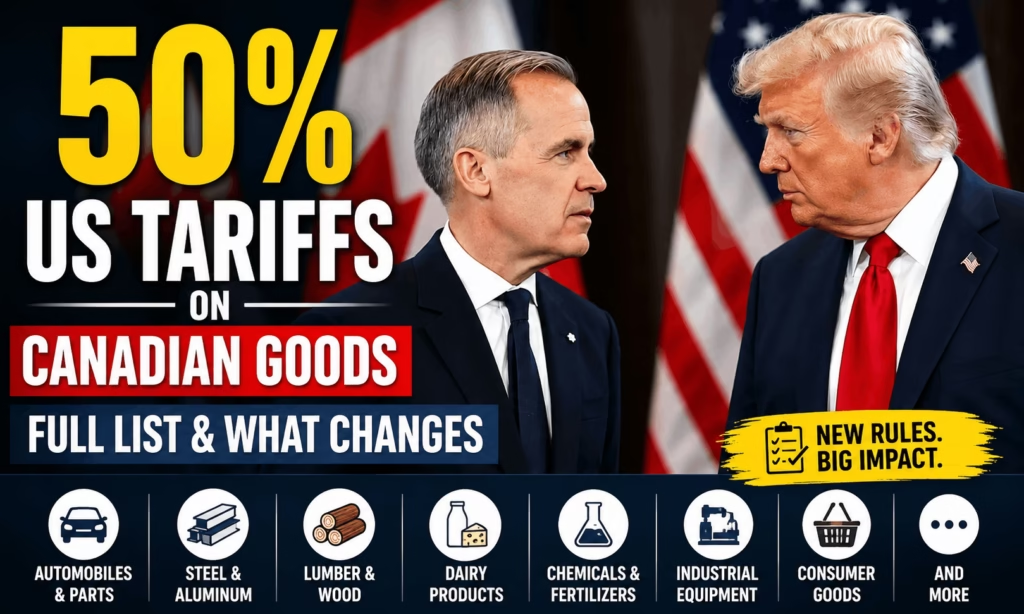
50% US Tariffs on Canadian Goods: With less than a week on the clock, a sweeping new round of 50% tariffs on Canadian goods is set to hit hundreds of product categories at the U.S. border starting at 12:01 a.m. Eastern Time on August 19, 2026. President Trump signed three separate presidential proclamations on July 20, 2026, invoking a rarely used trade law, Section 338 of the Tariff Act of 1930, to punish what the White House calls discriminatory Canadian treatment of American dairy, alcohol, and auto exports. Unlike earlier tariff rounds, these duties apply even to goods that would otherwise qualify for duty free treatment under the U.S. Mexico Canada Agreement, which is the detail catching the most Canadian exporters and American importers off guard.
The Office of the U.S. Trade Representative estimates the new duties will touch nearly 20 billion dollars in annual Canadian imports, covering everything from cheese and whisky to hockey sticks, cement, and cosmetics. Canadian Trade Minister Dominic LeBlanc and chief negotiator Janice Charette have met U.S. Trade Representative Jamieson Greer four times in three weeks, and a Canadian government source told Reuters on August 13 that talks were progressing with both sides hoping for a deal before the deadline. Prime Minister Mark Carney has kept retaliation on the table without confirming specific countermeasures. This guide breaks down exactly what is covered, what is exempt, who actually pays the bill, and what happens next. We’ll be updating this article monthly as the situation develops.
Why the White House Says These Tariffs Are Necessary
The administration built its case around three specific grievances, each tied to its own presidential proclamation.
The first concerns motor vehicles. Since April 2025, Canada has charged a 25 percent tariff on U.S. vehicles that do not qualify for USMCA duty free treatment, plus a 25 percent charge on the non-Canadian, non-Mexican content of qualifying vehicles under company specific quotas. The proclamation argues Canada does not apply similar restrictions to vehicles from Japan, South Korea, or Germany, and blames this imbalance for a roughly 22 percent, or 5.6 billion dollar, drop in U.S. vehicle exports to Canada between April 2025 and March 2026.
The second grievance targets alcoholic beverages. Nearly every Canadian province and territory stopped buying, distributing, or selling American alcohol products after the U.S. imposed earlier tariffs, without placing equivalent restrictions on other countries’ alcohol. According to the White House, Canadian imports of U.S. alcoholic beverages fell about 81 percent, or 582 million dollars, over roughly the same period.
The third grievance is dairy. The White House says Canada’s supply managed dairy system grants more generous tariff rate quotas to cheese from the European Union than to comparable American dairy exports, even though Canada holds trade agreements with both the U.S. and the EU.
The Legal Tool Behind the New Tariffs
These duties rely on Section 338 of the Tariff Act of 1930, a statute that lets the president impose additional duties of up to 50 percent on goods from any country found to discriminate against U.S. commerce. Trade analysts describe this as essentially the first modern use of Section 338 for an action of this scale, which is part of why it has been dubbed an unusually aggressive option in the current trade toolkit. The critical difference from earlier tariff rounds tied to Section 122 or Section 232 is that Section 338 duties apply regardless of USMCA compliance. A valid certificate of origin does not shield a covered Canadian product from this particular tariff.
Borrower Defense Student Loans: How to Apply for a Full Discharge?
IRS Business Tax Account New Features Give Small Businesses More Ways to Skip the Phone Line
SSA Payroll Information Exchange and New SSI Improvement Office: What the Report Actually Changes
Maryland SNAP Cost-Sharing Rules: Why the State Faces a $300 Million Bill Starting 2027
Full List of Canadian Product Categories Covered
The three proclamations collectively span more than 500 Harmonized Tariff Schedule subheadings. Despite one proclamation being labeled for motor vehicles, passenger cars themselves are not on the list, since automobiles already fall under a separate Section 232 tariff. Here is a breakdown of the major categories affected.
| Product Category | Examples of Covered Items |
|---|---|
| Dairy products | Milk, cream, whey, caseinates, lactose, cheese ingredients |
| Alcoholic beverages | Beer, wine, whisky, rum, vodka, gin, liqueurs, cider, spirits |
| Electronics and telecom equipment | Telephones, broadcast gear, monitors, circuit boards, antennas |
| Building materials | Cement, plywood, fibreboard, doors, windows, wood flooring |
| Furniture and home goods | Office furniture, metal seating, wooden furniture, lighting, mattress parts |
| Plastics and packaging | Floor coverings, adhesive films, bags, boxes, bottles, tableware |
| Clothing and textiles | T-shirts, sweaters, jackets, trousers, coats, gloves, headgear |
| Toys and sporting goods | Toys, gaming consoles, fishing rods, hockey sticks, golf gear, skates |
| Cosmetics and fragrances | Essential oils, perfumes, makeup, skin and hair products, candles |
| Agricultural products | Honey, live plants, cut flowers, seeds, bulbs, seaweed extracts |
| Wood and paper products | Charcoal, sawn timber, wood pulp, wallpaper, cardboard boxes |
| Leather and luggage | Raw hides, suitcases, handbags, leather gloves, fur skins |
| Machinery and tools | Hand tools, saws, wrenches, razors, cranes, boilers, turbines |
| Chemicals and minerals | Salt, mannitol, sorbitol, inks, paints, lubricant additives |
| Jewellery and precious metals | Gold jewellery, silver, diamonds, imitation jewellery, coins |
| Art, antiques, and collectibles | Original paintings, prints, sculptures, stamps, antiques over 100 years old |
| Vessels and motorcycles | Electric motorcycles, floating docks, light vessels, lifeboats |
Because the binding legal text is the specific tariff subheading listed in each proclamation’s annex, businesses should confirm their exact product classification against the official notice or with a licensed customs broker rather than relying on category summaries alone.
What Is Excluded from the New Tariffs
Several major categories were deliberately carved out of the Section 338 action. Energy products, including oil and natural gas, are exempt. Potash, a key fertilizer input the U.S. sources heavily from Saskatchewan producers, is also excluded, along with fish, critical minerals, and aerospace products covered under the WTO Agreement on Trade in Civil Aircraft. Goods already facing separate Section 232 tariffs, including automobiles, steel, aluminum, copper, certain wood products, semiconductors, and patented pharmaceuticals, are excluded from this action as well, since the administration does not want to double stack duties on the same product.
Who Actually Pays the 50 Percent Tariff
This is one of the most misunderstood parts of any tariff dispute. The duty is collected from American importers by U.S. Customs and Border Protection the moment goods cross into the United States. Canadian companies and the Canadian government do not send a payment to Washington. Once the charge hits, a U.S. importer typically responds in one of three ways: absorb the cost and accept a thinner profit margin, renegotiate a lower purchase price with the Canadian supplier, or pass some or all of the added cost on to American consumers through higher retail prices. In practice, most importers use some combination of all three, meaning U.S. households and businesses carry the real weight of the tariff. Canadian consumers are not directly taxed by this specific measure, though currency shifts and tightly linked supply chains can create smaller secondary effects north of the border. If Canada answers with its own retaliatory tariffs, that is the scenario that would raise prices most directly for Canadian shoppers on American made goods.
How the Tariffs Could Ripple Through the Canadian Economy
The tariffed products represent roughly 5 percent of Canada’s total exports to the United States by value, or close to 20 billion U.S. dollars a year. TD Economics estimates the tariffs, if they stay in place, could shave 0.3 to 0.6 percentage points off Canadian GDP growth over the following year, with most forecasters expecting an outcome closer to the lower end. Other analysts see a similar two to three tenths of a percentage point drag across both 2026 and 2027, though most do not expect the tariffs alone to trigger a recession.
The bigger long term risk is demand destruction. When American buyers suddenly face a 50 percent premium on Canadian electronics, furniture, building materials, and consumer goods, many will simply shift purchases to suppliers in other countries. The administration’s own proclamation cited a version of this pattern already happening in the auto sector, where Canadian imports of Mexican vehicles rose about 23.6 percent after Canada’s own tariffs on U.S. autos took hold, while imports from Japan, South Korea, and Germany rose 10 to 13.5 percent. A similar shift could now happen in reverse, with American buyers turning away from Canadian suppliers once the new duties raise prices.
Manufacturing, agriculture, building materials producers, and small and mid sized exporters carry the most exposure, since they form a large share of cross-border trade and cannot easily replace a sudden loss of their biggest customer. British Columbia, Ontario, and Quebec are seen as the most exposed provinces given how tightly their auto parts, electronics, wood products, and resource sectors are woven into U.S. supply chains.
Negotiations Are Still Active as the Deadline Nears
Talks have not stopped just because a deadline is approaching. Canadian officials met their American counterparts four times over three weeks leading up to mid August, and a Canadian government source described the discussions to Reuters as progressing, with both governments reportedly hoping to reach an agreement before August 19. Prime Minister Carney has said retaliation remains an option if talks collapse, but has avoided naming specific countermeasures, arguing that announcing retaliation too early would undermine the negotiation itself. Canada has reportedly signaled openness to addressing American complaints about alcohol distribution rules and dairy quota structures, while pushing in return for relief on the existing Section 232 tariffs covering steel and aluminum that have been in place since 2025. According to reporting, Canada’s negotiating team has privately warned that if the new tariffs actually take effect, it could function as a cliff edge that stalls further talks entirely.
Where This Fits in the Broader Trade Dispute
This latest round lands on top of tariffs that already cover major segments of Canadian trade, including existing Section 232 duties on steel, aluminum, copper, automobiles, trucks, certain lumber products, semiconductors, and patented pharmaceuticals. On July 1, 2026, the United States chose not to renew the USMCA for another full term, leaving the agreement technically in force but shifting it into annual reviews, which adds an extra layer of uncertainty for cross-border business planning. Notably, the White House has pointed out that among all its trading partners currently facing tariffs, only China and Canada have chosen open retaliation rather than negotiation, a distinction the administration has used to justify treating Canada more aggressively than some other partners.
The Bank of Canada has projected that, by the end of 2026, Canadian GDP could sit roughly 1.5 percent below where it would have been without the broader trade conflict, with about half of that shortfall tied to reduced long term economic potential and the rest reflecting weaker current demand. Canada’s economy grew 1.7 percent in 2025, its slowest pace in several years outside of the pandemic downturn.
Key Dates and Developments
| Development | Detail | Date |
|---|---|---|
| Proclamations signed | Trump signs three Section 338 proclamations targeting autos, alcohol, and dairy | July 20, 2026 |
| USMCA not renewed | U.S. declines to renew USMCA for a new term, shifting it to annual review | July 1, 2026 |
| Tariffs take effect | New 50% duties apply at the U.S. border | 12:01 a.m. ET, August 19, 2026 |
| Active negotiations | Canadian and U.S. trade officials hold fourth meeting in three weeks | Week of August 10, 2026 |
| GDP impact estimate | TD Economics projects 0.3 to 0.6 point drag on Canadian growth | Ongoing 2026 to 2027 |
What to Watch Before and After August 19
A few outcomes remain realistic in the days ahead. The two governments could reach a framework deal that delays or narrows the tariffs before they formally start, echoing how some past trade deadlines were pushed back at the last moment. The tariffs could also simply take effect as scheduled, which would likely trigger a fresh round of pressure on both sides to either keep absorbing the economic cost or find a face saving compromise afterward. A third possibility is that Canada responds with its own retaliatory tariffs on American goods, something Ottawa has not done on this scale since September 2025, which would raise prices more directly for Canadian consumers buying U.S. made products. Businesses with exposure to any of the covered categories should review the official tariff schedule, check their exact product classification, and speak with a licensed customs broker well before the effective date.
Official Resources for Tracking the Tariffs
| Resource | What It’s For | Official Link |
|---|---|---|
| White House Presidential Proclamations | Full legal text of the three Section 338 actions | whitehouse.gov/presidential-actions |
| USTR Trade Actions | Ongoing updates on Canada trade measures | ustr.gov |
| U.S. Customs and Border Protection | Tariff classification and entry guidance for importers | cbp.gov/trade |
| Global Affairs Canada | Canada’s official position and any retaliatory measures | international.gc.ca |
| Bank of Canada | Economic outlook and GDP impact analysis | bankofcanada.ca |
FAQs
What is the new 50 percent tariff on Canadian goods?
It is an additional duty imposed under Section 338 of the Tariff Act of 1930 on more than 500 categories of Canadian products, tied to disputes over motor vehicles, alcohol, and dairy, and scheduled to start at 12:01 a.m. Eastern Time on August 19, 2026.
Does USMCA protect Canadian imports from this tariff?
No. Unlike some earlier tariff actions, these Section 338 duties apply to covered goods regardless of USMCA qualification, so a valid certificate of origin does not exempt a listed product.
Are cars included in the new tariffs?
No. Passenger vehicles already fall under a separate Section 232 tariff and are not part of this new action, even though one of the three proclamations is labeled for motor vehicles.
Do Canadians pay this tariff directly?
No. The duty is collected from U.S. importers at the American border. Canadian consumers would only feel a direct price impact if Canada responds with its own retaliatory tariffs on U.S. goods sold in Canada.
What Canadian products are exempt?
Energy products, potash, fish, critical minerals, aerospace goods covered under the WTO civil aircraft agreement, and anything already subject to Section 232 tariffs, such as steel, aluminum, and pharmaceuticals.
Is a deal still possible before August 19?
Yes. As of the most recent reporting, Canadian and U.S. trade negotiators were meeting regularly and both sides reportedly wanted an agreement before the deadline, though nothing had been finalized.
How much could this cost the Canadian economy?
Estimates from TD Economics suggest a 0.3 to 0.6 percentage point reduction in Canadian GDP growth over the following year if the tariffs remain in place, with most economists expecting an impact closer to the lower end of that range.
Conclusion
The looming 50% tariffs on Canadian goods mark one of the most aggressive moves yet in the ongoing trade dispute between Washington and Ottawa, both because of the sheer number of product categories involved and because the measure bypasses USMCA protections that have shielded Canadian exporters in earlier rounds. With negotiators from both countries still talking as the clock runs down, the outcome by August 19 could range from a last minute framework agreement to the tariffs taking full effect and prompting Canadian retaliation. Businesses on both sides of the border with exposure to dairy, alcohol, electronics, furniture, or the dozens of other covered categories should confirm their tariff classification now rather than waiting to see how the negotiations end.
New $20,000 Visa Bond Program: What It Means for Travelers Entering the U.S.
VA Health and Benefits App: Every Feature You Can Use From Your Phone