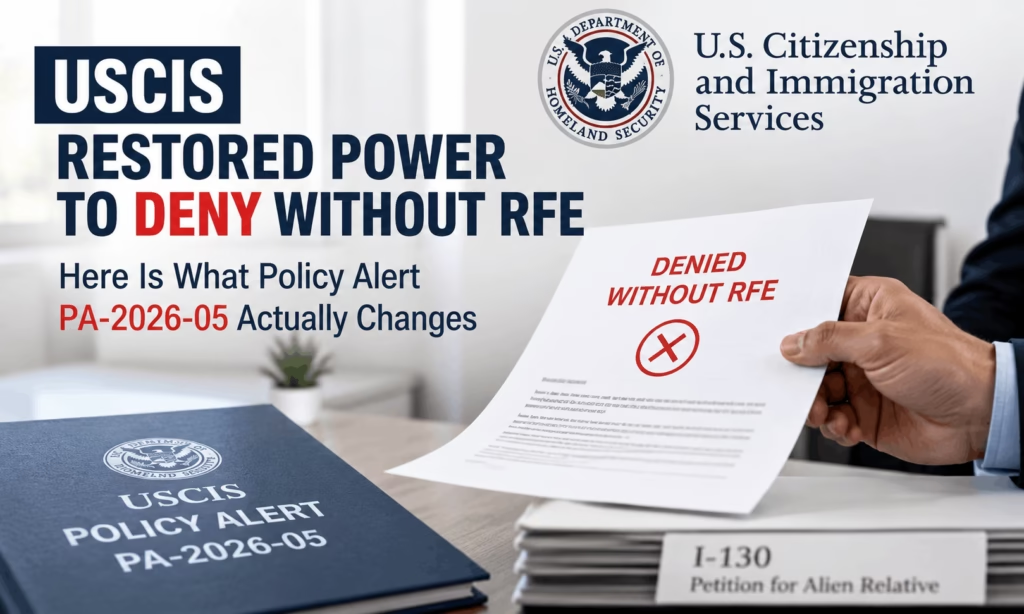
USCIS Restored Power To Deny Without RFE: Immigration applicants and employers across the country got a jolt this month when U.S. Citizenship and Immigration Services quietly rewrote one of the most consequential parts of its adjudication playbook. On August 5, 2026, USCIS issued Policy Alert PA-2026-05, giving officers back full discretion to deny a green card application, work permit, or employer-sponsored visa petition without first sending a Request for Evidence or a Notice of Intent to Deny, the two safety nets that have historically given applicants a second chance to fix an incomplete filing. The change took effect immediately and applies to cases already sitting in USCIS inboxes as well as anything filed from that date forward.
For the roughly two million people with a benefit request pending at USCIS at any given time, this is not a distant policy debate, it is an immediate shift in the odds. A petition that might once have triggered a request for missing tax returns, an updated employment letter, or additional medical evidence can now be denied outright if the officer decides the initial filing did not establish eligibility. Immigration attorneys describe this as the sharpest procedural swing at the agency in years, reviving a rule the first Trump administration introduced in 2018, which the Biden administration reversed in 2021, and which is now back in force under a new legal justification. We’ll be updating this article monthly as USCIS issues further guidance and as legal challenges to the policy develop.
What Policy Alert PA-2026-05 Actually Says
The policy alert, titled Evidence, Requests for Evidence, and Notices of Intent to Deny, updates the USCIS Policy Manual and rescinds guidance the agency had followed since 2021. Under that older guidance, officers were told to generally issue an RFE or NOID if there was any possibility the applicant could overcome a finding of ineligibility by submitting more evidence. The new policy strips that presumption away entirely.
USCIS says the regulatory authority for this discretion was never actually taken away. It points to 8 CFR Section 103.2(b)(8)(ii), which has always permitted officers to deny a case outright when required initial evidence is missing or the record does not establish eligibility. What changed is the agency’s internal instruction to its own workforce, moving from encouraging a second chance to allowing an immediate denial whenever an officer believes the filing falls short.
USCIS framed the change around discouraging what it calls frivolous or placeholder filings, cases where an applicant submits the bare minimum required documents and waits to see what specific evidence an officer requests before doing the real work of building their case. Agency officials argue that pattern slows down adjudication for everyone and consumes resources that could go toward complete, well-documented applications.
Key Details of the New RFE and NOID Policy
The policy does more than remove the presumption favoring a second chance. It also changes how existing RFEs and NOIDs are timed and evaluated.
| Detail | What the Policy Says |
|---|---|
| Effective date | August 5, 2026, immediately |
| Applies to | Benefit requests pending on or filed after August 5, 2026 |
| Legal basis cited | 8 CFR Section 103.2(b)(8)(ii) |
| Maximum RFE response window | Up to 12 weeks, but officers no longer required to grant the full period |
| Maximum NOID response window | Up to 30 days, subject to the same officer discretion |
| International mailing allowance | Removed; only the standard 3-day domestic mailing allowance applies |
| Partial RFE or NOID responses | Treated as a request for a final decision on the case as filed |
| Prior guidance rescinded | 2021 memo generally favoring RFE or NOID before denial |
That detail about partial responses is one attorneys are flagging most urgently. Under the new guidance, if an applicant responds to an RFE with some but not all of the requested evidence, USCIS will treat that as a request to decide the case on the record as it stands, rather than following up again. There is effectively no room left for a rolling back and forth once a request for evidence has gone out.
IEEPA Tariff Refund Process: How Businesses Are Claiming Their Share of $166 Billion
50% US Tariffs on Canadian Goods: Full List and What Changes
Borrower Defense Student Loans: How to Apply for a Full Discharge?
IRS Business Tax Account New Features Give Small Businesses More Ways to Skip the Phone Line
SSA Payroll Information Exchange and New SSI Improvement Office: What the Report Actually Changes
Why This Policy Sounds Familiar: The 2018 to 2021 History
This is not the first time USCIS adjudicators have had this authority, and understanding the back and forth helps explain why the current change feels so consequential to people who have watched immigration policy shift across administrations. USCIS Policy Memorandum PM-602-0163, issued July 13, 2018 during the first Trump administration, gave officers the same discretion to deny without first requesting evidence. That memo was explicitly aimed at deterring incomplete or placeholder filings. In 2021, the Biden administration rescinded that memo and restored the presumption that officers should generally issue an RFE or NOID before denying a case whenever more evidence might resolve the deficiency.
The August 2026 policy effectively reverses course again, reviving the 2018 approach but framing it differently. Where the original 2018 memo emphasized adjudicative efficiency and reducing agency workload, the 2026 version leans more heavily on evidentiary standards, arguing that applicants and petitioners bear the burden of establishing eligibility at the time of filing and that the agency’s job is not to help build a case after the fact.
Which Forms and Applicants Are Most Affected
The policy applies broadly across USCIS benefit categories, but the practical impact will land hardest on filings that historically relied on RFEs to fill gaps rather than complete documentation upfront. That includes employment-based petitions such as Form I-129 for H-1B, L-1, and O-1 workers, Form I-140 immigrant worker petitions, Form I-485 adjustment of status applications, and Form I-765 applications for employment authorization documents tied to a pending green card case.
Recent USCIS data already shows denial rates climbing well before this latest policy took effect. According to the American Immigration Council’s analysis of agency figures, the denial rate for employment authorization documents filed alongside pending I-485 adjustment applications more than doubled, moving from 5.1% to 13.6% year over year. Denial rates for O-1 extraordinary ability petitions rose from 5.0% to 7.3% between the fourth quarter of fiscal year 2024 and the same quarter of fiscal year 2025, according to a separate analysis from the National Foundation for American Policy. L-1A and L-1B intracompany transfer denials climbed in the same period as well. Immigration attorneys expect the removal of the RFE safety net to push these numbers higher still, since officers who previously might have sent a request for missing evidence now have a faster, simpler path to an outright denial.
What Applicants and Employers Should Do Now
Attorneys advising clients on this shift are converging on the same core message: treat every filing as though it has to succeed on the very first submission, because there may not be a second chance to fix it. That means front-loading every piece of required initial evidence rather than relying on the RFE process to identify what is missing.
For pending cases filed before August 5, 2026, the picture is murkier. USCIS has not clearly stated how the new discretion applies to filings that were submitted under the old, more forgiving standard, and immigration lawyers are split on whether applicants who filed in good faith under the prior approach have a fairness argument if their case is judged under the new one. Anyone with a pending petition, particularly one that may be missing supporting documentation the applicant assumed could be supplied later, should consult an immigration attorney promptly about whether supplemental evidence should be submitted proactively rather than waiting for USCIS to ask.
Employers filing on behalf of workers face a related risk. A change-of-employer H-1B petition or an extension request that historically might have drawn a routine RFE for updated wage or job duty documentation could now be denied without warning, disrupting a worker’s ability to remain employed while a corrected petition is prepared and refiled.
USCIS’s Shifting Institutional Role
The RFE and NOID policy did not emerge in isolation. It follows a broader shift in how USCIS has described its own mission over the past year. In 2025, the agency announced expanded law enforcement authorities for certain personnel, including special agents with investigative powers, a move USCIS Director Joseph Edlow tied to a broader philosophy, stating that USCIS has always been an enforcement agency. Backlogs have also grown across major categories during this period. Agency data cited in an April 2026 policy brief showed the net backlog for I-129 nonimmigrant worker petitions increased by more than 54,000 between the fourth quarter of fiscal year 2024 and the same period in fiscal year 2025, while the backlog for green card replacement applications increased by more than 200,000 over the same stretch.
For applicants trying to make sense of the moment, the throughline is consistent. An agency dealing with rising backlogs and a stated priority on discouraging incomplete filings has removed one of the procedural steps that used to slow individual cases down but also gave applicants room to correct honest mistakes.
Maryland SNAP Cost-Sharing Rules: Why the State Faces a $300 Million Bill Starting 2027
Official USCIS Resources
| Resource | Purpose | Link |
|---|---|---|
| USCIS Policy Manual | Full text of Policy Alert PA-2026-05 and related guidance | https://www.uscis.gov/policy-manual |
| Case Status Online | Check the status of a pending USCIS filing | https://egov.uscis.gov/casestatus |
| myUSCIS Account Portal | File benefit requests and manage existing cases | https://my.uscis.gov |
| USCIS Contact Center | General inquiries and filing support | https://www.uscis.gov/contactcenter |
| USCIS Forms Page | Download current versions of all immigration benefit forms | https://www.uscis.gov/forms |
FAQs
What does it mean that USCIS restored power to deny without RFE?
It means USCIS officers can now deny an immigration benefit request outright, without first requesting missing evidence or issuing a notice giving the applicant a chance to respond, whenever the officer decides the filing does not establish eligibility or is missing required initial documentation.
When did this USCIS policy take effect?
The policy took effect immediately on August 5, 2026, under Policy Alert PA-2026-05, and applies to benefit requests that were already pending on that date as well as new filings submitted afterward.
Does this policy apply to green card applications and work permits?
Yes. It applies broadly across USCIS benefit categories, including Form I-485 adjustment of status applications, Form I-765 work permit applications, and employment-based petitions such as Form I-129 and Form I-140, unless a specific regulation requires an RFE or NOID in a given situation.
Can USCIS still choose to send an RFE or NOID under the new policy?
Yes. Officers retain the discretion to issue an RFE or NOID when they believe additional evidence could resolve an eligibility question. The change removes the general expectation that they must do so before denying a case.
What happens if I only partially respond to an RFE under the new rules?
USCIS will treat a partial response as a request for a final decision on the case as it stands, rather than following up for the remaining missing evidence. This makes it important to submit a complete response the first time.
Is this the first time USCIS has had this authority?
No. A similar policy was introduced through Memorandum PM-602-0163 in July 2018 during the first Trump administration and was rescinded in 2021 under the Biden administration. The August 2026 policy revives that approach with an updated rationale focused on evidentiary standards.
Should I hire an immigration attorney because of this change?
Given that filings can now be denied without a chance to supplement missing evidence, many immigration attorneys recommend a thorough legal review of any pending or upcoming filing to ensure all required initial evidence is included from the start, particularly for employment-based petitions and adjustment of status applications.
Conclusion
The restoration of USCIS’s authority to deny immigration benefit requests without an RFE or NOID marks one of the most significant procedural changes at the agency in years, and it took effect with no transition period for cases already in the pipeline. For applicants and employers, the message from immigration attorneys is consistent, a complete, well-documented filing at the time of submission now matters more than it has in years, because the agency’s built-in second chance is no longer something anyone can count on. Whether the policy survives legal challenges, and how USCIS applies it in practice to cases filed under the old standard, remains to be seen in the months ahead. We’ll be updating this article monthly as USCIS issues further clarification and as denial-rate data for the fall filing season becomes available.
New $20,000 Visa Bond Program: What It Means for Travelers Entering the U.S.
VA Health and Benefits App: Every Feature You Can Use From Your Phone