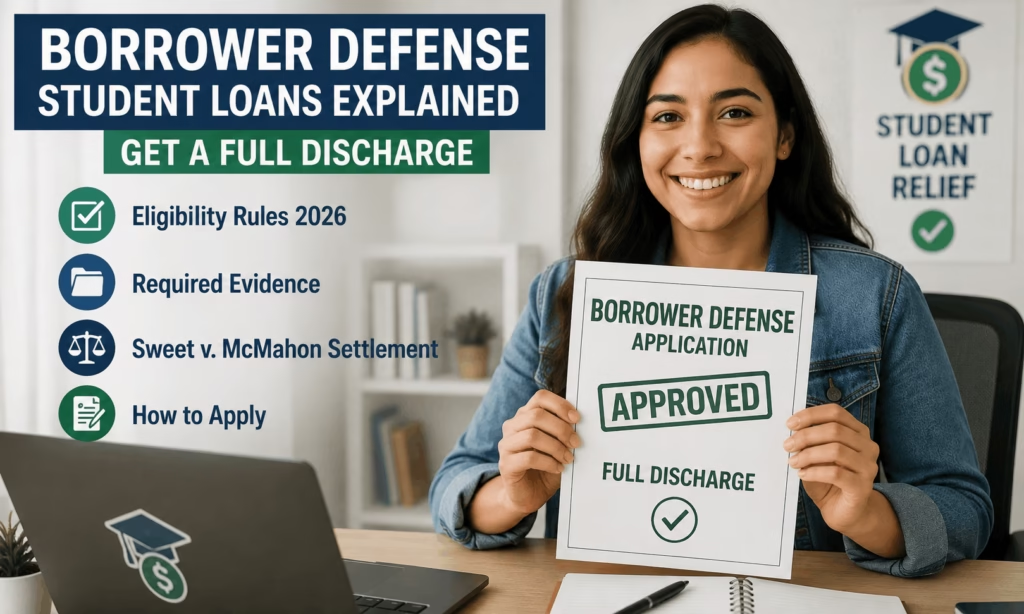
Borrower Defense Student Loans: A federal court ruled in July 2026 that the Department of Education must wipe out student debt for more than 500,000 borrowers under the Sweet v. McMahon settlement, after the agency missed court ordered deadlines to decide their claims. That ruling is the biggest development yet in borrower defense student loans, the federal program that lets borrowers get their debt cancelled when a college lied to them or broke the law to get them enrolled. If you applied for borrower defense before June 22, 2022 and never got an answer, this settlement may already apply to you, and the Department was required to start sending confirmation notices earlier this year.
Outside the settlement, the borrower defense program itself is running under a different rulebook than it was two years ago. The One Big Beautiful Bill Act, signed July 4, 2025, pushed the more borrower friendly 2022 rules out to 2035 and restored the tougher 2019 standard for any loan disbursed on or after July 1, 2020. That means the bar for a full discharge is higher than it briefly was, and colleges have been receiving fresh waves of borrower defense claims since March 2026 that have nothing to do with the Sweet settlement. This guide breaks down exactly who qualifies for student loan discharge right now, what evidence the Department wants to see, and how to file a complete application. We’ll be updating this article monthly as new court rulings and Department guidance come in.
What Borrower Defense to Repayment Actually Cancels
Borrower defense to repayment is a federal discharge program that cancels some or all of a borrower’s federal Direct Loans if their school misled them, lied to them, or broke certain state or federal laws while recruiting or retaining them as a student. It only applies to Direct Loans, including Direct PLUS Loans and Direct Consolidation Loans. Anyone still holding FFEL Program loans or Perkins Loans has to consolidate into the Direct Loan program before those balances become eligible.
The most common basis for a claim is misrepresentation, meaning the school lied about something material to the decision to enroll. According to the Department’s own application form, this typically shows up as false claims about how selective the school is, inflated national or regional rankings, invented job placement and graduate earnings numbers, or false promises that the school’s credits would transfer to another institution. A borrower does not need to prove intentional fraud in the criminal sense, only that the school made a substantial misrepresentation that a reasonable student would have relied on.
Which Rules Apply Depends on When You Borrowed
This is the part that trips up most applicants. Because the Department has issued four different sets of borrower defense regulations since the program began, in 1994, 2016, 2019, and 2022, the substantive standard a claim is judged against depends entirely on the date the loan was first disbursed, not the date the application is filed.
| Loan Disbursement Period | Rule That Applies | Key Standard |
|---|---|---|
| Before July 1, 2017 | 1994 regulations | Any act or omission that would give rise to a claim against the school under state law |
| July 1, 2017 to June 30, 2020 | 2016 regulations | Substantial misrepresentation, breach of contract, or a favorable court judgment |
| On or after July 1, 2020 | 2019 regulations | Substantial misrepresentation plus proof of financial harm beyond the loan itself |
| Not currently in effect | 2022 regulations | Delayed by litigation and now pushed to July 1, 2035 by the One Big Beautiful Bill Act |
The 2022 rules would have lowered the burden of proof and created a group discharge process for borrowers who attended the same school, but that rule was blocked by a federal court in the Career Colleges and Schools of Texas litigation and then formally delayed until 2035 under the One Big Beautiful Bill Act. For nearly all current applicants, that means proving individual harm one claim at a time rather than relying on a group finding against a school.
The Financial Harm Requirement for Newer Loans
For loans disbursed on or after July 1, 2020, showing that the school lied is not enough on its own. The Department also requires proof of financial harm connected to the misrepresentation, not just the fact that the borrower now owes money on a federal loan. The Department has specifically stated that some circumstances do not count as financial harm by themselves, including general unemployment unrelated to a recession, a voluntary decision to work part time or change careers, or simply choosing not to work.
Evidence that does support a financial harm claim typically includes a documented gap between the salary a graduate was promised and what the job market actually paid, a licensing or credentialing requirement the school never disclosed, or a program that left a graduate unable to sit for the exam needed to practice in their field. Borrowers whose loans were disbursed before July 1, 2020 do not need to clear this financial harm bar, which is one reason the disbursement date matters so much when preparing an application.
IRS Business Tax Account New Features Give Small Businesses More Ways to Skip the Phone Line
SSA Payroll Information Exchange and New SSI Improvement Office: What the Report Actually Changes
Maryland SNAP Cost-Sharing Rules: Why the State Faces a $300 Million Bill Starting 2027
What Evidence a Complete Application Needs
Federal Student Aid has said a single school claim takes roughly three hours to complete once the supporting material is gathered, so preparation matters more than the form itself. A strong application generally includes:
- School records, including enrollment agreements, the student handbook, the course catalog, and full transcripts
- Marketing and recruitment material, such as brochures, emails from admissions staff, or website pages that made the false claim, saved as screenshots with visible dates where possible
- A written, specific description of what the school said or did, not a general complaint, since vague statements are the most common reason applications stall
- Documentation of financial harm for any loan disbursed on or after July 1, 2020, such as pay records, job search logs, or licensing exam results
- Any court judgment, state attorney general action, or federal enforcement action against the school, which can serve as strong independent evidence and, for pre-2020 loans, can be the sole basis for a claim
- A statement addressing whether the borrower would have still enrolled had they known the truth, since the Department asks this question directly on the application
For loans disbursed on or after July 1, 2020, the completed application and evidence are sent to the school, and the borrower gets a limited window to review and respond to whatever the school submits back. Applicants should expect this back and forth to add time to an already lengthy process.
The Sweet v. McMahon Settlement, Explained
Sweet v. McMahon, formerly known as Sweet v. Cardona, began as a 2017 class action brought by borrowers who said the Department was sitting on their borrower defense applications without deciding them. The settlement, finalized in 2022, created two groups. Class members who applied before June 22, 2022 and attended one of the schools on the settlement’s list, known as Exhibit C, were entitled to automatic discharge. Post-class applicants who filed after the settlement was reached but before it received final court approval in November 2022 were instead entitled to have their applications actually reviewed and decided by a set deadline.
That deadline is where the Department fell short. According to court filings, borrowers from Exhibit C schools who had not received a decision by January 28, 2026 became entitled to full settlement relief automatically, and the Department was supposed to confirm that in writing by March 30, 2026. Post-class applicants from non-Exhibit C schools who had not received a decision by April 15, 2026 became entitled to the same automatic relief, with confirmation notices due by June 15, 2026. In July 2026, a federal court confirmed the Department had to follow through on this obligation for the full group, covering more than 500,000 borrowers.
Full settlement relief means complete discharge of the loans tied to the relevant school, a refund of payments already made, and removal of the loan from the borrower’s credit history. Borrowers who believe they qualify but have not received a confirmation notice are advised to contact the Department directly rather than assume nothing is happening, since servicer errors have been reported, including cases where forbearance protections were removed by mistake while a claim was still pending.
New Borrower Defense Claims Since March 2026
Separately from the settlement, colleges across the country began receiving a new round of borrower defense notices from the Department in March 2026. The Department clarified in an Electronic Announcement dated March 30, 2026 that these claims are unrelated to Sweet v. McMahon and will be adjudicated under the regulation that matches each loan’s disbursement date, following the standard framework described above. Schools are not required to respond to these notices, and the Department has said there is no negative inference for institutions that choose not to, though most schools are still expected to respond given the stakes involved.
Key Borrower Defense Updates at a Glance
| Development | What It Means | Date |
|---|---|---|
| One Big Beautiful Bill Act signed | 2022 rules delayed to 2035, 2019 rules restored for loans from July 1, 2020 forward | July 4, 2025 |
| Sweet settlement decision deadline | Exhibit C applicants without a decision became entitled to full relief | January 28, 2026 |
| Court confirmed relief for 500,000-plus borrowers | Department ordered to discharge loans and issue confirmations | July 2026 |
| New non-settlement BDR claims resume | Department sends fresh claims to schools under 1994/2016/2019 rules | March 30, 2026 |
| Non-Exhibit C settlement deadline | Post-class applicants without a decision became entitled to full relief | April 15, 2026 |
How to Apply for Borrower Defense Loan Discharge
- Confirm the loan type. Only Direct Loans, including Direct PLUS and Direct Consolidation Loans, qualify. FFEL and Perkins loans must be consolidated first.
- Identify the disbursement date for each loan, since this determines which regulation and evidence standard applies to the claim.
- Gather documentation before starting the form, including enrollment records, marketing material, transcripts, and any related legal judgments.
- Apply online at the Department’s official portal, which is the fastest and recommended method, or complete the fillable PDF and mail it in.
- Write a specific, factual account of the misrepresentation, avoiding vague or emotional language in favor of dates, names, and direct quotes where available.
- Submit evidence of financial harm if the loan was disbursed on or after July 1, 2020.
- Respond promptly if the school submits evidence back, since there is a limited window to reply once notified.
- Track the application status through the online account and keep records of every communication with the loan servicer while the claim is pending.
Borrowers should expect a long wait. The Department has acknowledged that, depending on application volume, a decision may not arrive for years, which is part of why the Sweet settlement’s automatic relief provisions became so significant for borrowers who had already been waiting since 2022.
Official Borrower Defense Resources
| Resource | What It’s For | Official Link |
|---|---|---|
| Borrower Defense Application Portal | Submit or check the status of a claim | studentaid.gov/borrower-defense |
| Borrower Defense Program Overview | Full eligibility rules and current regulations | studentaid.gov/manage-loans/forgiveness-cancellation/borrower-defense |
| Login and Account Access | Sign in to StudentAid.gov to track application status | studentaid.gov/login |
| Fillable PDF Application | Paper application for mailing instead of the online portal | studentaid.gov/sites/default/files/borrower-defense-application.pdf |
| Sweet v. McMahon Settlement Information | Class member and post-class applicant status details | studentaid.gov/courtactions |
FAQs
What qualifies as school misconduct for borrower defense?
The most common basis is substantial misrepresentation, meaning the school made false claims about things like job placement rates, graduate earnings, program rankings, or whether credits would transfer, and a reasonable student relied on those claims when deciding to enroll or stay enrolled.
Do private student loans qualify for borrower defense?
No. The program only discharges federal Direct Loans. Private loans and other federal loan types like FFEL or Perkins loans are not eligible unless the FFEL or Perkins balance is first consolidated into a Direct Loan.
How long does a borrower defense decision take?
There is no fixed timeline, and Federal Student Aid has said that depending on how many applications are pending, a decision can take years. This is part of why the Sweet v. McMahon settlement built in automatic relief for borrowers whose claims went undecided past a set deadline.
Am I part of the Sweet v. McMahon settlement?
Borrowers who filed a borrower defense application before June 22, 2022 may be covered. Class members who attended an Exhibit C school were entitled to automatic discharge, while post-class applicants were entitled to a timely decision, with automatic full relief kicking in if the Department missed its deadline.
Will my loan servicer know I have a pending claim?
Borrowers with a pending Sweet settlement claim should generally be placed in forbearance, but servicer errors have occurred, including cases where forbearance was incorrectly removed. Borrowers who are told to resume payments while a claim is pending should contact the Department directly before making a payment.
Can I still get a full discharge under the newer, easier 2022 rules?
Not right now. The 2022 regulations, which would have lowered the evidence standard, were blocked in court and then delayed until July 1, 2035 by the One Big Beautiful Bill Act, so current applications are judged under the 1994, 2016, or 2019 standards depending on when the loan was disbursed.
What if my school closed after I attended?
A school closure is generally handled through closed school discharge rather than borrower defense, though the two programs can sometimes overlap depending on the circumstances and the loan’s disbursement date.
Conclusion
Getting a complete discharge through borrower defense student loans now depends heavily on two things: when the loan was first disbursed and whether the claim falls inside the Sweet v. McMahon settlement or the standard application process. Loans from before July 1, 2020 face a lower bar, while newer loans require documented proof of financial harm on top of the misrepresentation itself. With the Department confirming automatic relief for more than 500,000 settlement borrowers in 2026 and a fresh wave of non-settlement claims moving through colleges since March, this remains one of the most active corners of federal student loan policy. Borrowers who think they may qualify should gather their documentation early, apply directly through the official portal, and follow up in writing if a decision or confirmation notice does not arrive on schedule.
New $20,000 Visa Bond Program: What It Means for Travelers Entering the U.S.
VA Health and Benefits App: Every Feature You Can Use From Your Phone