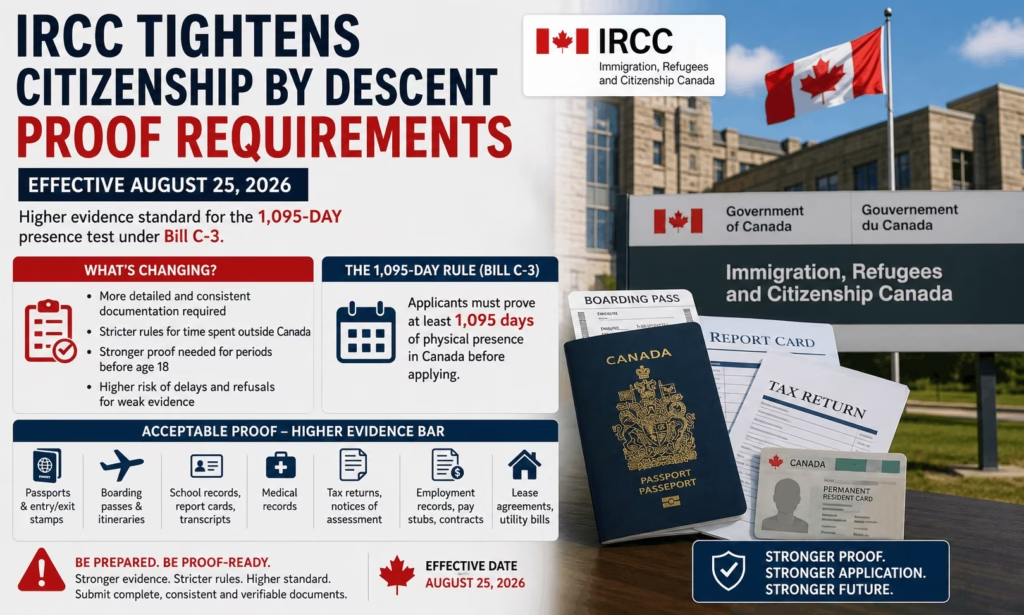
IRCC Tightens Citizenship by Descent: Immigration, Refugees and Citizenship Canada quietly rewrote the rulebook for one of its most consequential citizenship programs this week, and the change is already reshaping how families prove a decades-old connection to Canada. On August 25, 2026, IRCC updated its proof of citizenship certificate package — including the application form, document checklist, and instruction guide — to spell out in far greater detail exactly how a Canadian parent must document 1,095 days of physical presence in Canada before their child’s birth. The revision does not touch who qualifies for citizenship by descent under Bill C-3. It changes something arguably more important for thousands of applicants already gathering paperwork: how much proof is now required, and which relatives can no longer vouch for a parent’s time in the country.
The timing matters. Bill C-3, which eliminated Canada’s decades-old first-generation limit on citizenship by descent, has been in force since December 15, 2025, and 2026 has become the first full year families are actually filing claims under it. For anyone born in Canada or born abroad before that December cutoff, the citizenship question is largely settled — the first-generation limit no longer applies to them at all. But for children born on or after December 15, 2025 to a Canadian parent who was themselves born outside Canada, the 1,095-day presence test is now the deciding factor, and IRCC has just made clear that assumption and family memory will not be enough to satisfy it. We’ll be updating this article monthly as IRCC releases further guidance on the 1,095-day presence test.
Latest Update: What Changed on August 25, 2026
| Detail | Information |
|---|---|
| Update announced | August 25, 2026 |
| Agency responsible | Immigration, Refugees and Citizenship Canada (IRCC) |
| Legislation involved | Bill C-3, An Act to Amend the Citizenship Act (2025) |
| Bill C-3 came into force | December 15, 2025 |
| Forms updated | CIT 0001 (application), CIT 0014 (document checklist) |
| Guide updated | Guide 0001 instruction guide (carries the substantive new material) |
| Form unchanged | CIT 0555 (physical presence calculation form) |
| Core requirement | 1,095 cumulative days of physical presence in Canada before the child’s birth |
| Who this applies to | Children born outside Canada on or after December 15, 2025, to a Canadian parent who was also born outside Canada |
| Who is exempt | Anyone born or adopted before December 15, 2025 |
| Government filing fee | CAD $75 per applicant |
| Current processing time | Roughly 9 to 19 months, depending on case complexity |
Why IRCC Tightened the Citizenship by Descent Proof Standard?
To understand why this update matters, it helps to separate two different questions that often get blurred together: who is eligible for citizenship, and how that eligibility gets proven on paper. Bill C-3 already answered the first question when it came into force in December 2025, removing the first-generation limit that had excluded second and later generations born outside Canada since 2009. The August 25 update answers the second question, and it answers it with much more rigor than applicants had seen before.
Appendix F of the revised Guide 0001 instruction guide now spells out precisely what counts as acceptable evidence, what quality that evidence must meet, who is permitted to swear a supporting affidavit, and what an applicant must do when the underlying records simply no longer exist. In practical terms, IRCC has moved from a general statement of the substantial connection test to a detailed evidentiary rulebook — and that rulebook closes several shortcuts families had been relying on.
Who the 1,095-Day Presence Test Actually Applies To?
The physical presence requirement is narrower than headlines sometimes suggest, and getting this distinction right is the first step for any affected family. Two conditions must both be true for the test to apply:
- The child must have been born outside Canada on or after December 15, 2025.
- The Canadian parent passing on citizenship must have also been born outside Canada (making the child a second-generation-or-later descendant).
A related trigger applies where the Canadian parent obtained citizenship as an adopted person under section 5.1 of the Citizenship Act before the child’s birth. Outside these specific circumstances, the test simply does not come into play. Anyone born in Canada is automatically a citizen at birth regardless of this rule, and anyone born or adopted before December 15, 2025 is covered by Bill C-3’s retroactive restoration provisions, which carry no physical presence requirement at all.
SSI Address Change Service Enhancements: SSA’s New Fast-Track Process Explained
SSA Strategic Plan FY2026-2030: New Goals, Wait Times & Service Targets
Why 1,095 Days Is Harder to Prove Than It Sounds?
On its face, three cumulative years of physical presence sounds manageable, especially since the days do not need to be consecutive and can be gathered from any point in the parent’s life before the child was born. That flexibility, however, is exactly what makes the requirement more demanding in practice than it first appears.
A parent who once lived in Canada continuously for a few years — attending university or working a job, for example — can typically satisfy the requirement with a small, tidy set of documents: a lease agreement, an academic transcript, a tax record. But a parent whose connection to Canada consists of a lifetime of shorter family visits faces a fundamentally different task. Each individual trip needs its own documented entry and exit date, and the arithmetic adds up slowly. IRCC’s own worked example on the calculation form counts both the day of arrival and the day of departure in full, meaning a typical two-week family visit contributes roughly 15 days toward the total. Reaching 1,095 days through short visits alone could require documenting more than 70 separate trips, each with its own paper trail stretching back decades in some cases.
This is where many families are discovering that their real obstacle is not whether they qualify, but whether they can actually document that qualification with records that were never designed to be kept for this purpose.
What Counts as Acceptable Proof Under the New Guidance?
Appendix F asks applicants to submit what it describes as authentic, reliable, and verifiable evidence showing clear entry and exit dates or an established period of continuous residence. The accepted categories include several familiar document types, organized more explicitly than before:
- Travel records, including passports bearing Canadian entry and exit stamps
- Employment and education records, such as pay records from Canadian employers, tax slips, and school or university transcripts
- Residential records, including leases, mortgage documents, or proof of property ownership
- Financial and utility records that show a Canadian mailing address
- Government records at the federal, provincial, territorial, or municipal level
- Supporting affidavits, where official documentary records genuinely cannot be obtained
Two practical instructions apply across all categories. Submissions must be clear, legible color copies rather than faded or low-quality photocopies, and everything provided remains subject to independent verification by IRCC officers. Where a specific record cannot be located at all, the guide does not automatically treat that as disqualifying — but it does require the applicant to explain, in writing, what efforts were made to obtain it. A simple gap in the timeline with no explanation is treated far less favorably than a documented, unsuccessful attempt to retrieve the missing record.
Why the Affidavit Fallback Has Narrowed Sharply?
For families who genuinely cannot produce paper records — particularly for visits that happened decades ago, before digital record-keeping was routine — sworn affidavits have long served as the backup option. The August 25 update narrows that fallback considerably, and this is arguably the single most consequential change in the entire revision.
Affidavits must now be sworn before an authorized official: a notary public, commissioner of oaths, or commissioner for taking affidavits inside Canada, or the local equivalent for those signing abroad. The affidavit must include the signer’s full name, mailing address, and contact information that IRCC can use to follow up if verification becomes necessary.
The sharper restriction concerns who is no longer permitted to swear an affidavit at all. Immediate and extended family members are now excluded from this role, and the exclusion list is broad: parents, guardians, siblings, spouses, common-law and conjugal partners, grandparents, children, aunts, uncles, nieces, nephews, and first cousins. Professional credentials do not create an exception — a relative who happens to be a lawyer is still treated as a relative for this purpose. This matters because the people most likely to have firsthand memory of a parent’s childhood summers or extended family visits in Canada are, almost by definition, the very relatives now barred from providing sworn testimony about it. Families relying on this route need to identify eligible non-relatives — longtime family friends, former neighbors, employers, or community organizations — well before an application is filed, since locating and confirming willing witnesses after a file has already been submitted can cost months of delay.
A parallel rule applies to translated documents. Any records submitted in a language other than English or French must be translated by someone outside the same excluded family circle, meaning applicants can no longer rely on a bilingual relative to translate supporting paperwork.
How IRCC Verifies Physical Presence Claims?
The updated package makes explicit that a physical presence declaration is not simply accepted at face value once submitted. Processing officers retain the authority to request additional documentation at any stage of review, and applications are subject to random quality assurance checks, which can include a formal verification interview and, in cases where parentage itself is in question, DNA testing.
Applicants should also understand how IRCC handles a file that is missing required information. Rather than being refused outright, an incomplete application is typically returned to the applicant for correction and resubmission. That outcome is less severe than a formal refusal, but it still costs valuable months for families working against time-sensitive circumstances, such as an approaching passport renewal or an upcoming move.
SSA Ticket to Work Program: How Disability Beneficiaries Can Return to Work Without Losing Benefits
Canada 50% Tariff 2026: 700 US Goods Hit With Tariffs Up to 50% From September 8
How to Apply Under the Updated Citizenship by Descent Rules?
For families beginning or continuing a citizenship-by-descent application under the new evidentiary standard, the practical process now looks like this:
- Confirm which rule applies to your case. Determine whether the child was born before or after December 15, 2025, and whether the Canadian parent was themselves born inside or outside Canada.
- Gather physical presence documentation early, particularly if the parent’s time in Canada consisted of multiple shorter visits rather than one continuous stay.
- Complete Form CIT 0555 to calculate and document the cumulative 1,095 days, using the entry-and-exit-date method IRCC has laid out.
- Identify eligible affidavit witnesses in advance if documentary records are incomplete, since immediate and extended family members can no longer serve in that role.
- Submit the application package, including CIT 0001, CIT 0014, and all supporting evidence as clear color copies.
- Respond promptly to any request for additional documents, since delayed responses can extend an already lengthy processing timeline.
Processing Time Under the Updated Standard
Current processing times for proof of citizenship applications involving descent claims generally run between roughly 9 and 19 months, depending on how complex the family’s documentary chain is and how quickly requested evidence can be supplied. Applications with a straightforward, well-documented physical presence record tend to move faster than those requiring officers to request supplemental evidence or schedule a verification interview. Families should treat the evidence-gathering stage — not the application form itself — as the longest part of this process going forward.
What This Update Does Not Change: Fees and Payment Details?
The government filing fee for a citizenship certificate remains CAD $75 per applicant, and this update does not introduce any new charges tied specifically to the physical presence evidence requirement. Applicants should budget separately, however, for the practical costs of assembling documentation, including certified copies of provincial birth and marriage records, which typically run between roughly CAD $25 and $50 each, and potential legal fees where a chain-of-identity affidavit or complex submission requires professional drafting assistance.
Where the 1,095-Day Requirement Does Not Apply?
It is worth restating clearly who falls outside this requirement entirely, since confusion here can lead families to over-prepare or, worse, assume they are ineligible when they are not:
| Situation | Does the 1,095-Day Test Apply? |
|---|---|
| Child born in Canada | No — automatic citizenship at birth |
| Child born or adopted before December 15, 2025 | No — covered by Bill C-3’s retroactive restoration |
| Canadian parent born in Canada (first generation) | No — no physical presence test required |
| Canadian parent served in the Canadian Armed Forces or federal/provincial public service abroad | Special Crown servant exception may apply |
| Child born abroad on/after December 15, 2025 to a parent also born abroad | Yes — 1,095-day test applies |
Additional pathways also exist outside the descent framework entirely, including standard permanent residence followed by a citizenship grant, and discretionary consideration under specific subsections of the Citizenship Act, which can be relevant particularly where a child would otherwise be left stateless.
Social Security Payment September 2026: How Much Will You Receive This Week?
Trump-Carney Trade War: How Canada’s Tariffs On US Goods Can Put Nearly $900 Billion At Risk
What Families Should Do Now?
For parents who established their own citizenship by descent only recently and are now planning to pass it on to children born after December 15, 2025, the practical takeaway from this update is straightforward: start the evidence-gathering process immediately, and ideally before the child is even born, while relevant relatives, former neighbors, and community contacts can still be reached and are willing to assist. Waiting until an application is filed — or worse, until IRCC requests additional evidence — significantly increases the risk of delay. Families whose connection to Canada is spread across many short visits rather than one continuous stay should treat this as a research project requiring careful chronological documentation, not a simple form-filling exercise.
Official IRCC Resources for Citizenship by Descent Applicants
Always verify current forms, fees, and status information directly through official Government of Canada channels.
| Resource | Purpose | Official Link |
|---|---|---|
| Citizenship Act changes overview | Bill C-3 background and eligibility rules | canada.ca — IRCC Citizenship Act Changes |
| Proof of citizenship certificate application | Official CIT 0001 form and Guide 0001 instructions | canada.ca — Application forms and guides |
| Physical presence calculation form | CIT 0555 form for documenting the 1,095-day test | canada.ca — Citizenship forms |
| IRCC online account (login) | Track and manage submitted applications | canada.ca — IRCC secure account |
| Application status check | MyCIC / IRCC portal | canada.ca — Check application status |
| Change of address tool | Keep contact information current during processing | canada.ca — IRCC change of address |
| Supporting document submission | Web form to submit evidence using UCI and application number | canada.ca — IRCC web form |
Indian Student Applications to US Colleges Fall 15% Amid Visa Uncertainty: What the New Data Shows
FAQs
What exactly did IRCC change on August 25, 2026?
IRCC updated its proof of citizenship application package, including the CIT 0001 form, the CIT 0014 document checklist, and the Guide 0001 instruction guide, adding detailed new requirements for how a Canadian parent must prove 1,095 days of physical presence in Canada before their child’s birth.
Does the 1,095-day rule apply to everyone claiming citizenship by descent?
No. It only applies to children born outside Canada on or after December 15, 2025, to a Canadian parent who was also born outside Canada. Anyone born or adopted before that date is covered by Bill C-3’s automatic retroactive restoration and is not subject to the physical presence test.
Do the 1,095 days need to be consecutive?
No. The days can be accumulated across multiple separate visits over a lifetime, as long as all of them occurred before the child’s birth. However, each individual period must be independently documented with entry and exit dates.
Can a family member swear an affidavit about a parent’s time in Canada?
No, not anymore. The updated guidance excludes a wide range of relatives, including parents, siblings, spouses, grandparents, aunts, uncles, and first cousins, from serving as affidavit witnesses, regardless of their professional qualifications.
What happens if the required documents no longer exist?
Applicants must provide a written explanation of what efforts were made to obtain the missing records, along with any evidence of those attempts, such as correspondence with a records office confirming the document is unavailable.
How long does a citizenship by descent application take to process in 2026?
Processing times currently range from roughly 9 to 19 months, depending on the complexity of the case and how quickly any requested additional evidence can be provided.
Is there a fee for applying under the new rules?
Yes, the government filing fee remains CAD $75 per applicant. This update did not introduce any new fees specific to the physical presence evidence requirement.
What if I already submitted my application before this update?
Applicants with a file already in progress can proactively submit supporting documents through IRCC’s web form using their Unique Client Identifier and application number, rather than waiting for an officer to request additional evidence.
Conclusion
The August 25, 2026 update from IRCC does not shrink who qualifies for citizenship by descent under Bill C-3 — the underlying eligibility rules remain exactly as they were when the law came into force last December. What has changed is the burden of proof, and for many families that distinction matters just as much as eligibility itself. The narrowed affidavit rules, the detailed documentary standards, and the emphasis on verifiable, dated evidence all point toward the same practical lesson: families relying on the 1,095-day presence test can no longer treat this as a straightforward paperwork exercise. Evidence-gathering now needs to begin early, ideally well before a child is born, with a clear plan for who can serve as a witness and which records are recoverable. For applicants and their advisors alike, understanding exactly where this new evidentiary bar sits is now the difference between a smooth citizenship certificate approval and a returned application that costs months of avoidable delay.
SNAP Payments Dates September 2026: Full EBT Payment Schedule by State, New Rules & Status Check!
New Canada LMIA Rules September 2026: What Employers and Foreign Workers Need to Know
CPP, OAS & GIS September 2026 Payment: New Amounts, 1.2% Increase & Full Payment Details
Canada Pension Plan Payment September 2026: Who Will Receive CPP Benefits and How Much?