Minimum Wage Increase in 5 Canadian Provinces: Millions of Canadian workers across five provinces are about to see a bigger number on their pay stub. Starting October 1, 2026, Ontario, Prince Edward Island, Nova Scotia, Manitoba, and Saskatchewan all raise their general minimum wage on the exact same date, a coordinated timing pattern that happens because each province ties its annual adjustment to inflation data released around the same point in the year. For employers with staff spread across more than one of these provinces, that means five separate rate changes landing in a single payroll cycle, all at once.
The size of the increases varies considerably by province, from Manitoba’s 2.5% bump to Saskatchewan’s more modest 2.3% adjustment, but the practical effect is the same everywhere: full-time minimum wage workers in all five provinces will take home more money starting their very next shift after the change. With Ontario climbing to $17.95 an hour and Saskatchewan rising to just $15.70, the gap between the highest and lowest-paid minimum wage workers among these five provinces remains substantial, even as every one of them moves upward together. We’ll be updating this article monthly as new provincial minimum wage data is confirmed.
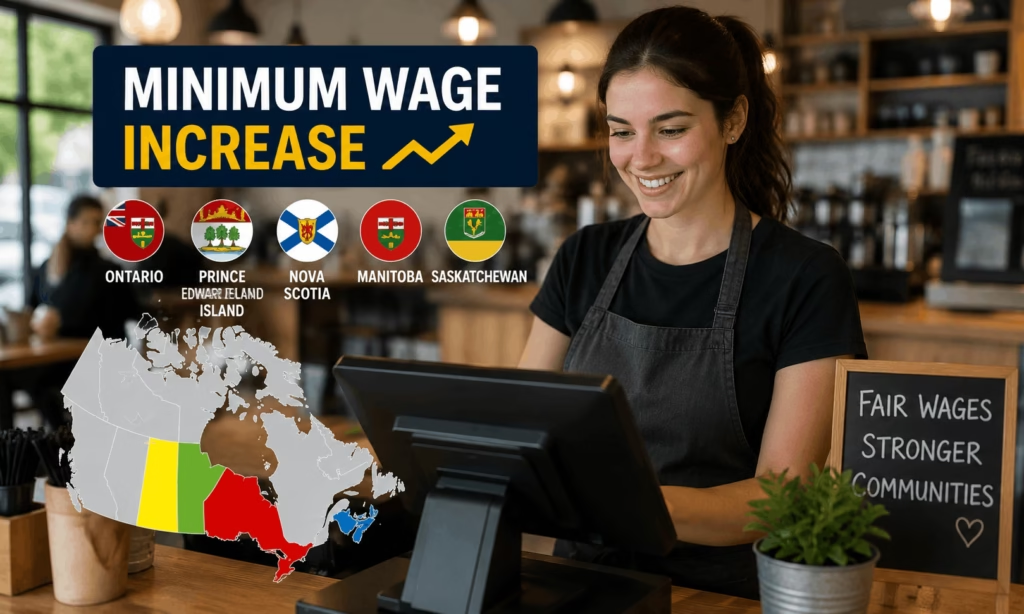
Latest Update: Minimum Wage Increase in 5 Canadian Provinces
| Province | Old Rate | New Rate (Oct 1, 2026) | Increase |
|---|---|---|---|
| Ontario | $17.60 | $17.95 | +$0.35 (2.0%) |
| Prince Edward Island | $17.00 | $17.30 | +$0.30 (1.8%) |
| Nova Scotia | $16.75 | $17.00 | +$0.25 (1.5%) |
| Manitoba | $16.00 | $16.40 | +$0.40 (2.5%) |
| Saskatchewan | $15.35 | $15.70 | +$0.35 (2.3%) |
Why These Five Provinces All Change Rates on the Same Day
This isn’t a coincidence, and understanding the mechanism explains a pattern that repeats every year. Each of these five provinces has adopted a formula-based, inflation-indexed approach to setting its minimum wage, rather than leaving the rate to periodic, discretionary legislative decisions. Ontario adjusts annually based on the province’s own Consumer Price Index reading, tied specifically to the 12-month period ending in April, with the resulting rate taking effect every October 1 under the Employment Standards Act. Manitoba’s Employment Standards Code applies a similar formula referencing the previous calendar year’s inflation rate, while Saskatchewan’s Employment Standards Act blends provincial CPI data with average hourly wage growth. Nova Scotia and Prince Edward Island both apply comparable annual review processes, and all five happen to land on the same October 1 implementation date as a matter of long-standing provincial practice.
This predictability is genuinely useful for both employers and workers. Because the formula and timing are known well in advance, businesses operating across multiple provinces can budget for the change months ahead of time rather than reacting to a surprise announcement close to the effective date.
OAS Payment Increase September 2026: Confirmed Amounts, Payment Date, and the Annual GIS Reset !
Ohio SNAP Food Ban starts October 1, 2026: What’s Banned, Court Update & Rules
Ontario: Minimum Wage Climbs to $17.95
Ontario’s general minimum wage rises from $17.60 to $17.95 per hour on October 1, 2026, a 2.0% increase calculated under the province’s Employment Standards Act formula. This keeps Ontario as the second-highest minimum wage among all ten provinces, trailing only British Columbia’s $18.25, and firmly ahead of every other province covered in this October round.
Ontario also maintains several special wage categories that adjust alongside the general rate. Student workers under 18 working no more than 28 hours a week during the school year, or working during a school break, are subject to a separate, slightly lower student minimum wage. Liquor servers and homeworkers, employees who perform paid work from their own residences such as sewing or phone-based customer service, also have their own distinct rate categories tied to the same October adjustment schedule.
Prince Edward Island: Holding Its Atlantic Canada Lead
PEI’s minimum wage rises from $17.00 to $17.30 per hour on October 1, 2026, maintaining the province’s position as the highest minimum wage in Atlantic Canada, a $0.30 lead over Nova Scotia after this round of increases. PEI’s Employment Standards Board reviews the rate annually, and the province has already confirmed its next scheduled increase will bring the rate to $17.60 on April 1, 2027, continuing PEI’s pattern of more frequent, incremental adjustments compared to some other provinces.
Nova Scotia: The Only Province With Two 2026 Increases
Nova Scotia stands out this year as one of just two Canadian jurisdictions implementing two separate minimum wage increases within the same calendar year. The province’s rate first rose to $16.75 on April 1, 2026, and now climbs again to $17.00 per hour on October 1, 2026, the ninth increase Nova Scotia has implemented since April 2021. This twice-yearly pattern reflects Nova Scotia’s particular approach to phasing in larger cumulative increases without a single disruptive jump, spreading the adjustment across two smaller steps within the same year instead.
Manitoba: The Largest Percentage Increase of the Five
Manitoba’s minimum wage rises from $16.00 to $16.40 per hour on October 1, 2026, a 2.5% increase that represents the largest percentage jump among all five provinces changing rates this month. The increase is calculated under Manitoba’s Employment Standards Code, which ties the annual adjustment to the previous calendar year’s inflation rate as measured by Manitoba’s Consumer Price Index.
Saskatchewan: Still the Lowest of the Five, But Closing the Gap
Saskatchewan’s minimum wage increases from $15.35 to $15.70 per hour on October 1, 2026, a 2.3% rise. Despite this increase, Saskatchewan remains the lowest minimum wage among the five provinces adjusting this month, though it stays above Alberta’s unchanged $15.00 rate, meaning Saskatchewan is no longer tied for the lowest position nationally the way it has been in some previous years.
$400 Inflation Refund Checks 2026: New York’s Real Program, Fact-Checked
Stimulus Check 2026: Fact-Checking Every Viral Payment Claim (Tracker)
Social Security SSI Payment Date September 2026 Confirmed by SSA- Check Full Schedule here!
How All Ten Provinces and Territories Compare After October 1
Seeing the full national picture helps put these five October increases in proper context against the provinces and territories that aren’t changing their rates this particular month.
| Jurisdiction | Current Rate | Last Changed |
|---|---|---|
| Nunavut | $20.17 | September 1, 2026 |
| British Columbia | $18.25 | June 1, 2026 |
| Yukon | $18.51 | April 1, 2026 |
| Federal (regulated industries) | $18.15 | April 1, 2026 |
| Ontario | $17.95 | October 1, 2026 |
| Prince Edward Island | $17.30 | October 1, 2026 |
| Northwest Territories | $17.20 | September 1, 2026 |
| Nova Scotia | $17.00 | October 1, 2026 |
| Quebec | $16.60 | May 1, 2026 |
| Newfoundland and Labrador | $16.35 | April 1, 2026 |
| Manitoba | $16.40 | October 1, 2026 |
| New Brunswick | $15.90 | April 1, 2026 |
| Saskatchewan | $15.70 | October 1, 2026 |
| Alberta | $15.00 | October 1, 2018 |
Alberta remains the clear outlier in this comparison, having gone unchanged since October 2018, the longest stretch of any Canadian jurisdiction without a minimum wage adjustment, and now sitting as the lowest minimum wage in the entire country.
Who Actually Benefits From These October Increases
Provincial governments typically publish estimates of how many workers a minimum wage change directly affects, and the pattern tends to be remarkably consistent across provinces. In Ontario specifically, government figures from a recent comparable increase showed that roughly 36% of workers earning at or below the new minimum wage worked in retail, with another 23% employed in accommodation and food services, two sectors that consistently account for the largest share of minimum wage employment across most Canadian provinces. For a full-time worker earning minimum wage in Ontario at 40 hours a week, this October’s $0.35 increase translates to an estimated $728 in additional annual earnings before taxes, based on standard full-time hours calculations.
How to Confirm You’re Being Paid Correctly: Step-by-Step
For workers wanting to verify their pay reflects the correct new rate, and for employers ensuring compliance across the transition, here’s the practical process.
- Confirm your province’s exact new rate using the table above, since even provinces changing on the same date apply different percentage increases.
- Check your pay stub for the first pay period that includes hours worked on or after October 1, 2026, since this is when the new rate legally applies, not the date your paycheck is issued.
- Verify which wage category applies to you if you’re a student, liquor server, or homeworker in a province with special rate categories, since these can differ from the general minimum wage.
- Contact your provincial employment standards office directly if your pay doesn’t reflect the updated rate after the effective date.
- Keep records of your hours and pay during the transition period, since this documentation is essential if a wage dispute needs to be filed later.
Trump Accounts Dell $250 Grant: Did Deposits Actually Start Monday? Here’s Who’s Actually Been Paid
2027 Social Security COLA Forecast: Latest 3.6% Estimate and How Much Retirees Could Get
$2000 Stimulus Payment September 2026 Fact-Check: Is It Really Coming?
How to Apply for a Wage Complaint If Underpaid
Workers who believe they haven’t received the correct minimum wage after October 1, 2026 can file a formal complaint with their province’s employment standards branch. Each province maintains its own complaint process, generally involving submitting a written claim detailing the hours worked, wages actually paid, and the applicable minimum wage rate, after which a provincial employment standards officer investigates and can order back pay if a violation is confirmed.
Processing Time for Minimum Wage Complaints
Processing timelines for wage complaints vary by province and case complexity, but most provincial employment standards branches aim to make initial contact with a complainant within a matter of weeks of a claim being filed. More complex cases involving disputed hours or multiple pay periods can take considerably longer to resolve, particularly if an employer contests the claim or additional documentation is required to verify the actual hours worked during the affected pay periods.
What This Means for Payroll and Payment Schedules
None of these five increases change how or when workers are paid, only the rate itself. Employers are legally required to apply the new minimum wage to all hours worked on or after October 1, 2026, regardless of when the actual paycheck for that pay period is issued. This distinction matters for pay periods that span the effective date: hours worked before October 1 are paid at the old rate, while hours worked on or after October 1 must reflect the new rate, even if both fall within the same paycheck.
Five-Year Rate History: How Far These Provinces Have Come
Looking at where each province’s minimum wage stood five years ago puts this October’s increases into longer-term perspective, showing just how much cumulative movement has occurred even though each individual annual step looks modest on its own.
| Province | 2021 Rate | 2026 Rate (Post-October) | Total Increase |
|---|---|---|---|
| Ontario | $14.25 | $17.95 | +$3.70 (26.0%) |
| Prince Edward Island | $12.85 | $17.30 | +$4.45 (34.6%) |
| Nova Scotia | $12.95 | $17.00 | +$4.05 (31.3%) |
| Manitoba | $11.90 | $16.40 | +$4.50 (37.8%) |
| Saskatchewan | $11.45 | $15.70 | +$4.25 (37.1%) |
Manitoba and Saskatchewan, the two provinces with the lowest current dollar rates among this group, have actually seen the largest percentage growth over the past five years, a pattern that reflects both provinces starting from a comparatively lower base and applying consistent annual formula-based increases without interruption. PEI shows a similar dynamic, having moved from one of the lowest rates in the country five years ago to now holding the top position in Atlantic Canada.
The Debate Behind These Increases: Two Sides Worth Understanding
As with virtually every minimum wage adjustment across Canada, this October’s changes have drawn perspectives from both worker advocates and business groups, and it’s worth presenting both sides fairly rather than treating the increases as universally welcomed or universally opposed.
Worker advocacy organizations, including labour unions and living wage researchers, generally argue that even these updated rates still fall short of what’s needed to cover basic living costs in many Canadian communities. The Ontario Living Wage Network, for instance, has calculated living wage benchmarks considerably higher than the province’s statutory minimum in high-cost regions like the Greater Toronto Area, arguing that formula-based CPI adjustments, while helpful, don’t fully account for how quickly housing and grocery costs have outpaced general inflation in specific local markets.
Small business associations and some employer groups, meanwhile, have historically raised concerns about the cumulative cost pressure of annual increases, particularly for labour-intensive sectors like retail and food service that employ a disproportionate share of minimum wage workers. These groups generally acknowledge the predictability of formula-based increases as preferable to unpredictable, politically-driven jumps, while still advocating for phased implementation timelines or targeted small business exemptions in some provinces. Alberta’s decision to leave its rate frozen since 2018 reflects one province’s response to these business-cost concerns, though critics of that approach point to Alberta now holding the lowest minimum wage in the country as evidence of the trade-off that decision has produced for the province’s lowest-paid workers.
Canada 50% Tariff 2026: 700 US Goods Hit With Tariffs Up to 50% From September 8
Social Security Changes September 2026: SSA Announces Major Update for Retirees and Beneficiaries
What Employers With Multi-Province Operations Should Know
Businesses operating across more than one of these five provinces face a genuinely more complex payroll transition than a single-province employer, since October 1 brings five separate rate changes simultaneously rather than one uniform national adjustment. Payroll teams managing multi-province operations should confirm their payroll software or provider has each province’s correct new rate loaded before the effective date, rather than assuming a single national update covers every jurisdiction automatically. This is particularly important for businesses with employees who work across provincial lines or who relocate between provinces mid-year, since the applicable minimum wage is determined by where the work is actually performed, not where the company is headquartered or where the employee normally resides.
Official Resources for Minimum Wage Information by Province
Always verify your specific provincial rate directly through these official government sources.
| Resource | Purpose | Official Link |
|---|---|---|
| Ontario Ministry of Labour | Official Ontario minimum wage rates and categories | ontario.ca/document/your-guide-employment-standards-act/minimum-wage |
| PEI Employment Standards | Official PEI minimum wage and Employment Standards Board information | princeedwardisland.ca (Employment Standards) |
| Nova Scotia Labour Standards | Official Nova Scotia minimum wage rate history and rules | novascotia.ca/lae/employmentrights |
| Manitoba Employment Standards | Official Manitoba minimum wage under the Employment Standards Code | gov.mb.ca/labour/standards |
| Saskatchewan Employment Standards | Official Saskatchewan minimum wage rate and rules | saskatchewan.ca (Employment Standards) |
| Canada.ca minimum wage database | National comparison of all provincial and federal rates | canada.ca (minimum wage database) |
| File a wage complaint | Provincial employment standards complaint portals | Varies by province; see individual links above |
Conclusion
The minimum wage increase across these five Canadian provinces on October 1, 2026 follows the same predictable, inflation-indexed pattern that’s governed these adjustments for years, even as the actual dollar amounts vary meaningfully from Manitoba’s 2.5% jump to Nova Scotia’s more modest 1.5% step. With Ontario now at $17.95, PEI at $17.30, Nova Scotia at $17.00, Manitoba at $16.40, and Saskatchewan at $15.70, the gap between these provinces and Alberta’s stagnant $15.00 rate continues widening, a reminder that not every Canadian jurisdiction is moving at the same pace even as five of them change on the exact same day. For workers in retail, food service, and other minimum wage-heavy sectors across these provinces, checking your first post-October paycheck against your province’s confirmed new rate remains the simplest way to make sure this increase actually reaches your bank account.
FAQs About Minimum Wage Increase in 5 Canadian Provinces
Which five provinces are raising their minimum wage on October 1, 2026?
Ontario, Prince Edward Island, Nova Scotia, Manitoba, and Saskatchewan all implement new minimum wage rates on October 1, 2026, though each applies a different percentage increase based on its own provincial formula.
What is Ontario’s new minimum wage in October 2026?
Ontario’s general minimum wage rises from $17.60 to $17.95 per hour, keeping it the second-highest minimum wage among Canadian provinces, behind only British Columbia.
Why does Nova Scotia get two minimum wage increases in one year?
Nova Scotia is one of only two Canadian jurisdictions with two scheduled 2026 increases, first to $16.75 on April 1, then to $17.00 on October 1, part of the province’s approach to phasing in larger cumulative increases in smaller steps.
Which province has the lowest minimum wage among these five?
Saskatchewan has the lowest rate among the five provinces increasing this October, rising to $15.70 per hour, though it remains above Alberta’s unchanged $15.00 rate, the lowest in the country overall.
Is Alberta increasing its minimum wage too?
No. Alberta’s minimum wage has remained unchanged at $15.00 per hour since October 2018, making it the longest stretch without an adjustment of any Canadian province or territory.
How much extra will a full-time minimum wage worker in Ontario earn from this increase?
Based on 40 hours per week, Ontario’s $0.35 hourly increase translates to approximately $728 in additional annual earnings before taxes for a full-time minimum wage worker.
Do these minimum wage increases apply to part-time workers too?
Yes. Minimum wage requirements apply to virtually all employees regardless of full-time or part-time status, with the specific exception of certain special wage categories like students or liquor servers in provinces that maintain separate rates for those groups.
What happens if my employer doesn’t update my pay to the new rate after October 1?
You can file a wage complaint directly with your province’s employment standards branch, which can investigate and order back pay if your employer failed to apply the correct minimum wage for hours worked on or after the effective date.