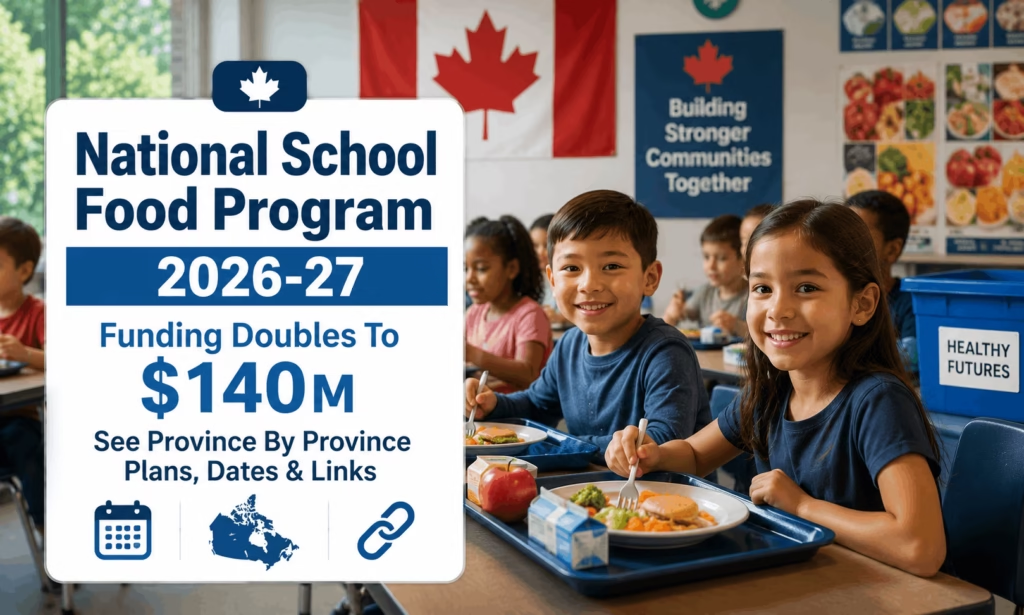
National School Food Program: Canada’s National School Food Program has crossed two major milestones within the same year, and the combined effect reaches directly into classrooms this school year. On June 16, 2026, Employment and Social Development Canada confirmed that every province and territory has finalized its action plan for the 2025-26 and 2026-27 school years, with total federal funding doubling from the program’s original 2024-25 level to $140 million annually. That funding increase builds on an even bigger development just months earlier: the National School Food Program Act received Royal Assent through Bill C-15 on March 26, 2026, making the program permanent under federal law rather than a temporary budget commitment that could lapse or be cut in a future fiscal year.
Together, these two changes mean the program is no longer just a pilot rolled out province by province with uncertain long-term funding. It is now a permanent, legally protected federal program with a funding trajectory that keeps climbing, from $488 million over its first five years announced in 2024, to $140 million annually for 2025-26 and 2026-27, and eventually to $216.6 million per year starting in 2029-30 once the program reaches full implementation. The program is expected to help feed up to 400,000 additional children every year once fully rolled out, building on Canada’s position as the only G7 country that lacked a national school food program before this initiative launched. We’ll be updating this article monthly as new provincial funding details, enrollment numbers, and program milestones are confirmed.
What the National School Food Program Actually Does?
The National School Food Program is a federal cost-sharing initiative that funds provinces, territories, and Indigenous partners to build new school meal programs or expand existing ones, rather than operating as a single, uniform national meal service. Each province and territory signs a bilateral agreement with the federal government and submits its own action plan describing how it will use the funding, meaning the specific meals, eligibility rules, and delivery models vary considerably from one province to another.
| Program Element | Detail |
|---|---|
| Administering department | Employment and Social Development Canada, alongside Indigenous Services Canada and Crown-Indigenous Relations and Northern Affairs Canada |
| Funding model | Federal transfers to provinces, territories, and Indigenous partners under bilateral agreements |
| Target population | Children in kindergarten through Grade 8, with some provinces extending to high school |
| Original funding announcement | $1 billion over five years, announced in Budget 2024 |
| Confirmed rollout funding | $488 million over five years, announced May 20, 2026, for the fall 2026 launch phase |
| Legal status | Made permanent through the National School Food Program Act, Bill C-15, Royal Assent March 26, 2026 |
Timeline: From 2024 Budget Promise to 2026 Permanent Law
Understanding how quickly this program has moved from announcement to permanent legislation helps explain why the 2026-27 update matters so much.
| Date | Milestone |
|---|---|
| April 2024 | Federal budget includes provisions for a national school food program, with a $1 billion, five-year funding commitment |
| May 20, 2026 | Federal government confirms $488 million in funding over five years for the program’s rollout, targeting a fall 2026 start |
| April 2026 | Government of Canada launches the $12.6 million FRESH Team Grant to fund school food research |
| March 26, 2026 | National School Food Program Act receives Royal Assent through Bill C-15, making the program permanent federal law |
| June 11, 2026 | Canada’s first-ever National Food Security Strategy launches, with the school food program as a core pillar |
| June 16, 2026 | All provinces and territories finalize 2025-26 and 2026-27 action plans; federal funding doubles to $140 million annually |
USCIS Addis Ababa Field Office: New International Office Opens September 9
Is It Hard to Refinance Student Loan, and What Are the Pros and Cons of Doing It?
Tax Filing Season 2027: IRS Start Date, Deadlines and Refund Schedule
SNAP Maximum Benefits FY2027 Confirmed: Family of Four Gets Up to $1,023 (Effective Oct 1, 2026)
Funding Growth Under the National School Food Program
The dollar figures behind this program have moved substantially since the original announcement, and the 2026-27 numbers represent the clearest sign yet of the government’s long-term commitment.
| Funding Milestone | Amount | Timeframe |
|---|---|---|
| Original Budget 2024 commitment | $1 billion | Over five years |
| Confirmed rollout package | $488 million | Over five years, starting fall 2026 |
| Annual federal funding, 2024-25 (starting point) | Approximately $70 million | Single fiscal year |
| Annual federal funding, 2025-26 and 2026-27 | $140 million | Doubled from the 2024-25 starting level |
| Long-term permanent funding, starting 2029-30 | $216.6 million | Per year, ongoing |
| FRESH Team Grant for school food research | $12.6 million | Announced April 2026 |
Province by Province: What the 2026-27 Action Plans Include
Because each province designs its own implementation plan, the funding and expansion details differ meaningfully depending on where a family lives.
| Province | 2026-27 Federal Funding Allocation | Key 2026-27 Expansion Detail |
|---|---|---|
| Ontario | $44.8 million | Expansion of the Student Nutrition Program, First Nations Student Nutrition Program, and a new fruit and vegetable program, projected to reach over 2.1 million enrolled students |
| Nova Scotia | Approximately $102.3 million (provincial budget forecast, includes federal share) | Nova Scotia School Lunch Program expanding to all 37 public high schools in the province |
| Other provinces and territories | Varies by signed bilateral agreement | Each jurisdiction’s specific action plan is published through Employment and Social Development Canada |
Ontario’s numbers illustrate the scale of the expansion clearly. The province’s own reporting shows enrolled students rising from 1,844,621 in the 2024-25 interim reporting period to a projected 2,119,809 for 2026-27, alongside growth from 3,963 participating schools to a projected 4,460 schools in the same window.
Why the Program Was Made Permanent Through Legislation
Turning a funded initiative into permanent law is a meaningful shift, and it addresses a specific criticism that followed the program since its 2024 launch: that a future federal budget could simply choose not to renew the funding. The National School Food Program Act, passed as Bill C-15 and given Royal Assent on March 26, 2026, changes that by embedding the government’s funding obligation into federal statute rather than leaving it dependent on annual budget decisions. This legislative step followed directly from a Budget 2025 commitment, in which the government proposed introducing legislation and providing $216.6 million per year, starting in 2029-30, specifically to make the program permanent across Employment and Social Development Canada, Indigenous Services Canada, and Crown-Indigenous Relations and Northern Affairs Canada.
How the Program Connects to Canada’s National Food Security Strategy
Just weeks after the legislation passed, the government tied the school food program into a broader policy framework. Canada’s first-ever National Food Security Strategy launched on June 11, 2026, positioning the National School Food Program as one of its central components alongside other measures aimed at reducing food insecurity across the country. This connection signals that school meal funding is no longer being treated as a standalone education initiative but as part of a coordinated national approach to child and family food security.
IRS Identity Protection PIN: How to Get One and Stop Tax Fraud
Express Entry Labour Shortage Categories 2027: What Canada May Tighten?
CPP/EI Max Earnings 2027: New Rate Cut and Contribution Limits Explained
How Schools and Families Can Apply or Access the Program
Because the National School Food Program operates through provincial and territorial delivery rather than direct federal applications, access works differently depending on where a school is located.
- Check whether your child’s school already participates in an existing provincial nutrition program, such as Ontario’s Student Nutrition Program or Nova Scotia’s School Lunch Program, since most funding flows into expanding these existing structures rather than creating an entirely separate national application system
- Contact your school board or local Lead Agency, which administers day-to-day meal delivery and can confirm whether a program is currently offered at a specific school
- Watch for announcements about new schools being added, since each province’s 2026-27 action plan includes specific targets for expanding into schools not previously covered
- For Indigenous communities, funding channels separately through Indigenous Services Canada and Crown-Indigenous Relations and Northern Affairs Canada, alongside the provincial and territorial agreements
- Most school food programs are provided at no direct cost to families, though several provinces note that voluntary parental contributions are welcomed but never required
Processing Time: How Provincial Action Plans Move From Agreement to Meals
Understanding the practical rollout timeline helps set expectations for when a specific school or region actually sees new or expanded meal service.
| Stage | Typical Timing |
|---|---|
| Federal budget commitment | Announced in the relevant federal budget cycle |
| Bilateral agreement signed between Ottawa and a province or territory | Months following the budget announcement |
| Provincial or territorial action plan finalized | Published action plans confirmed federal funding allocation and expansion targets for the specific fiscal year |
| School-level rollout | New or expanded meal service typically begins at the start of the relevant school year, aligned with the September start of the academic calendar |
| Reporting and reassessment | Provinces report enrollment and program data annually, feeding into the following year’s action plan |
Payment Schedule: How Federal Funding Actually Reaches Schools
Federal dollars under the National School Food Program do not go directly to individual schools or families. Instead, the money moves through a defined chain from Ottawa down to the classroom.
- Employment and Social Development Canada transfers funding to each province and territory according to the terms of its signed bilateral agreement
- Provincial and territorial governments then allocate that funding to Lead Agencies, school boards, or Transfer Payment Recipients responsible for actually running meal programs
- In Ontario, for example, funding flows to 13 designated Student Nutrition Program Lead Agencies along with First Nations Student Nutrition Program partners
- Funding for a given fiscal year, such as 2026-27, generally supports program costs across that full school year rather than being disbursed as a single lump sum
- Schools and families do not receive direct payments; the funding covers food procurement, staffing, equipment, and program administration rather than being distributed as individual benefits
UPS Tariff Refund: Who Is Eligible to Get One and How Can You Apply?
Ontario Minimum Wage Rises to $17.95 on Oct 1, 2026
SNAP Income Limits FY2027 Confirmed: Single Applicants Capped at $1,729, Family of Four at $3,575
FAQs About National School Food Program 2026-27
What is the National School Food Program?
The National School Food Program is a federal initiative that funds provinces, territories, and Indigenous partners across Canada to build new school meal programs or expand existing ones, aiming to provide meals to up to 400,000 additional children every year.
How much funding does the National School Food Program have for 2026-27?
Total federal funding for the National School Food Program has doubled to $140 million annually for both the 2025-26 and 2026-27 school years, up from its original 2024-25 funding level.
Is the National School Food Program a permanent program now?
Yes. The National School Food Program Act received Royal Assent through Bill C-15 on March 26, 2026, making the program a permanent part of federal law rather than a temporary budget item.
How do I know if my child’s school participates in the program?
Contact your local school board or the relevant provincial Lead Agency, since the National School Food Program expands funding into existing provincial nutrition programs rather than operating as a single, direct national application system.
Which age groups does the National School Food Program cover?
The program primarily targets children from kindergarten through Grade 8, though several provinces, including Nova Scotia, are using 2026-27 funding to expand coverage into high schools as well.
How much funding will the program receive in the long term?
The federal government has committed to $216.6 million per year starting in 2029-30 to fund the program on a permanent, ongoing basis.
Does the National School Food Program cost families anything?
Most school food programs funded through this initiative are provided at no direct cost to families, though some provinces allow voluntary parental contributions that are never required for a child to participate.
How is funding split between provinces?
Each province and territory negotiates its own bilateral agreement and receives a specific funding allocation based on its signed action plan, meaning the dollar amount and program design vary by jurisdiction, as seen in Ontario’s $44.8 million allocation compared to other provinces’ figures.
What is the FRESH Team Grant and how does it relate to the school food program?
The FRESH Team Grant is a $12.6 million research investment launched in April 2026 to strengthen the National School Food Program through evidence-based research, with a particular focus on First Nations, Inuit, and Metis communities.
How does the National School Food Program connect to Canada’s National Food Security Strategy?
The school food program is positioned as a central pillar of Canada’s first National Food Security Strategy, launched June 11, 2026, reflecting a broader federal push to address food insecurity beyond schools alone.
Conclusion
The National School Food Program enters the 2026-27 school year in a fundamentally stronger position than when it first launched, backed by permanent legislation through Bill C-15 and federal funding that has doubled to $140 million annually across every province and territory. For families, the practical effect depends heavily on location, since implementation flows through provincial Lead Agencies and school boards rather than a single national application process, with Ontario and Nova Scotia among the provinces already publishing detailed expansion targets for the current school year. As additional provincial action plans, enrollment figures, and funding updates are confirmed through the rest of the 2026-27 school year, check back here, since this article is reviewed and updated with the latest confirmed information each month.
SSDI Pay Chart: The Least Amount You Can Get Per Month and the Most Common Disabilities
Ohio SNAP Sugary Beverage Ban Delayed: What Happened and Why
Missouri Minimum Wage Amendment Could Return to the Ballot on November 3, 2026