Express Entry Labour Shortage Categories 2027: Canada’s immigration department is weighing a significant narrowing of the occupation lists that currently make hundreds of thousands of skilled workers eligible for fast-tracked permanent residence invitations. Immigration, Refugees and Citizenship Canada opened a public consultation on August 4, 2026, asking whether the five labour shortage categories used in Express Entry, covering healthcare, STEM, trades, education, and transport occupations, should continue as broadly as they exist today or be reduced to a smaller, more targeted list of eligible jobs.
The stakes are high for applicants already in the Express Entry pool. Category-eligible candidates received 87 percent of all Express Entry invitations in 2025, up sharply from 63.5 percent in 2023, meaning most successful applicants in recent years got their invitation through one of these targeted categories rather than through general, points-based draws alone. If IRCC narrows the eligible occupation lists for 2027, candidates currently qualifying under a broad labour shortage category may find their specific job no longer included once the new lists take effect. We’ll be updating this article monthly as the consultation results and final 2027 categories are announced.

What Is Category-Based Selection in Express Entry?
Category-based selection was introduced in 2023 as a tool that lets Canada’s immigration minister invite candidates from the Express Entry pool who work in specific occupations or share specific characteristics tied to an identified economic goal, rather than relying only on the general Comprehensive Ranking System score. Within each category, candidates are still ranked using their CRS score, and the highest-ranking eligible candidates receive invitations to apply for permanent residence first.
For 2026, IRCC organized its ten Express Entry categories around three broad economic priorities: addressing long-term labour shortages, attracting and retaining top global talent, and supporting Francophone immigration outside Quebec. The current consultation is specifically about how these priorities, and particularly the labour shortage piece, should be structured going into 2027.
OAS Payment Increase September 2026: Confirmed Amounts, Payment Date, and the Annual GIS Reset !
Ohio SNAP Food Ban starts October 1, 2026: What’s Banned, Court Update & Rules
The 5 Labour Shortage Categories Under Review
The five occupation-based categories at the center of this consultation are healthcare and social services occupations, science, technology, engineering and math occupations, trade occupations, education occupations, and transport occupations. These categories have made up the core of Canada’s labour-shortage-focused Express Entry strategy since being introduced or expanded in recent years, and together they cover a wide range of jobs, from nurse practitioners and pharmacists to carpenters, machinists, teachers, and aircraft mechanics.
IRCC’s consultation survey specifically asks respondents whether each of these categories, along with several others, should continue in 2027 in their current form. Nine of Canada’s ten existing 2026 Express Entry categories are included in this continuation question, with only the skilled military recruits category excluded from that specific part of the survey.
Key Facts and Dates
| Detail | Information |
|---|---|
| Consultation opened | August 4, 2026 |
| Consultation closed | September 1, 2026 |
| Categories under review for narrowing | Healthcare, STEM, trades, education, and transport occupations |
| Categories currently active in 2026 | 10 total categories, including French-language proficiency and Canadian-experience-based categories |
| Share of 2025 invitations that were category-based | 87 percent, up from 63.5 percent in 2023 |
| New talent-focused categories being explored | Up to four, including a potential dedicated pathway for U.S. H-1B visa holders |
| Possible narrowing criteria | Higher training level occupations (TEER 0, 1, or 2), alignment with government priorities, ESDC-identified persistent shortages, occupations less served by programs like the Provincial Nominee Program |
| Expected announcement window for final 2027 categories | Late 2026 or the first quarter of 2027 |
Why IRCC Is Considering Narrowing These Categories?
According to the consultation materials, IRCC’s core rationale is strategic focus rather than a reduction in overall labour shortage attention. The department has stated it is examining whether category-based selection should attempt to address every identified labour shortage across the economy, or whether a smaller, more targeted list would allow Express Entry to concentrate on the occupations where permanent residence selection specifically, rather than temporary work permits or provincial programs, is the most effective tool.
The consultation survey outlines several possible ways IRCC could narrow the current occupation lists. One option involves restricting eligibility to occupations that require higher training levels, specifically those classified at Training, Education, Experience and Responsibilities levels 0, 1, or 2 under Canada’s National Occupational Classification system, which generally correspond to management, professional, and technical or skilled roles rather than lower-skill positions. Another option ties eligibility to alignment with broader Government of Canada economic priorities. A third option would prioritize occupations that Employment and Social Development Canada has identified as facing the most persistent, long-term shortages, based on the department’s own labour market data. A fourth option would focus eligibility on occupations that are less well served by other immigration pathways, such as Provincial Nominee Programs, which already allow provinces to target their own specific regional labour needs.
What This Could Mean for Current Category-Eligible Applicants
Being eligible for a labour shortage category under the current 2026 rules does not guarantee that the same occupation will remain eligible once 2027 categories are finalized. IRCC has been explicit in its consultation communications that applicants should not base long-term immigration decisions solely on the assumption that today’s category eligibility will continue unchanged.
This is particularly relevant for candidates working in occupations classified at lower training levels within the current healthcare, trades, education, STEM, or transport lists, since a shift toward higher-training-level eligibility could remove certain roles from category-based selection even if the broader category itself continues to exist in 2027. Candidates should also be aware that the minimum work experience requirement for these renewed occupational categories was already increased from six months to one year within the past three years as part of the 2026 changes, a trend toward more selective eligibility that the 2027 consultation could extend further.
IRS Identity Protection PIN: How to Get One and Stop Tax Fraud
The Other Side of the Consultation: Attracting Global Talent
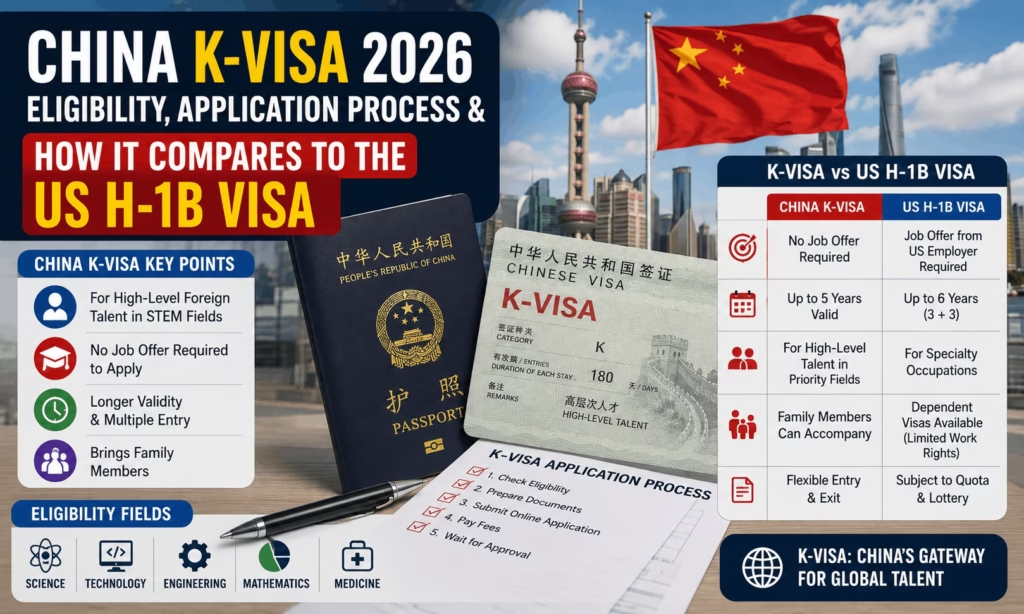
Alongside the possible narrowing of labour shortage categories, IRCC’s consultation also explores expanding Express Entry’s focus on attracting high-value international talent. This includes discussion of up to four new talent-focused categories, among them a potential dedicated pathway aimed at people currently holding U.S. H-1B visas, along with categories oriented toward researchers, artificial intelligence professionals, and other specialized fields the government considers strategically important.
This dual approach, potentially narrowing broad occupation-based labour shortage categories while simultaneously creating new, more specialized talent categories, reflects IRCC’s stated goal of making category-based selection more strategic overall, rather than simply expanding or shrinking the system uniformly.
Francophone Immigration Remains a Stated Priority
The consultation also confirms that supporting Francophone immigration outside Quebec remains one of the three overarching economic priorities IRCC intends to maintain into 2027, alongside addressing labour shortages and attracting top talent. The French-language proficiency category, which requires a minimum language score rather than a specific occupation, has consistently been one of the more accessible categories for candidates who meet its language threshold, and nothing in the current consultation suggests IRCC is considering removing or narrowing this category in the way it is examining the occupation-based lists.
How Express Entry Categories Have Evolved Since 2023
Category-based selection has changed substantially since its introduction, and understanding that history helps explain why the 2027 consultation is significant. When the tool was first introduced in 2023, IRCC focused on a smaller set of categories tied to specific, clearly identified shortages. Over the following two years, the department steadily added new categories and adjusted eligibility requirements as it gathered more data on which categories were actually delivering qualified candidates versus which ones saw limited uptake.
By February 2026, when the current 10-category structure was announced, IRCC had already made one significant change by removing the agriculture and agri-food occupations category entirely, indicating that category-based selection is not a static list but one that IRCC actively adjusts based on outcomes. At the same announcement, four new categories were added, including physicians with Canadian work experience, researchers with Canadian work experience, senior managers with Canadian work experience, and transport occupations, while the minimum qualifying work experience for renewed categories was raised from six months to a full year. This pattern of removing underperforming categories while adding more targeted ones is consistent with the direction the 2027 consultation appears to be taking, only now applied specifically to the five broader occupation-based labour shortage categories rather than smaller, newer ones.
SSDI Pay Chart: The Least Amount You Can Get Per Month and the Most Common Disabilities
Comparing the 2026 Structure to What 2027 Might Look Like
| Category type | 2026 status | Possible 2027 direction |
|---|---|---|
| Healthcare and social services | Full occupation list active | Possible narrowing to higher-training-level roles |
| STEM occupations | Full occupation list active | Possible narrowing or realignment with talent priorities |
| Trade occupations | Full occupation list active, cooks already removed in 2026 | Possible further narrowing |
| Education occupations | Full occupation list active | Possible narrowing based on persistent shortage data |
| Transport occupations | Newly added in February 2026 | Under review alongside older categories |
| French-language proficiency | Active, language-score based | Expected to continue largely unchanged |
| Canadian-experience categories (physicians, researchers, senior managers) | Active, added in 2026 | Likely to continue, possibly joined by new talent categories |
| Skilled military recruits | Active, added in 2026 | Excluded from the 2027 continuation question specifically |
| Agriculture and agri-food | Removed before 2026 | Not currently part of the active category list |
Why Employers and Industry Groups Are Watching Closely
Employers in sectors covered by the current labour shortage categories, particularly healthcare, skilled trades, and education, have relied on category-based Express Entry draws as a relatively predictable channel for recruiting internationally trained workers into permanent roles. A narrower occupation list could shift some of that recruitment pressure back toward employer-driven programs, such as the Provincial Nominee Program or standard employer-specific work permits, particularly for occupations that fall outside whatever refined list IRCC ultimately adopts.
This is part of why the consultation specifically asks whether narrower lists should prioritize occupations less served by other pathways like the Provincial Nominee Program. If IRCC adopts that criterion, occupations that already have a strong existing route through a provincial program could be more likely to be trimmed from the federal labour shortage categories, on the reasoning that federal Express Entry resources should focus on gaps that provinces are not already addressing on their own.
What Data IRCC Is Using to Guide This Decision?
The consultation materials reference operational data IRCC has compiled internally, including a snapshot as of April 7, 2026, showing which categories have generated significant application volume and which have seen comparatively limited activity. While IRCC has not published this full internal breakdown publicly in granular detail, the fact that the department is citing specific operational data suggests the eventual narrowing decisions, if adopted, will be based at least in part on which occupations within each category have actually produced qualified, successful candidates, rather than being an across-the-board reduction applied evenly to every occupation on each list.
What Happens Next in the Process?
The public consultation period ran from August 4 to September 1, 2026, giving stakeholders, employers, immigration consultants, and prospective applicants a defined window to submit feedback directly to IRCC. No changes to the 2027 Express Entry categories have been finalized as of this writing, and the specific occupations that will ultimately be included or excluded from each category have not been announced.
Based on IRCC’s own past pattern of announcing category changes, including the mid-February 2026 announcement of that year’s categories, final decisions on 2027 categories are expected sometime in late 2026 or during the first quarter of 2027, ahead of the new categories taking effect.
How to Apply Through Express Entry?
- Confirm your eligibility for one of Canada’s three federal economic immigration programs managed through Express Entry, namely the Federal Skilled Worker Program, the Federal Skilled Trades Program, or the Canadian Experience Class.
- Take a recognized language test to obtain your Canadian Language Benchmark or Niveaux de compétence linguistique canadiens scores, and complete an Educational Credential Assessment if your education was obtained outside Canada.
- Create an Express Entry profile through the official IRCC portal, entering your work experience, education, language scores, and other required details accurately, since your National Occupational Classification code and duties will determine which categories you may be eligible for.
- Once in the pool, your profile will be ranked using the Comprehensive Ranking System, and you may also be considered for category-based invitations if your profile matches an active category, such as one of the current labour shortage categories, provided the category still exists and includes your occupation at the time of a given draw.
- If you receive an Invitation to Apply, submit your complete permanent residence application within the deadline provided, including all required supporting documents.
UPS Tariff Refund: Who Is Eligible to Get One and How Can You Apply?
Processing Time for Express Entry Applications
Once an Invitation to Apply is issued and a complete application is submitted, IRCC’s standard service target for Express Entry permanent residence applications is generally around six months, though actual processing times can vary depending on application completeness, background and security checks, and current application volumes. Category-based invitations do not typically change this processing timeline once an application has been submitted, since the category mainly affects who receives an invitation and when, not how quickly a submitted application is subsequently processed.
Payment and Fee Schedule for Express Entry
Applicants pay a combination of processing fees and the Right of Permanent Residence Fee as part of a complete Express Entry application, along with fees for required items such as language testing and Educational Credential Assessments completed earlier in the process. These fee requirements apply regardless of which category, if any, a candidate received their invitation through, and are not expected to change based on the outcome of the current labour shortage category consultation.
Official Resources
| Resource | Link |
|---|---|
| IRCC Express Entry official page | https://www.canada.ca/en/immigration-refugees-citizenship/services/immigrate-canada/express-entry.html |
| Express Entry online profile portal | https://www.canada.ca/en/immigration-refugees-citizenship/services/immigrate-canada/express-entry/eligibility.html |
| IRCC Express Entry rounds of invitations | https://www.canada.ca/en/immigration-refugees-citizenship/corporate/mandate/policies-operational-instructions-agreements/ministerial-instructions/express-entry-rounds.html |
| Come to Canada online tool | https://ircc.canada.ca/english/e-services/index.asp |
FAQs About Express Entry Labour Shortage Categories 2027
Will my current Express Entry category still exist in 2027?
It is not yet confirmed. IRCC is consulting on whether to narrow the number or eligibility of occupations within the five labour shortage categories, so an occupation eligible in 2026 may not automatically remain eligible in 2027.
What are the five labour shortage categories Canada may narrow?
The categories under review are healthcare and social services occupations, STEM occupations, trade occupations, education occupations, and transport occupations.
When will Canada announce the final 2027 Express Entry categories?
No official date has been confirmed, but based on past timing patterns, an announcement is expected in late 2026 or during the first quarter of 2027.
Does narrowing these categories mean fewer people will get permanent residence overall?
Not necessarily. IRCC has framed the review as a shift toward more targeted occupation lists within category-based selection, not a stated reduction in Canada’s overall immigration levels, though the practical effect on specific occupations will depend on the final decisions.
Is the French-language proficiency category also being narrowed?
There is no indication in the current consultation that the French-language proficiency category is being narrowed. Supporting Francophone immigration outside Quebec remains one of IRCC’s three stated priorities going into 2027.
What should I do if I am currently eligible under a labour shortage category?
Continue meeting current requirements and consider submitting your Express Entry profile if you are eligible now, since eligibility for a specific occupation in 2026 does not guarantee inclusion once 2027 categories are finalized.
Is there a new pathway for H-1B visa holders being considered?
Yes. IRCC’s consultation includes discussion of a potential dedicated Express Entry category or pathway aimed at attracting current U.S. H-1B visa holders, though this has not been finalized.
Conclusion
Canada’s Express Entry system is heading into a period of meaningful change for 2027, with IRCC actively considering whether to narrow the occupation lists behind its five core labour shortage categories in favor of a more targeted, strategic approach, while simultaneously exploring new categories aimed at high-value global talent. Nothing has been finalized yet, and the consultation that closed on September 1, 2026 will inform decisions expected in late 2026 or early 2027. Applicants currently relying on healthcare, STEM, trades, education, or transport category eligibility should watch for the official announcement closely, since their occupation’s continued inclusion is not guaranteed under the proposed changes.
USCIS Addis Ababa Field Office: New International Office Opens September 9
Is It Hard to Refinance Student Loan, and What Are the Pros and Cons of Doing It?