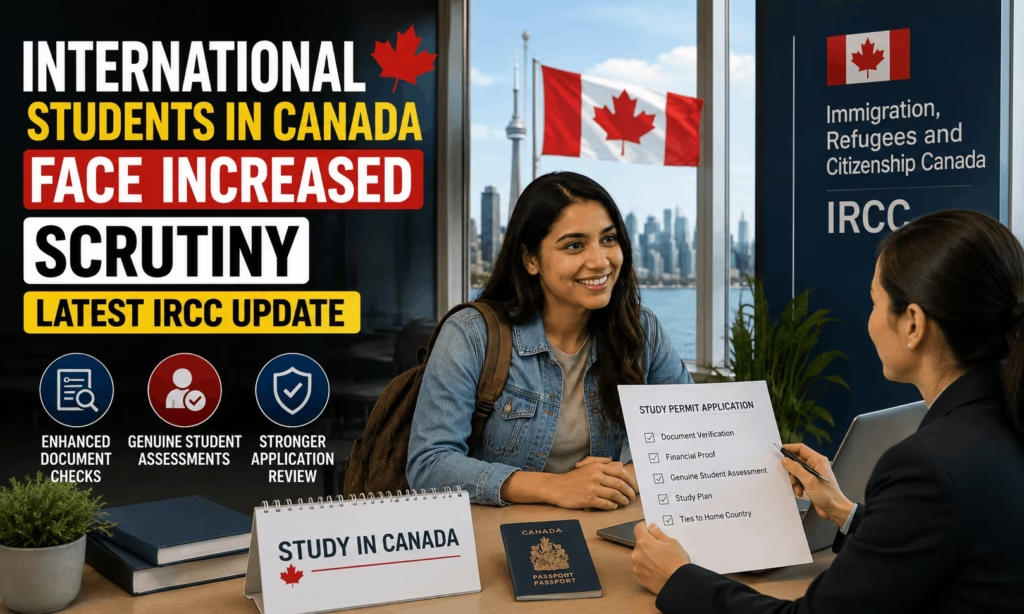
International Students In Canada Face Increased Scrutiny: Canada’s immigration department has quietly tightened the rules for international students, and the change is already reshaping who gets approved and who gets turned away. Immigration, Refugees and Citizenship Canada (IRCC) updated its internal guidance for visa officers on July 24, 2026, directing them to examine not just how much money a study permit applicant has, but where that money actually came from. Officers must now check the source and history of funds in every single application, not only in files from countries previously flagged as higher risk. For hundreds of thousands of students hoping to study in Canada this year, this single change means bank statements, income proof, and family transfer records are being read more carefully than ever before.
This shift did not happen in isolation. It follows a scathing federal audit, a major overhaul of immigration law, and a sharp fall in the number of students actually arriving in the country. Canada’s Auditor General reported in March 2026 that immigration officials had flagged more than 153,000 international students for possible non-compliance between 2023 and 2024, yet had the resources to investigate only about 2,000 cases a year. That gap between enforcement on paper and enforcement in practice is exactly what the new financial checks, compliance audits, and study permit reviews are designed to close. We’ll be updating this article monthly as IRCC releases new figures and policy updates, so bookmark this page if you are tracking your own application or advising students.
Why International Students In Canada Are Facing Increased Scrutiny?
For close to a decade, Canada’s international education sector grew faster than almost any other part of the immigration system. Colleges and universities leaned heavily on tuition from overseas students, some institutions expanded enrolment far beyond what local housing and support services could absorb, and a pattern emerged where a study permit was treated by some as a side door into permanent residence rather than a genuine path to education.
The federal government has openly acknowledged this. Internal planning documents describe unsustainable volumes, a shift of the program away from its educational purpose, over-reliance by designated learning institutions on international tuition to cover funding gaps, and rising financial hardship among students who arrived without adequate support. Officials also pointed to uneven approval rates between regions and the need to bring the number of incoming students in line with how many permanent residence spots the country can realistically offer. The result is a policy reset that has been rolling out over roughly eighteen months, and the study permit financial scrutiny update is simply the latest and most direct piece of it.
Key Highlights: Canada International Student Rules 2026
| Update | Detail | Effective Date |
|---|---|---|
| Financial documentation review | Visa officers must assess amount and source of funds for every applicant, not only high-risk countries | July 24, 2026 |
| Bank statement history | Statements must now cover six months instead of four | July 24, 2026 |
| Accepted fund sources | Pension income and rental income now explicitly accepted; bank drafts removed as an example of acceptable proof | July 24, 2026 |
| Proof of funds for a single applicant | Rising from $22,895 to $23,448, plus tuition and travel costs | September 1, 2026 |
| Study permit compliance manual | Officer guidance titled “Study Permits: Assessing study permit conditions” revised | June 18, 2026 |
| Immigration law reform | Government given power to mass terminate applications and mass cancel documents; two new asylum restrictions introduced | March 26, 2026 |
| Auditor General report | Found over 153,000 students flagged for non-compliance, but funding to investigate only about 2,000 cases a year | March 23, 2026 |
| Study permit cap for 2026 | Roughly 309,670 new application spaces; up to about 408,000 total permits expected, including extensions | 2026 intake year |
| Student Direct Stream (SDS) | Cancelled; students who entered under this former fast-track stream are now treated as a high-risk group requiring mandatory risk review | 2026 audit cycle |
| Off-campus work hours | Reinstated cap of 24 hours per week after the pandemic-era waiver | Ongoing |
Trump Deportation Fines: US Targets Migrants Abroad Over $423 Million in Unpaid Penalties
Tax Filing Season 2027: IRS Start Date, Deadlines and Refund Schedule
SNAP Maximum Benefits FY2027 Confirmed: Family of Four Gets Up to $1,023 (Effective Oct 1, 2026)
Cognizant Green Card Filings Frozen as US Labor Department Escalates Visa Fraud Crackdown
The New Financial Documentation Rules
The most immediate and widely felt change is how IRCC assesses money behind a study permit application. Under the previous approach, an applicant largely needed to show a bank balance that met the minimum threshold. Under the current guidance, an officer is expected to trace where that balance came from and whether it is credible given the applicant’s background.
A few practical points matter here for anyone applying now or helping a student prepare their file:
Bank statements now need to cover six months of history rather than four, including the month just before or the month of the application date. A sudden, unexplained deposit shortly before applying is far more likely to raise a flag than it once was.
Officers can request extra proof of employment, salary, or business income in any file, regardless of which country the applicant is from. This is a change from the earlier system, where deeper checks were mostly reserved for countries designated as higher risk.
Rental income and pension income are now explicitly listed as acceptable sources of funds, which is helpful for applicants whose parents or sponsors rely on property income or retirement income rather than a salary. On the other hand, bank drafts have been dropped from the list of standard proof-of-funds examples, so applicants relying on a draft alone should check current guidance before submitting.
None of this changes the headline dollar figure for the 2025 to 2026 application cycle, which remains $22,895 for a single applicant outside Quebec. What has changed is the depth of evidence officers expect behind that number, and from September 1, 2026, the number itself rises to $23,448 for new applications, on top of full first-year tuition and return travel costs.
Proof Of Funds Payment Schedule: What Changes And When?
Because IRCC adjusts the minimum financial requirement every year in line with Statistics Canada’s low-income cut-off figures, applicants need to track which threshold applies to their specific submission date rather than assuming last year’s number still holds.
| Application Submission Window | Minimum Funds Required (Single Applicant, Outside Quebec) |
|---|---|
| January 1, 2025 to August 31, 2026 | $22,895 |
| On or after September 1, 2026 | $23,448 |
This $23,448 figure covers one year of living costs only. It does not include tuition, which must be shown separately based on the actual program fee, and it does not include return airfare. A student with first-year tuition of $20,000, for example, would need to demonstrate access to the living-cost amount, the tuition amount, and travel funds combined, which pushes real financial readiness well above the headline number quoted in most advertising and agent brochures. Families bringing dependents must also add the additional per-person amounts published on the official IRCC funds table, which increases with each accompanying family member.
Study Permit Extensions Now Under Sharper Review
Roughly 460,695 people currently hold a study-permit-only status in Canada, and hundreds of thousands more hold combined work and study permits. For this group, the extension process, not just the first application, is where scrutiny has increased the most.
IRCC’s 2026 planning prioritizes extensions over brand-new permits, expecting to process about 253,000 extension applications compared with roughly 155,000 new permits. But higher volume does not mean easier approval. The department’s internal audit specifically flagged students who originally entered through the now-cancelled Student Direct Stream as a high-risk category, meaning their files now go through a mandatory additional risk assessment before an extension is granted.
Officers reviewing extension files are drawing on data analytics that cross-check a student’s attendance record, academic standing, and financial documentation against what was declared in earlier applications. Gaps in enrolment, unexplained breaks in study, or documentation that does not line up with earlier submissions can now result in an outright refusal rather than a request for clarification. Students who switch schools or programs are also required to apply for a new study permit reflecting the change, and IRCC has begun enforcing designated learning institution transfer rules more strictly, including tighter checks on institutions that repeatedly lose or gain large numbers of transferring students.
IRS Identity Protection PIN: How to Get One and Stop Tax Fraud
Express Entry Labour Shortage Categories 2027: What Canada May Tighten?
How To Apply For A Canada Study Permit Under The New Rules?
The core application steps have not changed, but each stage now carries a higher documentary bar. Here is the process as it currently stands.
First, secure a letter of acceptance from a designated learning institution and confirm it through IRCC’s enhanced verification system, which was introduced specifically to reduce fraudulent or altered acceptance letters.
Second, obtain a Provincial or Territorial Attestation Letter if your program requires one. As of January 1, 2026, master’s and doctoral students enrolled at a public university are exempt from this requirement, along with K-12 students and certain exchange and priority categories, but most college and undergraduate applicants still need one tied to that year’s provincial allocation.
Third, assemble financial documentation that shows both the amount and the traceable source of funds, covering at least six months of account history, along with tuition payment proof and a credible explanation of how the full program will be financed if it runs longer than one year.
Fourth, submit the study permit application online through the IRCC secure portal, pay the applicable fees, and complete biometrics where required.
Fifth, respond promptly and completely to any request for additional documents. Because officers can now request supplementary financial or employment evidence in any file, delays in responding are one of the more common reasons applications stall in 2026.
Study Permit Processing Time In 2026
Processing times continue to vary by country of application and by how complete the initial submission is, but the broader pattern this year is a smaller pool of applications moving through the system with a higher share ultimately being approved. Comparing the first four months of 2025 with the same period in 2026, new study permit applications fell by roughly 43 percent, while the overall approval rate rose by about nine percentage points to around 35 percent. Immigration consultants attribute this to stricter financial documentation filtering out weaker applications earlier, leaving a pool of files that clears review more consistently. Applicants from some countries, including South Korea, continue to see approval rates above 90 percent, while other markets remain well below a third, underscoring how uneven the country-by-country experience still is.
Because of this variation, applicants should always check the live processing time estimator on the official IRCC website for their specific country and application type rather than relying on averages, since actual current processing time can shift from month to month as volumes change.
Official Canada Immigration Resources And Links
What This Means For Students Already In Canada?
For students currently enrolled, the practical takeaway is that consistency across every document now matters more than it used to. An officer reviewing an extension will compare current attendance and academic records against what was declared when the original permit was issued, so any change in institution, program, or course load should be reported and reflected in a fresh application rather than left unaddressed. Students working off campus should keep to the reinstated 24-hour weekly limit, since hour violations are one of the compliance issues the revised officer manual specifically instructs staff to check.
Students who entered through the Student Direct Stream before it was discontinued should be especially prepared for extra questions at extension or renewal stage, since that group has been identified as needing a mandatory additional risk assessment. Keeping organized records of tuition payments, attendance confirmations, and any communication with the designated learning institution will make that review faster and less stressful.
UPS Tariff Refund: Who Is Eligible to Get One and How Can You Apply?
Ontario Minimum Wage Rises to $17.95 on Oct 1, 2026
SNAP Income Limits FY2027 Confirmed: Single Applicants Capped at $1,729, Family of Four at $3,575
What This Means For Institutions?
Designated learning institutions are not exempt from the new environment. IRCC now has regulatory power to penalize non-compliant institutions directly, and the first formal penalties under this authority are expected in spring 2026. Institutions with unusually high numbers of students who stop attending, transfer out immediately after enrolment, or fail to maintain proper records face a real risk of losing their designated status, which would end their ability to host new international students altogether. This gives colleges and universities a strong incentive to tighten their own admissions and monitoring practices rather than leaving compliance entirely to IRCC.
Fewer Arrivals, Tighter Law
The scrutiny on study permits is happening alongside a much larger drop in actual arrivals. The number of international students arriving in Canada in 2026 has fallen by around 70 percent compared with 2024, a decrease of roughly 225,335 people. This decline reflects the combined effect of the national study permit cap introduced in recent years, the higher financial bar, and the broader signal that the government is prioritizing quality and compliance over sheer volume.
At the legislative level, the government passed significant immigration law reforms on March 26, 2026, granting the Governor in Council authority to mass terminate pending applications and mass cancel previously issued immigration documents under specific circumstances. The same reform introduced two new restrictions on asylum claims, including a ban on claims filed more than a year after a person’s first entry into Canada and a ban on claims from certain irregular border crossers. While these measures are aimed primarily at the asylum system, they form part of the same broader push toward tighter, more centrally controlled immigration management that is also driving the international student changes.
FAQs About International Students In Canada Face Increased Scrutiny
Why are international students in Canada facing increased scrutiny in 2026?
Because a federal Auditor General report found tens of thousands of students had been flagged for possible non-compliance without enough investigators to follow up, IRCC responded by tightening how officers verify financial documents, monitor attendance, and assess extension applications across the board.
What is the new proof of funds amount for a Canada study permit?
For applications submitted between January 1, 2025 and August 31, 2026, a single applicant outside Quebec must show $22,895. For applications submitted on or after September 1, 2026, that amount rises to $23,448, not including tuition and travel costs.
Do bank statements need to cover a longer period now?
Yes. As of the July 2026 guidance update, bank statements must show six months of history, up from the previous four-month requirement, and should include the month before or the month of the application.
Are students who used the Student Direct Stream at higher risk of refusal?
Students who originally entered Canada through the now-cancelled Student Direct Stream are treated as a high-risk group under the 2026 compliance audit and undergo a mandatory additional risk assessment when applying for an extension.
How long does it take to get a Canada study permit in 2026?
Processing time varies significantly by country and by how complete the application is. Approval rates and speed differ widely, with some countries seeing approval rates above 90 percent and others below a third, so applicants should check the official IRCC processing times tool for their specific case rather than relying on a single average figure.
Can international students still work off campus without restrictions?
No. The pandemic-era waiver on off-campus work hours has ended, and the standard limit of 24 hours per week during academic sessions has been reinstated and is now actively checked as part of compliance reviews.
Will the study permit cap continue in 2027?
IRCC has indicated that annual multi-year immigration levels planning will continue to include specific targets for temporary residents, including international students, so a form of managed intake is expected to remain in place, though exact figures for future years have not yet been finalized.
What happens if a designated learning institution fails to comply with the rules?
IRCC can now issue formal regulatory penalties against non-compliant institutions, with the first set expected in spring 2026, and institutions that repeatedly fail compliance checks risk losing their designated status entirely.
Conclusion
The message from Ottawa is consistent across every recent update: the era of straightforward, high-volume approvals for international students is over, at least for now, and the system is shifting firmly toward verified, well-documented, genuine applications. For students still planning to study in Canada, that means building a financial file that can withstand a source-of-funds check, choosing a designated learning institution with a clean compliance record, and keeping every piece of paperwork consistent from the first application through to graduation. For those already here, it means treating attendance, work hours, and program changes as compliance issues to actively manage rather than administrative details to ignore. The direction of travel is clear, and with financial requirements set to rise again on September 1, 2026, and further regulatory penalties against institutions expected this spring, the coming months are likely to bring more updates rather than fewer. This article will continue to be updated monthly as new figures and policy changes are released by IRCC.
SSDI Pay Chart: The Least Amount You Can Get Per Month and the Most Common Disabilities
Ohio SNAP Sugary Beverage Ban Delayed: What Happened and Why