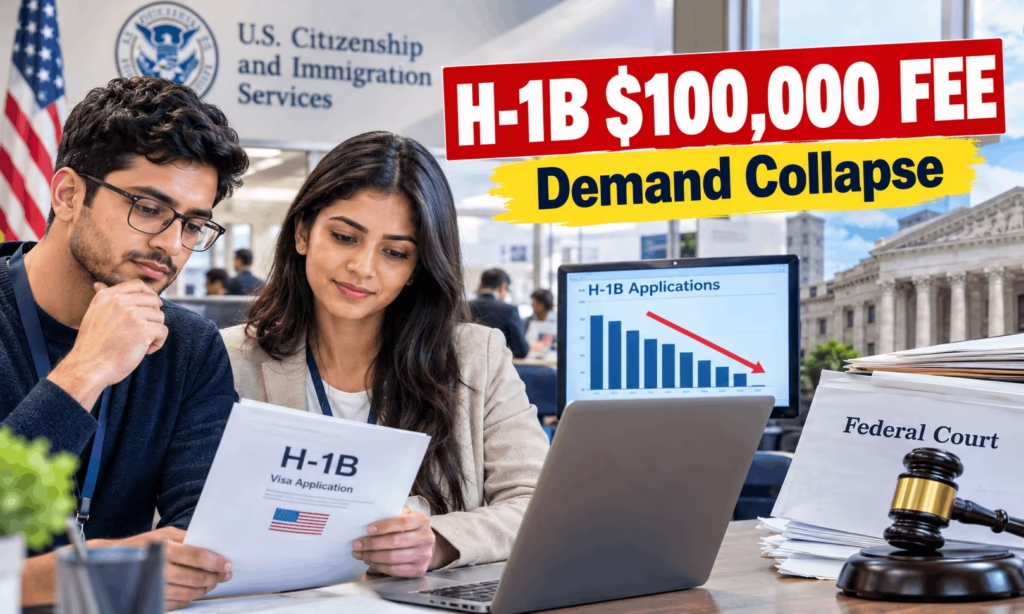
H-1B $100,000 Fee: New government data released this week has put hard numbers behind what immigration attorneys and IT executives had been predicting for months. According to Department of Homeland Security figures reported September 8, 2026, H-1B visa lottery entries fell by 85 to 100 percent this year among the firms most heavily affected by President Trump’s proclamation imposing a $100,000 fee on new H-1B petitions filed for workers outside the United States. The collapse translated into cuts of thousands of sponsored workers at IT staffing and outsourcing giants including Infosys, Tata Consultancy Services, and IBM, marking one of the sharpest single-year demand shifts in the H-1B program’s history.
The numbers are specific and striking. Infosys cut more than 8,100 lottery entries this spring compared to the prior year, a 91 percent drop, while Tata Consultancy Services slashed entries by more than 5,600, a 95 percent decline. Cognizant Technology Solutions also posted a steep pullback. What makes this data especially notable is that it directly contradicts an earlier DHS internal assessment, which had evaluated more modest fee increases between fiscal 2021 and 2025 and concluded that demand for H-1B visas was weakly inelastic, meaning it typically does not shift much based on price. The six-figure fee proved to be a different story entirely. We’ll be updating this article monthly as new DHS data, litigation outcomes, and hiring trends continue to develop.
What the New DHS Data Actually Shows?
The figures reported this week come directly from Department of Homeland Security records tracking H-1B lottery registrations for the most recent selection cycle, offering the clearest picture yet of how employers actually responded to the fee once it took effect.
| Company | Lottery Entry Change | Approximate Entries Cut |
|---|---|---|
| Infosys | Down 91 percent | More than 8,100 fewer entries |
| Tata Consultancy Services | Down 95 percent | More than 5,600 fewer entries |
| Cognizant Technology Solutions | Steep decline reported | Thousands of entries cut |
| IBM | Among firms with cuts in the thousands of sponsored workers | Cuts described in the thousands |
| Firms most heavily affected overall | Down 85 to 100 percent | Varies by company |
Despite this sharp drop, total H-1B lottery registrations still exceeded the annual cap of 85,000 visas, since demand for the program has for more than a decade far outstripped the available supply, even after accounting for this year’s steep pullback from the largest IT staffing users.
The Proclamation Behind the Fee: What It Actually Requires
Understanding exactly what the fee covers, and what it does not, matters for anyone trying to interpret the DHS data correctly.
| Detail | Information |
|---|---|
| Legal basis | Presidential Proclamation 10973, signed September 19, 2025 |
| Effective date | 12:01 a.m. Eastern Daylight Time, September 21, 2025 |
| Fee amount | $100,000 |
| Who must pay | The sponsoring employer, not the employee, under federal labor rules |
| Who is covered | New H-1B petitions filed for beneficiaries located outside the United States without a valid H-1B visa |
| Who is exempt | H-1B extensions, amendments, transfers, and changes of status filed and approved from within the United States; workers who already held a valid H-1B visa before the effective date |
| Original scheduled expiration | September 20, 2026, unless extended by the administration |
Is It Hard to Refinance Student Loan, and What Are the Pros and Cons of Doing It?
Tax Filing Season 2027: IRS Start Date, Deadlines and Refund Schedule
SNAP Maximum Benefits FY2027 Confirmed: Family of Four Gets Up to $1,023 (Effective Oct 1, 2026)
Why the Fee Hit Indian IT Outsourcing Firms Hardest?
The DHS data lines up closely with which companies have historically relied most heavily on hiring H-1B workers from abroad rather than sponsoring workers already inside the United States, explaining why the impact landed so unevenly across the industry.
- Indian IT services and staffing firms have traditionally sponsored large numbers of workers directly from India for initial H-1B employment, meaning a disproportionate share of their petitions fell squarely within the fee’s scope
- Companies that instead relied more on transferring existing H-1B holders between employers, or converting workers already inside the U.S. through other visa categories, faced far less exposure to the new fee
- Average reported wages for H-1B workers at some of the largest staffing firms have historically sat well below the median wage for comparable U.S. tech roles, a gap that critics of the outsourcing model have pointed to for years and that the administration cited as part of its justification for the fee
- Immigration attorneys note that some Indian IT firms had already been reducing H-1B reliance for several years prior to this fee, shifting toward offshore delivery models, local U.S. hiring, and increased use of AI tools, meaning the fee accelerated an existing trend rather than starting an entirely new one
The Legal Rollercoaster: Where the $100,000 Fee Stands Right Now
This is the detail most searched by employers and workers trying to plan ahead, and it has changed multiple times over the past several months.
| Date | Legal Development |
|---|---|
| September 19, 2025 | Presidential Proclamation 10973 signed, establishing the $100,000 fee |
| September 21, 2025 | Fee takes effect for qualifying new H-1B petitions |
| October 16, 2025 | U.S. Chamber of Commerce files a lawsuit challenging the fee |
| December 2025 | A federal court in Washington, D.C. upholds the fee in a separate lawsuit, State of California v. Mullin-adjacent litigation, that case remains on appeal at the D.C. Circuit |
| June 8, 2026 | U.S. District Court for the District of Massachusetts vacates the policy implementing the fee, ruling it an unlawful tax and an improper use of executive power |
| June 12, 2026 | The district court judge administratively stays his own ruling, temporarily putting the fee back into effect while the government sought emergency relief |
| July 24, 2026 | U.S. Court of Appeals for the First Circuit denies the government’s request for a stay in State of California v. Noem, meaning the fee cannot currently be enforced |
| August 2026 | USCIS confirms it is complying with the First Circuit’s order and currently has no lawful basis to collect the $100,000 fee, though the agency states it will resume collection if the order is later lifted |
| September 20, 2026 | Original proclamation is scheduled to expire under its own terms, unless extended or reissued by the administration |
As of the most recent confirmed status, the $100,000 fee is not currently enforceable, though the underlying legal fight is far from over, and a separate, related regulatory proposal for a new cap-subject fee structure remains under DHS consideration.
Why the DHS Data Still Matters Despite the Legal Pause?
Even though the fee is not currently being collected, the newly released lottery entry data captures the real-world behavior of employers during the period when the fee was actively in force and enforced, making it one of the most direct measures available of how the policy actually changed hiring decisions.
- The dramatic entry declines occurred during the spring registration period, when the fee was fully enforced and employers had to assume it would apply to any new offshore hire
- Economists who reviewed the DHS figures, including Johns Hopkins University economics professor Michael Clemens, have said the data indicates H-1B petitions will collapse under an even broader fee proposal currently being considered, since the current numbers already demonstrate real elasticity in demand contrary to the administration’s earlier internal projections
- The administration has stated it remains unconcerned that expanding the fee’s scope to a larger pool of foreign talent could produce a similar demand collapse, setting up a continued disagreement between government economic projections and outside analysis of the same data
What Happens if the Proclamation Expires or Is Extended?
With the September 20, 2026 sunset date now imminent, employers face genuine uncertainty about what the fee landscape looks like heading into the next H-1B cycle.
- If the administration allows Proclamation 10973 to expire without action, the $100,000 fee requirement tied specifically to that proclamation would lapse by its own terms
- The administration could instead extend or reissue the proclamation, keeping the fee structure in place beyond September 20, 2026
- Separately, DHS has pursued a new, higher fee proposal through the formal federal rulemaking process rather than another presidential proclamation, a different legal pathway that would not automatically expire the same way
- Regardless of the proclamation’s fate, the litigation over whether a fee of this kind is lawful at all remains unresolved, with the government retaining the option to seek review from the U.S. Supreme Court
How Employers Should Apply Given the Current Legal Status?
Given how frequently the fee’s enforceability has changed, employers considering new H-1B petitions for workers abroad need a clear, current process rather than relying on outdated guidance.
- Confirm the fee’s current enforcement status directly through official USCIS guidance before filing, since the legal status has changed multiple times within a matter of weeks
- File Form I-129, Petition for a Nonimmigrant Worker, through the standard USCIS process for any new H-1B petition, regardless of the fee’s current status, since the underlying filing requirements remain unchanged
- Maintain complete records of any $100,000 fee payments made while the fee was previously enforced, since refund mechanics for those earlier payments remain unresolved and unaddressed by the courts
- Consult with immigration counsel before deciding whether to proceed with an offshore hire given the pending September 20, 2026 expiration date and the possibility of a new fee structure emerging through the separate DHS rulemaking process
- Employers in sectors such as artificial intelligence, defense technology, or semiconductors should ask counsel about whether a national-interest exception pathway may apply to their specific hiring needs
IRS Identity Protection PIN: How to Get One and Stop Tax Fraud
Express Entry Labour Shortage Categories 2027: What Canada May Tighten?
Processing Time: How the Fee’s Legal Status Affects Filing Timelines
Because the fee’s enforceability has shifted multiple times, processing expectations for affected petitions have become more complicated than a typical H-1B filing.
| Filing Scenario | Current Processing Consideration |
|---|---|
| New H-1B petition for a worker abroad, filed now | Fee not currently enforceable following the First Circuit’s July 24, 2026 order, but status could change again before adjudication |
| Premium processing request | Generally adjudicated within 15 business days, though fee status changes mid-process can complicate specific cases |
| H-1B extension, amendment, or change of status from within the U.S. | Generally outside the scope of the fee regardless of its current enforcement status |
| Petitions filed while the fee was previously enforced | May require case-specific review regarding fee payment status and any potential future refund process |
Payment Schedule: What Employers Who Already Paid Should Know
For employers who paid the $100,000 fee before the courts intervened, the question of what happens to that money remains unresolved.
- The June 8, 2026 court judgment vacated the fee’s implementing policy but did not directly address refund mechanics for fees already collected
- Based on how the administration has handled similar situations in separate litigation, it has not volunteered refunds unless specifically ordered to do so by a court
- Employers who paid the fee should retain complete payment records, receipts, and confirmation documentation, and consult with immigration counsel about pursuing recovery through appropriate legal channels
- Any future refund process, if ordered, would likely follow its own separate timeline distinct from standard H-1B petition processing
Official Resources for Checking H-1B Fee Status and Filing
Given how frequently this fee’s legal status has changed, employers and workers should verify current requirements directly through official government channels before filing or relying on secondhand summaries.
| Resource | Purpose | Official Link |
|---|---|---|
| USCIS H-1B FAQ page | Official, regularly updated guidance on the fee’s current enforcement status | uscis.gov/newsroom/alerts/h-1b-faq |
| USCIS Form I-129 | The petition form used for all H-1B filings | uscis.gov/i-129 |
| USCIS H-1B program page | General program requirements, cap information, and lottery details | uscis.gov/working-in-the-united-states/h-1b-specialty-occupations |
| Federal Register | Official text of Presidential Proclamation 10973 and any related DHS rulemaking notices | federalregister.gov |
| Department of Homeland Security newsroom | Official DHS statements and data releases related to H-1B policy | dhs.gov/news |
| U.S. Court of Appeals for the First Circuit | Official case dockets for State of California v. Noem and related litigation | ca1.uscourts.gov |
UPS Tariff Refund: Who Is Eligible to Get One and How Can You Apply?
Ontario Minimum Wage Rises to $17.95 on Oct 1, 2026
SNAP Income Limits FY2027 Confirmed: Single Applicants Capped at $1,729, Family of Four at $3,575
FAQs About H-1B $100,000 Fee
Is the H-1B $100,000 fee currently in effect?
No. As of the most recent confirmed status in August 2026, the fee is not enforceable after the U.S. Court of Appeals for the First Circuit declined to reinstate it on July 24, 2026, though the government’s appeal remains pending.
How much did H-1B demand actually drop at major IT firms?
According to Department of Homeland Security data reported September 8, 2026, lottery entries fell 85 to 100 percent among the firms most heavily affected, with Infosys down 91 percent and Tata Consultancy Services down 95 percent compared to the prior year.
Who has to pay the $100,000 H-1B fee?
The fee must be paid by the sponsoring employer, not the employee, and cannot be passed on to the worker under U.S. labor rules.
Does the $100,000 fee apply to H-1B extensions or transfers?
No. The fee applies specifically to new H-1B petitions for beneficiaries located outside the United States without a valid H-1B visa. Extensions, amendments, transfers, and changes of status filed and approved from within the U.S. are generally not subject to the fee.
When does the H-1B fee proclamation expire?
Presidential Proclamation 10973 is scheduled to expire on September 20, 2026 under its own terms, unless the administration extends or reissues it.
Will employers get refunds for the $100,000 fee they already paid?
This remains unresolved. The June 8, 2026 court judgment did not address refund mechanics, and the administration has not volunteered a refund process, so affected employers should retain payment records and consult counsel.
Why did Indian IT outsourcing firms see the steepest declines?
These firms have historically sponsored a large share of new H-1B workers directly from abroad rather than relying on transfers of existing H-1B holders, meaning a disproportionate share of their petitions fell within the fee’s scope.
Could the $100,000 fee come back even if the proclamation expires?
Yes. DHS has pursued a separate, higher fee proposal through formal federal rulemaking rather than a presidential proclamation, a pathway that would not automatically expire and could result in a new fee structure regardless of what happens to the current proclamation.
Is H-1B demand still exceeding the annual visa cap despite the drop?
Yes. Even after the steep decline among heavily affected firms, total lottery entries this year still exceeded the annual cap of 85,000 visas, since overall demand for the program has outstripped supply for more than a decade.
What does the DHS data mean for a proposed, larger H-1B fee?
Economists reviewing the data, including a Johns Hopkins University economist, say the demonstrated demand collapse suggests H-1B petitions would fall even further under a broader fee proposal currently under DHS consideration, contradicting the administration’s earlier assumption that demand for the program does not shift much based on price.
Conclusion
The newly released DHS data confirms with hard numbers what industry observers had anticipated since the $100,000 H-1B fee first took effect: a genuine, sharp collapse in demand from the program’s largest institutional users, with entry drops of 85 to 100 percent at the most heavily affected firms. That the data emerges just as the underlying proclamation faces an imminent September 20, 2026 expiration date, and while the fee itself sits legally unenforceable pending appeal, adds real uncertainty for employers trying to plan hiring for the next H-1B cycle. Whether the administration extends the current proclamation, lets it lapse, or pursues an entirely new fee structure through formal rulemaking will shape H-1B sponsorship decisions well beyond this single data release. As the legal appeal, the proclamation’s expiration, and any new DHS rulemaking develop, check back here, since this article is reviewed and updated with the latest confirmed information each month.
SSDI Pay Chart: The Least Amount You Can Get Per Month and the Most Common Disabilities
Ohio SNAP Sugary Beverage Ban Delayed: What Happened and Why