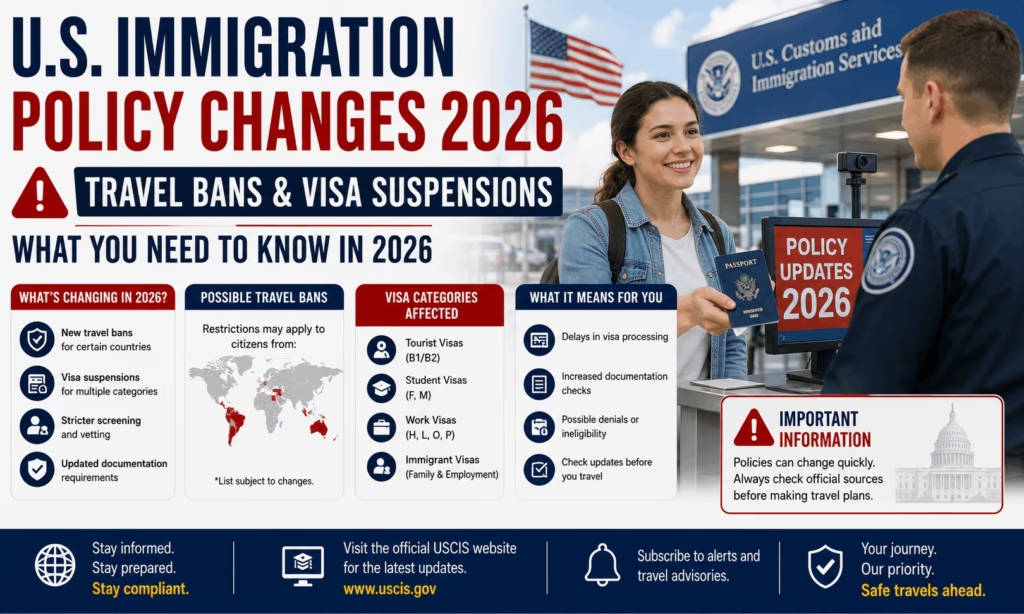
New Public Charge Rule for Green Card: Washington DC, September 16: A major shift in how the United States decides who qualifies for a green card takes effect in just two days, and it carries direct consequences for the hundreds of thousands of Indian nationals currently waiting in the employment-based and family-based immigration pipeline. Starting September 18, 2026, the US Citizenship and Immigration Services will apply a broader, more discretionary public charge test to every Form I-485 adjustment of status application filed on or after that date, replacing the narrower 2022 framework that has governed green card decisions for the past three and a half years. For the large Indian applicant pool stuck in decades-long employment-based backlogs, this rule change lands at an especially sensitive moment, since many of these cases are only now becoming current for final approval. We’ll be updating this article monthly as USCIS issues further clarifications, releases the revised Form I-485, and as real-world case outcomes under the new standard start to emerge.
The Department of Homeland Security formally rescinded the 2022 public charge rule on July 16, 2026, with the final rule published in the Federal Register on July 20, 2026. USCIS followed up with detailed implementation guidance, Policy Alert PA-2026-09, on August 18, 2026, spelling out exactly how officers will now weigh an applicant’s age, health, family situation, finances, education and skills before deciding whether that person is likely, at any time, to become dependent on government support. For Indian families who have spent ten, fifteen, or even twenty years waiting for an employment-based green card to become current, understanding this new test before filing could make the difference between a smooth approval and a costly delay.

Key Highlights: New Public Charge Rule for Green Card in 2026
| Detail | Information |
|---|---|
| Effective date | September 18, 2026 |
| Announcing agency | US Department of Homeland Security and USCIS |
| Final rule published | Federal Register, July 20, 2026 |
| Rescission announced | July 16, 2026 |
| USCIS implementation guidance | Policy Alert PA-2026-09, released August 18, 2026 |
| Rule being replaced | 2022 Public Charge Final Rule (in effect since December 23, 2022) |
| Forms affected | Form I-485, Adjustment of Status |
| Who is covered | Family-based, employment-based and diversity visa green card applicants, plus certain nonimmigrant visa applicants and returning green card holders absent more than 180 days |
| Who is exempt | Refugees, asylees, VAWA self-petitioners, T and U visa applicants, green card renewals, and citizenship applicants |
| Standard applied | Totality of circumstances, based on five statutory factors under INA Section 212(a)(4) |
| Minimum public charge bond | 1,000 dollars, with higher amounts possible depending on the case |
Why the Rule Is Changing Again?
Public charge policy in the United States has swung back and forth for years depending on the administration in power. The 1999 Interim Field Guidance governed most green card decisions for two decades and used a narrow definition focused mainly on cash assistance and long-term institutional care. In 2022, under the Biden administration, DHS issued a final rule that further narrowed the list of benefits that could count against an applicant, largely excluding non-cash programs such as food assistance and housing support from the analysis.
The Trump administration reversed that approach this year. On July 16, 2026, DHS announced it was rescinding the 2022 rule entirely, arguing that immigration law requires officers to evaluate whether applicants are self-sufficient rather than dependent on taxpayer-funded benefits. The new framework restores the broader, pre-2022 approach and gives USCIS officers significantly more discretion to weigh an applicant’s overall circumstances rather than checking a short, fixed list of disqualifying programs.
Medicaid Work Requirements 2026: New Rule Rollout, State Start Dates and Who Is Exempt
ABLE Account Eligibility 2026: Who Qualifies Now, New Age Limit and Calculator
What Exactly Changes on September 18?
The most important date-based rule to understand is this: your Form I-485 filing date determines which standard applies to your case, not the date your case gets decided.
Applications filed before September 18, 2026 will generally continue to be reviewed under the outgoing 2022 rule, the narrower standard that only weighs cash assistance for income maintenance and government-funded long-term institutionalization. Applications filed on or after September 18, 2026 fall under the new framework, where officers can consider virtually any means-tested public benefit received, applied for, or approved on or after that date, whether it is a cash program or a non-cash one such as food assistance, housing assistance, or need-based educational aid.
Importantly, this is not retroactive. Any means-tested benefit an Indian applicant’s family received before September 18, 2026 continues to be evaluated only under the old, narrower standard, even if the green card application itself is decided after that date. USCIS has also confirmed it is revising Form I-485 to include new questions about benefit history, financial status and employment background, and older editions of the form will be rejected once the new edition takes effect.
The Five Statutory Factors Officers Must Weigh
Under Section 212(a)(4) of the Immigration and Nationality Act, which has not changed, officers must always consider five factors together rather than in isolation. What has changed is how broadly and strictly USCIS interprets each one under the new guidance.
| Factor | What officers look at |
|---|---|
| Age | Whether the applicant is of standard working age or whether age raises questions about long-term self-sufficiency |
| Health | Whether a medical condition could limit the ability to work, study or care for oneself without significant financial support |
| Family status | Household size, number of dependents, and whether the applicant is supporting or being supported by others |
| Assets, resources and financial status | Income, savings, property, debts, and the strength of any Form I-864 Affidavit of Support |
| Education and skills | Work experience, professional credentials, licenses, English proficiency and trade skills |
According to the new policy guidance, no single factor other than a missing or insufficient Affidavit of Support in a category that requires one is automatically disqualifying on its own. A healthy, working-age applicant with steady employment is generally not considered likely to become a public charge, even with a modest income or with some history of receiving public benefits in the past.
What Counts as a Means-Tested Public Benefit Now?
This is the single biggest technical change in the new rule, and it directly affects Indian families where a spouse or child may have used a state or local benefit program at some point.
| Benefit type | Under the outgoing 2022 rule | Under the new rule effective Sept 18 |
|---|---|---|
| Cash assistance for income maintenance | Counted | Counted |
| Long-term institutionalization at government expense | Counted | Counted |
| Food assistance such as SNAP | Not counted | Counted if received on or after Sept 18, 2026 |
| Housing assistance | Not counted | Counted if received on or after Sept 18, 2026 |
| Need-based financial aid for college | Not counted | Counted if received on or after Sept 18, 2026 |
| Medicaid, non-emergency | Not counted | May be considered as relevant evidence |
| Social Security retirement or disability benefits | Not counted | Remains excluded |
| Medicare | Not counted | Remains excluded |
| Unemployment insurance | Not counted | Remains excluded |
| Public or subsidized health insurance premium tax credits | Not counted | May be considered when relevant to the case |
Benefits used by an applicant’s spouse or children generally are not automatically counted against the primary applicant, but they can still be considered as part of the household’s overall financial picture under the totality of circumstances standard.
SNAP Benefits October 2026 Increase: New Amounts, Eligibility and Calculator
PROMISE Act Social Security Deadline: What the September 17 Trigger Actually Means for Your Benefits
How This Specifically Affects Indian Green Card Applicants?
Indian nationals make up one of the largest groups waiting inside the US employment-based green card system, particularly in the EB-2 and EB-3 categories, where decades-long backlogs mean many applicants only become eligible to file Form I-485 after ten or more years on an H-1B visa. Several practical realities make this population especially sensitive to the new rule.
First, timing of filing matters enormously right now. Any Indian applicant whose priority date recently became current and who is ready to file a complete, well-documented I-485 has a strong incentive to submit before September 18, 2026, to be reviewed under the narrower, more predictable 2022 standard rather than the new discretionary framework.
Second, most H-1B-to-green-card applicants are not the population this rule is designed to catch. Officers view a healthy, employed, working-age applicant with an approved employment-based petition and steady income as generally unlikely to become a public charge, which describes the profile of most Indian EB-2 and EB-3 applicants. The bigger practical risk sits with dependent family members, particularly a spouse who has used a state-level food, housing or education benefit while the primary applicant’s case was pending, since that use could now become relevant evidence in the household’s overall public charge evaluation if it occurred on or after September 18.
Third, family-based applicants, including parents, spouses and adult children of US citizens filing under family preference categories, face more direct exposure than employment-based applicants, since family petitions often involve sponsors and household members with more varied income levels and less consistent employment history.
Fourth, the revised Form I-485 will ask more detailed questions about benefit history and financial circumstances, meaning Indian applicants and their attorneys will need to prepare more thorough documentation packages than before, including updated Affidavit of Support paperwork, proof of income, employment verification letters, and educational credentials.
How to Apply Under the New Rule?
Applicants filing Form I-485 on or after September 18, 2026 should follow a more document-heavy process than in the past.
- Confirm your priority date is current using the monthly Visa Bulletin published by the State Department, if filing in an employment or family preference category.
- Use the updated edition of Form I-485 once USCIS publishes it, since older editions will be rejected after the effective date.
- Prepare a complete Form I-864 Affidavit of Support where required, since an insufficient affidavit remains an automatic ground for a public charge finding in categories where one is legally mandated.
- Gather evidence addressing all five statutory factors, including recent pay stubs, tax returns, educational diplomas, professional licenses, employment verification letters and, where relevant, medical exam results from Form I-693.
- Disclose any means-tested public benefits received by household members truthfully, and be prepared to explain the circumstances, since honest disclosure paired with strong supporting evidence is treated more favorably than a discovered omission.
- File online through the USCIS online account portal or by mail, depending on the category, and retain proof of the filing date, since that date determines which public charge standard applies to the case.
Processing Time: What to Expect After Filing
USCIS has not announced a separate processing track for cases filed under the new public charge framework, so applicants should expect standard I-485 processing times to continue applying in the near term. Historically, employment-based adjustment of status cases have taken anywhere from eight months to over two years depending on the service center and category, while family-based cases often see similar or longer ranges depending on backlogs. Officers reviewing cases filed on or after September 18 may take somewhat longer per case initially while the new discretionary framework is applied in practice, since more evidence may need to be reviewed and, in some cases, a Request for Evidence or Notice of Intent to Deny may be issued specifically on public charge grounds. Applicants should monitor their case status through the official USCIS case status portal rather than relying on estimated processing time averages alone.
Public Charge Bonds: A Safety Valve, Not a Default Outcome
In limited cases where an officer finds an applicant inadmissible solely on public charge grounds, USCIS may invite that applicant to post a public charge bond rather than issuing an outright denial. Under the new guidance, bond amounts can range from a minimum of 1,000 dollars up to roughly 42,000 dollars over five years for certain adults with children, up to approximately 53,430 dollars over five years for certain adults without children, and up to about 28,200 dollars over five years for certain children, with the exact figure set case by case. This mechanism existed under earlier rules as well and is not a routine step for most applicants; it applies only when public charge is the sole basis for a finding of inadmissibility.
2027 Social Security Benefits Changes: COLA Increase, Possible Cuts, and New Bills
Stimulus Check 2026: Fact-Checking Every Viral Payment Claim (Tracker)
Timeline of Key Dates
| Date | Development |
|---|---|
| December 23, 2022 | 2022 Public Charge Final Rule took effect |
| July 16, 2026 | DHS announces rescission of the 2022 rule |
| July 20, 2026 | Final rule published in the Federal Register |
| August 18, 2026 | USCIS releases Policy Alert PA-2026-09 with implementation guidance |
| September 17, 2026 | Last day cases are guaranteed review under the 2022 standard if filed and postmarked on or before this date |
| September 18, 2026 | New public charge framework takes effect for all covered Form I-485 filings |
| Ongoing | Revised Form I-485 rollout and further USCIS field guidance expected |
Should You File Before or After September 18?
Immigration attorneys generally advise that any applicant who is currently eligible, has a current priority date, and can assemble a complete and accurate I-485 package should aim to file before September 18, 2026 to be reviewed under the more predictable, narrower 2022 standard. Applicants who are not yet eligible, whose priority dates are not current, or who need more time to gather documentation should not rush an incomplete filing purely to beat the deadline, since an incomplete or poorly documented application filed under time pressure carries its own risks regardless of which public charge standard applies.
Should Applicants Stop Using Public Benefits They Are Legally Entitled To?
USCIS guidance is explicit that the new rule does not require immigrants to stop using benefits they are otherwise eligible for, and benefit use alone does not automatically result in a public charge finding. Applicants and their family members should not cancel medical care, food assistance, housing support or other services based only on general warnings, since the determination is always based on the totality of circumstances rather than any single factor.
Official Resources for Indian Green Card Applicants
| Resource | What it provides | Official link |
|---|---|---|
| USCIS Policy Manual, Volume 8, Part G | Full text of the new public charge guidance | uscis.gov/policy-manual |
| USCIS Case Status Online | Track your I-485 processing status | egov.uscis.gov/casestatus |
| USCIS Form I-485 page | Latest form edition, filing instructions and fees | uscis.gov/i-485 |
| USCIS myUSCIS account portal | Online filing and case management | my.uscis.gov |
| US Department of State Visa Bulletin | Monthly priority date cut-offs for employment and family categories | travel.state.gov |
| USCIS Contact Center | General filing and status questions | uscis.gov/contactcenter |
| Federal Register final rule notice | Full legal text of the rescission and new rule | federalregister.gov |
| Indian Embassy, Washington DC | Consular assistance for Indian nationals in the US | indianembassyusa.gov.in |
Conclusion
The new public charge rule taking effect on September 18, 2026 represents the most significant shift in how the United States evaluates green card self-sufficiency in several years, and it arrives at a pivotal moment for the large population of Indian nationals moving through employment-based and family-based immigration pipelines. The core message from immigration authorities is one of balance rather than alarm: a healthy, working applicant with steady income, a solid education, and a properly completed Affidavit of Support remains in a strong position under either the old or the new standard. Where Indian applicants and their families need to pay closer attention is in documentation, timing of filing relative to the September 18 deadline, and honest, well-supported disclosure of any household benefit history. As USCIS rolls out the revised Form I-485 and issues further field guidance in the coming weeks, this article will be updated monthly to reflect the latest official clarifications and real-world processing trends.
FAQs
What is the new public charge rule that takes effect on September 18, 2026?
It is updated USCIS guidance, following a Department of Homeland Security rule rescinding the narrower 2022 public charge regulation, that restores a broader totality of circumstances test for green card and certain visa applicants based on five statutory factors: age, health, family status, financial resources, and education and skills.
Does the new public charge rule apply to Indian citizens already holding a green card?
No. The rule does not apply to green card renewals or to lawful permanent residents unless they have spent more than 180 days outside the United States and are treated as applicants for admission upon return.
Will my previous use of a public benefit count against my green card application?
Only if the benefit was received on or after September 18, 2026. Benefits received before that date continue to be judged under the narrower 2022 standard, which counted only cash assistance for income maintenance and long-term institutional care.
Are H-1B holders applying for a green card through employment sponsorship affected?
Yes, but most H-1B-based EB-2 and EB-3 applicants from India are considered lower risk under this rule because they are typically healthy, working-age, employed, and educated, all factors that weigh in an applicant’s favor under the totality of circumstances test.
Should I rush to file my I-485 before September 18?
If your priority date is already current and your application package is complete and accurate, filing before September 18, 2026 allows your case to be reviewed under the more predictable 2022 standard. If your case is not ready, it is generally better to file a complete application later than an incomplete one under time pressure.
What happens if USCIS decides I am a public charge?
In limited situations where public charge is the sole ground of inadmissibility, USCIS may offer the option of posting a public charge bond instead of denying the case outright, with bond amounts starting at a 1,000 dollar minimum and going higher depending on individual circumstances.
Does this rule affect family-based green card sponsors and their income requirements?
The Form I-864 Affidavit of Support requirement is unchanged, but officers now have more discretion to weigh the sponsor’s and household’s overall financial picture, employment history and other factors alongside the affidavit itself.
How long does it take to process a green card application under the new rule?
USCIS has not announced separate processing timelines specifically tied to the new public charge framework, so applicants should continue to expect standard I-485 processing ranges, while being prepared for possible additional evidence requests in cases with more complex financial or benefit histories.
Is Medicaid or health insurance assistance counted as a public benefit now?
Medicaid and certain subsidized health insurance benefits may be considered as relevant evidence under the new framework if received on or after September 18, 2026, though Medicare, Social Security and unemployment insurance remain excluded from the public charge analysis.
Where can I check the official status of my green card application?
Applicants should use the official USCIS Case Status Online portal and their myUSCIS account for the most accurate and current information on their individual I-485 case.
Trump $5000 Dividend Check: Latest Update on Cost, Eligibility and Payment Date
US Russia Sanctions Bill 2026: 100% Tariff Threat to India Explained