Trump Interest Rates Demand: President Donald Trump called on the Federal Reserve to cut interest rates to 1 percent or less on Wednesday, just hours after the central bank did the opposite and raised its benchmark rate for the first time since 2023. In a post on Truth Social, Trump argued that the United States has the strongest credit standing in the world and should be borrowing far more cheaply than it currently does, while also reviving his long-standing complaint that America is being taken advantage of by trading partners running deficits with the US. The remarks reignited a debate over US economic policy that has simmered for most of Trump’s second term, now playing out against a Federal Reserve led by his own hand-picked chairman. We’ll be updating this article monthly as new Fed decisions, inflation data and White House statements come in.
The timing made the comments especially pointed. The Federal Open Market Committee had just voted unanimously to raise the federal funds rate by 25 basis points to a target range of 3.75 percent to 4 percent, ending a three-year run without a single hike. Fed Chair Kevin Warsh, who Trump himself nominated to lead the central bank earlier in 2026, defended the increase publicly, saying inflation remained too high and that the committee’s focus was on restoring price stability. Trump said he still had confidence in Warsh despite the decision, a notable contrast to the relentless public criticism he directed at former Fed Chair Jerome Powell throughout 2025, though he did describe the broader Fed board as hostile to his position. Here is exactly what Trump said, why the Fed moved in the opposite direction, what his renewed trade deficit argument means, and how a 1 percent rate environment would actually change borrowing costs for everyday Americans.
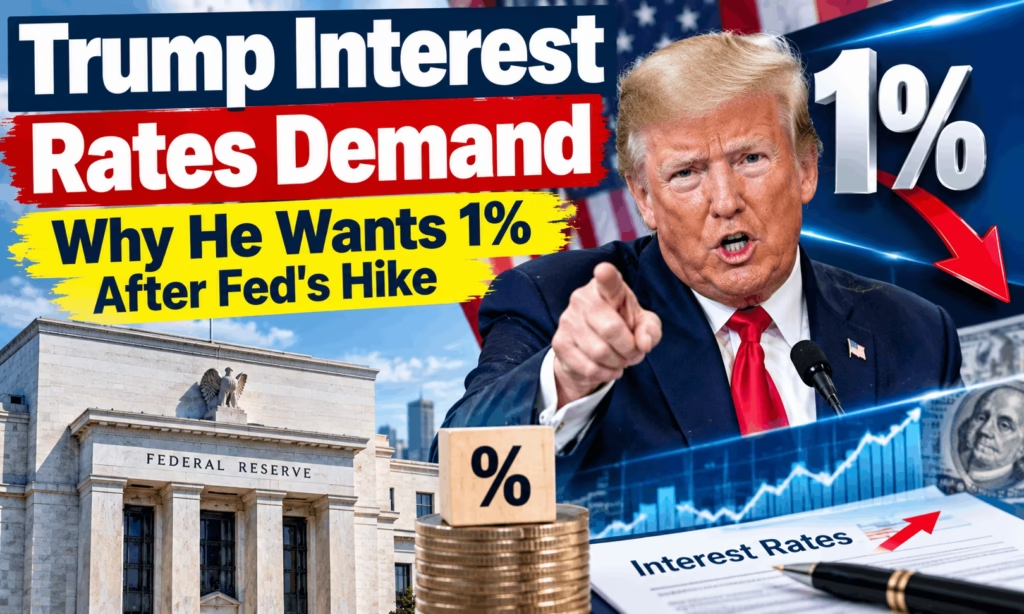
Key Highlights: Trump Interest Rates Demand
| Detail | What Happened |
|---|---|
| Date of comments | September 16, 2026, via Truth Social |
| What Trump wants | Interest rates at 1 percent or less |
| Fed’s actual move | Raised rates 25 basis points to 3.75 percent to 4 percent |
| Vote | Unanimous, first hike since 2023 |
| Fed Chair | Kevin Warsh, nominated by Trump, took over from Jerome Powell in 2026 |
| Warsh’s position | Inflation still too high, hike needed for price stability |
| Fed’s forward guidance | 16 of 18 policymakers project at least one more hike before the end of 2026 |
| Trump’s trade argument | Claims ending trade with deficit countries could generate at least $1.5 trillion a year |
| Inflation status | Core PCE inflation remains above the Fed’s 2 percent target |
| Historical pattern | Trump has made this same 1 percent demand repeatedly since 2025 |
What Trump Actually Said?
Trump’s post came within hours of the Fed’s announcement and combined two separate arguments into one message. On interest rates, he argued that because the United States holds what he called the best credit in the world, borrowing costs should sit at 1 percent or below, a level far under both the Fed’s new target range and anything the central bank has signaled it is considering. He described the economy as booming with new investment and pushed for the rate cut to happen quickly.
On trade, Trump separately argued that stopping trade with countries that run deficits with the United States, something he said applies to most of the country’s trading partners, could generate at least 1.5 trillion dollars a year. He characterized the word deficit as essentially another term for loss and said the United States has effectively been carrying most of the rest of the world economically, a situation he said could not continue.
Both arguments are ones Trump has raised before in different forms throughout his second term, but the timing of this latest version, arriving the same day the Fed moved rates in the opposite direction he wants, gave the comments unusual weight in financial media coverage.
Amazon Prime Settlement Refund: Who Qualifies for Up to $200 Now?
FEHB 2026 Open Season: Which Plans Left and What It Means for Your Premium?
CPP OAS GIS Payment Amounts: September 25 Deposit, October Increase and Free Calculator
Why The Fed Just Raised Rates Instead Of Cutting Them?
To understand why Trump’s demand and the Fed’s actual decision are moving in opposite directions, it helps to look at what has happened inside the central bank since Warsh took over as chair earlier in 2026. At his first policy meeting in June, the Fed held rates steady but released a dot plot, the chart showing where each policymaker expects rates to land, that revealed a sharp shift toward expecting higher rates rather than lower ones. Nine of eighteen officials projected at least one hike by the end of 2026, up from a dot plot just three months earlier that had shown a single projected cut and no hikes at all. The Fed’s own inflation forecast for 2026 was revised up to 3.6 percent from an earlier projection of 2.7 percent, with core inflation raised to 3.3 percent, both well above the central bank’s long-standing 2 percent target.
By the September meeting, that hawkish shift turned into an actual rate increase, and the updated projections released alongside it showed the committee leaning even further toward additional tightening, with 16 of 18 policymakers now projecting at least one more hike before the year is out. Fed officials have pointed to a combination of pressures behind the persistent inflation, including tariff-related cost increases working through supply chains, elevated energy prices, and strong demand tied to AI-related investment. Warsh himself has been cautious about giving specific forward guidance since taking the job, telling reporters after his first meeting that the committee would simply reassess at its next scheduled gathering rather than commit to a path in advance.
This is the core tension behind Trump’s comments. He is calling for rates near historic lows at the exact moment the institution responsible for setting them is moving toward higher rates because inflation, by the Fed’s own measurement, has gotten worse rather than better over the course of 2026.
How Markets Reacted To The Hike And Trump’s Response?
Financial markets responded to the rate decision before Trump’s post even went out, and the reaction was consistent with a central bank signaling it intends to keep fighting inflation rather than easing up. Treasury yields moved higher immediately after the Fed’s statement, reflecting investor expectations that borrowing costs would stay elevated for longer than previously priced in. US stocks slipped modestly on the day, while the dollar gained ground against a basket of other currencies, a combination that typically reflects markets treating a rate hike as a credible, and somewhat unexpected, signal about where policy is actually headed rather than where political pressure wants it to go. Short-term interest rate futures, which traders use to bet on the Fed’s next move, shifted to price in a greater likelihood of another hike rather than a pause at the committee’s next scheduled meeting. None of these market signals moved in the direction Trump’s comments called for, underscoring how far apart the administration’s preferred policy and the market’s current expectations have become.
A Shift In Tone From The Powell Years
One detail worth noting in how Trump handled this latest disagreement is what he did not do. Throughout 2025, Trump repeatedly and personally criticized then Fed Chair Jerome Powell by name, often in blunt terms, over the central bank’s refusal to cut rates as quickly as the White House wanted. In his response to this week’s hike, Trump notably avoided criticizing Warsh personally, instead saying he still relies on him and retains confidence in his leadership, even while directing frustration at what he called a hostile Fed board more broadly.
That distinction matters because Warsh is not an inherited Fed chair the way Powell effectively was during Trump’s return to office. Warsh is Trump’s own pick, installed specifically to reshape how the central bank operates, and he has already made visible changes since taking over, including shortening the Fed’s policy statements, launching a series of internal reviews covering everything from the bank’s balance sheet to its inflation framework, and adopting a communication style that avoids committing to future rate moves in advance. The unanimous 12-0 vote behind September’s rate hike suggests that even a Fed chair handpicked by Trump, along with the rest of the committee he now leads, judged a rate increase necessary given the inflation data in front of them, rather than deferring to the administration’s preferred outcome.
The Trade Deficit Argument, Explained
Trump’s renewed call to stop trading with countries running deficits with the United States is a version of an argument he has made at various points throughout his presidency, and it draws a direct line between the country’s trade balance and his broader case for lower interest rates. Under his framing, if the United States ended trade specifically with countries where it imports more than it exports, the country would avoid the underlying loss he associates with a trade deficit, freeing up the 1.5 trillion dollars a year he referenced in his post.
Mainstream economists have generally pushed back on the idea that trade deficits function as a direct loss in the way Trump describes, arguing instead that deficits reflect a range of factors including currency valuation, domestic savings rates, and consumer demand for imported goods, rather than money simply being given away to other countries. Critics of the interest rate argument specifically note that cutting rates to near zero while inflation remains above target would risk reigniting the kind of price pressures the Fed spent much of the past several years trying to bring under control. Supporters of Trump’s position counter that a stronger, cheaper-borrowing domestic economy would ultimately outweigh short-term inflation risk, and that a AAA-credit nation like the United States should not be paying rates comparable to countries with far weaker fiscal positions. Both sides of this debate remain active in financial commentary following the September rate decision, and neither has been resolved by the Fed’s latest move.
IRS 2027 Tax Brackets: How Much Can You Earn Before Hitting the 37% Rate
32-Hour Workweek Bill: What the Thirty-Two Hour Workweek Act Means for Your Paycheck
Flat-Rate COLA: What the 2027 Social Security Proposal Really Means for Retirees
What A 1 Percent Rate Would Actually Mean For Your Money?
Setting aside the political debate, it is worth understanding concretely what a shift toward 1 percent interest rates would change for ordinary borrowers and savers if it ever happened. Lower benchmark rates from the Fed generally flow through to lower rates on variable-rate debt, including credit cards, home equity lines of credit, and adjustable-rate mortgages, along with somewhat lower rates on new fixed mortgages and auto loans over time. With average credit card annual percentage rates currently sitting near 21 percent, a meaningful Fed rate cut could bring real relief to households carrying revolving debt.
The other side of that equation affects savers rather than borrowers. Certificates of deposit, high-yield savings accounts, and Treasury securities all tend to offer lower returns when the Fed’s benchmark rate falls, meaning retirees and others relying on interest income would see that income shrink under a 1 percent rate environment. Financial planners have generally suggested that anyone holding CDs or Treasuries consider the maturity timing of those holdings based on where actual Fed policy is heading, rather than reacting to political statements about where rates should be, since the Fed’s own current guidance points toward higher rates in the near term, not lower ones.
How Rate Changes Actually Move Through The System?
For anyone trying to track what happens next, it helps to understand the mechanical process rather than just the headline number. The Federal Open Market Committee meets roughly every six weeks to set the federal funds rate, the rate banks charge each other for overnight lending, which then influences the prime rate that banks use as a baseline for consumer and business loans. Changes typically take a few weeks to a few months to fully show up in mortgage rates, credit card APRs and savings account yields, since lenders adjust their own pricing gradually rather than instantly matching the Fed’s move. The next scheduled FOMC meeting will be the venue where markets look for any sign of whether the committee’s hawkish lean continues or shifts, particularly given how sharply the dot plot moved between the June and September meetings this year.
Interest Rate Impact Calculator
Use the calculator below to see how a change in interest rates, from today’s actual rate environment toward the 1 percent level Trump is calling for, would affect a real monthly payment on a mortgage, credit card balance, or auto loan.
What would lower rates mean for your payment?
Compare your monthly payment today against what it could look like if rates dropped toward the 1% level Trump has called for. This is a simplified estimate that runs entirely in your browser.
Official Sources
| Resource | Purpose | Link |
|---|---|---|
| Federal Reserve | Official rate decisions and FOMC statements | federalreserve.gov |
| FOMC meeting calendar | Dates of upcoming rate decisions | federalreserve.gov/monetarypolicy/fomccalendars |
| Bureau of Labor Statistics | Official inflation and CPI data | bls.gov/cpi |
| Bureau of Economic Analysis | Core PCE inflation data | bea.gov |
| White House | Official statements on economic policy | whitehouse.gov |
Hungary Poland Immigrant Visa Resumption: What Changed and Who Is Affected?
DHS LPR Rule for Foreign Government Employees’ Children: Eligibility, Fees and How to Apply
HUD-VASH Housing Voucher New 2026 Eligibility Rules Explained
FAQs
Why does Trump want interest rates at 1 percent?
Trump has argued that the United States holds the strongest credit rating in the world and should therefore be able to borrow at much lower rates than it currently does, and he has tied this argument to broader claims about the country’s economic strength and trade position.
Did the Federal Reserve lower interest rates in September 2026?
No. The Fed raised its benchmark rate by 25 basis points to a range of 3.75 percent to 4 percent on September 16, 2026, its first rate hike since 2023, moving in the opposite direction from what Trump requested.
Who is Kevin Warsh and why does he matter here?
Kevin Warsh is the current Federal Reserve Chair, nominated by Trump earlier in 2026 to succeed Jerome Powell. Despite being Trump’s own pick, Warsh and the full Federal Open Market Committee voted unanimously to raise rates rather than cut them.
Is the Fed likely to cut rates to 1 percent soon?
Current Fed projections point in the opposite direction. As of the September 2026 meeting, 16 of 18 policymakers projected at least one additional rate hike before the end of the year, driven by inflation that remains above the central bank’s 2 percent target.
What would 1 percent interest rates mean for mortgages and credit cards?
Lower benchmark rates typically bring down variable-rate debt costs, including credit cards and adjustable mortgages, over time. With average credit card rates near 21 percent currently, a significant cut could meaningfully lower monthly payments for borrowers carrying balances.
How would low interest rates affect savings accounts and CDs?
Savers would likely see lower returns, since banks generally reduce the interest paid on savings accounts, CDs and similar products when the Fed’s benchmark rate falls.
Is this the first time Trump has called for 1 percent rates?
No. Trump has made similar demands for near-zero interest rates at multiple points during his second term, both under former Chair Jerome Powell and now under Kevin Warsh.
What is Trump’s trade deficit argument about?
Trump argues that ending trade with countries that run deficits with the United States would generate substantial revenue, which he estimated at 1.5 trillion dollars a year, and has described trade deficits as equivalent to a financial loss for the country.
Do economists agree with Trump’s trade deficit argument?
Many mainstream economists disagree with the framing that trade deficits directly equal a national loss, pointing instead to factors like currency valuation, domestic savings behavior and consumer demand for imports as key drivers of trade imbalances.
What did Trump say about interest rates in September 2026?
Trump said US interest rates should be 1 percent or less, arguing the country’s strong credit standing justified far lower borrowing costs, in a post made shortly after the Federal Reserve raised its benchmark rate for the first time since 2023.
Why did the Fed raise interest rates in September 2026?
The Fed raised rates because inflation, measured by core PCE, remained above its 2 percent target, with officials citing pressures from tariffs, energy prices and strong AI-related investment demand as contributing factors.
What is the current Fed interest rate range?
Following the September 2026 decision, the federal funds rate sits in a target range of 3.75 percent to 4 percent.
Does the president control interest rates in the United States?
No. The Federal Reserve operates independently from the White House, and while presidents can nominate the Fed chair and voice opinions on policy, the Federal Open Market Committee makes rate decisions on its own.
Conclusion
Trump’s call for interest rates at 1 percent or less lands at a moment when the Federal Reserve, now led by his own appointee, is moving firmly in the opposite direction because of inflation data the central bank cannot ignore. The disagreement highlights a real and unresolved debate in American economic policy, between an administration that sees cheap borrowing as a tool for growth and a central bank mandated to keep prices stable even when that means raising rates against the president’s wishes. For now, the practical reality for anyone with a mortgage, a credit card balance, or a savings account is shaped far more by the Fed’s actual September decision than by any political statement about where rates should be, though that could change quickly if inflation data shifts enough to alter the central bank’s projections at its next meeting.