
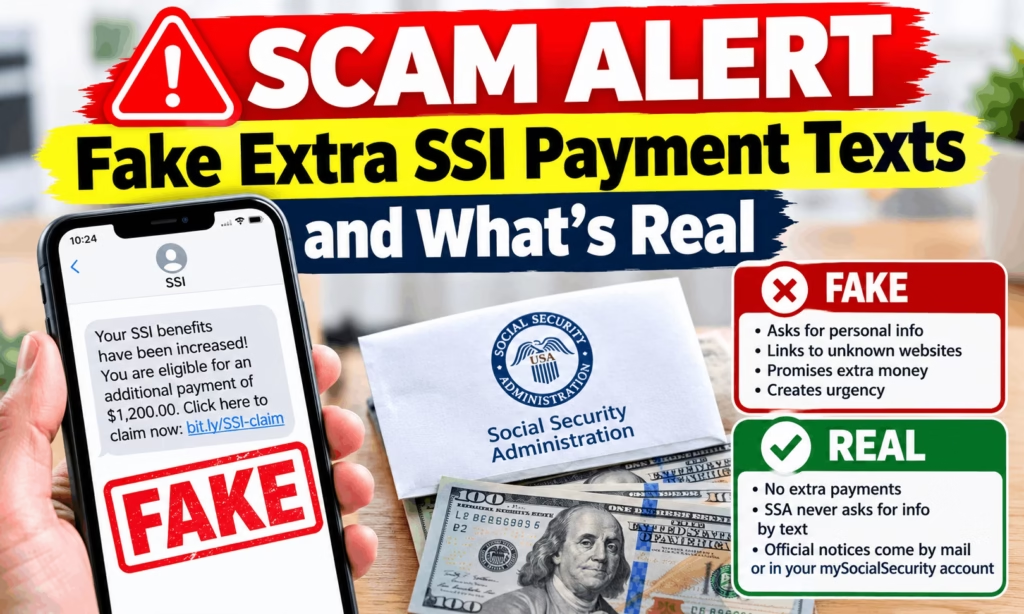
Scam Alert Fake “Extra SSI Payment” Texts: If a text on your phone promises an extra SSI deposit this month, treat it as a trap. October 2026 really does feature unusual deposits: SSI pays on Thursday, October 1, and again on Friday, October 30, because the November payment moves up when November 1 lands on a Sunday. People who also receive Social Security see a third deposit on October 2. That genuine calendar quirk is exactly what makes fake “extra payment” messages believable, and scammers know it. The texts push you to tap a link, confirm your bank details or pay a small fee to “release” money that does not exist. We could not find an official Social Security alert that names this exact text, so treat the wave as reported by recipients and advocates rather than confirmed by the agency. The tactic itself matches well documented impersonation scams. We’ll be updating this article monthly as new warnings and payment dates are confirmed.
Here is the part worth remembering: every real SSI payment this year is already on a public schedule, and none of them requires you to click, call back or pay anything. The Social Security Administration deposits SSI automatically, so a message asking you to “claim” it is not from the agency. Below you will find the confirmed October dates, the red flags that give fake messages away, the latest fraud numbers from federal agencies, and the steps to take if you already responded. If you have a text sitting on your phone right now, do not tap anything in it. Read the checklist first, compare its date with the calendar, and only then decide what to do. There is also a free message checker at the end of this guide that scores a suspicious text in under a minute.
Real SSI & Social Security Dates vs Fake Extra Payment Claims Key Highlights
| Item | What is real | What is fake |
|---|---|---|
| SSI deposit for October | Thursday, October 1, 2026 | Any “bonus” or “second October” payment |
| SSI deposit for November | Friday, October 30, 2026 (paid early) | A request to confirm details to receive it |
| Social Security for dual and pre-May 1997 recipients | Friday, October 2, 2026 | Claims that it is delayed until you verify |
| Birthday-based Social Security | October 14, 21 or 28 | A text naming some other date |
| 2027 COLA announcement | Expected October 14, 2026 | “Early COLA” links sent before that date |
| Next regular SSI payment after October 30 | Tuesday, December 1, 2026 | An “extra” November deposit |
| Maximum federal SSI in 2026 | $994 individual, $1,491 couple | Any promised lump sum on top of this |
What Is Actually Happening: The Fake Extra SSI Payment Text
The scam works because it borrows a true story. Headlines this month explain that SSI recipients get two deposits in October and that some households get three. A criminal only has to add a small lie to that true story. The messages we have seen described by recipients and advocates tend to fall into four patterns:
- A “bonus deposit” text that says you are owed an extra October SSI payment and need to tap a link to confirm your account.
- A “failed deposit” text that claims your October 30 payment could not be delivered and asks for updated bank details.
- A “COLA early access” text that promises the 2027 raise now if you verify your identity.
- A “release fee” text that says a held payment will be sent after a small processing charge.
Each pattern is built to create urgency. The link usually leads to a copy of the Social Security website or a form that harvests your Social Security number, date of birth and bank login. Some versions ask you to call a number, where a person posing as an agency employee takes over.
One caution on sourcing. The agency’s Office of the Inspector General has issued broader warnings about Social Security text scams, but as of October 6, 2026 we did not find an alert that specifically names an “extra SSI payment” message. That is why this guide leans on the agency’s standing rules, which apply to every version of this con.
The Rules the Agency Itself Publishes
The Social Security Office of the Inspector General has spelled out what the agency will never do, and these rules make a quick test for any message:
- It will never send a text asking you to call back an unknown number.
- It will only text you if you opted in to receive messages, or as part of the added security when you sign in to your my Social Security account.
- It will never promise a benefit increase or other help in exchange for payment.
- It will never ask you to pay with a gift card, wire transfer, cryptocurrency or mailed cash.
- If you owe money, it mails a letter with payment options and appeal rights.
Notice what is missing from that list: nothing allows a text that asks you to claim a deposit. SSI money is sent automatically to the bank account or card on file, so the correct response to “claim your payment” is to ignore it.
SSI Payment Gap Alert: 2 Deposits in October, None in November, 2 in December (Full Calendar)
Social Security COLA 2027 for Seniors Could Get Nearly $200 More Per Month
The Numbers Behind the Problem
Impersonation fraud is not a fringe issue. These are the figures that are most recent and publicly reported.
| Statistic | Figure | Source |
|---|---|---|
| Government imposter scam reports to the FTC in 2025 | Over 375,000 | SSA advocate notice, June 2026 |
| Losses from those reports | $917 million | SSA advocate notice, June 2026 |
| Losses by adults 60 and older, 2024 | $2.4 billion, quadrupled since 2020 | SSA advocate notice, June 2026 |
| Reported losses of $100,000 or more by adults 60 and older | $55 million in 2020 to $445 million in 2024 | FTC data spotlight |
| FTC fraud losses, first three quarters of 2025 | Over $12 billion, with over $700 million from government imposter scams | SSA OIG, March 2026 |
| Social Security scams among government imposter scams | Most reported type | SSA OIG quarterly report, April to June 2026 |
A note on data quality. Another consumer advocacy summary cites over 330,000 government imposter complaints in 2025, a 25 percent increase from 2024. The gap with the 375,000 figure likely reflects different counting methods, so we show the agency’s number and flag the difference rather than pick the larger one.
The inspector general’s quarterly report for April through June 2026 also notes that the agency issued one scam alert in that period. Congress marked March 5, 2026 as National Slam the Scam Day, and the campaign’s message has not changed: hang up, delete, and report.
How to Tell a Real SSI Message From a Fake One?
Real notices from the agency arrive in predictable ways. Use the table below to sort what lands on your phone.
| Sign | Real Social Security contact | Likely scam |
|---|---|---|
| Channel | Mailed letter, or your my Social Security account inbox | Unexpected text, social media message or email |
| Text messages | Only if you opted in, usually security codes | Link, callback number or urgent warning |
| Asks for money | Never to receive or release a benefit | “Small fee,” gift cards, crypto or wire |
| Asks you to verify | Only inside your own secure account | Via a link or by reading out a code |
| Tone | Plain notice with a mailing date | Threats, countdowns, “last chance” |
| Payment dates | Match the public calendar | Dates that do not appear on the SSA calendar |
Two extra checks help. First, compare the date in the message with the calendar above. Real SSI dates this fall are October 1, October 30, December 1 and December 31. A message claiming a deposit on October 15 or November 5 for SSI does not match. Second, look at the sender. Caller ID and text sender names can be faked, so a familiar number proves nothing.
What Is Real in October 2026?
With the scams set aside, here is the genuine picture for the month. SSI pays on the first business day, and when the 1st falls on a weekend or holiday, the payment moves earlier. That produces two SSI deposits this month and none in November.
Social Security retirement, disability and survivor benefits follow the birthday calendar unless you started before May 1997 or also receive SSI. If you were born from the 1st to the 10th, you are paid October 14. Birthdays from the 11th to the 20th are paid October 21, and the 21st to the 31st on October 28. Everyone in the pre-May 1997 and dual group is paid October 2.
The 2026 amounts already include the 2.8 percent cost-of-living increase from January. The next adjustment will be announced on October 14, when the September inflation report is released. Current projections sit around 3.5 to 3.6 percent from The Senior Citizens League and AARP. Those are forecasts, and no one can legitimately promise you the final number early.
Real Payment Schedule 2026
| Month | SSI | Dual or pre-1997 Social Security | Birthday-based Social Security |
|---|---|---|---|
| October 2026 | Oct 1 and Oct 30 | Oct 2 | Oct 14, 21, 28 |
| November 2026 | None, paid Oct 30 | Nov 3 | Nov 10, 18, 25 (our reading: the second Wednesday, Nov 11, is Veterans Day) |
| December 2026 | Dec 1 and Dec 31 | Dec 3 | Dec 9, 16, 23 |
The November birthday dates follow the same Wednesday rule, but Veterans Day falls on the second Wednesday, so that group is expected one business day earlier. That shift is our reading of the rule, so check the official SSA calendar before you rely on the exact day. The December 31 SSI payment is the January 2027 benefit paid early. Anyone who texts you about a “January bonus” is not describing a real payment.
GOP Convention Fact-Check: What Held Up and What Didn’t From the Dallas Midterm Convention
How to Apply for SSI?
Scam texts often target people who are still waiting on an application, because they are anxious and expecting contact. The real process has no fee and no shortcut.
- Call Social Security at 1-800-772-1213, or visit a local office, to start an SSI application. You can also begin some steps online through the agency’s website.
- Gather proof of age and identity, immigration or citizenship documents, bank information, details about your income, savings and living arrangements, and medical records if you are applying because of disability.
- Complete the interview and sign the forms. If a representative helps you, make sure they are registered with the agency, because legitimate help does not require upfront payment.
- Wait for a decision by mail. Official notices arrive as paper letters or in your online account.
No one can speed up your claim for a fee. If a caller or texter offers faster approval for money, that is a scam.
Processing Time: What to Expect and When a Message Is Suspicious
The agency’s August 2026 performance update showed initial disability decisions averaging about 186 days, down from 220, while appeals hearings averaged about 275 days. Long waits are one reason scammers find willing targets: people expecting news are more likely to answer an unexpected message.
Some timing rules are worth knowing so you can tell real from fake:
- SSI payments can begin the month after you file, if you meet every requirement.
- In certain presumptive disability cases, payments can start for up to six months before the final decision.
- A decision arrives by mail, not by a link in a text.
- If your payment is missing, the agency generally asks you to wait a few days past the scheduled date before reporting it, and then you contact the agency through its known phone number or your online account.
If a text claims your processing is “complete” and asks for a fee or code, it is not following any real step.
Scam Alert
Several things line up this month. Double deposits are being widely discussed, which makes “extra payment” claims plausible. The 2027 COLA announcement on October 14 gives scammers another hook. A November with no SSI deposit invites messages like “your payment is missing.” And the gap between October 30 and December 1 leaves some households short on cash, which makes a promised bonus tempting.
Fraud researchers have also noted that scammers use fake alarms to exploit older adults’ care about protecting their money. The Federal Trade Commission warns that the common thread is a stranger insisting you must move money to keep it safe. Genuine agencies never ask for that.
What to Do If You Clicked, Replied or Shared Information
If you responded, act quickly and calmly. Speed matters more than embarrassment.
- Stop all contact. Do not call the number back or reply again.
- If you shared bank details, call your bank’s published number and ask to freeze or change the account and watch for unauthorized transfers.
- If you shared your Social Security number, place a free fraud alert or credit freeze with the three credit bureaus and review your reports.
- Create or check your my Social Security account so no one else can open one in your name, and look at your payment and direct deposit information.
- Change passwords for any account that shares the one you used, starting with email and banking.
- If you paid by gift card, wire or crypto, report it right away to the company that issued or moved the money, because quick reports sometimes help.
- Report the message to the agencies listed in the resource table below.
Direct deposit changes at the agency now require online sign in or in-person identity checks, so a scammer cannot simply call and redirect your payment. That protection is only as strong as your login, which is why keeping your credentials private matters.
How to Report a Fake Extra SSI Payment Text
Reporting does two things: it helps investigators, and it helps block the sender for others. You can report in several places at once.
- Report Social Security related scams to the agency’s inspector general through its online form.
- Report any scam to the Federal Trade Commission through its fraud reporting site.
- If money was lost or the scam involved a crime, file with the FBI’s Internet Crime Complaint Center.
- Forward the text to 7726 (SPAM) so your carrier can flag the sender, then delete it.
- Tell friends and relatives. Scam awareness spreads faster than scam texts.
Official Resources and Links
| Resource | Use it to | Link |
|---|---|---|
| Social Security Administration | Main portal for benefits and the payment calendar | https://www.ssa.gov |
| my Social Security login | Check payments, update direct deposit, read official messages | https://www.ssa.gov/myaccount |
| SSI program page | Eligibility rules and how to apply | https://www.ssa.gov/ssi |
| SSA payment calendar | Confirm real monthly payment dates | https://www.ssa.gov/pubs/calendar.htm |
| SSA scam information | Current scam tips and alerts | https://www.ssa.gov/scam |
| SSA Office of the Inspector General | Report Social Security scams | https://oig.ssa.gov |
| FTC fraud reporting | Report any scam | https://reportfraud.ftc.gov |
| FBI Internet Crime Complaint Center | Report fraud involving losses | https://www.ic3.gov |
| Identity theft recovery | Step by step recovery plan | https://www.identitytheft.gov |
| SSA toll-free line | Verify a message or report a missing payment | 1-800-772-1213 |
Fake SSI Message Checker
The free checker published with this article walks you through a suspicious message. You enter the payment date it claims, then tick the red flags you see, such as a link, a fee request, a callback number or a threat. The tool compares the date with the real October and December schedule, adds up the warning signs and returns a plain risk rating with the next step to take. It is a planning aid and does not replace the agency’s own guidance, so when in doubt, sign in to your account or call the official number.
Fake SSI Message Checker
Check a suspicious text, call or email about an extra SSI or Social Security payment. Planning aid only. Verify at ssa.gov or 1-800-772-1213.
Tick every red flag you see:
FEHB Open Season 2027 Dates: November 9 to December 14, Premiums Up 10.9% and What to Do Now
FAQs
Is there an extra SSI payment in October 2026?
No. SSI pays on October 1 and again on October 30, but the second one is the November payment paid early. There is no additional bonus.
Why did I get two SSI payments in October?
November 1, 2026 falls on a Sunday, so the November payment moves to Friday, October 30. That leaves no SSI deposit in November.
How can I tell if an SSI text is fake?
Look for a link, a callback number, a fee request, a threat or a date that does not match the official calendar. Any of these is enough to treat the message as a scam.
Does Social Security ever send text messages?
Only in limited cases, such as when you opted in for updates or when you sign in to your account and receive a security code. It never texts asking you to call an unknown number.
Will Social Security ask me to pay to receive a benefit?
No. The agency never requires payment by gift card, wire transfer, cryptocurrency or cash to release or increase a benefit.
Can a text really change my direct deposit?
No. Direct deposit changes require online sign in or in-person verification, so a text message alone cannot redirect your payment.
What should I do if I already clicked the link?
Stop contact, secure your bank and email accounts, consider a fraud alert or credit freeze, check your my Social Security account and report the incident using the links above.
When will the 2027 COLA be announced?
The announcement is expected on October 14, 2026. Until then, any message offering early access to the increase is not legitimate.
Where can I report a Social Security scam text?
Use the agency’s inspector general reporting form, the Federal Trade Commission fraud site and, if money was lost, the FBI’s complaint center.
What happens to my payment if I report a scam?
Reporting does not affect your benefits. It helps investigators and, if your account was compromised, the agency can help secure it.
How do I know if a Social Security text is real?
A real message only arrives if you opted in or are signing in to your account. It will not push you to click a link, call back or pay a fee.
Does Social Security text you about payments?
Not as a routine. Payment notices come by mail or in your online account, and the payment itself arrives automatically through direct deposit or a card.
What is the Social Security scam text?
It is a message that appears to come from the agency and warns of a problem, offers extra money or threatens to suspend your benefits, then pushes you to share data or send money.
Can scammers fake the Social Security phone number?
Yes. Caller ID can be spoofed, so a call or text that looks official may not be. Hang up and call 1-800-772-1213 yourself.
How do I report a fake Social Security text message?
Report it to the agency’s inspector general and the FTC, forward it to 7726, and delete it.
Will Social Security ever suspend my account?
Scammers use this threat often. Do not respond, and verify through your my Social Security account or the official phone line.
Who is most targeted by Social Security scams?
Older adults are hit hardest. FTC data shows reported losses by people 60 and older have quadrupled since 2020.
Is the 3 deposit story in October true?
Yes for people who receive both SSI and Social Security: deposits come on October 1, 2 and 30. It is a calendar shift, not extra money.
Conclusion
October 2026 has genuine payment quirks, and that is the opening scammers are using. The real facts are simple: SSI arrives on October 1 and October 30, dual recipients also see Social Security on October 2, and everyone else follows the Wednesday birthday calendar. None of these payments requires a text reply, a link, a callback or a fee.
Save the official dates, bookmark the agency’s website, and treat any message that offers extra money as suspect until you have checked it yourself through your online account or the agency’s phone line. If you do get fooled, report quickly and secure your accounts, and share what you learned with someone who may be next. The next big date is October 14, when the 2027 COLA is expected. Expect a fresh round of fake “early raise” messages around it. We will keep this guide current each month.
Social Security COLA Increase 2027: How Much Your Check Could Rise and the Catch for Retirees
SSI Payment Gap Alert: October 2 Deposits, November 0, December 2 (Full Calendar)
Who Gets 3 Deposits in October 2026? SSI and Social Security Recipients Explained