Trump Account $1000 Deposit: Millions of American children now have a Trump Account they never asked for, and a growing number of parents say they want nothing to do with the $1,000 that comes with it. Since Treasury finished automatic enrollment on October 1, 2026, roughly 60 million more children have been given an account on top of the 7 million or so that parents signed up themselves, which puts the White House count at about 70 million. Babies born from 2025 through 2028 are in line for a one-time federal deposit of $1,000, but only after a parent claims the account. Some parents are refusing on principle, some distrust the Trump name on a child’s savings, and many simply do not know the claim step exists. One new survey found that only 32 percent of parents realize the money must be claimed. This report covers what changed this month, what the rules say, and what a family gives up by walking away. We’ll be updating this article monthly.
The pushback is real, but it is not universal. According to Alternet’s summary of an Atlantic report, one Michigan veteran said her first reaction to the offer was that it had to be a scam, and a California mother turned the money down over concerns about the administration and possible tax complications. A survey of pregnant women and new mothers, cited by Alternet, found 27 percent did not plan to open an account. Reasons included opposition to the administration, a preference for a 529 college savings plan, and plain unfamiliarity with the program, though the reporting does not make clear what base the individual percentages use. At a White House event on October 7, President Trump said he had not heard anyone speak badly of the program. California Governor Gavin Newsom, a Democrat, told parents in August that it is the child’s money, not Trump’s. For now, parents cannot stop Treasury from opening an account. They can only decide whether to claim it.
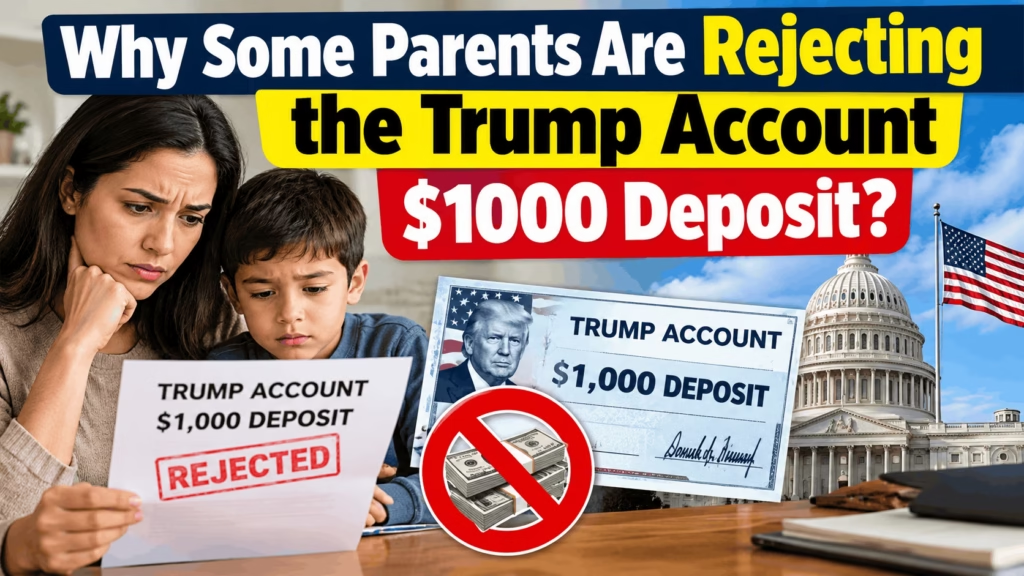
Trump Account $1000 Deposit Key Dates and Highlights
| Item | Latest detail |
|---|---|
| Program launch | July 4, 2026 |
| Federal seed deposit | $1,000, one time |
| Who qualifies for the $1,000 | U.S. citizen children with a valid Social Security number, born January 1, 2025 to December 31, 2028 |
| Automatic enrollment completed | October 1, 2026 |
| Accounts reported by the White House | About 70 million |
| Temporary IRS rules | T.D. 10056, dated September 30, 2026 (as summarized by tax-industry sources) |
| Claim deadline | None announced as of October 27, 2026 |
| Yearly contribution cap | $5,000 per child from family, friends and employers |
| Employer limit | $2,500 per year, counted inside the $5,000 cap |
| Dell family $250 gift | Children age 10 and under in ZIP codes with median income under $150,000; a child gets one gift or the other, not both |
| Earliest withdrawal | Age 18 |
| Official site | trumpaccounts.gov |
Why Some Parents Are Rejecting the Trump Account $1000 Deposit?
Politics is the loudest reason, but it is not the only one. Parents interviewed since the July 4 launch have described wariness about a government program carrying a sitting president’s name, a worry that the account could be changed later, and a general suspicion that anything labelled free money has a catch. The Alternet report quotes one mother who simply called the whole thing a con. Others raised a quieter concern, that an extra account adds paperwork and tax questions to a household that already has a 529 plan or a custodial brokerage account.
Financial advisers mostly split the issue in two. On the question of whether to put your own savings into the account, many say better vehicles exist, especially 529 plans, which offer more flexibility. On the question of whether to claim the free federal money, they lean the other way. Suze Orman wrote on August 27 that the $1,000 is free money no one should pass up, then advised most parents to stop adding their own cash until debt is cleared and retirement saving is on track.
Critics add a fairness argument. Some analysts say the program’s benefits tilt toward higher earners, because families with spare cash can use the full $5,000 yearly limit while others can only take the one-time deposit. Supporters answer that the $1,000 and the Dell gifts are aimed at children who would otherwise start with nothing invested, and that automatic enrollment widens access. Both claims can be true at once, which is part of why the debate has not settled.
The practical point for parents who object to the program: declining to claim the money does not remove the account. It only means the child’s account sits empty, or holds only whatever government or charity deposits it is allowed to receive.
Trump $1 Million Voter Fraud Reward: What We Know, Who Would Pay and Where to Report Real Problems
What Changed on October 1: Automatic Enrollment and Empty Accounts
Until this month, a parent had to sign a child up. About 7 million children were enrolled that way, and Treasury says roughly 73 million are eligible in total. On October 1, Treasury announced it had completed automatic enrollment of more than 60 million children under 18 who are U.S. citizens with a Social Security number. Tax-industry summaries tie this to temporary rules, T.D. 10056, issued September 30.
Here is the part many families miss. The account Treasury opens is not funded. The parent or guardian still has to claim it, verify their identity and ask for the $1,000. Until then, one tax-education site reports, the account can receive only government and charity contributions, which is why grandparents who want to give are being told to wait for a parent to claim it.
The jump is large against earlier numbers. On March 31, the IRS said taxpayers had signed up more than four million children, with more than one million covered by elections for the $1,000 pilot contribution. By late July, Treasury was citing 6.5 million sign-ups, of which 1.5 million were eligible for the seed money. Automatic enrollment turned a voluntary program into a near-universal one almost overnight, which is exactly why so many parents are only now learning their child has an account.
Is there a deadline? Two separate trackers, Omni Calculator and SwitchWize, found no claim deadline in official sources, and none had been announced when this article was updated. Treat that as current status, not a promise. A Korean business paper reported that fewer than 1 percent of family-opened accounts had been claimed, but that figure does not match the Treasury counts above and could not be confirmed, so it is not used in the analysis here.
How to Apply for the Trump Account $1,000 Deposit?
Here is the claim process as Treasury and the IRS describe it. Check the official site for any step that has changed.
- Visit trumpaccounts.gov or download the official Trump Account app for iOS or Android.
- Verify your identity as the parent or legal guardian. Have a government-issued ID, your own Social Security or taxpayer number, date of birth and address ready.
- Confirm your relationship to the child and enter the child’s legal name, birth date, address and Social Security number.
- Accept the account terms.
- If your child was born between January 1, 2025 and December 31, 2028, request the $1,000 pilot contribution. This is the election the IRS built Form 4547 around, and the app walks parents through it.
- Save your confirmation and watch for a status update in the app.
Form 4547 is titled Trump Account Election(s). It can be filed with a federal tax return, mailed to the IRS, or submitted electronically through an IRS Online Account, which also lets you track the election. Only an authorized individual can file it, generally a legal guardian or parent in that order of priority. The child must have a Social Security number issued before the election date and must not already have an election filed on their behalf. Do not attach Form 4547 to an amended return.
Trump Account $1,000 Processing Time: When Will the Money Arrive?
Treasury has said most parents see the deposit within one or two days of completing the claim. In July, some families who opened accounts for babies reported being told it could take up to four weeks, and several told reporters they were still waiting. Those accounts came from the first weeks after launch, and the wave of automatic enrollment may change timing, so treat the one-to-two-day figure as Treasury’s goal rather than a guarantee.
If your deposit has not appeared after about a month, work through this list:
- Confirm the account is claimed, not just opened.
- Confirm you requested the $1,000 pilot contribution.
- Check the child’s Social Security number and birth date for typos.
- Check your IRS Online Account for the election status.
- Use the support options on trumpaccounts.gov rather than a number from a search ad or a text message.
Trump Account Payment Schedule: One Federal Deposit, Many Possible Gifts
The government does not pay in installments. The $1,000 arrives once. Everything else depends on who else decides to contribute. Parents should also know that the money is never paid to them. It is deposited straight into the child’s account, so there is nothing to spend, nothing to report as income, and no check or direct deposit to wait for in a bank account. A family that sees no money in its own bank account after claiming has not been shortchanged, because that is how the program is built.
| Source | Amount | Timing |
|---|---|---|
| Federal pilot program | $1,000 | One time, after the account is claimed and the contribution requested |
| Michael and Susan Dell | $250 | Rolling deposits for children age 10 and under in qualifying ZIP codes; no firm date found |
| Employers | Up to $2,500 a year | Set by each employer |
| Family and friends | Up to $5,000 a year combined with employer money | Accepted since July 4 for claimed accounts |
| Corporate pledges | Varies | At least 16 companies, including Uber, SoFi and Visa, have pledged cash |
| Elon Musk | One SpaceX share per child | Musk said October 19 it would come next year; not confirmed by Treasury |
Money from the government and nonprofit donors does not count toward the $5,000 yearly cap. Employer contributions are not taxable income to the employee, but personal contributions are not tax deductible.
STIIIZY $2.95M Data Breach Settlement: Claims Closed, Final Approval Granted
Musk’s SpaceX Share and the New Stock Donation Rules
Treasury changed the rules in September to let donors give individual stocks, not just cash. Families cannot refuse a donated share, and the gift generally cannot be sold until five years pass or the calendar year the child turns 17 ends, whichever comes first. CNBC reported that Musk only appeared to suggest his SpaceX shares would flow through Trump Accounts, and his representatives had not confirmed it.
Critics worry about the incentives. The Wall Street Journal sketched a hypothetical in which a company seeking approval for a data center gifts its stock to local children. Treasury’s stock donation rules are described as temporary and open to public comment, so the final lockup terms could still change.
Trump Account Rules: Investments, Withdrawals and Taxes
Money in a Trump Account goes into a low-cost index fund managed by State Street, tracking a broad U.S. stock index. Nobody can withdraw until the child turns 18. After that the account follows individual retirement account rules, including a 10 percent penalty on most withdrawals before age 59 and a half, with exceptions for first-home purchases, higher education and some medical costs. At 18 the child owns the account, so parents lose control. A child can also start contributing once they earn income.
What Could the $1,000 Become? Trump Account Growth Calculator
The seed money is small, and growth depends heavily on what happens next. The figures below are our own illustrations, using monthly compounding over 18 years with no fees. They are not forecasts.
| Scenario | Total put in | At 5% a year | At 7% a year | At 9% a year |
|---|---|---|---|---|
| $1,000 deposit only | $1,000 | $2,400 | $3,400 | $4,700 |
| Plus $50 a month | $11,800 | $19,700 | $24,400 | $30,500 |
| Plus $100 a month | $22,600 | $36,900 | $45,500 | $56,300 |
| Plus $250 a month | $55,000 | $88,700 | $108,600 | $133,700 |
| Plus the $5,000 yearly maximum | $91,000 | $146,300 | $178,800 | $219,600 |
Other published projections run higher or lower depending on assumptions. The White House Council of Economic Advisers earlier estimated about $5,800 at 18 with no added money, which assumes stronger returns than our middle case. Use the Trump Account growth calculator on this page to test your own deposit, monthly contribution and return rate. Real results will differ, because markets move and fund fees reduce returns.
Trump Account vs 529 Plan: Which Comes First?
| Feature | Trump Account | 529 plan |
|---|---|---|
| Free federal money | $1,000 for eligible babies | None |
| Access | Locked until age 18 | Flexible for education costs |
| Control | Parent until 18, then the child | Parent stays the owner |
| Investments | Low-cost U.S. index fund | Plan menu |
| Best use | Long-term savings and retirement start | College and, in many states, K-12 tuition |
Mistakes That Can Delay the Trump Account $1,000
- Leaving the auto-created account unclaimed.
- Skipping the request for the pilot contribution.
- Entering a Social Security number that does not match the child’s record.
- Assuming a child born in 2024 or 2029 qualifies. The window is 2025 through 2028.
- Filing for a child who already has an election on file.
- Using a link from a text message or social media post instead of the official site.
Should Parents Reject the Trump Account $1,000?
That is a personal call, and this article is general information, not financial advice. The case for claiming is simple: the deposit is free, no strings are attached beyond the age 18 rule, and no one else can claim it for the child. The case against rests on distrust of the program, a preference for more flexible accounts, or a wish to keep the child’s savings separate from a political brand. Parents who decline should know that no deadline has been announced today, but Treasury could set one.
LIHEAP 2026-27 Application Dates by State: When Winter Heating Assistance Opens and How to Apply
Official Trump Account Links and Resources
| Resource | What it is for | Link |
|---|---|---|
| Trump Accounts official site | Login, registration, claim and status | https://trumpaccounts.gov |
| IRS Form 4547 | Account and pilot contribution election | https://www.irs.gov/Form4547 |
| Form 4547 instructions | Who can file and eligibility rules | https://www.irs.gov/pub/irs-pdf/i4547.pdf |
| IRS Online Account | File electronically and track status | https://www.irs.gov/payments/your-online-account |
| IRS newsroom | Official announcements | https://www.irs.gov/newsroom |
| U.S. Department of the Treasury | Program news | https://home.treasury.gov |
| Federal Register | Regulations text | https://www.federalregister.gov |
| Social Security Administration | Apply for a child’s Social Security number | https://www.ssa.gov/number-card |
Trump Account $1,000 FAQs
What is a Trump Account?
It is a tax-advantaged investment account for children under 18, created by the One Big Beautiful Bill Act. It works like an individual retirement account with special rules during childhood.
Who gets the $1,000 deposit?
U.S. citizen children with a valid Social Security number born from January 1, 2025 to December 31, 2028.
Do I have to claim the account to get the money?
Yes. Treasury says a parent or guardian must claim the account and request the contribution.
Is there a deadline to claim the Trump Account $1,000?
None has been announced as of October 27, 2026. That could change.
Can I opt out of a Trump Account?
Not for now. Setup is automatic, though you can decline to claim it.
How much can I contribute each year?
Family, friends and employers can give up to $5,000 per child combined, with employers limited to $2,500.
Can a child have a Trump Account and a 529 plan?
Yes. They are separate accounts, and many families hold both.
When can money be withdrawn?
Not until the child turns 18.
Is the Trump Account $1,000 real or a scam?
The program is real and was created by federal law. Scammers can still imitate it, so use only trumpaccounts.gov, the official app and irs.gov, and never pay anyone to claim the money.
Why are parents rejecting the Trump Account?
Reasons include distrust of the Trump name, a preference for 529 plans, tax worries and a lack of understanding of how the program works.
What happens if I do not claim my child’s Trump Account?
The account stays open, but the $1,000 is not deposited, and the account can reportedly receive only government and charity money.
Is a Trump Account better than a 529 plan?
They serve different goals. A 529 is more flexible for education, while the Trump Account offers the free deposit.
What happens to a Trump Account at 18?
The child takes ownership and the account follows individual retirement account rules.
Can grandparents contribute to a Trump Account?
Yes, once a parent has claimed the account, within the $5,000 yearly cap.
Will Elon Musk’s SpaceX share go into Trump Accounts?
Musk said children would get a share next year and appeared to suggest Trump Accounts, but that has not been confirmed.
Is a Trump Account worth it for a child born before 2025?
There is no $1,000 deposit, but the child may qualify for the Dell $250 gift or employer contributions.
Conclusion
The Trump Account $1,000 has become a test of how Americans feel about a government savings program wearing a political brand. The rules are plain enough: a one-time deposit for babies born in 2025 through 2028, a claim step that parents cannot skip, no opt-out for the account itself, and no announced deadline. Parents who object can still weigh the free money against their principles and their other savings plans. Check trumpaccounts.gov and the IRS for changes before acting, since several rules, including stock donation terms, are still temporary. Whatever a family decides, the important thing is to decide on purpose. An unclaimed account is not a neutral choice, because the $1,000 stays unspent for as long as nobody asks for it, and a child born in this window only gets one chance at the federal seed money.
Social Security Payment October 28: Who Gets Paid on Wednesday and What Comes Next