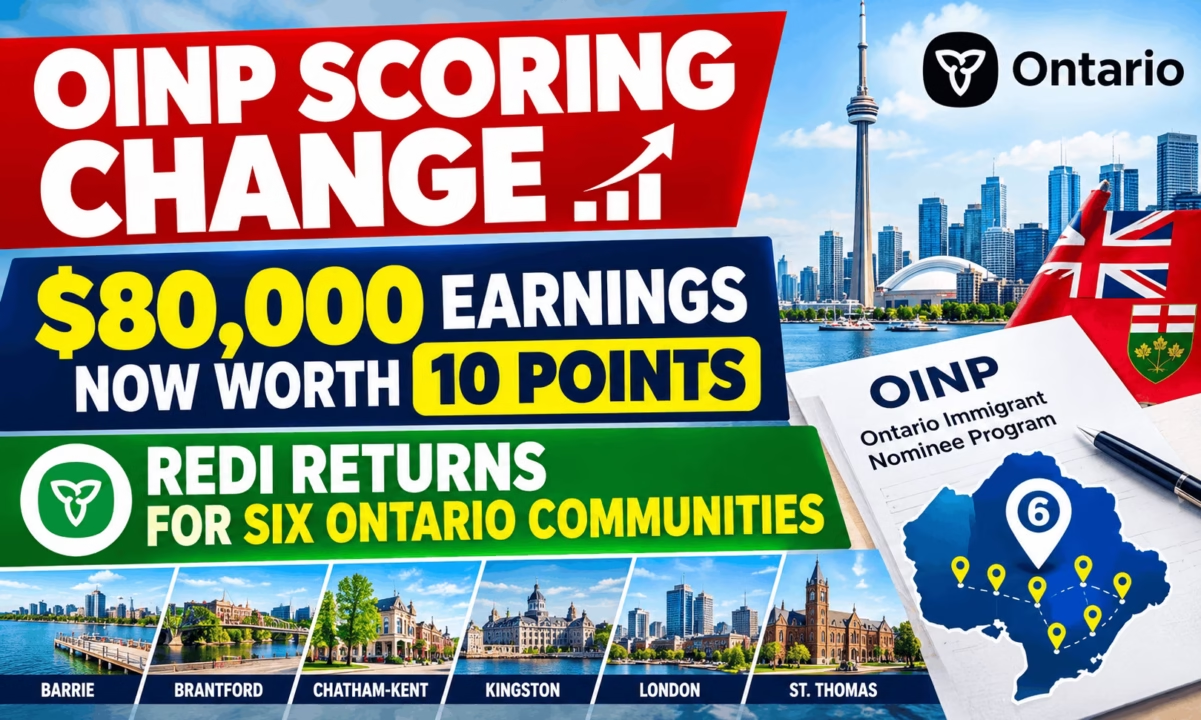
The OINP scoring change took effect on October 5, 2026, and it quietly raised the ceiling for Ontario’s highest earners. Under the Ontario Workforce Priority stream, anyone who earned at least $80,000 in a single year within the past five years now gets 10 points for earnings history, up from 8 points that the old top bracket of $70,000 or more was worth. Ontario applied the new points to existing profiles automatically, so nobody has to log in or resubmit. Eleven days later, on October 16, the province relaunched the Regional Economic Development through Immigration (REDI) initiative, reserving nomination spaces for six northern and rural communities through the end of 2027. Together, the two updates are the biggest changes to Ontario’s provincial nominee program since the June redesign wiped out eight older streams. We’ll be updating this article monthly as Ontario publishes its first invitation round and any new scoring tweaks.
Here is the catch that most headlines skip. Ontario has not published a draw for the Workforce Priority stream, a minimum score or an invitation schedule, so a higher number on your profile does not yet tell you where you stand. Trackers that monitor the Ontario Immigrant Nominee Program (OINP) page reported no invitation round as of early October, and Ontario gives no advance notice of draws. What the scoring change does is improve your odds if you are already in the pool and meet the earnings test. The REDI relaunch matters for a different group: foreign workers with jobs in Greater Sudbury, Kenora, Nipissing, Rainy River, Renfrew County or Thunder Bay, who can be considered without filing a separate application. This guide covers both updates, the full scoring grid, how to apply, deadlines, fees and what to watch next.
OINP Scoring Change and REDI Initiative Key Highlights
| Detail | Information |
|---|---|
| Scoring change effective | October 5, 2026 |
| Change announced | October 7, 2026 |
| Factor changed | Canadian work experience, earnings history |
| New top bracket | $80,000 or more in one year within the past five years earns 10 points |
| Previous top bracket | $70,000 or more earned 8 points |
| Proof required | One Canada Revenue Agency Notice of Assessment |
| Profile update needed | None. Existing profiles were updated automatically |
| REDI round relaunched | October 16, 2026, running to the end of 2027 |
| REDI communities | Greater Sudbury, Kenora District, Nipissing District, Rainy River District, Renfrew County, Thunder Bay |
| Separate REDI application | No. Applicants meet standard OINP rules |
| Main active pathway | Ontario Workforce Priority (OWP) stream, which opened to registrations on August 4, 2026 |
| 2026 provincial allocation | 14,119 nominations across the OINP, per a consultancy summary |
Timeline: How Ontario Got Here
| Date | What happened |
|---|---|
| 2020 | REDI starts as a pilot with three partner communities |
| 2025 | REDI expands with four new communities |
| April 30, 2026 | Last invitation round under the old Employer Job Offer streams: 1,063 invitations for GTA job offers |
| May 30, 2026 | Ontario revokes its previous permanent residence pathways |
| June 25 to 26, 2026 | Regulation change takes effect and the Workforce Priority stream launches |
| July 20, 2026 | Scoring factors are published |
| August 4, 2026 | Registration of expressions of interest opens |
| October 5, 2026 | Earnings history scoring changes |
| October 13 to 16, 2026 | New REDI partner communities posted and relaunch announced |
| End of 2027 | Current REDI round ends |
New Student Loan Rules USA 2026: Repayment Plans, Borrowing Limits & PSLF Changes Explained
OINP Scoring Change October 2026: What Exactly Changed
Ontario changed one factor, and only one. The earnings history factor sits inside the employment section of the Workforce Priority grid and looks at annual income shown on a Canada Revenue Agency (CRA) Notice of Assessment issued within the past five years. Candidates need just one qualifying year, not an average.
| Annual earnings in one qualifying year | Points |
|---|---|
| $80,000 or more | 10 |
| $70,000 to $79,999 | 8 |
| $50,000 to $69,999 | 6 |
| $30,000 to $49,999 | 4 |
| Under $30,000 | 0 |
The practical effect is a two point gain for people who earned $80,000 or more, since the old top tier paid 8. Nobody lost points. Candidates in the $70,000 to $79,999 band keep their 8, and every lower bracket is unchanged. CIC News reported the earlier tiers, and Envoy Global confirmed the effective date and the automatic profile update. Neither source says why Ontario made the change, and Ontario has not published its reasoning, so any explanation beyond the rule itself is guesswork.
Who Benefits From the New 10 Point Earnings Tier
The group that gains is narrow: foreign workers already in Canada who earned $80,000 or more in a recent year and have a Notice of Assessment to show for it. In practice, that tends to describe people in higher paid professional, management, health and skilled trade roles. A worker in a lower paid job would see no difference.
Two points can matter in a ranked pool, since candidates are ordered by score. But a note of caution applies. Cutoffs from the old streams, such as 57 for Foreign Worker and 81 for International Student in April, came from closed streams scored on a different grid, and they do not carry over. Until Ontario runs its first Workforce Priority round, nobody can say what a competitive score will be.
Full OINP Workforce Priority Scoring Grid
The grid below pulls together the factors Ontario publishes for the job offer pathways. Ontario does not state a maximum score. Adding the top band of each factor gives 132 points, according to one consultant’s tally, while several third party calculators still show 130. Treat any maximum as an estimate.
| Factor | Points |
|---|---|
| TEER level | TEER 0 or 1: 9. TEER 2 or 3: 6. TEER 4 or 5: 0 |
| Broad occupational category | Category 3: 10. Category 7: 8. Category 2: 6. Categories 0, 1, 4, 8, 9: 4. Categories 5 and 6: 2 |
| Hourly wage | $40 or more: 15. $35 to $39.99: 12. $30 to $34.99: 10. $25 to $29.99: 8. $20 to $24.99: 5. Under $20: 0 |
| Ontario experience in the offered role | Over 24 months: 18. 13 to 24 months: 15. 6 to 12 months: 12. Under 6 months: 0 |
| Other Ontario experience, if under 6 months in the role | 24 months or more: 12. 13 to 24 months: 9. 6 to 12 months: 6 |
| Earnings history | $80,000 or more: 10. $70,000 to $79,999: 8. $50,000 to $69,999: 6. $30,000 to $49,999: 4. Under $30,000: 0 |
| Legal status | Work permit: 10. Study permit: 5. Neither: 0 |
| Highest education | Doctorate or professional degree: 10. Master’s: 8. Bachelor’s: 6. College, apprenticeship or trade: 5. Below that: 0 |
| Canadian credentials | More than one: 10. One: 5. None: 0 |
| Language ability (lowest CLB score) | CLB 9 or higher: 15. CLB 8: 12. CLB 7: 8. CLB 6: 4. CLB 5 or lower: 0 |
| Knowledge of both official languages | Both at CLB 6 or higher: 10. One: 5 |
| Job location | Northern Ontario: 15. Eastern, Central outside the GTA, Southwestern: 10. GTA outside Toronto: 5. Toronto: 0 |
Two features stand out. Regionalization pays up to 15 points for northern jobs and nothing for Toronto, which pushes the system toward smaller communities. And field of study and location of study are no longer scored, a quiet change from the old international student streams.
Quebec PEQ Deadline: Applications Close October 31, Who Can Still Apply and How to File in Arrima
Full Social Security at 60: Who Qualifies Under the New Blue Collar Bill
REDI Initiative Ontario 2026 to 2027: Six Communities, No Separate Application
REDI is a partnership between the OINP and participating communities that need workers the local labour market cannot supply. Each community receives a quota of nomination spaces reserved for workers who qualify under OINP rules. Ontario’s page says there is no separate application for the initiative. Eligible foreign workers apply through the normal OINP route, and the communities are the ones that benefit from reserved spaces.
The program began as a three community pilot in 2020 and added four communities in 2025. Ontario says it has supported nearly 1,000 nominations to date, mostly in health care and skilled trades. The relaunch runs until December 31, 2027 and covers these six partners.
| Community | Federal pilots also active there |
|---|---|
| Greater Sudbury | Rural Community Immigration Pilot, Francophone Community Immigration Pilot, Francophone Minority Communities Student Pilot |
| Nipissing District | Rural Community Immigration Pilot, Francophone Minority Communities Student Pilot |
| Thunder Bay | Rural Community Immigration Pilot |
| Kenora District | None |
| Rainy River District | None |
| Renfrew County | None |
Ontario chose the partners in spring 2026 after inviting communities outside the Greater Toronto Area to express interest. It weighed geographic diversity, labour challenges including health care, community capacity, readiness to support newcomers and stakeholder backing. Only Thunder Bay carried over from the previous round, which also included Lanark, Leeds and Grenville, and Sarnia-Lambton.
REDI vs Workforce Priority: How Nominations Actually Work Now
This is where applicants get confused. REDI does not replace the Workforce Priority stream. At the moment, the Workforce Priority stream is the main provincial route open to foreign workers, because Ontario closed the old Employer Job Offer streams in May. REDI previously ran through those closed streams, and no invitation round has yet been held under the new one, so how reserved spaces will be used in practice is not yet visible.
The OINP has not published the quotas, and its REDI page does not describe eligibility, application steps or employer requirements. It also does not explain how REDI links to the Workforce Priority stream. Anyone planning around REDI should contact the OINP before assuming a faster or easier path. The last REDI round before the redesign was April 8, when Ontario issued 32 invitations to candidates with job offers in Lanark or Leeds and Grenville, with minimum scores of 46 for Foreign Worker, 57 for International Student and 33 for In-Demand Skills.
How to Apply for the OINP Workforce Priority Stream
The job offer route works in steps, and employers go first.
- The employer registers with the OINP and submits the job offer in the Employer Portal, then receives a job offer ID.
- The worker registers an expression of interest in Ontario’s e-Filing Portal within 30 calendar days of the employer’s submission.
- Ontario scores the profile on the grid above. Profiles sit in the pool, and Ontario has not published how often it will draw.
- If invited, the employer has 14 calendar days to submit its approval application.
- The worker then has 17 calendar days from the invitation to submit the application and pay, but only after the employer has filed.
- Ontario assesses the application and, if approved, issues a nomination.
- The worker applies to Immigration, Refugees and Citizenship Canada (IRCC) for permanent residence.
Self employed physicians follow a shorter path with no job offer, but they need an OHIP billing number and a qualifying College of Physicians and Surgeons of Ontario certificate.
Employers must meet their own tests. They need an active business for at least three years, premises in Ontario, no outstanding orders under the Employment Standards Act or the Occupational Health and Safety Act, and minimum revenue and full time employee levels based on job location. The job must be full time, permanent, urgently needed and meet the required wage.
OINP Processing Time and Key Deadlines
Ontario’s Workforce Priority page does not state a processing time for decisions, so applicants should not rely on figures from third party sites. What the province does publish is a set of strict clocks.
| Step | Deadline |
|---|---|
| Register expression of interest after employer files | 30 calendar days |
| Employer submits after invitation | 14 calendar days |
| Applicant submits and pays after invitation | 17 calendar days, concurrent with the employer’s window |
| Accept or decline an Express Entry linked nomination | 30 calendar days |
| Apply to IRCC after accepting | 60 calendar days |
| Apply to IRCC after a non Express Entry nomination | Within 6 months |
| Time in the pool | Up to 12 months, per one consultancy |
Missing the 17 day window can end the process, according to one consultancy summary, so applicants should assemble documents before any invitation arrives. Accepting an Express Entry linked nomination adds 600 Comprehensive Ranking System points.
OINP Fees and Payment Schedule
Registering an expression of interest costs nothing. The application fee after an invitation is where money changes hands. Ontario’s page confirms that an application fee exists and says it is refunded if the application is returned as incomplete, but it does not list the amount. One consultancy reports $1,500 or $2,000 depending on the file and says the fee is not refundable once processing starts. Confirm the current figure on Ontario.ca before paying.
The payment schedule is short. Nothing is due at registration. The fee is due with the application, and it must be submitted within 17 calendar days of an invitation. IRCC fees for permanent residence come later and are set by the federal government, not by Ontario.
What to Do Now If You Are in the OINP Pool
Start with your Notice of Assessment. If you earned $80,000 or more in a single year in the past five years, check that the figure on your CRA record matches what your profile shows. Ontario updated profiles automatically, so no resubmission is needed, but accuracy still matters when you apply.
Next, check your job location. A northern or eastern location can add up to 15 points, and the REDI communities all fall in regions that score well. Then gather the documents you will need in a hurry, since the post invitation window is only 17 days. Employers should confirm their registration and revenue thresholds now rather than after an invitation lands.
2027 COLA: How Much Will Your Social Security Check Increase?
What Happens Next: Draws, Phase Two and Unknowns
Three things are unresolved. Ontario has not published a first Workforce Priority invitation round or a minimum score. It has not published REDI quotas or explained how they connect to the new stream. And the second phase of the redesign has no date, although Ontario has said it plans a Priority Healthcare stream, an Entrepreneur stream and an Exceptional Talent stream.
Until then, the OINP page is the source to watch. Ontario posts rounds there, and it does not give notice. Treat third party draw trackers as signals, not as confirmation.
OINP Score and Scoring Change Calculator
Use the free tool below to estimate your Workforce Priority score under the grid above and see how many points the October 5 earnings change added. It is a planning aid built on published factors, and Ontario sets the real score.
OINP Workforce Priority Score Estimator
Job offer pathway, using the published factors and the October 5, 2026 earnings change.
Based on the factors published on Ontario.ca and in consultant summaries. Ontario publishes no maximum score, and the top-band total is about 132 by one tally. Ontario had not held a Workforce Priority draw as of early October 2026, so no minimum score exists yet. Wage and other points apply to job offer pathways and do not apply to self-employed physicians. This tool is for planning only and is not an official score.
Official OINP and REDI Links
| Resource | What you can do there | Link |
|---|---|---|
| OINP updates page | Read the latest notices, scoring changes and invitation rounds | https://www.ontario.ca/page/2026-ontario-immigrant-nominee-program-updates |
| Ontario Workforce Priority stream | Check eligibility, steps and scoring factors | https://www.ontario.ca/page/ontario-workforce-priority-stream |
| REDI initiative page | See the six partner communities | https://www.ontario.ca/page/regional-economic-development-through-immigration-redi-initiative |
| OINP e-Filing Portal | Register an expression of interest, log in, submit an application and check status | https://www.ontarioimmigration.gov.on.ca/oinp_index/resources/app/guest/index.html |
| OINP application process | Read the general application steps | https://www.ontario.ca/page/ontario-immigrant-nominee-program-oinp-application-process |
| Applicant document checklist | Prepare documents before an invitation | https://www.ontario.ca/document/oinp-document-checklists/ontario-workforce-priority-stream-applicant-checklist |
| Employer guide | Check employer requirements | https://www.ontario.ca/page/oinp-employer-job-offer-streams-employer-guide |
| OINP contact line | General questions, Monday to Friday, 9 a.m. to 5 p.m. | 416-327-0374 or 1-866-214-6820 |
| REDI employer inquiries | Ask about REDI support | immigration.ontario@ontario.ca |
OINP Scoring Change and REDI FAQs
What is the OINP scoring change in October 2026?
Ontario added a new top tier to the earnings history factor on October 5, 2026. Candidates who earned $80,000 or more in one year within the past five years now get 10 points, up from 8 points for the old $70,000 or more tier.
Do I need to update my OINP profile after the scoring change?
No. Ontario applied the new points automatically to existing expressions of interest. You do not need to log in or resubmit, though you should check that your Notice of Assessment is accurate.
How do I prove my earnings for OINP points?
You provide a Canada Revenue Agency Notice of Assessment showing annual income for a qualifying year within the past five years. One qualifying year is enough, and you do not need to average several years.
What is the REDI initiative in Ontario?
REDI stands for Regional Economic Development through Immigration. It reserves OINP nomination spaces for partner communities that need workers, and it has supported nearly 1,000 nominations since 2020, mostly in health care and skilled trades.
Which communities are in the 2026 to 2027 REDI round?
Greater Sudbury, Kenora District, Nipissing District, Rainy River District, Renfrew County and Thunder Bay. The round launched on October 16, 2026 and runs until the end of 2027.
Do I apply separately for REDI?
No. Ontario says there is no separate application. You apply through the OINP and must meet its standard eligibility requirements. Contact the OINP for details on how reserved spaces work.
Has Ontario held a Workforce Priority draw yet?
Trackers reported no draw as of early October, and Ontario has not published a minimum score or schedule. Check the OINP updates page for any invitation round before acting.
What is the maximum score in the OINP Workforce Priority stream?
Ontario does not publish a maximum. Adding the top band of each factor gives 132 points, though some calculators show 130. Treat the figure as an estimate.
How much does the OINP application cost?
Ontario does not list the fee on its Workforce Priority page. One consultancy reports $1,500 or $2,000. Registering an expression of interest is free, and the application fee is due within 17 days of an invitation.
Is the OINP still open in 2026?
Yes, but through a redesigned route. Ontario closed eight older streams and now runs the Ontario Workforce Priority stream. Registration opened on August 4, 2026.
How many points do I need for the OINP?
There is no published minimum score. Ontario has not run a Workforce Priority draw, and older cutoffs came from closed streams on a different grid. Higher scores improve your odds, but no number is guaranteed.
Can I get OINP nomination without a job offer?
Only in limited cases. Self employed physicians do not need a job offer. Other applicants need a full time, permanent job offer from an employer registered with the OINP.
How does an OINP nomination lead to permanent residence?
After nomination, you apply to IRCC. If you used an Express Entry linked route, you have 30 days to accept and 60 days to apply, and you gain 600 points. Otherwise, you apply within six months.
Does Toronto get points in the OINP grid?
No. Toronto earns 0 regional points, while Northern Ontario earns 15 and other non GTA regions earn 10. The GTA outside Toronto earns 5.
Is REDI faster than the regular OINP?
Ontario has not said so. It reserves nomination spaces for certain communities, but it has not published quotas or processing times, so assume the normal process applies.
Conclusion
The OINP scoring change is real, but its value depends on a draw Ontario has not yet announced. If you earned $80,000 or more in a qualifying year, your score is already two points higher, and that came without any action on your part. The REDI relaunch is more of a signal than a shortcut: Ontario wants workers in six northern and rural communities, and it has reserved spaces to make that happen through 2027.
The smart move now is preparation. Check your Notice of Assessment, confirm your job location and score on the official grid, and keep your documents ready for a 17 day window. Rely on Ontario.ca for any draw, fee or processing update, and treat consultant blogs as context rather than confirmation. This article will be updated as Ontario publishes new information.
Canada 2026 Federal Income Tax Brackets: Full Rates, Changes & How Much You’ll Pay This Year