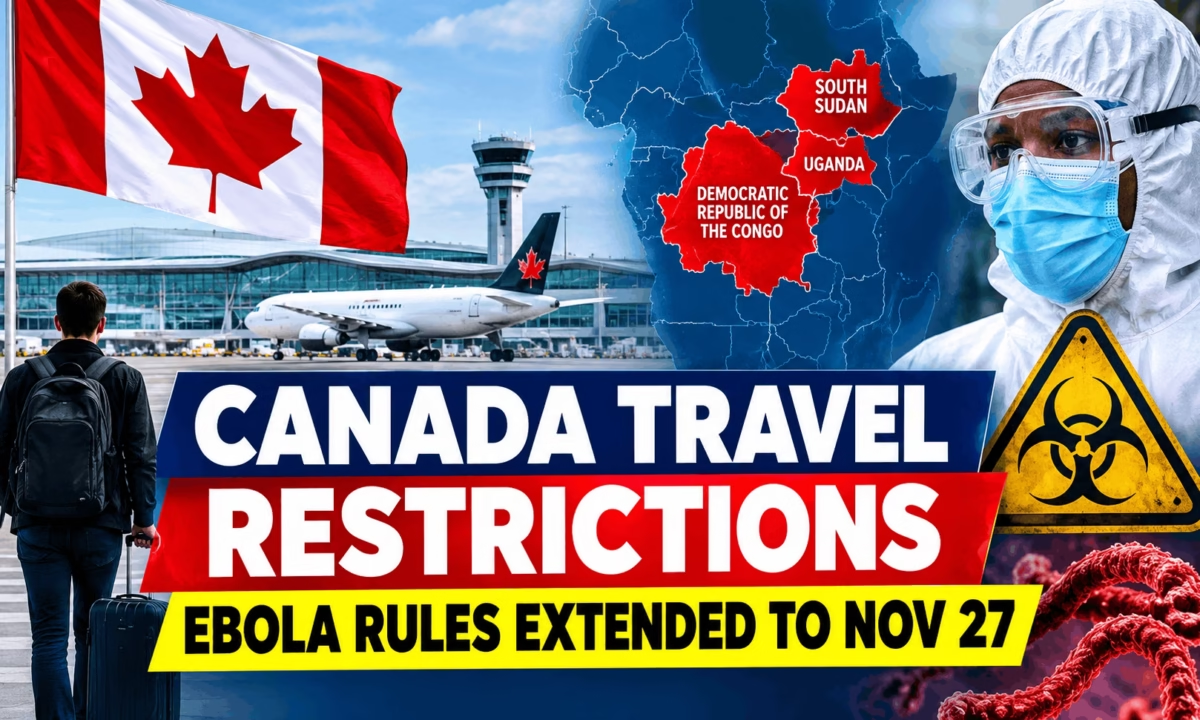
Canada Ebola travel restrictions now run until November 27, 2026, after Ottawa renewed its temporary border and immigration measures for another 60 days on September 28. The rules stay in place at 11:59 p.m. Eastern time on that date unless the government repeals or extends them again. For anyone whose last country of residence was the Democratic Republic of the Congo (DRC), Uganda or South Sudan, the practical effect is blunt: visas, electronic travel authorizations (eTAs) and permanent resident visas stay suspended, and no application will be finalized while the order lasts. Foreign nationals who were in the DRC in the past 21 days still cannot board a flight to Canada. Visitors who were in Uganda or South Sudan face a 21 day quarantine on arrival. Canadian citizens and permanent residents can come home but must quarantine too. We’ll be updating this article monthly as Ottawa announces any decision for late November.
The outbreak behind the order is still growing. DRC government data released on October 27 showed 10,060 confirmed cases and 4,887 deaths, making this the fastest growing and deadliest Ebola outbreak in the country’s history. The World Health Organization (WHO) reported cases in five countries as of its October 23 update, and it started the first clinical vaccine trial in the DRC on October 23. Canada’s own figures show the scale of disruption at home: 24,945 immigration documents were suspended as of September 15, and 33,795 applications were affected. This guide explains who is covered, how the quarantine works, how to ask for an exemption, what processing and payment look like, and what to expect after November 27.
Canada Ebola Travel Restrictions 2026 Key Highlights
The table below gives the essentials from the Government of Canada pages. Dates and rules come from Immigration, Refugees and Citizenship Canada (IRCC) and the Public Health Agency of Canada (PHAC).
| Detail | Information |
|---|---|
| Current end date | November 27, 2026, at 11:59 p.m. Eastern time |
| Original start | May 27, 2026 |
| Latest extension | 60 days, announced September 28, 2026 |
| Countries covered | DRC, Uganda and South Sudan |
| Test for immigration suspension | Last country of residence on the application, not citizenship |
| Documents suspended | Temporary resident visas, eTAs, temporary resident permit counterfoils, permanent resident visas |
| DRC flight rule | Foreign nationals in the DRC in the past 21 days cannot board a flight to Canada (since July 20, 2026) |
| Quarantine | 21 days for most arriving travellers from the three countries |
| Status inside Canada | Not affected. People can stay for their authorized period |
| After the end date | Documents reactivate automatically, no action needed |
| Penalty for breaking quarantine | Fine up to $1,000,000, up to 3 years in prison, or both |
Quebec PEQ Deadline: Applications Close October 31, Who Can Still Apply and How to File in Arrima
Timeline: How Canada Got to the November 27 Deadline
| Date | Development |
|---|---|
| May 15, 2026 | The outbreak is declared |
| May 27, 2026 | Canada suspends immigration documents for residents of the affected countries |
| July 20, 2026 | New border measures bar foreign nationals who were recently in the DRC from boarding flights |
| August 27, 2026 | WHO recognizes the end of Uganda’s outbreak |
| September 28, 2026 | Canada extends the measures by 60 days |
| October 10, 2026 | Canada Gazette publishes document suspension figures |
| October 23, 2026 | WHO starts the first vaccine trial in the DRC and publishes its latest outbreak update |
| November 27, 2026 | Measures expire unless extended |
Ebola Outbreak Update: Why Canada Extended the Measures
Canada says it extended the order because the DRC outbreak is still active. The latest numbers explain the caution. WHO’s October 23 report counted 9,704 confirmed cases and 4,687 deaths in the DRC as of October 20, across 66 health zones in eight provinces, with 2,595 recoveries. Government data a week later pushed the totals to 10,060 cases and 4,887 deaths. The virus is Bundibugyo, and there is no approved vaccine or treatment for it.
Two details stand out. About 80 percent of new cases are coming from outside monitored chains of transmission, while Africa CDC says at least 95 percent should come from known contacts before an outbreak can be called under control. And the geographic footprint is wider than a year ago. WHO lists the DRC, Uganda, France, Kenya and Nigeria among countries that have reported cases since mid May. Kenya has reported nine cases, including one death, linked mostly to a single imported case, and Nigeria reported an imported case on October 20.
There is a tension worth stating plainly. WHO advises against restricting travel to or trade with affected countries, and says the global risk is low. Canada has chosen a stricter path. Officials have not published a different risk assessment, but the immigration minister can amend, repeal or extend the order, which is why every renewal depends on how the DRC numbers move.
Which Countries and Travellers Does the Canada Ebola Order Cover?
The immigration suspension is based on where you lived when you applied, not on your passport. IRCC says the measures apply to foreign nationals who listed the DRC, South Sudan or Uganda as their last country of residence. A citizen of another country who lived in Uganda when applying is covered. A Ugandan citizen who lived outside the three countries when applying is not.
Documents that are suspended cannot be used to travel or board a plane, even if they were approved before May 27. The suspension does not extend a document’s expiry date. If a visa expires during the freeze, the holder will need a new application to travel later.
Separate from the immigration documents, PHAC’s border measures apply to anyone who visited or lived in the three countries. There is no exemption for transiting or refuelling, according to PHAC.
Canada Ebola Travel Rules by Traveller Type
| Traveller | What the rules say |
|---|---|
| Foreign national who lives in the DRC, Uganda or South Sudan | Cannot travel to Canada during the suspension, even with a valid visa, permanent resident visa or eTA |
| Foreign national who was in the DRC in the past 21 days | Barred from entering Canada, boarding a flight to Canada or transiting, unless exempt |
| Foreign national who was in Uganda or South Sudan in the past 21 days | May travel with valid documents, but must quarantine for 21 days on arrival unless exempt |
| Canadian citizen, permanent resident or Indian Act registrant who was in any of the three countries | May enter, must complete medical screening and quarantine for 21 days unless exempt |
| Person already in Canada | Not affected. Can stay for their authorized period |
Flight Boarding Rules and the DRC 21 Day Ban
Since July 20, airlines have been told not to carry foreign nationals who spent time in the DRC in the 21 days before travel. Travellers who qualify for an exemption that requires a letter must show the letter to the airline and again at the border. PHAC accepts exemption letter requests by email before departure at ebola.bordermeasures-ebola.mesuresfrontalieres@phac-aspc.gc.ca.
Some groups do not need a letter. PHAC lists crew members, Indian Act registrants, holders of certain diplomatic or official passports, certain embassy and international organization staff, attendees at international meetings with diplomatic privileges, and visiting force members. Others may qualify with a letter, including people entering to provide medical care, carry essential medical supplies, repair medically necessary equipment, or whose entry serves the national interest without creating a public health risk.
21 Day Quarantine in Canada: What Arriving Travellers Must Do
Quarantine is the part that catches travellers off guard. People who must quarantine need a suitable place to stay for 21 days from the day they enter. They cannot have direct contact with others and must have access to necessities and local health care. Higher risk travellers, such as health care or humanitarian workers, must quarantine within three hours or 250 kilometres by ground of a provincial test and hold centre.
Canadian citizens, permanent residents and Indian Act registrants who lack a safe place are given one. Foreign nationals must arrange their own, and may be denied entry if they cannot fund the 21 days.
Travellers who arrive without symptoms must report their arrival within 48 hours, check their temperature twice a day, keep a daily health record and receive no visitors. They get a kit with a digital thermometer and instructions. Anyone with symptoms receives an immediate medical exam and isolation care. People in quarantine can qualify for employment insurance (EI) sickness benefits and can request a medical certificate by email using the arrival kit instructions. Breaking the rules is an offence under the Quarantine Act, with fines up to $1,000,000, up to three years in prison, or both.
Full Social Security at 60: Who Qualifies Under the New Blue Collar Bill
How Many Canadian Immigration Documents Are Suspended Over Ebola?
| Category | Count |
|---|---|
| Documents suspended | 24,945 |
| Visitors | 20,035 |
| Students | 2,975 |
| Workers | 405 |
| Permanent residents | 1,530 |
| Applications affected | 33,795 |
| Permanent residence applications affected | 21,295 |
| Temporary residence applications affected | 12,500 |
The largest group inside the permanent residence figure is protected persons at 18,890, with Uganda accounting for 17,865 of them. By country of residence, 22,660 affected applications list Uganda, 10,620 list the DRC and 510 list South Sudan. The rounded figures do not add up perfectly in some tables, so treat them as close estimates rather than exact counts.
How to Apply for an Ebola Exemption to Canada’s Travel Restrictions?
Exemptions are reviewed case by case. IRCC asks requesters to explain why they should be exempt, provide evidence and show they are not a public health risk. Officials weigh the health risk if the person is exempted, steps taken to lower it, urgent protection needs for Convention refugees or country of asylum class members, and other humanitarian or compassionate grounds.
- Open the IRCC crisis web form and choose the option for help with something else.
- Explain the exemption you are asking for and why it applies to you.
- Attach evidence. IRCC lists proof of being outside the affected countries for at least 21 days before May 27, 2026, such as boarding passes, rental agreements or pay stubs.
- Add proof of self isolation or quarantine if relevant, and a note from a medical professional.
- For border exemptions that need a letter, email PHAC before departure at the address above and carry the letter on your trip.
Do not send passports to a visa application centre while the measures are in force. Centres cannot process these submissions and will not hold passports. Passports sent anyway will be returned and the applicant may have to pay additional fees.
Processing Time for Affected Applications
IRCC says it will keep accepting and working on new and existing applications from affected people, but it will not finalize any of them while the measures are in place. Practically, that means no decision before November 27, and no firm date after it. If the order lapses, files can move forward. If it is extended again, the wait continues.
Applicants should keep their contact details current. IRCC notifies affected people by email, and the crisis web form is how to update an address. Anyone with a document that will expire during the freeze should plan for a new application, since the suspension does not stretch expiry dates.
Fees and Payment Schedule: What Costs Money Under the Ebola Order
The official pages do not describe any fee for an exemption request, and they do not mention refunds for suspended applications. Applicants should therefore assume that fees already paid stay with the application and are not returned unless IRCC says otherwise. The one cost IRCC flags directly is the extra fee a person may face if a passport is sent to a visa application centre while the measures apply.
Travellers should also budget for quarantine. Foreign nationals arranging their own place must cover 21 days of accommodation and food. Canadian citizens and permanent residents who lack a safe place are provided one. EI sickness benefits may be available to eligible workers in quarantine, and the benefit rules are set by Service Canada, not by the Ebola order.
What Happens After November 27, 2026?
If nothing changes, the measures end at 11:59 p.m. Eastern time on November 27, and suspended documents reactivate on their own. IRCC says no action is needed from document holders. Anyone in India converting the time should note that the cutoff falls at about 10:29 a.m. on Saturday, November 28 in India.
The government has not said whether it will renew the order. Immigration Minister Lena Metlege Diab can grant exemptions and can amend, repeal or extend the order. Past behaviour matters: Canada has renewed once at the end of August and again on September 28. Because the DRC outbreak is still above 10,000 confirmed cases, another extension is plausible, though not announced. Travellers with trips planned for late November or December should keep refundable bookings and check the official pages weekly.
Ebola Travel Restrictions Eligibility and Quarantine Calculator
Use the free tool below to see which rules are likely to apply to your trip, work out the last day of a 21 day quarantine, and count down the days to the November 27 deadline. It is a planning aid built on the published rules, not legal advice, and officials decide each case on arrival.
Canada Ebola Travel Rules Checker
Based on the IRCC and PHAC measures in force until November 27, 2026.
This tool simplifies the published rules for planning only. Exemptions exist for crew, diplomats, medical care and other cases, and border officers decide on arrival. Check the IRCC and Public Health Agency of Canada pages before you travel. It is not legal or medical advice.
Official Canada Ebola Resources
| Resource | What you can do there | Link |
|---|---|---|
| IRCC Ebola temporary measures | Check suspension rules, exemptions and processing notes | https://www.canada.ca/en/immigration-refugees-citizenship/services/special-measures/ebola-2026.html |
| IRCC crisis web form | Ask questions, request an exemption, update your email address | https://secure.cic.gc.ca/ClientContact/en/Crisis |
| PHAC border measures | Read entry, flight and quarantine rules | https://www.canada.ca/en/public-health/services/diseases/ebola/border-measures.html |
| PHAC travel health advice | Read symptom and prevention guidance | https://www.canada.ca/en/public-health/services/diseases/ebola/travel-health-advice.html |
| Government of Canada travel advisories | Check country advisories before you go | https://travel.gc.ca/travelling/advisories |
| Employment insurance | Check sickness benefit rules for quarantine | https://www.canada.ca/en/services/benefits/ei.html |
| WHO Disease Outbreak News | Read the latest case counts | https://www.who.int/emergencies/disease-outbreak-news/item/2026-DON622 |
| PHAC information line | Ask about border measures, Monday to Friday, 8 a.m. to 8 p.m. Eastern | 1-844-280-5020 |
Practical Advice for Travellers, Students and Employers
Travellers should check where they have been in the past 21 days before booking, since that window can trigger a flight ban or quarantine regardless of citizenship. Keep proof of your travel history, such as boarding passes, because exemption requests depend on evidence.
Students and workers who hold approved documents but live in an affected country should assume they cannot travel until the order ends. Employers and universities can help by flagging affected hires early, considering deferred start dates and avoiding commitments that depend on a November arrival.
Anyone already in Canada is not affected by the immigration suspension and can remain for their authorized period. If your own permit is about to expire, apply for an extension through IRCC in the normal way.
Canada Ebola Travel Restrictions FAQs
How long are Canada’s Ebola travel restrictions extended?
They are extended by 60 days and now run until November 27, 2026, at 11:59 p.m. Eastern time. The government announced the extension on September 28. It has not said whether it will renew them again after that date.
Which countries are covered by Canada’s Ebola measures?
The measures cover the Democratic Republic of the Congo, Uganda and South Sudan. The immigration suspension applies to people whose last country of residence on an application was one of the three, while border rules apply to anyone who visited or lived there.
Can I travel to Canada with a valid visa if I live in Uganda?
No. IRCC suspended temporary resident visas, eTAs, permit counterfoils and permanent resident visas for residents of the three countries. A suspended document cannot be used to board a plane, even if it was approved before the order began.
Do I have to quarantine for 21 days when I arrive in Canada?
Most travellers who were in the DRC, Uganda or South Sudan in the past 21 days must quarantine for 21 days unless they qualify for an exemption. That includes returning Canadian citizens and permanent residents. Foreign nationals who were in the DRC cannot board a flight at all unless exempt.
Will my Canadian visa application be refused because of Ebola?
Not automatically. IRCC says it will keep processing applications from affected people, but it will not finalize them while the measures are in place. That means a decision cannot come before the order ends or is repealed.
How do I request an exemption from the Ebola travel restrictions?
Use the IRCC crisis web form, explain your situation and attach evidence. For border exemptions that need a letter, email PHAC before departure. Requests are reviewed case by case, and officials look at public health risk and humanitarian grounds.
Are Canadian citizens affected by the Ebola border measures?
Citizens can return to Canada, but if they were in the DRC, Uganda or South Sudan in the past 21 days they must complete medical screening and quarantine for 21 days unless they qualify for an exemption.
Will the Ebola measures be extended again after November 27?
Unknown. The immigration minister can extend, amend or repeal the order. The DRC outbreak is still growing, with 10,060 confirmed cases as of October 27, so another extension is possible. Check the IRCC and PHAC pages before travelling.
What happens to my suspended visa when the order ends?
IRCC says suspended documents reactivate automatically once the measures end or are repealed, and holders do not need to do anything. The suspension does not extend expiry dates, so a document that expires in the meantime will need replacing.
Is Canada banning travel from Ebola countries?
Canada has not imposed a blanket ban on every traveller, but it has suspended immigration documents for residents of the DRC, Uganda and South Sudan and barred foreign nationals who were recently in the DRC from boarding flights to Canada.
Why did Canada extend the Ebola restrictions?
The government extended the measures because the DRC outbreak is still active, with 10,060 confirmed cases and 4,887 deaths as of October 27. The order is meant to lower the chance of imported cases while the outbreak continues.
Does WHO recommend travel bans for Ebola?
No. WHO advises against restricting travel to or trade with affected countries and rates the global risk as low. Canada’s measures are a national decision, and they are reviewed each time the order comes up for renewal.
What is the penalty for breaking Ebola quarantine in Canada?
Non compliance is an offence under the Quarantine Act, with fines up to $1,000,000, imprisonment up to three years, or both.
Can I fly through Canada if I am transiting from an affected country?
Transit exemptions are narrow. PHAC says there are no exemptions for transiting through the three countries or for refuelling. Travellers who stay in the designated international departures area and are not cleared by a border services officer may be exempt from assessment and quarantine.
How do I check the status of my immigration application during the Ebola order?
Sign in to your IRCC account to see the status, and use the crisis web form for questions. IRCC will keep processing your file but will not finalize it until the measures end.
Conclusion
Canada Ebola travel restrictions are in place until November 27, and the outbreak numbers suggest the government will watch the DRC closely before deciding what comes next. The practical points are simple. Check your last country of residence and the past 21 days of travel before booking, keep documents and proof of travel history, avoid sending passports to visa application centres, and use the official forms for exemption requests.
Applicants with suspended documents do not need to do anything when the order ends, but they should not plan trips that depend on a specific reopening date. Follow IRCC and PHAC rather than social media for any change. This article will be updated as new decisions are announced.
Government Shutdown 2026 Update: Stopgap Bill Signed Into Law, Federal Funding Runs to December 11