Updated November 18, 2026
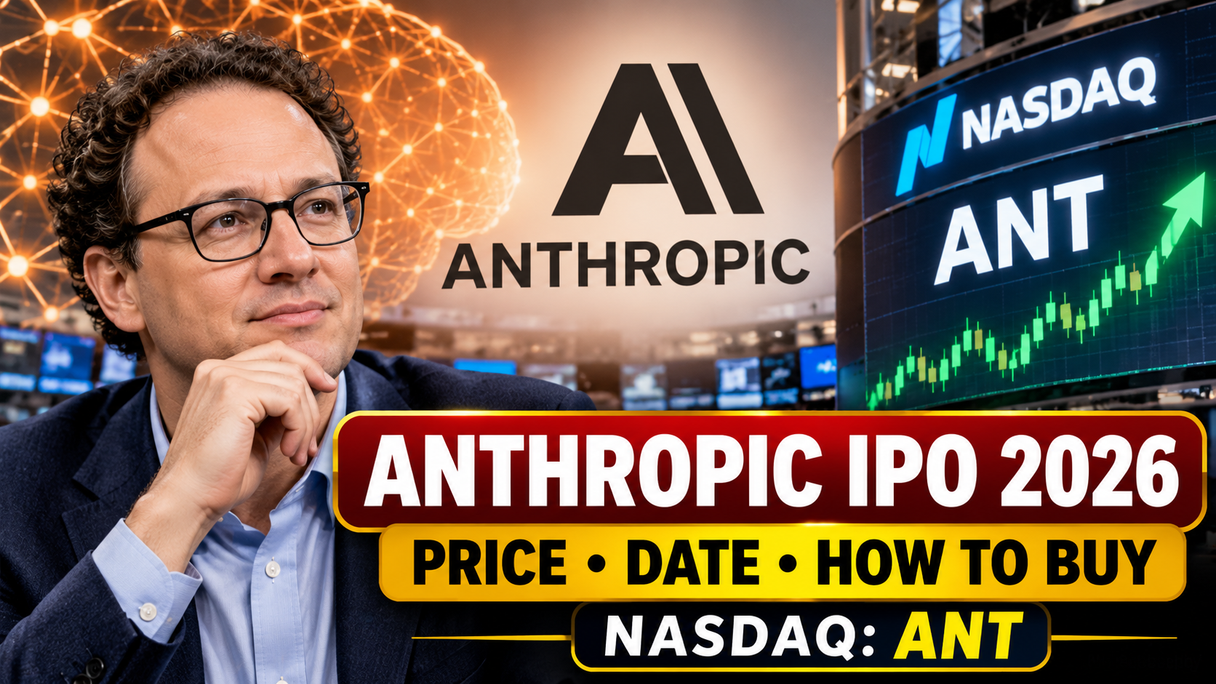
Anthropic IPO 2026: If you’ve been following the markets this month, you already know the story: Anthropic, the company behind Claude, is about to become a public company. The deal is expected to price tonight, Wednesday, November 18, and shares should start trading on the Nasdaq on Thursday, November 19, under the ticker ANT.
This is a big one. Depending on how you count, it could be the largest IPO in history, ahead of SpaceX’s record debut in June. It’s also being treated as a test of whether Wall Street still has an appetite for the AI boom, after a bumpy few weeks for tech stocks.
In this article, we have include all the details as of today such as: the dates, the price range, how many shares are on offer, and, the part most people searching for this want, how an ordinary investor in the U.S. can try to get a piece. Where something is reported by news outlets rather than confirmed in an SEC filing, I’ve said so.
When is the Anthropic IPO?
Pricing on the evening of Wednesday, November 18, and first trade on Thursday, November 19, on the Nasdaq Global Select Market. Anthropic announced those dates itself, subject to regulatory clearance. Shares should settle on November 20.
Getting here took about five and a half months. Here’s the path:
| Date | What happened |
|---|---|
| May 28, 2026 | Anthropic closes a $65 billion Series H at a $965 billion post-money valuation |
| June 1, 2026 | Confidential draft S-1 submitted to the SEC |
| October 26, 2026 | Public S-1 filed (ticker ANT, no price range yet) |
| November 2, 2026 | Amended filing adds third-quarter results and names retail brokers |
| November 10, 2026 | Roadshow launches; $70 to $78 range and 825 million shares set |
| November 18, 2026 | Expected pricing, after the market closes |
| November 19, 2026 | Expected first day of trading |
The confidential filing is a routine step. Companies use it to work through SEC comments privately before going public with the paperwork. Anthropic’s own announcement in June was careful to say the offering would depend on market conditions, and that’s still true today. Nothing is final until the SEC declares the registration effective and the deal actually prices.
What’s the IPO price?
There isn’t a final price yet. According to the amended S-1 and Anthropic’s roadshow announcement, the company expects to price between $70 and $78 per share. It’s selling 825 million Class A shares: 801,351,354 from Anthropic itself and 23,648,646 from existing stockholders, who in this case are the seven co-founders. Anthropic gets no money from the shares the founders sell.
Do the math and the deal is worth roughly $57.75 billion at the bottom of the range and $64.35 billion at the top, before fees. Underwriters also have a 30-day option to buy up to 123.75 million extra shares, which could add close to $10 billion.
Then there’s the private placement. Alongside the public offering, seven tech companies, Google among them, are buying about $26 billion of non-voting Class N stock at whatever the IPO price turns out to be. Add that to the IPO and the total raise reaches as much as $90 billion, which is why you’ll see such large numbers in headlines.
Why does the valuation depend on who’s counting?
The valuation is where people get tripped up. At the top of the range, Anthropic is worth about $1.4 trillion on a fully diluted basis (counting options and unvested employee shares). Count only shares actually outstanding and the figure is closer to $1 trillion. Both numbers are right; they just measure different things. For comparison, the May private round valued the company at $965 billion.
It’s also worth knowing that expectations have swung around. Earlier in the fall, investors were talking about $1.5 to $2 trillion. That cooled to roughly $1.1 to $1.3 trillion as the market wobbled, and then demand picked up again. Bloomberg reported this week that the order book is several times oversubscribed, with some accounts putting it near seven times, and the Financial Times reported that bankers want to price above the range, possibly lifting the valuation to $1.5 trillion or more. Those are press reports, not filings, so treat them as a signal rather than a promise. A price above $78 is possible, and the final number could surprise in either direction.
How to buy Anthropic shares
There are 2 options available to buy Anthropic shares:
Option 1: Request IPO shares at the offer price
Anthropic’s filing says up to 20% of the offering may go to individual investors. That’s roughly double what big IPOs usually set aside, which tends to be 5% to 10%. The filing names these U.S. brokers as part of the retail group:
- Fidelity
- Charles Schwab
- Robinhood (including its TradePMR unit)
- SoFi
- E*TRADE from Morgan Stanley
The process is the same everywhere in spirit. You open or log into an account at one of them, find the Anthropic listing in the IPO section, and submit what’s called an indication of interest (Robinhood calls it a conditional order). You’ll need enough buying power to cover the request. Rules differ by broker. SoFi and Robinhood reportedly have no account minimum, while Fidelity and Schwab have their own eligibility requirements, and Fidelity’s deadline to submit a request was reportedly November 17. Check your broker’s IPO page today, because cutoffs are tight.
Now the honest part: a request is not an order, and it’s not a guarantee. With demand reportedly running six to seven times the shares available, and bankers telling investors that existing backers get priority, most retail investors should expect a small allocation or nothing at all. Brokers use lotteries or proportional systems to divide up what’s left. You’ll usually find out what you got after pricing and before trading opens.
One more catch if you do get shares. Some brokers have anti-flipping rules. Robinhood, for example, can restrict IPO access for a period if you sell quickly, so read the fine print before you plan a same-day trade.
Option 2: Buy on the open market
This is the simple route and the one most people will end up taking. Starting November 19, ANT trades like any other Nasdaq stock. If you have a brokerage account that handles Nasdaq-listed shares, you search the ticker, choose how many shares, and place an order.
A tip for day one: use a limit order, not a market order. First-day trading in hot IPOs can swing wildly in the opening minutes, and a market order can fill far from where you expected. Setting a maximum price protects you from paying a spike.
What about buying before the IPO through other channels?
You may see pre-IPO shares or “exposure” offered on secondary markets, synthetic contracts on crypto exchanges, or new ETFs. Be careful. Anthropic has said it does not recognize share transfers it hasn’t approved, and a private-market premium can be steep. Leverage Shares has filed for Anthropic-linked ETFs, but those aren’t the same as owning the stock. For most people, a regular brokerage account is the cleanest way in.
What the filings show
The S-1 runs around 400 pages, so here are the pieces that matter most if you’re deciding whether to put money in.
Revenue is exploding. Anthropic reported $16.96 billion in third-quarter revenue, up 1,127% from a year earlier and about 47% above the second quarter. Nine-month revenue was roughly $33.2 billion. For context, the company booked $4.6 billion in all of 2025. Renaissance Capital pegs trailing twelve-month revenue through September at $35.3 billion.
Growth is slowing from a ridiculous pace to a merely huge one. Quarter-over-quarter growth fell from about 144% in Q2 to 47% in Q3. Price cuts on new models cost around $600 million in revenue between the two quarters.
The profit picture is messy. Anthropic swung from a $974 million operating profit in Q2 to a $567 million operating loss in Q3. The company blames short-term compute costs and non-cash charges tied to its donation-matching program. The headline net loss, $23.3 billion for the quarter, is mostly an accounting item: about $21.9 billion came from revaluing convertible notes as the company’s valuation rose. On an adjusted basis, operating income was about $2.5 billion. Net loss and cash burn are different things, and it’s worth keeping them separate when you read the coverage.
The spending commitments are enormous. The amended filing lists roughly $895 billion in purchase and lease obligations, mostly compute, against about $95.6 billion in cash. Anthropic will reportedly pay SpaceX around $3.1 billion a month for compute once promised capacity is delivered, and Amazon has agreed to provide up to $15 billion in financing.
Founders keep control. The seven co-founders hold a single Class F share that carries 50.1% of the voting power, and a trust elects a board majority. Public Class A shareholders get a vote, but not the deciding one. After the deal, Amazon is expected to hold about 14.7% of the company’s capital stock and Google about 13.7%.
Anthropic is also a public benefit corporation, so its charter lets it weigh things beyond profit. Some investors like that, and some will see it as a reason for caution.
Risks, and what to watch after the debut
Big, hyped IPOs have a mixed record. A packed order book tells you institutions want shares at the offer price. It doesn’t tell you where the stock will trade a month from now. A few things deserve attention.
- Valuation. Annualizing Q3 revenue gives roughly $68 billion, so even the lower end of the valuation talk is a high multiple for a business whose growth is decelerating.
- Lock-up expirations. Existing holders don’t all sell at once, but they’re not locked up for long either. The filing shows up to 316 million shares eligible to trade from day one, with further releases at days 27, 48, 62 and 76, and most of the rest by day 180 (day 365 for the co-founders). Each release can add selling pressure.
- Heavy compute bets. Those $895 billion in commitments only pay off if demand keeps growing.
- Concentrated relationships. Anthropic says Amazon, Google and Microsoft are at once investors, customers, distribution partners and competitors.
- Policy and safety risk. The filing devotes more than 90 pages to risk factors, including regulation, ongoing friction with the Trump administration, and the possibility that its models develop capabilities the company doesn’t anticipate.
- Weak market backdrop. The Nasdaq closed about 11% below its October high on Tuesday, according to one analyst’s note. A rough tape can cut a first-day pop short.
If you’re new to IPOs, a few ground rules help. Don’t invest money you’ll need within a few years. Decide your price ceiling before the open so the excitement doesn’t make the decision for you. And remember that a stock can be a great company and a poor purchase at a given price, both at once.
This article is general information, not personalized investment advice, and I’m not a financial advisor. If you’re unsure, a licensed advisor can help you work out how a stock like this fits into your plan.