
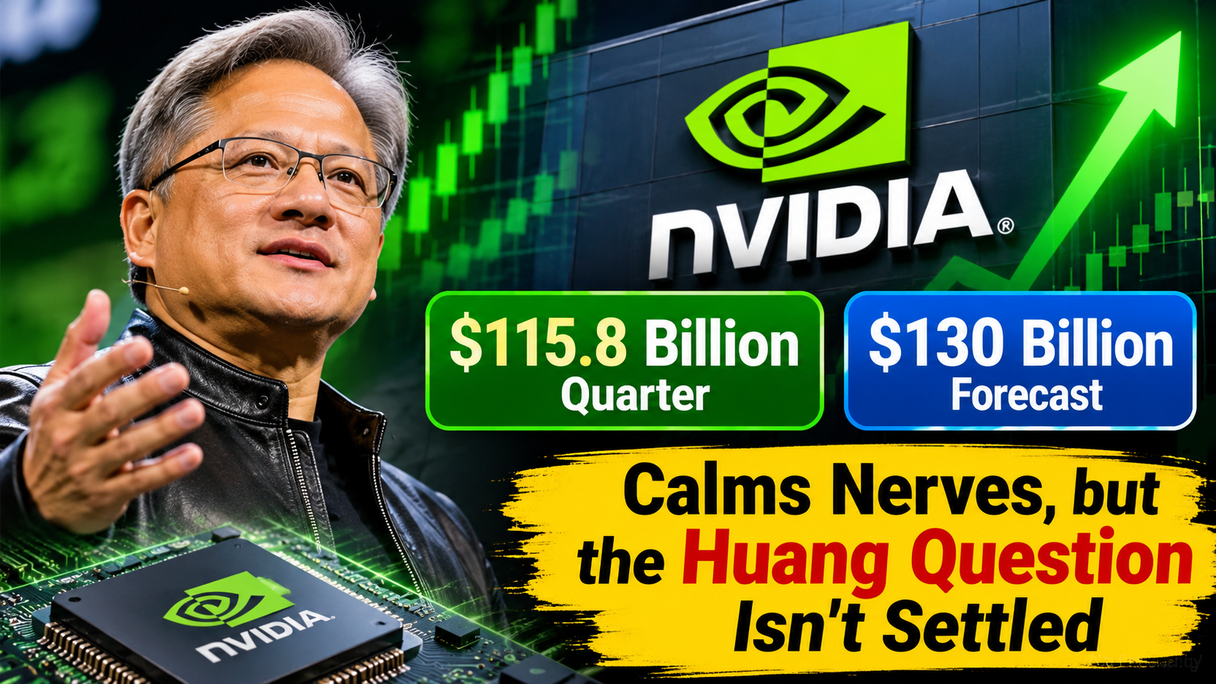
Nvidia Earnings: Nvidia just handed Wall Street the cleanest answer it could have asked for on the business, and no answer at all on the bigger worry hanging over the stock. In its first earnings report since Jensen Huang resigned as CEO, the chipmaker posted third-quarter revenue of $115.8 billion, up 103% from a year ago and about $7 billion above what analysts were expecting.
It then guided to $130 billion for the current quarter, well ahead of the roughly $125 billion the Street had penciled in. Shares, which had been sliding for six straight weeks, rose roughly 4% in after-hours trading Tuesday. Whether that holds when the U.S. market opens Wednesday is a separate question. After-hours moves on a company this size get revised constantly once the regular session starts.
Nvidia Earnings in Q3
| Metric | Reported (Q3 FY27) | Wall Street expected |
|---|---|---|
| Revenue | $115.8 billion | About $108.8 to $109.1 billion |
| Adjusted EPS | $2.68 | About $2.47 |
| Data Center revenue | $107.6 billion | About $101.8 billion |
| Non-GAAP gross margin | 74.9% | About 74% (Nvidia’s guidance) |
| Q4 revenue outlook | $130 billion, plus or minus 3% | About $125 billion |
Those come from Nvidia’s own release for the quarter that ended Oct. 25, plus consensus figures reported by LSEG and others before the report. Estimates vary slightly by provider, but the beat is large on any of them.
A few more details from the release. Revenue was up 20% from the prior quarter. Data Center, which is now about 93% of the business, hit $107.6 billion, up 21% sequentially and 110% from a year earlier. Edge Computing, the smaller segment that covers gaming, automotive and robotics, brought in $8.2 billion. GAAP net income was $65.3 billion, and GAAP earnings per share were $2.70.
Nvidia also returned $28.1 billion to shareholders through buybacks and dividends in the quarter, and it still has about $227 billion left on its repurchase authorization. The next dividend is 25 cents a share, payable Dec. 23 to holders of record on Dec. 2.
The guidance is what moved the stock
The quarter itself was close to a lock. Nvidia had guided to $108 billion, plus or minus 2%, and it cleared the top of that range by a wide margin. The real fight was over what came next. The $130 billion outlook for the quarter ending in January landed at the high end of what even the optimists were talking about. UBS had floated as much as $130 billion going in, while the consensus sat near $125 billion.
Nvidia’s release does note that the fourth quarter includes an extra week, which accounts for some of the jump, so it’s not an apples-to-apples read against a normal 13-week quarter. Still, a forecast that’s roughly $5 billion above the average analyst is the kind of number that changes the tone of a conversation.
Then there was the bigger long-range number. Management raised its fiscal 2028 revenue growth forecast to 75% from 70%. When Morgan Stanley’s Joseph Moore asked about it on the call, Kress said, “We feel confident in the demand in front of us, as well as the supply, that we can do 75%.” She also said demand continues to exceed supply. That matters for the “AI bubble” debate. Nvidia isn’t saying customers might spend more. It’s saying it can’t build chips fast enough for the orders already in hand.
Margins held up better than feared
Gross margin was the other quiet worry. Nvidia had warned that rising memory costs would squeeze profitability, guiding to about 74% this quarter and a trough of 71% to 72% in the next. Some analysts were braced for worse, with estimates as low as 70.2%. The actual third-quarter margin was 74.9% on a non-GAAP basis, slightly above the guidance range. The fourth-quarter margin outlook is 71% to 72%, exactly where management said it would be, not lower. Kress also pointed to margin improvement in fiscal 2028 even while the company keeps investing in growth.
So the margin story is still “down a bit,” not “falling off a cliff,” which is about the best outcome investors could have hoped for. One more number to keep an eye on: purchase commitments rose to $390 billion this quarter, up from $279 billion at the time of the August report. That’s what Nvidia has promised suppliers, including memory makers. It’s a bet that demand keeps growing, and it’s an enormous one. If the AI buildout slows, those are obligations Nvidia still has to honor.
Kress’s first test as interim CEO
This was never going to be only about revenue. The board named Kress interim CEO on Nov. 12, and Tuesday was the first time the outside world heard her explain the situation. Her release statement was upbeat. “Our momentum is real,” she said. “Vera Rubin is off to an explosive start, our roadmap is on track and our ambition has never been greater.”
On the leadership question, the message was disciplined and brief. Asked about Huang’s departure, Kress said, “Probably the most important thing right now as we think through this transition are our employees.” Board chair Harvey Jones said the board does not intend to bring Huang back and that Nvidia has hired Heidrick & Struggles to run the search for a permanent CEO, looking at both internal and external candidates.
He also said management won’t discuss the circumstances of Huang’s exit. Huang, for his part, has said he would be honored to return if the board thought it was in the company’s best interest, according to Decrypt, but the board has now ruled that out. If you were hoping for a name or a timeline, you didn’t get one. The board says it won’t rush.
Wedbush’s Cullen Rogers framed the call as the first read on whether Nvidia “can execute without its founder,” and the early evidence says the machine is still running. Others weren’t ready to call it settled. GAMCO’s John Belton said fundamentals “should continue to look quite strong but these debates will persist.” Summit Insights has downgraded the stock to Hold from Buy, citing “too much uncertainty” around leadership. And Wedbush’s Dan Ives, who rates the stock Outperform with a $225 target, said a clean quarter and guide strengthen the board’s hand but don’t resolve the leadership question. He also flagged possible activist-investor involvement and a possible special shareholder meeting as things to watch.
Kress also addressed another point investors had been fretting about: Nvidia’s financial ties to the “neocloud” companies it supplies. She said Nvidia’s commitments to those firms total about $32 billion as of quarter-end, that significant construction milestones and development benchmarks must be met under every commitment, and that the company will stay careful about how it deploys capital and guarantees. That’s a measured answer, and it doesn’t sound like a company about to pull back.
China is still zero
Nvidia’s fourth-quarter outlook once again assumes no Data Center compute revenue from China. That’s been the standing assumption for a few quarters now, which means any China sales that do show up are upside, not something the Street is counting on.
Little has changed on the ground. The H200 chips Washington approved for China in January have mostly been stuck, with Reuters reporting roughly 600,000 of them sitting in Hong Kong warehouses while Beijing withholds approval for large-scale imports. New U.S. restrictions on advanced AI chips, announced Monday, added more uncertainty.
Decrypt also reported an SEC civil investigation into whether Nvidia violated investor-disclosure laws. That’s from a single outlet, so treat it carefully until Nvidia or the SEC says more.
What the stock did, and what it’s up against
Nvidia slipped about 0.4% during Tuesday’s regular session, after closing Monday at $156.14, its lowest finish since July 2025. After the report, the stock moved higher in stages: up around 1.6% when the release came out, closer to 3.5% by the time Kress finished her prepared remarks, and more than 4% by 6 p.m. Eastern. Options traders had been pricing a move of roughly 8% in either direction, so a 4% pop is well inside the range. Keep that in perspective. Even with the jump, Nvidia is still roughly a third below its October high near $240, and the market backdrop isn’t helping.
On Tuesday, the Dow fell 848 points, or 1.6%, to 50,759, after dropping more than 1,000 points at one stage. The S&P 500 slid 1% to 7,340, its lowest close since late July, and the Nasdaq lost 0.7%. The 10-year Treasury yield has been sitting above 5%, and futures fully price a Federal Reserve rate hike at the Dec. 8-9 meeting after a hotter-than-expected inflation report.
Higher rates tend to hit growth stocks hardest, and Nvidia is the biggest one in the market. That’s why Nvidia matters even if you only hold an index fund in a 401(k). One estimate circulating before the report suggested a 10% swing in Nvidia alone could move the S&P 500 by 45 to 50 points.
Why the customer spending matters
Nvidia’s revenue is, in large part, other companies’ capital budgets, and those budgets are enormous. The four biggest U.S. cloud spenders (Amazon, Alphabet, Microsoft and Meta) are guiding to roughly $720 billion to $750 billion of combined 2026 capital spending, compared with about $376 billion in 2025. Amazon is at about $220 billion, Alphabet at $195 billion to $205 billion, and Meta at $135 billion to $145 billion. Alphabet has said its 2027 spending will rise significantly.
Tuesday’s report is the strongest evidence in weeks that those budgets are turning into real orders. Amazon CEO Andy Jassy said on CNBC before the call that he doesn’t “foresee a day where we’re not partners with Nvidia.” A $130 billion quarter backs that up. For chipmakers, memory suppliers and the power and data-center companies riding the same wave, it’s a green light, at least for now.
So is Nvidia a buy here?
That depends on who you ask, and none of this is investment advice. But the debate before the report was clear enough. The bulls point to the valuation. Going into the report, Nvidia’s forward price-to-earnings ratio was below PepsiCo’s, for a company growing revenue 100% a year with a 75% gross margin. The average analyst price target tracked by TipRanks is about $232, and the ratings skew heavily to Buy, with 26 Buy, 12 Hold and one Sell. UBS’s Tim Arcuri has called the pullback an attractive buying opportunity.
The cautious camp isn’t arguing with the numbers. It’s arguing about what the numbers are worth when the person who built the strategy is gone, the China business is in limbo, a $390 billion supply commitment is on the books and the Fed is about to raise rates. Bernstein’s Stacy Rasgon moved to Market Perform and cut his target to $200 before the report. Cardiff’s Dean Lyulkin put it in a way that’s hard to improve on: “This is no time to be overweight NVDA,” but “it’s also late to panic.”
What to watch next
- The Wednesday open. After-hours gains can vanish fast, especially with the Fed and rates in the picture. Retail sales data and Fed minutes this week could also move tech.
- The CEO search. The board hasn’t given a timeline. A strong external name could help. A drawn-out search could keep a discount on the stock.
- Washington. The new chip restrictions, the export-control investigation and congressional interest in Huang, including a private interview requested for December, all carry headline risk.
- Supply. Nvidia says it can’t make enough chips. Any slippage on Vera Rubin or the memory supply chain would matter more than usual with a 75% growth target out there.
This article is for general information only and isn’t investment advice. Figures reflect results and after-hours trading reported through Tuesday evening, Nov. 17, and may change when the U.S. market opens.