Updated October 21, 2026. All figures are unofficial until Elections Alberta announces official results on October 29.
Alberta Referendum Results: Albertans have voted to remain part of Canada in the province’s first referendum on separation. With about 86% of polls counted, 75.3% of votes on Question 10 were for staying in Canada, and 24.7% were for starting the legal process toward a binding separation vote. The other nine questions, on immigration and constitutional change, produced much closer margins.
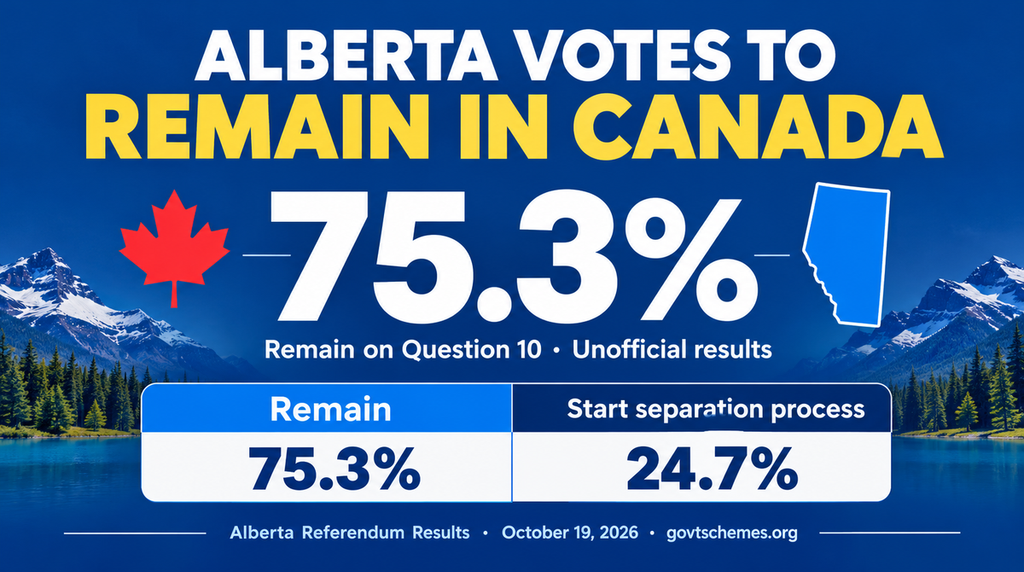
Alberta Referendum Results at a Glance
- Question 10 (separation): Remain 75.3% (1,433,877 votes), start the separation process 24.7% (470,837 votes), with the remain side leading by more than 960,000 votes
- Questions 1 to 5 (immigration and voting): All five passed, with support between about 54% and 64%
- Questions 6 to 9 (Constitution): Questions 6, 7 and 9 narrowly passed, and Question 8 narrowly failed
- Polls vs result: Final polls had remain at 66% to 78% among decided voters, and the result landed inside that range
- Binding? Questions 1 to 5 and Question 10 are non-binding by government order. Questions 6 to 9 would still need other governments to agree
- Official results: October 29, 2026
Question 10: Alberta Chooses to Remain in Canada
Question 10 asked: Should Alberta remain a province of Canada, or should the Government of Alberta commence the legal process required under the Canadian Constitution to hold a binding provincial referendum on whether or not Alberta should separate from Canada?
It was not a direct vote to leave Canada. Even if the second option had won, Alberta would not have left. It would have signaled the government to begin the legal steps toward a second, binding vote.
Because every voting place counts Question 10 first, it was the first result to come in. CBC projected a remain win overnight, and the lead held through Tuesday. The separation option did lead in a small number of rural ridings, including Central Peace-Notley and Rimbey-Rocky Mountain House-Sundre, at the last count we reviewed. Remain won large majorities in Calgary and Edmonton ridings.
Results for All 10 Questions
| # | Topic | Unofficial result |
|---|---|---|
| 10 | Remain in Canada or start the separation process | Remain 75.3% |
| 1 | More provincial control over immigration | Yes 54.4% |
| 2 | Limit provincially funded programs to citizens, permanent residents and Alberta-approved status | Yes 55.7% |
| 3 | 12-month residency before social supports for non-permanent residents | Yes 58.0% |
| 4 | Fees for health care and education for non-permanent residents | Yes 57.5% |
| 5 | Proof of citizenship to vote in provincial elections | Yes 63.9% |
| 6 | Provinces choose King’s Bench and Appeal court judges | Yes 51.8% |
| 7 | Abolish the Senate | Yes 53.7% |
| 8 | Opt out of federal programs without losing funding | No 50.9% |
| 9 | Provincial laws take priority over federal laws in shared areas | Yes 51.0% |
Question 8 is the only one of the nine that did not pass. These numbers come from Elections Alberta’s unofficial count as reported by results trackers and may shift slightly before the official announcement.
What the Alberta Referendum Results Mean
Questions 1 to 5 and Question 10 were ordered by the government to be non-binding. The order for Questions 6 to 9, the constitutional questions, does not say whether those results bind. In practice, constitutional change cannot be done by Alberta alone.
Immigration and voting (Questions 1 to 5). A yes vote gives the government political backing to bring in new laws, but any law would still have to be passed and could face legal challenges. The government has also said it will not define “Alberta-approved immigration status” until after the referendum, so what a yes vote on Question 2 means in practice is not yet clear. On Question 5, voting in Alberta is already restricted to Canadian citizens.
Constitutional questions (Questions 6 to 9). A yes vote means Alberta would work with other willing provinces to seek amendments. Abolishing the Senate, for example, would need the consent of all 10 provinces, the House of Commons and the Senate itself.
Separation (Question 10). With remain winning by a wide margin, there is no mandate to begin the legal process toward a separation referendum.
Reaction From Smith and Carney
Premier Danielle Smith, who announced the referendum, said she was very pleased that early results showed widespread support for remaining in Canada. Prime Minister Mark Carney issued a statement shortly after midnight saying that Albertans had chosen Canada, and he acknowledged that votes on the other questions were still being tallied. The result is widely seen as a boost for Carney as he tries to unify the country amid a trade war with the United States.
How the Polls Compared With the Result
Polls throughout the campaign showed a large majority for remaining, and the final results matched them.
| Pollster (fieldwork) | Remain | Separation process |
|---|---|---|
| Mainstreet (Oct 17) | 66% | 34% |
| Research Co. (Oct 17) | 77% | 23% |
| Léger (Oct 16) | 78% | 22% |
| Angus Reid (Oct 15) | 66% | 34% |
| Abacus Data (Oct 13) | 73% | 27% |
| Actual result (unofficial) | 75.3% | 24.7% |
The figures above exclude undecided voters. An Ipsos poll for Global News in September, which included undecided voters, had 70% for remain and 20% for the separation process.
How the Alberta Referendum Came About
Premier Smith announced nine referendum questions on February 19, 2026, and cabinet approved two orders in council, O.C. 109/2026 and O.C. 110/2026, on March 31, 2026. On May 21, Smith announced in a televised address that a tenth question on Alberta’s place in Canada would be added, and O.C. 160/2026 added it on May 28. Smith has said she personally wants Alberta to stay in Canada.
| Date | What happened |
|---|---|
| February 19, 2026 | Premier Smith announces nine referendum questions |
| March 31, 2026 | O.C. 109/2026 and O.C. 110/2026 approved |
| May 21, 2026 | Smith announces a tenth question on Alberta’s place in Canada |
| May 28, 2026 | O.C. 160/2026 approved, adding Question 10 |
| October 13 to 17, 2026 | Advance voting |
| October 19, 2026 | Referendum day |
| October 20, 2026 | Question 10 results show remain winning |
| October 29, 2026 | Official results announced |
How the Count Works
Ballots are counted by hand. Every voting place counts Question 10 first, then Questions 1 to 9 one at a time, so results for the later questions fill in over the following days. Elections Alberta had up to 48 hours after polls closed to publish unofficial results, and official results come on October 29. More than one million people voted in advance polls.
Official Resources
| Resource | What it’s for | Link |
|---|---|---|
| Elections Alberta: Referendum | Official question wording and voting information | https://www.elections.ab.ca/elections/referendum/ |
| Elections Alberta: Referendum results | Unofficial results, then official results on October 29 | https://www.elections.ab.ca/elections/referendum/referendum-results/ |
| Referendum Act | The law governing the referendum | https://www.qp.alberta.ca/documents/Acts/r08p4.pdf |
| O.C. 109/2026 | Constitutional questions (6 to 9) | https://kings-printer.alberta.ca/Documents/Orders/Orders_in_Council/2026/2026_109.pdf |
| O.C. 110/2026 | Non-constitutional questions (1 to 5) | https://kings-printer.alberta.ca/Documents/Orders/Orders_in_Council/2026/2026_110.pdf |
| O.C. 160/2026 | Question 10 (remain or start separation process) | https://kings-printer.alberta.ca/Documents/Orders/Orders_in_Council/2026/2026_160.pdf |
We will update this article when Elections Alberta publishes the official results.
FAQs about Alberta Referendum
Did Alberta vote to leave Canada?
No. Alberta voted by a large majority to remain part of Canada in its first-ever referendum on separation
What was the result on Question 10?
With 80% of voting locations reporting, 76% of valid votes backed remaining in Canada, and about 25% backed starting the legal process toward a binding separation vote. These are unofficial figures and may shift slightly as the count finishes.
Was Question 10 a direct vote on separation?
No. It asked whether Alberta should remain a province or whether the government should begin the legal process needed to hold a later, binding referendum on separating. Even if the second option had won, Alberta would not have left Canada.
Are the referendum results binding?
No. The orders in council for Questions 1 to 5 and Question 10 state the results are not binding, and the constitutional questions (6 to 9) cannot be carried out by Alberta alone.
What were Questions 1 to 5 about?
They covered immigration and voting rules: more provincial control over immigration, limiting provincially funded programs to citizens, permanent residents and people with Alberta-approved status, a 12-month residency wait for non-permanent residents, fees for health care and education for non-permanent residents, and proof of citizenship to vote in provincial elections.
What were Questions 6 to 9 about?
They asked whether Alberta should work with other willing provinces to amend the Constitution on four topics: provinces choosing provincial court judges, abolishing the Senate, letting provinces opt out of federal programs without losing funding, and giving provincial laws priority over conflicting federal laws in provincial or shared areas.
Could Alberta abolish the Senate if voters said yes?
When will official results be announced?
Unofficial results are due within 48 hours of voting places closing, and official results are announced on October 29, 2026.
Why did the count take so long?
Every voting place counts Question 10 first and then Questions 1 to 9 one at a time, so results for the later questions come in over the following days.
How did the polls compare with the Alberta Referendum Results?
Final polls before voting had remain between 66% and 78% among decided voters. Mainstreet had 66–34, Research Co. 77–23, Léger 78–22, Angus Reid 66–34 and Abacus 73–27. The actual unofficial result of about 75% to 76% remain falls inside that range.
We’ll update this article when Alberta Referendum Results are published.
Also Read:
Who Will Get the ACA Payments in 30 States? $500 Refund Eligibility and Payment Schedule
SSI Payment Dates December 2026 and January 2027: Who Gets Paid When?