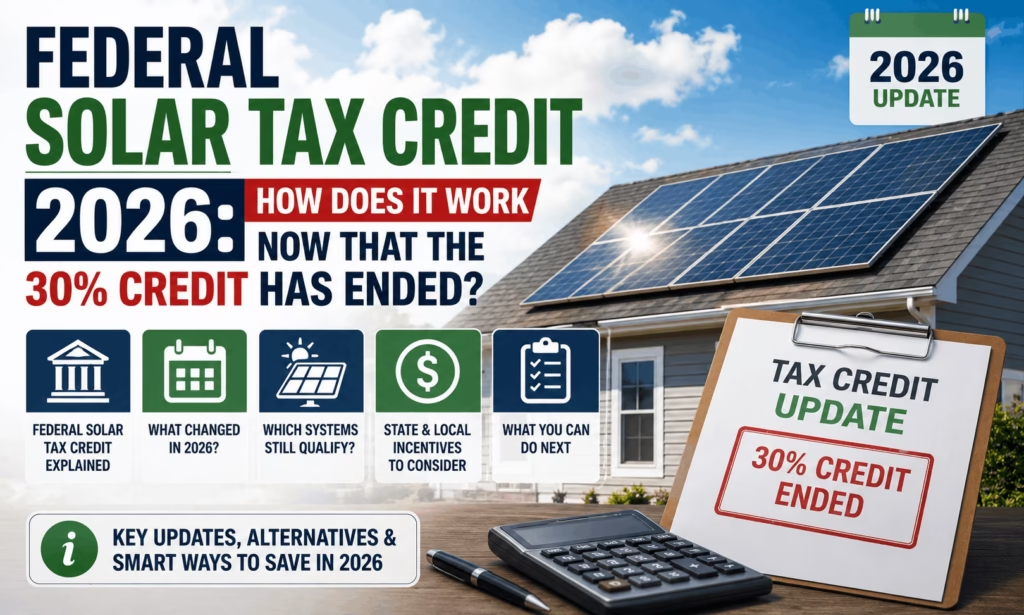
Federal Solar Tax Credit 2026: The federal solar tax credit that homeowners relied on for more than a decade is officially gone for new purchases, and the abrupt ending is catching thousands of homeowners off guard as 2026 solar quotes land on their desks with no federal discount attached. The Residential Clean Energy Credit, known formally as Section 25D, expired for any system paid for or placed in service after December 31, 2025, after the One Big Beautiful Bill Act repealed it roughly seven years ahead of its original 2032 phase-out schedule. Anyone who signs a contract, pays a deposit, or completes installation starting in 2026 receives zero federal credit on a homeowner-owned system, a sharp reversal from the 30 percent, uncapped credit that applied through the end of 2025.
The change does not mean every path to federal solar savings has closed. A separate commercial credit under Section 48E still applies to systems owned by a third party, meaning leased systems and power purchase agreements can still carry federal value, just claimed by the company that owns the equipment rather than the homeowner. We’ll be updating this article monthly as the IRS issues new guidance, as state and utility programs adjust to fill the gap, and as any further congressional action on energy tax policy develops, so check back here for the most current rules rather than outdated information still circulating from before the law changed.
Federal Solar Tax Credit 2026 Key Highlights
| Detail | Information |
|---|---|
| Law that ended the credit | One Big Beautiful Bill Act, signed July 4, 2025 |
| Credit affected | Section 25D, Residential Clean Energy Credit |
| Original credit rate | 30 percent of total project cost, no dollar cap |
| Original expiration under prior law | Phase-down beginning 2033, full end in 2035 |
| Actual termination date | December 31, 2025, no phase-down |
| 2025 installations | Still eligible for the 30 percent credit if placed in service by December 31, 2025 |
| 2026 and later homeowner-owned systems | 0 percent federal credit |
| Remaining federal option | Section 48E commercial credit, available through third-party leases and PPAs |
| 48E general deadline | December 31, 2027, for most projects |
| Related credit also ended | Section 25C Energy Efficient Home Improvement Credit, also terminated after December 31, 2025 |
What Actually Happened to the Federal Solar Tax Credit?
For years, the residential solar tax credit operated on a predictable, gradually declining schedule. Under the Inflation Reduction Act of 2022, the credit sat at 30 percent of a system’s total cost, including panels, inverters, battery storage, wiring, and installation labor, and it was scheduled to remain at that level through 2032 before stepping down to 26 percent in 2033 and 22 percent in 2034. That timeline changed when President Trump signed the One Big Beautiful Bill Act on July 4, 2025. Rather than trimming the credit gradually, the new law eliminated Section 25D outright for any qualifying expenditure made after December 31, 2025. There was no step-down period and no transition window. Homeowners who completed a purchase and had their system placed in service on or before that date can still claim the full 30 percent credit on their 2025 tax return, but anyone starting a project in 2026 receives nothing from this particular federal incentive.
Original Timeline vs. What Actually Happened
| Year | Originally Scheduled Rate (IRA) | Actual Rate After OBBBA |
|---|---|---|
| 2022 to 2032 | 30 percent | 30 percent, through December 31, 2025 only |
| 2033 | 26 percent | 0 percent |
| 2034 | 22 percent | 0 percent |
| 2035 and later | 0 percent | 0 percent |
US Diesel Prices $6 a Gallon: Iran War Squeezes Fuel Supply to a Record High
25th Anniversary of 9/11 Attacks: How America Is Marking ‘Moments That Divide Time’
Who Can Still Claim the Credit for a Solar Project?
If a solar or battery storage system was completed and placed in service by December 31, 2025, the homeowner who paid for it can still claim the full 30 percent Residential Clean Energy Credit on the 2025 federal tax return filed in 2026. The IRS treats the expenditure as made when the installation is finished and the system becomes operational, not simply when a contract was signed or a deposit was paid, so a project that was only partially complete by year end does not qualify. Homeowners in this position use IRS Form 5695 to calculate and claim the credit, entering total qualifying costs in Part I of the form and attaching it to their standard federal tax return. There is no income limit on this credit and no dollar cap, though it remains nonrefundable, meaning it can only offset actual federal tax liability for the year rather than generating a cash refund beyond what was owed.
How to Apply: Claiming a Solar Tax Credit on Your Return?
Homeowners who qualify for the final year of the credit do not need to apply to a government agency in advance. The credit is claimed directly on a federal income tax return using Form 5695, typically filed by the standard April 15 deadline, or October 15 with an approved extension. To claim it correctly, homeowners should gather itemized installation invoices, proof of payment, and confirmation from the installer of the date the system was placed in service. Tax preparation software generally walks users through the residential clean energy credit section automatically when Form 5695 is included, and many solar installers provide a completed cost summary specifically formatted for this form. Because this is the final year the credit is available, the IRS has indicated it will apply normal scrutiny to placed-in-service dates, so documentation showing the exact operational date matters more than usual.
Processing Time and Payment Schedule for the Credit
The Residential Clean Energy Credit does not arrive as a separate payment. It reduces the amount of federal income tax owed for the year, so its financial benefit shows up as either a smaller tax bill or, if too much was already withheld from paychecks throughout the year, as part of a larger standard tax refund. Refunds tied to electronically filed returns with direct deposit are typically issued by the IRS within 21 days of acceptance, assuming no errors or additional review flags. Paper returns and returns claiming multiple credits can take six weeks or longer. If the total credit exceeds tax liability for 2025, the unused portion does not disappear. It carries forward automatically to the 2026 tax year and can continue carrying forward in future years until it is fully used, since the credit itself remains nonrefundable but not use-it-or-lose-it within a single year.
Why Lawmakers Ended the Credit Early?
Supporters of the repeal, including congressional Republicans who backed the One Big Beautiful Bill Act, framed the early termination of Section 25D as part of a broader effort to reduce federal spending and unwind clean energy subsidies they argued had grown too costly and too generous relative to their original purpose. Budget estimates circulated during the legislative debate suggested the residential clean energy credit had cost the federal government billions of dollars more than initial projections from when the Inflation Reduction Act passed in 2022, driven in part by rising solar adoption and expanding battery storage claims. Critics of the repeal, including solar industry trade groups and clean energy advocates, argued the sudden cutoff, rather than a gradual phase-down, would disrupt an industry that had built hiring and installation capacity around the expectation of a credit lasting through 2032, and warned of potential job losses among installers who depended heavily on residential projects. Both sides of that debate continue to reference the policy shift as 2026 unfolds, with some lawmakers introducing bills to reinstate or partially restore the credit, though none of those proposals had been enacted as of this update.
Battery Storage and the Solar Tax Credit: What Changed
Standalone battery storage was one of the more significant additions to the residential clean energy credit in recent years, allowing homeowners to claim the 30 percent credit on a battery system even when it was installed separately from solar panels, as long as it met minimum capacity requirements. That provision expired on the same December 31, 2025 deadline as the rest of Section 25D. A homeowner who paired solar panels with a battery and completed installation by the end of 2025 could claim the credit on both components combined. Anyone adding a battery in 2026, whether alongside new panels or as a standalone addition to an existing solar system, receives no federal credit on that battery cost under the homeowner-owned path. As with panels, battery systems financed through a lease or paired with a third-party-owned solar array may still connect to the separate Section 48E commercial credit, with the value passed through by the financing company rather than claimed directly by the homeowner.
Is Trump Bribing Voters? $500 Obamacare Rebate After $5000 Dividend
Trump’s $5000 Dividend: Is It a Bribe If Americans Never Get Paid?
Social Security Max Contribution 2026: How to Get $3,000/Month?
How the Expiration Is Reshaping Solar Costs and the Industry?
The sudden end of the credit has already shown up in how solar companies price and market systems heading into 2026. Installers who spent years quoting a system’s after-credit cost as the headline number have shifted toward emphasizing full pretax pricing, financing options, and any remaining state or utility incentives instead. Industry analysts have also noted a wave of installation activity concentrated in the final months of 2025, as homeowners who had been considering solar accelerated their decision to lock in the 30 percent credit before the deadline, followed by a noticeably slower start to 2026 bookings. For homeowners now shopping without a federal credit in the picture, the math shifts toward longer payback periods based purely on electricity bill savings, financing terms, and any local incentives, making it more important than ever to compare multiple quotes and confirm exactly which federal, state, or utility programs, if any, actually apply to a specific system and ownership structure before signing a contract.
Solar Tax Credit Carryforward and Savings Calculator
Use the calculator below to estimate what a 30 percent federal solar credit would have been worth on a 2025 project, and to see how much of that credit could carry forward if it exceeds your federal tax liability for the year. This tool provides a general estimate only and does not replace guidance from a qualified tax professional.
Solar Tax Credit Carryforward Calculator
What Still Exists: The Section 48E Commercial Credit and Leased Systems
Homeowners who buy and own their solar system outright in 2026 no longer have a federal credit available to them, but the picture looks different for leased systems and power purchase agreements. Under those arrangements, a solar company or financing partner owns the equipment and can claim a separate credit under Section 48E, the commercial clean electricity investment credit. That credit generally remains available through December 31, 2027 for most projects, and companies can pass some of that value through to homeowners in the form of lower monthly lease or PPA payments, even though the homeowner never claims a credit directly on their own tax return. Projects that begin construction before July 4, 2026 may qualify under a longer timeline extending to 2030 under transition rules tied to when construction started, though the exact requirements involve detailed IRS safe harbor guidance that a tax advisor or the leasing company should confirm on a project by project basis.
Section 25C Also Ended: Other Home Energy Credits Homeowners Are Losing
The solar credit was not eliminated in isolation. The same legislation ended the Energy Efficient Home Improvement Credit under Section 25C on the identical date, December 31, 2025. That credit had covered a wide range of home upgrades including insulation, energy efficient windows and doors, heat pumps, and home energy audits. Like the solar credit, it terminated with no phase-down, so any qualifying improvement placed in service in 2026 or later does not receive a federal credit under this section either. Homeowners who were planning to bundle a heat pump or insulation upgrade with a solar installation to maximize federal credits in the same tax year needed to complete both projects by the same December 31, 2025 deadline to capture any federal benefit from either one.
What Homeowners Can Still Do to Reduce Solar Costs in 2026
With the federal residential credit gone, the financial case for solar in 2026 leans more heavily on state and local programs, utility rebates, net metering arrangements, and financing structures rather than a single federal deduction. Many states continue to offer their own solar tax credits, rebates, or property tax exemptions that were never tied to the federal Section 25D timeline and remain unaffected by this change. Utility net metering or net billing programs, which credit homeowners for excess electricity sent back to the grid, also continue independently of federal tax policy in most regions, though the specific credit rates vary significantly by state and utility. Homeowners evaluating solar in 2026 are generally advised to request quotes from installers that clearly separate the base system cost from any assumed federal savings, confirm whether a lease or PPA-based Section 48E pass-through applies, and check directly with their state energy office or public utilities commission for programs that remain active locally.
Official Resources: Forms, Guidance, and Where to Check the Rules
| Resource | Purpose | Official Link |
|---|---|---|
| IRS Form 5695 | Claim the 2025 residential clean energy credit | irs.gov/forms-pubs/about-form-5695 |
| IRS Energy Credit FAQs | Official guidance on the credit termination and transition rules | irs.gov/newsroom |
| IRS Where’s My Refund | Check the status of a refund tied to a claimed credit | irs.gov/wheres-my-refund |
| Database of State Incentives for Renewables and Efficiency | Find state and utility solar programs that remain active | dsireusa.org |
| ENERGY STAR Federal Tax Credits | General overview of remaining federal energy incentives | energystar.gov/about/federal-tax-credits |
| Department of Energy Solar Resources | Consumer guidance on solar ownership and financing options | energy.gov/eere/solar |
Trump $5000 Dividend Check: Latest Update on Cost, Eligibility and Payment Date
Trump’s Obamacare Rebate Plan Could Send $500 to 1 Million Americans Before the Midterms
FAQs About Federal Solar Tax Credit 2026
Is the federal solar tax credit still available in 2026?
No. The 30 percent Residential Clean Energy Credit under Section 25D ended for homeowner-owned systems placed in service after December 31, 2025. Leased systems and power purchase agreements may still carry value through a separate commercial credit.
Can I still claim the solar credit if I installed my system in 2025?
Yes. If your system was completed and placed in service by December 31, 2025, you can claim the full 30 percent credit on your 2025 federal tax return using Form 5695.
What happens if my solar credit is bigger than my tax bill?
Unused credit amounts carry forward automatically to future tax years. The credit is nonrefundable, meaning it cannot generate a refund beyond what you actually owed, but it does not expire after one year.
Why did the federal solar tax credit end early?
The One Big Beautiful Bill Act, signed into law on July 4, 2025, repealed Section 25D roughly seven years ahead of the original schedule set under the Inflation Reduction Act, which had planned a gradual phase-down through 2035.
Are solar leases and power purchase agreements still eligible for a federal credit?
Yes, indirectly. Third-party owned systems, including leases and PPAs, can still access the separate Section 48E commercial credit, which the leasing company claims rather than the homeowner.
Did other home energy tax credits end at the same time as the solar credit?
Yes. The Energy Efficient Home Improvement Credit under Section 25C, which covered heat pumps, insulation, windows, and energy audits, also ended for property placed in service after December 31, 2025.
Do state solar incentives still exist even though the federal credit ended?
Many do. State tax credits, rebates, and net metering programs generally operate independently of federal tax law and were not affected by this change, though availability varies significantly by state and utility.
How do I know if my solar system counts as placed in service by the deadline?
The IRS considers a system placed in service when installation is complete and the system is operational, not simply when it was purchased or a deposit was made. Installers can typically confirm the exact operational date for documentation purposes.
Why did the solar tax credit go away in 2026?
Congress passed the One Big Beautiful Bill Act in July 2025, which eliminated the homeowner-claimed residential solar credit several years earlier than originally scheduled under the Inflation Reduction Act.
Is there any federal incentive left for solar panels?
Homeowner-owned systems no longer qualify, but leased and power purchase agreement systems can still access a separate commercial credit claimed by the system’s owner rather than the homeowner.
What is the difference between Section 25D and Section 48E?
Section 25D was the homeowner-claimed residential credit that ended after 2025. Section 48E is a commercial credit available to businesses and third-party system owners, including companies that offer solar leases, and it remains active for several more years.
Can I still get a tax break for going solar in 2026?
Not through the direct federal homeowner credit, which has ended. State incentives, utility rebates, and lease-based programs that tap into the commercial credit may still reduce costs depending on where you live.
Conclusion
The federal solar tax credit’s abrupt end after December 31, 2025 marks one of the most significant shifts in clean energy policy in years, closing a 30 percent, uncapped incentive that had defined the economics of home solar for over a decade. Homeowners who completed a purchase in 2025 still have a path to claim that credit using Form 5695, with any unused portion carrying forward into future tax years. For anyone considering solar in 2026 and beyond, the financial equation now depends far more on state incentives, utility programs, and whether a lease or power purchase agreement can tap into the separate commercial credit still available to system owners. This page will continue to track IRS guidance, state-level policy responses, and any further legislative changes as they are confirmed.
How Government Shutdown Affects VA Benefits, Will Your Payment Still Arrive?
Do I Qualify for ACA Subsidy 2027? The 400% FPL Cliff Explained
Healthcare.gov Premiums Rising 2027: What Changed and What It Means for Your Coverage
ACA Subsidy Cliff 2027: Premiums Could Double, Calculator Inside