Student Loan Wage Garnishment: Yes, the federal government can take money straight from your paycheck for a defaulted student loan, and it does not need a court order to do it. The more urgent question this week is whether it is doing so right now. As of October 27, 2026, it is not. The Education Department paused wage garnishment and Treasury tax refund seizures on January 16, 2026, and has not named a restart date. But a wave of reports in the past ten days says the pause may be ending. Several people familiar with administration discussions told reporters that Treasury is preparing to hire private debt collectors as early as November and that a broader return to collections is planned for 2027. The Education Department’s spokesperson denied the reports. Borrowers in default are caught between a legal threat that has not gone away and an official silence that makes planning hard. We’ll be updating this article monthly.
The scale explains why this matters. More than 9.3 million borrowers were in default as of June 30, according to figures reported this month, holding roughly $234 billion in debt. The Center for American Progress put the count near 9.5 million, more than one in five federal borrowers. Some officials have reportedly discussed applying wage and benefit collections to the current tax year, with April 15, 2027 floated as a possible target, though that is not a public deadline. Treasury and the Education Department opened a Defaulted Loans Support Center on September 30, and Treasury says approved rehabilitation applications are up 69 percent. Below is what the law allows, what is confirmed, what is only rumour, and the steps that protect your wages before a notice arrives.
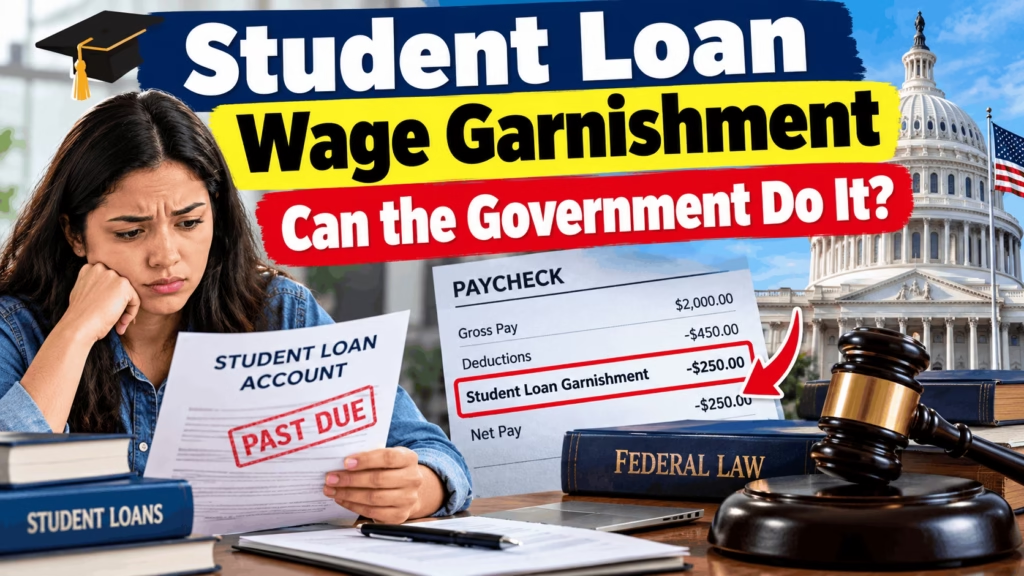
Student Loan Wage Garnishment Key Dates and Highlights
| Item | Latest detail |
|---|---|
| Can the government garnish wages for defaulted federal student loans? | Yes, through administrative wage garnishment, with no court judgment |
| Garnishment cap | Up to 15 percent of disposable pay |
| When a loan is in default | At least 270 days past due, about nine months |
| Collections paused | January 16, 2026, for wage garnishment and Treasury Offset Program |
| Restart date | None announced as of October 27, 2026 |
| Reported Treasury plan | Private collectors possibly from November 2026, broader collections in 2027 (unconfirmed) |
| Possible tax-season target | April 15, 2027, per reports, not an official deadline |
| Borrowers in default | More than 9.3 million as of June 30, 2026 |
| Defaulted balance | About $234 billion |
| Time to respond to a garnishment notice | 30 days |
| New repayment plan | Repayment Assistance Plan, available since July 1, 2026 |
| Second rehabilitation | Now allowed, per the Education Department |
Can the Government Garnish Wages for Defaulted Student Loans?
For federal student loans, yes. Most debts require a creditor to sue, win a judgment and then ask a court for permission to garnish. Federal student loans are different. Under federal law, the government can use administrative wage garnishment, which means the agency sends a notice to your employer and withholds money from your pay without first going to court. It can take up to 15 percent of your disposable pay. Disposable pay is what is left after legally required deductions such as taxes, not after voluntary ones like health premiums you chose.
The government has a second tool, the Treasury Offset Program. It can intercept federal tax refunds and certain federal benefits, including some Social Security benefits. Together these are called involuntary collections, because they happen whether or not the borrower agrees.
Private student loans work differently. A private lender has to sue first. Everything in this article applies to federal loans, which you can confirm by logging in to studentaid.gov.
Is Student Loan Wage Garnishment Happening Right Now?
No. The Education Department announced in January that it was delaying involuntary collections while it rolls out repayment changes passed by Congress. The delay covers both wage garnishment and the Treasury Offset Program, and the department called it temporary. It gave no end date. The department said collections should work more efficiently and fairly once the new repayment options are in place, and it told borrowers in default to talk to their servicer about resolving the loan while the pause lasts.
Then came the reports. In late October, outlets summarizing an October 19 report said five sources described preparations to restart collections, including wage garnishment, tax refund seizures and offsets of certain federal benefits. Three of those sources said Treasury could start contracting with private agencies as early as November, though announcements are reportedly unlikely before the midterm elections. Contract awards, vendors and timelines are unconfirmed. A March notice from Treasury asked industry for input on a draft solicitation but did not award anything. The Education Department spokesperson denied the reporting.
Here is the practical reading. No official restart date exists today, the pause is still in place, and the direction of travel is toward restarting. A borrower who waits for a formal announcement may get little warning.
How We Got Here: A Short Timeline of Student Loan Collections
Collections were suspended during the pandemic, and borrowers got used to the pause. In May 2025 the administration announced that collections on defaulted loans would restart, and the schedule has shifted several times since. The table below shows the main steps as reported.
| Date | Development |
|---|---|
| May 2025 | Administration announces collections will restart |
| January 16, 2026 | Education Department delays wage garnishment and Treasury offsets |
| March 2026 | Operational responsibility for defaulted loans moves to Treasury |
| July 1, 2026 | Repayment Assistance Plan opens |
| September 30 | Defaulted Loans Support Center launches |
| October 19 to 20, 2026 | Reports of Treasury hiring private collectors; department denies |
| October 25, 2026 | Reports cite April 15, 2027 as a possible tax-season target |
Notice how little of this is a firm restart. Each step either delays collections or builds the system that would carry them out, and none of them sets a date that borrowers can plan around.
Who Is Most at Risk if Student Loan Wage Garnishment Restarts?
Only borrowers whose federal loans are in default are in line for garnishment, and that means loans at least 270 days past due. The people most exposed are those who do not know they are in default, usually because the notices went to an old address or an unused email. Others at risk are borrowers whose servicer records contain errors, since a wrong balance or a missing payment can put a loan in the wrong category. People with steady paychecks are the easiest to reach, because wages are what the process targets.
Borrowers who are current on payments, in an approved deferment or forbearance, or in bankruptcy have valid grounds to object if they receive a garnishment notice by mistake.
What to Do This Week if Your Federal Student Loans Are in Default?
Treat the pause as a short window and use it. A practical checklist:
- Log in to studentaid.gov and confirm which loans are in default and who holds them.
- Update your address, phone number and email with the servicer and the Defaulted Loans Support Center.
- Choose between rehabilitation and consolidation, and start the paperwork.
- Download your loan history and payment records and store them somewhere safe.
- Do not pay anyone who promises to erase your loans for a fee. The official options are free.
- If a notice arrives, write the date down and respond inside 30 days.
What Happens at Work if a Garnishment Order Arrives?
If garnishment starts, your employer receives the withholding order and takes the money from each paycheck. You will usually hear about it from payroll or human resources. Employers generally cannot ignore a federal order, so the time to act is before it reaches them. If you receive a notice, ask your employer to hold off only if you have filed an objection or hearing request within the 30-day window, and keep proof of the filing date.
Why Student Loan Collections Moved to Treasury?
Operational responsibility for collecting defaulted federal student loans moved to the Treasury Department in March 2026. That is why borrowers now see Treasury, not only the Education Department, in headlines about default. Treasury and the Education Department launched the Defaulted Loans Support Center on September 30 as an online portal for people in default. Treasury says approved rehabilitation applications rose 69 percent, and consolidations out of default rose 95 percent once a technical issue was fixed.
Those numbers show borrowers are already acting. They also show why a restart would be a large operation. With about 9.3 million people in default, a new collections system has to find them, send notices and process objections at a scale the government has not handled in years.
Will the 2027 Social Security COLA Make My Benefits Taxable?
How Much Can the Government Take From Your Paycheck?
The cap is 15 percent of disposable pay. If your take-home pay is $2,000 a month, that works out to up to $300. Federal law also protects a floor of pay, generally the amount equal to 30 times the federal minimum wage per week, so lower earners can see a smaller deduction or none. That floor is a general federal rule rather than something covered in this month’s reporting, so confirm the figure with studentaid.gov or an attorney before relying on it.
Garnishment continues until the debt is paid or the loan is resolved. The Treasury Offset Program works separately and can take an entire federal tax refund. The calculator on this page estimates the paycheck deduction for your pay schedule.
Student Loan Wage Garnishment Process: What the Notice Looks Like
Before wages are touched, the collector sends a Notice Prior to Wage Withholding. That notice starts a 30-day clock. Within it you can object, ask for a hearing or set up a payment arrangement. Notices go to the last address on file, which is a real risk, because officials worry many borrowers will never see them. Update your contact details with your servicer right now.
If you request a hearing in writing within the window, you complete a form about your income, debts and expenses. A decision usually comes about 60 days after the request. If you win, your wages can be protected for 12 months or the deduction reduced, and partial garnishments are reviewed each year. If you miss the 30 days, you can still ask for a review, but collection can continue at up to 15 percent while it is pending, and that can take two to three months.
How to Stop Student Loan Wage Garnishment
Your options depend on timing. The cleanest approach is to deal with the default before any notice arrives.
- Rehabilitate the loan. This takes nine on-time monthly payments and, when completed, can remove the default notation from your credit report.
- Consolidate into a Direct Consolidation Loan. This pays off the defaulted loans with a new federal loan. You usually need to agree to an income-driven plan or make a few qualifying payments first. It does not remove the default from your credit history.
- Object. Valid reasons include not owing the debt, being current on payments, being in bankruptcy or being totally and permanently disabled. A closed school may also qualify.
- Request a hardship hearing. You argue that a 15 percent deduction would cause extreme financial hardship. The standard is hard to meet, and past decisions have focused on circumstances such as imminent homelessness.
- File for bankruptcy. The automatic stay halts garnishment and offsets while the case is open, but discharging student loans generally requires proving undue hardship in a separate proceeding.
- Pay in full or negotiate a settlement for less than the balance.
Completing rehabilitation or consolidation before garnishment starts avoids it. After it starts, those routes are harder.
How to Apply for Student Loan Rehabilitation or Consolidation
Because the pause gives borrowers room, this is the moment most advisers point to for acting. The steps are straightforward:
- Log in at studentaid.gov with your FSA ID and open your loan details to confirm which loans are in default and who holds them.
- Contact your defaulted loan servicer or use the Defaulted Loans Support Center to choose rehabilitation or consolidation.
- For rehabilitation, agree to a monthly payment amount and make nine on-time payments over a period of up to 10 months.
- For consolidation, complete the Direct Consolidation Loan application and agree to the repayment plan the servicer requires.
- Keep written confirmation of every agreement and payment.
A defaulted borrower cannot use income-based repayment until the loan returns to good standing, which is why resolving the default comes first.
Why Some Parents Are Rejecting the Trump Account $1000 Deposit?
Student Loan Rehabilitation Processing Time and Payment Schedule
| Path | What you pay | How long it takes |
|---|---|---|
| Rehabilitation | Nine agreed monthly payments | Up to 10 months |
| Direct Consolidation | Plan-based payments after consolidation | Brief window before garnishment begins |
| Hardship hearing | None to request | Decision about 60 days after request |
| Garnishment if it starts | Up to 15 percent of disposable pay | Until resolved |
| Bankruptcy | Depends on the case | Automatic stay while the case is open |
What the New Repayment Assistance Plan Means for Borrowers in Default
The Repayment Assistance Plan opened on July 1, 2026. Monthly payments run from 1 to 10 percent of income, reduced by $50 for each dependent child, with a $10 minimum payment. If your payment does not cover the interest that builds each month, the unpaid interest is waived, and the Department adds a $50 monthly payment toward principal in some cases. Forgiveness comes after 30 years. Older income-driven plans are being phased out by July 2028.
The Education Department says the new plan could bring 8.8 million borrowers now in default back into good standing. The catch is that RAP is not capped at the standard 10-year payment, so the average borrower could pay $60 to almost $170 more per month than under income-based repayment, according to one analysis. Defaulted borrowers also gain a second chance at rehabilitation, which was previously allowed only once.
Data Errors Can Make Garnishment Worse
Problems with records are a documented risk. A GAO report in March found that four of five federal student loan servicers failed to meet accuracy standards. An October 14 analysis from the Debt Collection Lab raised concerns about incomplete or inaccurate records in the federal default management system. If a notice lists a balance that looks wrong, object. Keep payment records, correspondence and screenshots of your studentaid.gov account.
Student Loan Wage Garnishment Calculator
Use the student loan wage garnishment calculator on this page to estimate the maximum a collector could take from a paycheck. Enter your pay frequency and disposable pay. The tool applies the 15 percent cap and the federal minimum-pay floor and shows a monthly estimate. Treat the result as a ceiling, not a prediction, since a hearing can lower it and no restart date has been set.
Student Loan Wage Garnishment Calculator
Estimate the most a collector could take from one paycheck on a defaulted federal student loan.
This tool applies the 15 percent cap and a pay floor of 30 times the federal minimum wage per week, scaled to your pay period. The floor is a general federal rule that is not covered in recent news reporting, so confirm it at studentaid.gov or with an attorney. It estimates a maximum, not what will be taken. As of October 27, 2026, wage garnishment on federal student loans is paused and no restart date has been announced. Not legal advice.
Official Student Loan Default and Garnishment Resources
| Resource | What it is for | Link |
|---|---|---|
| Federal Student Aid | Login, loan status, default information | https://studentaid.gov |
| Loan default help | Rehabilitation, consolidation and repayment options | https://studentaid.gov/manage-loans/default |
| U.S. Department of Education | Announcements on collections | https://www.ed.gov |
| U.S. Department of the Treasury | Offset and collection updates | https://home.treasury.gov |
| Student Aid Ombudsman | Dispute help | https://studentaid.gov/feedback-ombudsman |
| Consumer Financial Protection Bureau | Complaints and borrower guidance | https://www.consumerfinance.gov |
Trump $1 Million Voter Fraud Reward: What We Know, Who Would Pay and Where to Report Real Problems
Student Loan Wage Garnishment FAQs
Can the government garnish wages for defaulted student loans?
Yes. For federal loans it can use administrative wage garnishment without a court order.
How much can be garnished?
Up to 15 percent of disposable pay.
Is wage garnishment for student loans happening now?
No. It has been paused since January 16, 2026, and no restart date has been announced.
When does a student loan go into default?
After at least 270 days of missed payments.
How long do I have to respond to a garnishment notice?
30 days from the notice.
Can I stop garnishment after it starts?
Sometimes. A hearing, rehabilitation, consolidation or bankruptcy can stop or reduce it, but it is harder than acting early.
Does consolidation remove a default from my credit report?
No. Rehabilitation can, when completed.
Will private student loans be garnished the same way?
No. Private lenders must sue and win a judgment first.
Can they garnish my wages without a court order for student loans?
Yes, for federal loans. Private loans need a court judgment.
What is the maximum student loan garnishment percentage?
15 percent of disposable pay.
How do I avoid wage garnishment on student loans?
Resolve the default through rehabilitation or consolidation, or object during the 30-day notice window.
Can the government take my tax refund for student loans?
Yes, through the Treasury Offset Program when collections are active.
Can student loans garnish Social Security?
The Treasury Offset Program can reach certain federal benefits, including eligible Social Security benefits, when active.
How long does it take to rehabilitate a student loan?
Nine on-time payments within up to 10 months.
Will student loan garnishment restart in 2027?
Reports say a broader restart is planned, but the Education Department denied them and no date is official.
What is RAP and can I use it if I am in default?
It is the Repayment Assistance Plan. You generally need to resolve the default first.
Conclusion
The government has the legal power to garnish wages for defaulted federal student loans, and nothing in recent reporting suggests it has given that up. What has changed is timing. Collections are paused, no restart date exists and the reports about private collectors remain unconfirmed. Borrowers in default should treat the pause as a window, not a reprieve. Log in to studentaid.gov, confirm your loan status, update your address and choose rehabilitation or consolidation while those routes are open. If a notice arrives, count 30 days from the date on it and respond in writing.
STIIIZY $2.95M Data Breach Settlement: Claims Closed, Final Approval Granted
LIHEAP 2026-27 Application Dates by State: When Winter Heating Assistance Opens and How to Apply