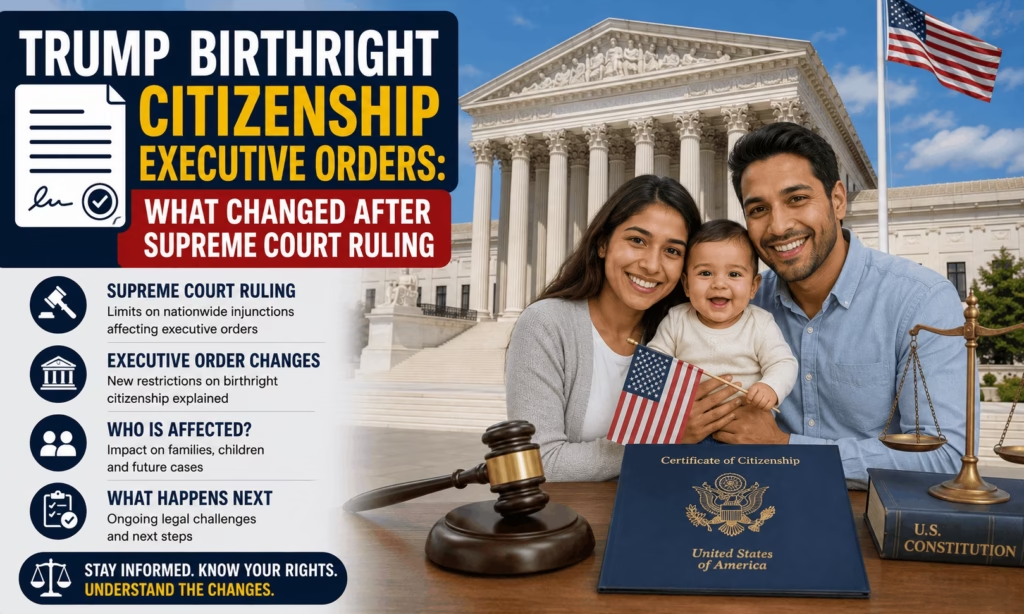
Trump Birthright Citizenship Executive Orders: President Donald Trump signed two new executive orders on Thursday, August 6, 2026, in a fresh attempt to limit birthright citizenship for children born on U.S. soil, just five weeks after the Supreme Court struck down his original 2025 order as unconstitutional. Speaking during the Oval Office signing, Trump called the Supreme Court’s June ruling “a very unfortunate decision” and said his administration was “making adjustments” in response. The move immediately reopens one of the most closely watched constitutional fights of his second term.
The first of the two new orders targets what the White House calls commercial “birth tourism,” the practice of traveling to the United States specifically to give birth so a child automatically becomes a U.S. citizen. The second order broadens the list of people the administration considers ineligible for birthright citizenship, including children of foreign nationals who lobby on behalf of foreign governments. White House deputy chief of staff Stephen Miller defended both orders at the signing, while immigrant rights groups, including the ACLU, said the new orders are already destined for the same fate as the first one. We’ll be updating this article monthly as new developments, lawsuits, and court rulings come in.
Why This Is Happening Again: The June 2026 Supreme Court Ruling
To understand Thursday’s signing, it helps to go back to January 20, 2025, Trump’s first day back in office. On that day, he signed an executive order titled “Protecting the Meaning and Value of American Citizenship,” which said that children born in the United States would not automatically receive citizenship if their parents were in the country illegally or on a temporary visa.
The order was blocked almost immediately. The ACLU, the Legal Defense Fund, the Asian Law Caucus, and several state-level ACLU chapters sued on behalf of affected families in a case that eventually became known as Trump v. Barbara. Federal courts across the country issued injunctions preventing the order from taking effect while the case worked its way up.
On June 30, 2026, the Supreme Court ruled 6-3 that Trump’s original executive order was unconstitutional. Chief Justice John Roberts, writing for the majority, held that children born in the United States to parents who are unlawfully or temporarily present are still “subject to the jurisdiction” of the United States and are entitled to citizenship at birth under the 14th Amendment’s Citizenship Clause. Justices Elena Kagan, Sonia Sotomayor, Amy Coney Barrett, and Ketanji Brown Jackson joined the majority opinion, while Justice Clarence Thomas wrote a notable dissent.
The 14th Amendment, ratified in 1868, states that “all persons born or naturalized in the United States, and subject to the jurisdiction thereof, are citizens of the United States and of the state wherein they reside.” The Supreme Court had already interpreted this clause broadly in the 1898 case United States v. Wong Kim Ark, which confirmed that children born in the U.S. to non-citizen parents are American citizens. The June 2026 ruling reaffirmed that precedent and effectively ended Trump’s first attempt to reinterpret the amendment through executive action rather than a constitutional amendment or new legislation.
What the Two New Executive Orders Actually Do
Because the White House had not released the full text of either order at the time of signing, exact legal language is still emerging. Based on statements from the president and Stephen Miller during the Oval Office event, here is what is known so far.
Order 1: Targeting “Birth Tourism”
This order is aimed at people who travel to the United States on tourist or visitor visas with the specific purpose of giving birth so their child receives automatic U.S. citizenship. Miller described the practice as people “pretending to be a tourist, pretending to be a visitor, saying they want to go to Disneyland or they want to go visit a monument or go to a national park,” while the real purpose of the trip is childbirth. According to the Migration Policy Institute, there is no official government estimate for how many births nationwide fall into this category, though MPI has estimated the number could be around 26,000 out of the roughly 3.5 million births recorded in the U.S. each year.
Visa Waiver Program (VWP) 2026: ESTA Fee, Eligible Countries & Entry Rules
EB-5 Visa Cap India: Why New Green Card Approvals Stay Blocked Until October
Order 2: Expanding Who Is Considered Ineligible
The second order widens the administration’s definition of people it considers ineligible for automatic birthright citizenship. This reportedly includes children born to foreign nationals who are registered as lobbyists or agents working on behalf of a foreign government, in addition to categories carried over from the original 2025 order involving parents who are undocumented or in the country on a temporary basis.
Trump also repeated a long-standing argument from his allies that the 14th Amendment was intended narrowly, to address the status of formerly enslaved people after the Civil War, rather than as a broad guarantee for all children born on U.S. soil. “This was done right after the Civil War,” Trump said. “This was for the babies of slaves.” Legal scholars and the Supreme Court majority in Trump v. Barbara have rejected that narrow reading, pointing to more than a century of precedent, including Wong Kim Ark, that treats the clause as a general rule of citizenship by birth.
Reaction From Immigrant Rights Groups and Legal Experts
The response from civil rights organizations was swift. Cody Wofsy, deputy director of the ACLU’s Immigrants’ Rights Project and lead counsel for the plaintiffs in Trump v. Barbara, said in a statement that “the Supreme Court already decided this issue: Birthright citizenship is guaranteed by the Constitution. No additional executive order can change the meaning of the Constitution. Any executive order that tries to rewrite birthright citizenship will meet the same fate as the last one.”
Legal commentators have noted that during the April 2026 oral arguments in Trump v. Barbara, the “birth tourism” issue was raised directly. Chief Justice Roberts told U.S. Solicitor General John Sauer that such tourism “has no impact on the legal analysis before us,” even as Sauer argued that the practice illustrated problems with the current interpretation of the Citizenship Clause. That exchange suggests the new birth tourism order may face the same constitutional hurdles as the first, since the location of a child’s birth, not the parents’ travel intentions, is what the 14th Amendment addresses.
Groups including the ACLU, the Asian Law Caucus, and the Legal Defense Fund have indicated they are prepared to challenge the new orders in court, most likely by asking the same federal judges who blocked the 2025 order to block enforcement of the 2026 orders as well.
Trump Birthright Citizenship Executive Orders Key Facts
| Detail | Information |
|---|---|
| New orders signed | August 6, 2026, in the Oval Office |
| Number of new orders | Two |
| Order 1 focus | Restricting citizenship linked to commercial “birth tourism” |
| Order 2 focus | Expanding ineligible categories, including children of registered foreign lobbyists |
| Original executive order | Signed January 20, 2025 |
| Supreme Court case | Trump v. Barbara |
| Supreme Court ruling date | June 30, 2026 |
| Supreme Court vote | 6-3 against the original order |
| Constitutional basis | 14th Amendment, Citizenship Clause (ratified 1868) |
| Key precedent | United States v. Wong Kim Ark (1898) |
| Current legal status | Birthright citizenship remains the law; new orders expected to face fresh lawsuits |
Does Birthright Citizenship Still Apply to Your Child?
As of now, birthright citizenship remains unchanged and fully protected under the law. The Supreme Court’s June 30, 2026 ruling means the original 2025 order was never allowed to take effect anywhere in the country, and any child born on U.S. soil, regardless of the parents’ immigration status, is a U.S. citizen at birth. The two new orders signed on August 6, 2026 had not been implemented as of publication, and legal challenges are widely expected before either order could be enforced. Families should watch for updates from official government sources rather than social media, since enforcement status can change quickly once litigation begins.
Max Social Security Benefit at Age 67 in 2026: How to Get It?
Canada Ranked Second Most Trustworthy Country for Investment 2026
Official Resources and Where to Verify Information
| Resource | Link |
|---|---|
| White House Presidential Actions | whitehouse.gov/presidential-actions |
| U.S. Supreme Court opinions | supremecourt.gov/opinions |
| USCIS citizenship and naturalization info | uscis.gov/citizenship |
| U.S. Department of State passport and citizenship info | travel.state.gov |
| 14th Amendment text, Congress.gov | constitution.congress.gov |
| ACLU case tracker, Barbara v. Trump | aclu.org/cases |
| SCOTUSblog case page, Trump v. Barbara | scotusblog.com |
FAQs
What is birthright citizenship?
Birthright citizenship is the constitutional principle, based on the 14th Amendment, that anyone born on U.S. soil automatically becomes a U.S. citizen at birth, regardless of the immigration status of their parents.
Did Trump succeed in ending birthright citizenship?
No. The Supreme Court ruled 6-3 on June 30, 2026 that Trump’s original executive order restricting birthright citizenship was unconstitutional. Birthright citizenship remains the law across the entire United States.
What do the new executive orders signed in August 2026 do?
The two new orders target commercial “birth tourism” and expand the list of people the administration considers ineligible for automatic citizenship, including children of registered foreign lobbyists. Full legal text was not publicly released at the time of signing.
Are the new executive orders already in effect?
Not immediately. Given the Supreme Court’s recent ruling and existing legal precedent, civil rights groups have signaled they plan to challenge the new orders in federal court, which is likely to delay or block enforcement while litigation is pending.
Can a child already born in the U.S. lose their citizenship because of these orders?
No. The Supreme Court’s ruling in Trump v. Barbara applies nationwide, and citizenship already granted at birth under the 14th Amendment cannot be revoked through an executive order.
What is “birth tourism” and is it illegal?
Birth tourism refers to traveling to the United States, often on a visitor visa, specifically to give birth so the child receives automatic citizenship. Immigration law experts note that while it is a legal gray area under current rules, past Supreme Court arguments suggest the parents’ travel purpose does not change the constitutional citizenship status of a child born on U.S. soil.
Where can I check if my child’s citizenship status is affected?
The most reliable sources are official government pages, including USCIS.gov and the White House’s presidential actions page, along with case updates from organizations directly involved in the litigation, such as the ACLU and SCOTUSblog.
Conclusion
Trump’s decision to sign two new executive orders on birthright citizenship just weeks after losing at the Supreme Court signals that this fight over the 14th Amendment is far from over. For now, the legal reality has not changed: birthright citizenship remains protected nationwide following the June 30, 2026 ruling in Trump v. Barbara, and the newly signed orders are expected to face immediate legal challenges from the same coalition of civil rights groups that won the first case. Families and immigration attorneys will be watching closely to see whether these narrower, more targeted orders fare any differently in court, or whether they are blocked before ever taking effect. This article will be updated as the White House releases the official order text and as new court filings are made public.
IRS confirms ACTC Refund 2026: $1,700 Child Tax Credit Payout Dates & Eligibility
Form I-551 Confirmed Green Card Holders Enter US Without a Visa