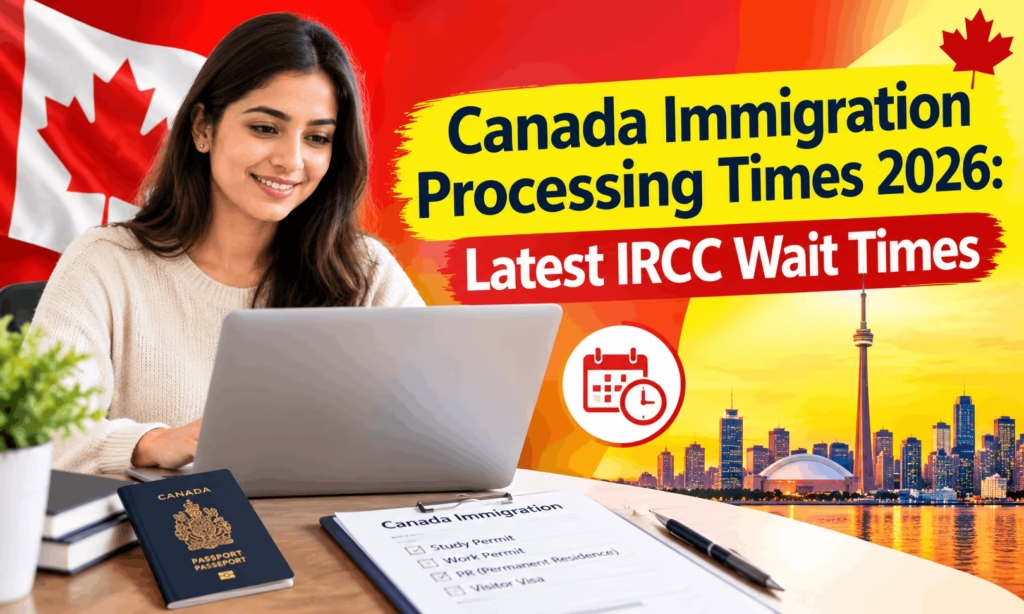
Canada Immigration Processing Times 2026: Canada’s official processing time for a proof of citizenship certificate jumped from 25 months to 33 months in a single monthly update, according to figures Immigration, Refugees and Citizenship Canada (IRCC) published on September 3, 2026. That eight-month jump in one revision is the largest single monthly movement recorded since Bill C-3 removed the first-generation limit on citizenship by descent in December 2025, and it means someone filing a proof of citizenship application today can expect to wait until roughly mid-2029 for a decision. Canada Immigration Processing Times 2026 have become one of the most closely watched figures for anyone with an active IRCC file, and this update shows a system where some categories are speeding up sharply while others are falling further behind at the same time.
The proof of citizenship queue has swelled to about 136,000 applications, with roughly 14,200 new filings added in under a month, yet IRCC’s own inventory only grew by about 1.5 percent while the quoted wait time jumped 32 percent, meaning queue size alone no longer explains the delay. Meanwhile, Express Entry permanent residence applications are processing close to their six-month service standard, a Canadian Experience Class draw on September 1 issued 2,000 invitations at a minimum Comprehensive Ranking System score of 521, and a healthcare-focused draw the same week invited 229 physicians at a Express Entry cut-off of 198. This guide breaks down every major processing time category IRCC currently publishes, what changed this month, and how to check your own file. We’ll be updating this article monthly as IRCC releases new processing time figures.
Why Citizenship Certificate Wait Times Are Rising So Fast?
The proof of citizenship category, sometimes called a citizenship certificate, confirms that a person already holds Canadian citizenship rather than granting it. Historically a low-volume administrative function, this category absorbed a massive surge after Bill C-3 took effect on December 15, 2025, expanding eligibility to people born outside Canada who can trace an unbroken line of descent to a Canadian ancestor, even through a great-grandparent, without the previous one-generation cutoff.
The trajectory has been steep and consistent. Processing time stood at 10 months in January 2026, climbed to 12 months in May, 15 months in June, 19 months in July, 25 months in August, and now 33 months as of the September update. A certificate review completed June 30 that pulled officer time away from new applications to examine roughly 6,500 already-issued certificates has compounded the backlog further. IRCC calculates this estimate using a forward-looking method based on current queue size, available staff, and expected new applications, which is why the number can move sharply from one month to the next rather than tracking smoothly with queue growth alone.
By contrast, citizenship grants, the naturalization route used by permanent residents becoming citizens for the first time, remain far more stable at approximately 12 months, even though roughly 327,100 people are waiting in that queue, more than double the size of the proof of citizenship line. This divergence exists because grants are a mature, heavily resourced processing stream with a formal departmental service standard, while proof of citizenship applications were never built to handle this volume.
Canada Immigration Processing Times September 2026 Highlights
| Application Category | Current Processing Time | Notes |
|---|---|---|
| Proof of Canadian citizenship (certificate) | Approximately 33 months | Up from 25 months in August; queue near 136,000 |
| Citizenship grant (naturalization) | Approximately 12 months | Queue near 327,100 |
| Express Entry (CEC, FSWP) | Approximately 6 months | At or near the official service standard |
| PR card (new or renewal) | Approximately 34 to 41 days | One of the fastest categories in the system |
| Study permit (inside Canada, extension) | Approximately 7 to 10 weeks | Varies by country for new applications abroad |
| Work permit (inside Canada, extension) | Roughly 113 to 120 days | Figures vary by source and month; check IRCC directly |
| Spousal sponsorship (outland) | Approximately 15 to 17 months | Applicant applies from outside Canada |
| Spousal sponsorship (inland) | Approximately 21 to 27 months | Open work permit available while waiting |
| Parents and Grandparents Program (PGP) | Intake paused since July 15, 2026 | Existing applications still being processed |
| Visitor visa (temporary resident visa) | Roughly 11 to 36 days inside Canada | Outside Canada varies significantly by country |
| Super visa | Improving sharply for several countries | Allows up to 5 years per visit |
SSDI Pay Chart: The Least Amount You Can Get Per Month and the Most Common Disabilities
IRS Identity Protection PIN: How to Get One and Stop Tax Fraud
Express Entry: Still the Fastest Path to Permanent Residence
Express Entry remains Canada’s flagship system for skilled workers, covering the Canadian Experience Class, Federal Skilled Worker Program, and Federal Skilled Trades Program. The department’s service standard is six months from the date it issues an Acknowledgement of Receipt for a complete application, and as of the most recent figures, both the Canadian Experience Class and Federal Skilled Worker Program are processing at or close to that six-month mark, a meaningful improvement compared with where the category stood in 2025.
Draw activity has stayed steady through the late summer. On August 31, 2026, IRCC issued 562 invitations to apply targeting candidates who had already secured a Provincial Nominee Program nomination. On September 1, 2026, a Canadian Experience Class-specific round issued 2,000 invitations at a minimum CRS score of 521. Around the same time, a healthcare-category draw invited 229 physicians, with the CRS cut-off for that round falling to 198, a notably lower threshold than general rounds, reflecting the priority Canada continues to place on healthcare occupations.
It is important to understand what the six-month clock actually measures. It begins the day IRCC receives a complete application after an invitation to apply, not the day a candidate enters the Express Entry pool or receives an invitation. Missing documents, an incomplete biometrics submission, or an additional document request can pause or reset that clock, which is why application completeness remains the single largest factor within an applicant’s control.
Citizenship Processing: A Tale of Two Very Different Queues
| Citizenship Category | Applications Waiting | Processing Time |
|---|---|---|
| Proof of citizenship (certificate) | Approximately 136,000 | Approximately 33 months |
| Citizenship grant (naturalization) | Approximately 327,100 | Approximately 12 months |
The contrast between these two lines is one of the more striking developments in the entire 2026 processing picture. A queue roughly 2.4 times larger, in the grants category, carries an estimated wait roughly 2.75 times shorter than the far smaller proof of citizenship line. For applicants stuck in the proof of citizenship queue, urgent processing remains available in a narrow set of circumstances, including applicants who need expedited processing to support planned studies in Canada, though meeting the criteria for urgent processing does not guarantee the underlying application will be approved.
Applicants should also understand that a delayed certificate does not delay their actual citizenship status. A person born outside Canada to a Canadian parent who qualifies under the reformed descent rules is already a citizen as a matter of law from the date the rules took effect; the certificate is simply a paper confirmation of status that already exists, not a precondition for holding it.
Family Sponsorship: Improvement in One Stream, Strain in Another
Family reunification categories are moving in genuinely opposite directions depending on the specific stream. Spousal or common-law partner sponsorship filed from outside Canada, known as outland sponsorship, currently runs at approximately 15 to 17 months, while inland sponsorship, filed by an applicant already living in Canada, currently takes considerably longer, in the range of 21 to 27 months depending on the reporting period. Applicants pursuing the inland route can apply for an open work permit at the same time as their sponsorship application, allowing them to work legally in Canada while the sponsorship decision is pending, which is often the single most useful tool available to inland applicants facing a long wait.
The Parents and Grandparents Program tells a very different story. IRCC announced on July 15, 2026 that it is pausing intake of new PGP sponsorship applications, with no interest-to-sponsor forms being invited until further notice. The department says it will continue processing PGP applications already received, aiming to finalize approximately 15,000 permanent residence approvals in 2026 from the existing queue. For prospective sponsors currently shut out of the program, a super visa remains available, allowing parents and grandparents of Canadian citizens and permanent residents to visit for extended stays of up to five years per entry, without requiring the multi-year PGP sponsorship timeline.
Study Permits and the New Financial Requirement
Study permit processing has generally improved through 2026, particularly for applicants using the Student Direct Stream, which continues to offer significantly faster processing for eligible countries that meet specific requirements, including a Guaranteed Investment Certificate of at least 10,000 Canadian dollars, an IELTS score of 6.0 or higher in all four bands, and an acceptance letter from a designated learning institution. Countries eligible for this faster stream include India, China, the Philippines, Vietnam, Morocco, Senegal, Pakistan, Costa Rica, Peru, and Antigua and Barbuda.
However, prospective students should note a significant policy shift announced on September 2, 2026. Canada has increased the financial requirement applicants must prove they can meet before receiving a study permit, a change that directly affects the documentation and savings threshold international students need to demonstrate as part of a complete application. Applicants should confirm the exact updated figure through IRCC’s official guidance before assembling their financial documents, since submitting an application under the old threshold can result in delays or refusal.
Express Entry Draw Update: CEC Cut-Off Falls To 521, Physicians Round Drops To 198 CRS
Canada Counter-Tariffs Worker Support Package: $7.5 Billion in Relief Confirmed
StayNJ Income Cap Drops From $500,000 to $200,000: Why Your Check Already Got Smaller
New York POWER Rebate Checks: $100 to $200 Payments Begin Landing in Mailboxes This Fall
Work Permits: Conflicting Signals Depending on the Route
Work permit processing times present one of the more inconsistent pictures in the current data. Some tracking sources report in-Canada work permit extensions reaching a 2026 record low of approximately 113 days as of early September, a steady decline from 142 days in January. Other sources report in-Canada work permit extensions running closer to 119 to 255 days depending on the month and reporting method, reflecting how volatile this category has become. Outside Canada, work permit timelines vary considerably by country, with some offices like Pakistan reporting waits around seven weeks while higher-volume offices such as India report closer to ten weeks due to local inventory pressure.
Given this volatility, anyone renewing a work permit from inside Canada should apply well before their current permit expires, generally four to five months ahead, since submitting on time preserves implied status, meaning the applicant can continue working under their previous permit’s conditions while IRCC finishes processing the renewal.
Visitor Visas, Super Visas, and PR Cards: The Fastest-Moving Categories
Temporary resident visas, commonly called visitor visas, and PR cards remain among the fastest categories in the entire system. Visitor visa applications filed from inside Canada are currently running anywhere from about 11 to 36 days depending on the specific reporting period, while PR cards, whether a first-time card or a renewal, are processing in roughly 34 to 41 days, making this one of the more predictable categories for applicants to plan around.
Super visa processing has also shown some of the strongest sustained improvement of any temporary residence category in 2026, with country-specific gains particularly pronounced for Indian and Pakistani applicants, in some cases falling by more than 200 days since January. Visitor record extensions, however, remain a persistent weak spot, with some tracking sources placing this category as high as 233 to 418 days, a clear outlier compared with the otherwise fast-moving visitor and super visa categories.
Application Fees: What to Budget Alongside Processing Time
| Application Type | Approximate Government Fee (CAD) |
|---|---|
| Express Entry permanent residence (principal applicant) | $850 processing fee plus $515 Right of Permanent Residence Fee |
| Citizenship grant (adult applicant) | $630 (includes right of citizenship fee) |
| Proof of citizenship certificate | $75 |
| Spousal or family sponsorship | $1,135 combined sponsor and applicant fees |
| Study permit | $150 |
| Work permit | $155 |
| Visitor visa (temporary resident visa) | $100 |
| PR card renewal | $70 |
Fees are set by IRCC and are subject to change, so applicants should always confirm the current fee schedule on the official fee page before submitting payment, since paying an outdated amount can result in an application being returned as incomplete.
How to Apply and Track Your Application
- Confirm your program’s eligibility requirements using IRCC’s official program pages before starting any application, since eligibility criteria differ significantly by category and can change with little notice, as seen with the study permit financial requirement update.
- Create or log into your IRCC secure account to submit most application types online, which is generally faster and easier to track than paper submissions.
- Submit a complete application the first time. Missing documents, unclear biometrics, or an incomplete financial declaration are the leading causes of delay within an applicant’s control, and an Additional Document Request can pause or reset processing time.
- Pay the correct, current fee for your application type and keep your receipt, since fee amounts change periodically and an incorrect payment can delay processing.
- Check your status regularly through your IRCC secure account rather than relying on the general processing times tool alone, since the tool provides an estimate based on recently completed cases, not a personalized timeline for your specific file.
- Respond immediately to any request for additional documents, a medical exam, or biometrics, since delays on the applicant’s side add directly to total wait time rather than running alongside IRCC’s own review.
How IRCC Updates Processing Times
IRCC updates its processing times tool on different schedules depending on the application category. Temporary residence categories, including visitor visas, study permits, and work permits, are generally updated weekly, while permanent residence and citizenship categories, including Express Entry, family sponsorship, and citizenship grants and certificates, are typically updated monthly. The published figure reflects the time it took to process 80 percent of recently completed applications of that type, meaning it is a historical measure of recent performance rather than a guaranteed timeline or promise for any individual file. An applicant’s own processing time can run faster or slower depending on document completeness, background check complexity, medical exam results, and which specific visa office is handling the file.
New Canada Prescription Drug Rules October 2026: What Every Patient and Pharmacy Needs to Know
October 15 Tax Deadline Is Final — What Happens If You Still Don’t File
VA Benefits Lawyer: For Which Claims Do You Need One, and How Much Can They Cost?
Green Card Sponsors Face New Scrutiny: USCIS Can Now Pull Your Credit Report
Official IRCC Resources
| Resource | Official Link |
|---|---|
| IRCC Processing Times Tool | canada.ca/en/immigration-refugees-citizenship/services/application/check-processing-times.html |
| IRCC Secure Account (Login) | canada.ca/en/immigration-refugees-citizenship/services/application/account.html |
| Express Entry Portal | canada.ca/en/immigration-refugees-citizenship/services/immigrate-canada/express-entry.html |
| Application Status Check (GCKey / Secure Account) | canada.ca/en/immigration-refugees-citizenship/services/new-immigrants/pr-card/check-status.html |
| IRCC Fee Schedule | canada.ca/en/immigration-refugees-citizenship/services/application/fees.html |
| Proof of Citizenship Application Guide | canada.ca/en/immigration-refugees-citizenship/services/canadian-citizenship/proof.html |
Common Mistakes That Slow Down Processing
Many applicants assume that applying earlier in a category with a growing queue guarantees a shorter relative wait, but because IRCC uses a forward-looking method based on current staffing and expected volume, filing today does not lock in today’s quoted processing time, since the estimate can rise again before a decision is reached. Others mistakenly believe that following up repeatedly through webform inquiries speeds up their individual file, when in most cases only a missing document request, a security flag, or genuine officer error affects the timeline. Applicants should also avoid relying on third-party websites that republish IRCC figures without regular updates, since temporary residence categories change weekly and even a few weeks of lag can produce a meaningfully outdated estimate.
FAQs About Canada Immigration Processing Times 2026
Why did Canada’s citizenship certificate processing time jump so much in September 2026?
The proof of citizenship processing time rose from 25 to 33 months because application volume tied to Bill C-3’s expanded descent eligibility kept climbing while a certificate review that pulled officer time away from new applications compounded the existing backlog, even though the queue itself only grew by about 1.5 percent that month.
How long does Express Entry take in 2026?
Express Entry permanent residence applications, covering the Canadian Experience Class and Federal Skilled Worker Program, are currently processing at approximately six months, close to IRCC’s official service standard, though individual files can take longer if additional documents or security checks are required.
Is the Parents and Grandparents Program still accepting new applications?
No. IRCC paused intake of new PGP sponsorship applications on July 15, 2026, and has not resumed accepting interest-to-sponsor forms, though the department continues processing applications already received and aims to finalize approximately 15,000 approvals in 2026.
How long does a spousal sponsorship application take in Canada?
Outland spousal sponsorship, filed from outside Canada, currently takes approximately 15 to 17 months, while inland sponsorship, filed by an applicant already in Canada, currently takes approximately 21 to 27 months, though applicants pursuing the inland route can apply for an open work permit while they wait.
Does waiting longer to apply for proof of citizenship shorten my eventual wait?
No. IRCC’s processing clock starts only once a complete application is received, so delaying an application does not reduce the eventual wait and can mean joining an even longer queue, since the line has grown every month since Bill C-3 took effect.
How can I check the processing time for my specific application?
You can check current processing times by application type and, for many temporary residence categories, by country, using IRCC’s official processing times tool, which is updated weekly for temporary residence applications and monthly for permanent residence and citizenship categories.
What is the fastest way to immigrate to Canada in 2026?
Express Entry remains the fastest major economic immigration pathway, with permanent residence applications currently processing at approximately six months once a complete application is submitted following an invitation to apply.
Why is Canada’s immigration backlog still so large in 2026?
IRCC’s total application inventory across all categories sits above 2 million, though the overall backlog has been falling since mid-2025; specific categories like proof of citizenship and inland work permit extensions have moved in the opposite direction due to sudden volume surges or policy changes.
Can I speed up my Canadian immigration application?
Outside of narrow urgent processing criteria for specific circumstances, most applicants cannot formally expedite processing, though submitting a complete application, responding immediately to document requests, and confirming eligibility requirements before filing are the most effective ways to avoid unnecessary delay.
What happens if my Canadian immigration application takes longer than the published processing time?
If a file exceeds the published processing time, applicants can submit a webform inquiry referencing their application number, request GCMS notes for more detail on their file’s status, or, for applicants inside Canada, request assistance from their local Member of Parliament.
Conclusion
Canada immigration processing times in 2026 show a system pulling in two directions at once. Express Entry, PR cards, and several temporary residence categories are processing faster than they have in years, while proof of citizenship applications have nearly tripled in wait time since December 2025, now sitting close to three years, and the Parents and Grandparents Program remains closed to new applicants entirely. For anyone with an active or upcoming application, the most reliable approach remains checking IRCC’s official processing times tool directly for the specific category and country involved, filing a complete application the first time, and building realistic timeline expectations around the category-specific trends outlined above rather than assuming last year’s, or even last month’s, published figure still applies.
Trump Accounts Dell $250 Grant: Did Deposits Actually Start Monday? Here’s Who’s Actually Been Paid
2027 Social Security COLA Forecast: Latest 3.6% Estimate and How Much Retirees Could Get
$2000 Stimulus Payment September 2026 Fact-Check: Is It Really Coming?